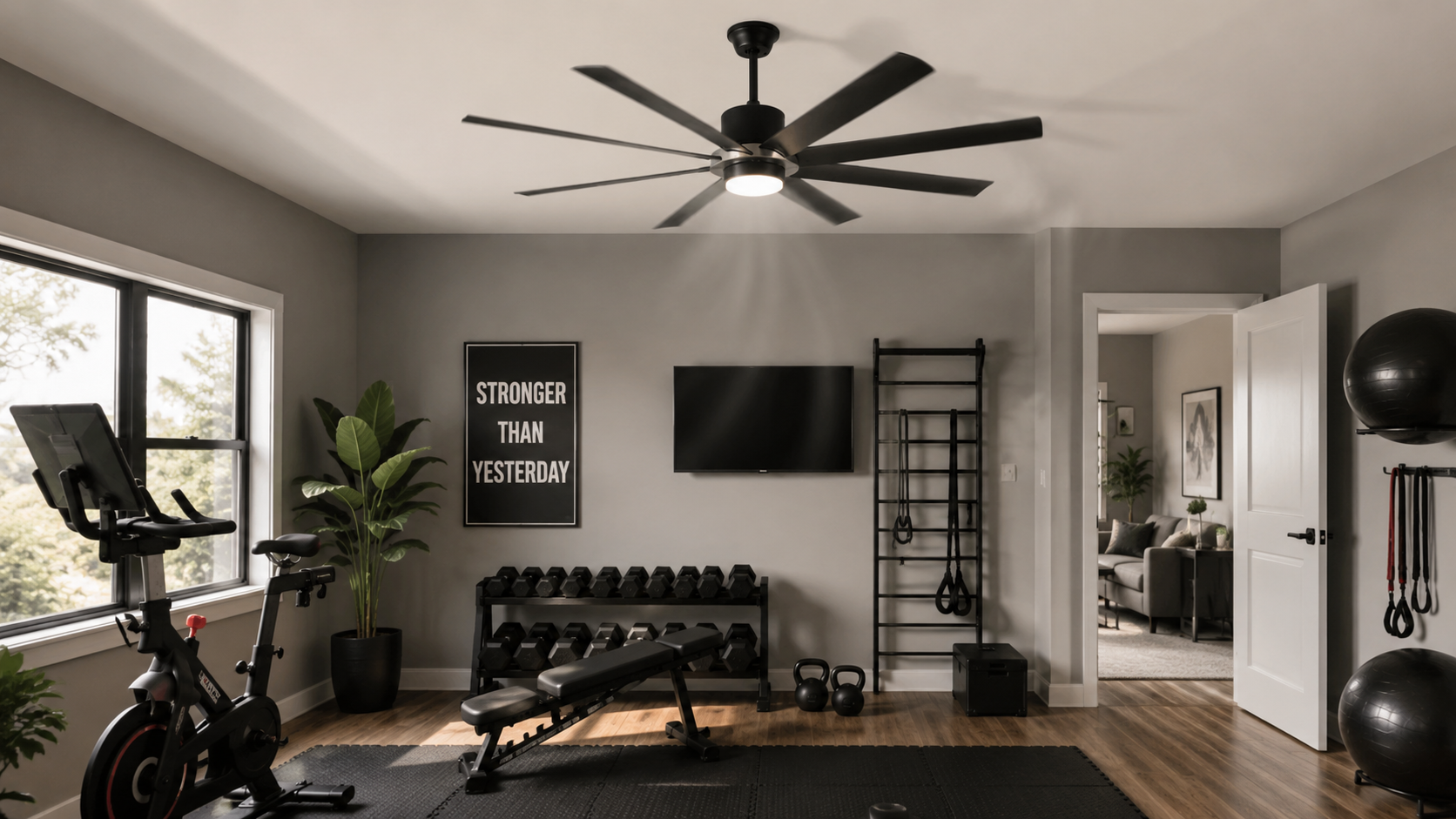


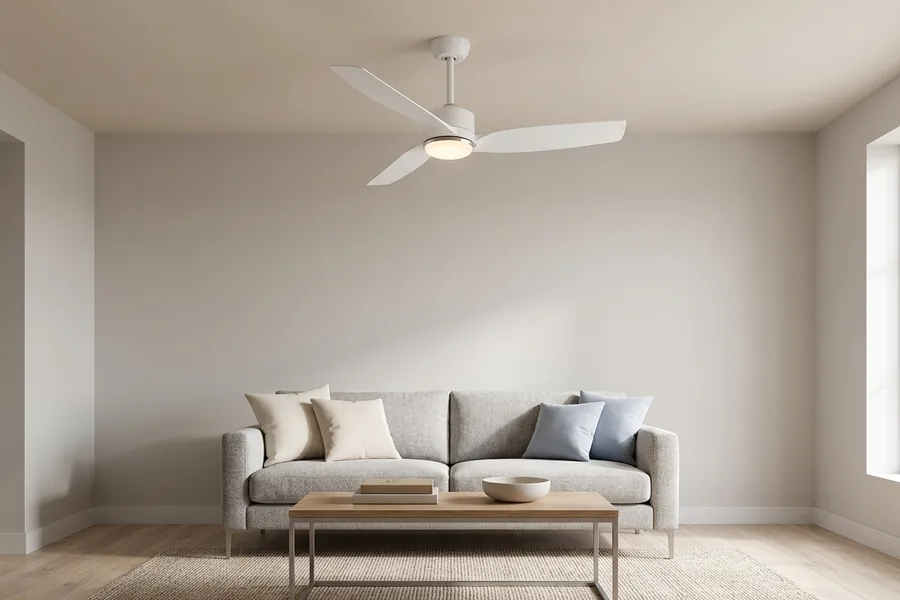
Choosing the right ceiling fan size should not be hard. But many people still get it wrong.
They buy a fan because it looks nice. Then it arrives. It is too small, too large, too noisy, or just not right for the room. Not ideal.
The good news is simple: the right ceiling fan size starts with your room size. Once you know the room size, you can choose the right fan blade span, avoid weak airflow, and stop your room from looking out of balance.
This ceiling fan size by room guide will help you choose with confidence.
Contents
1. Start with Room Size: The Main Factor in Choosing a Ceiling Fan
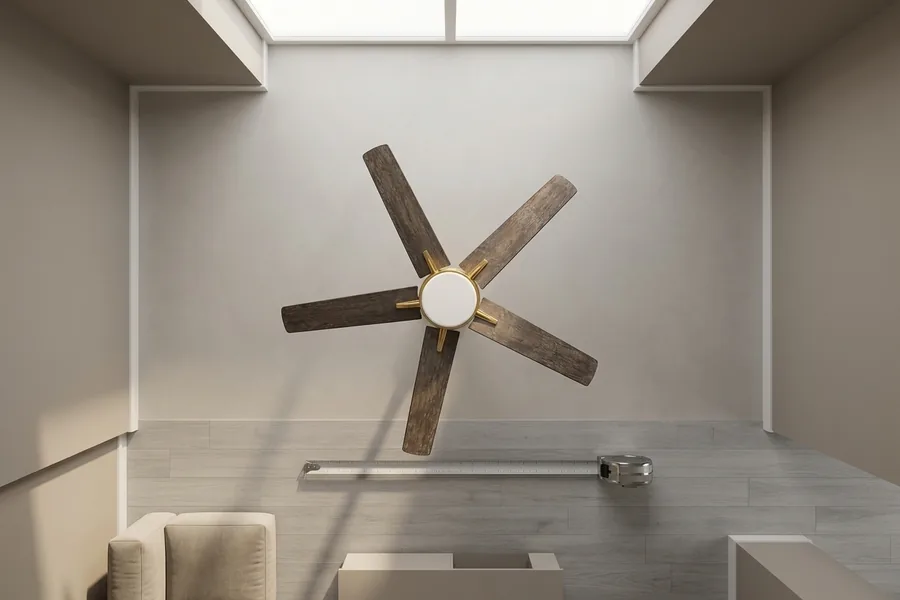
Room size is the first thing to check. Always.
A ceiling fan is not only there to look good. It must move air around the room. If the fan is too small, the room may still feel warm. If the fan is too large, the airflow may feel too strong.
So before looking at colour, style, or price, start with this question:
How big is the room?
1-1. Match Your Room Size to the Right Fan Blade Span
Fan blade span means the full width of the ceiling fan from one blade tip to the opposite blade tip. It is the fan’s diameter.
A small room needs a smaller blade span. A large room needs a wider blade span. Simple.
| Room Size | Recommended Fan Blade Span | Best For |
|---|---|---|
| Up to 75 sq ft | 29–36 inches | Small bedroom, bathroom, utility room |
| 76–144 sq ft | 36–44 inches | Small bedroom, nursery, home office |
| 145–225 sq ft | 44–52 inches | Standard bedroom, dining room |
| 226–400 sq ft | 52–60 inches | Living room, master bedroom |
| Over 400 sq ft | 60+ inches or multiple fans | Great room, open-plan space |
This table gives you a strong starting point. Start here before choosing any design.
1-2. Use Square Footage as Your First Selection Rule
Square footage matters because it tells you how much space the fan needs to cover.
A fan does not cool the air like an air conditioner. It moves air so your skin feels cooler. If the room is large and the fan is too small, the airflow will not reach enough of the space.
That is why square footage is the first rule. It gives you the basic size range.
For example, a 12 ft x 12 ft room is 144 sq ft. That usually needs a fan around 36–44 inches, or sometimes a little larger if the ceiling is high or the room feels open.
1-3. Adjust the Fan Size Based on Room Layout and Ceiling Height
Room size gives the first answer, but the room itself gives the final answer.
Think about:
- Ceiling height
- Room shape
- Furniture layout
- Where people sit or sleep
- Whether the room is open-plan
- Whether there are beams, wardrobes, or lights nearby
A long room may need two fans. A low ceiling may need a flush mount fan. A high ceiling may need a downrod.
The smart rule is this: start with square footage, then adjust for real life.
2. How to Measure Your Room Before Choosing a Ceiling Fan
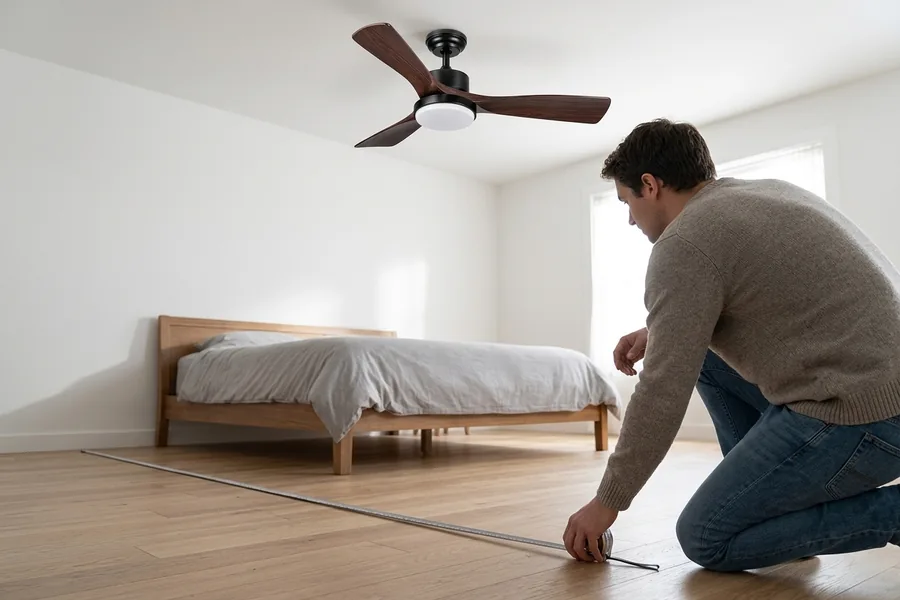
Now we move from “why room size matters” to “how to measure it”.
This is where many buying mistakes happen. People guess. Guessing is risky. Measuring is easy.
2-1. Measure Room Length and Width
Use a tape measure. Measure the full length and full width of the room from wall to wall.
You need two numbers:
- Room length
- Room width
For example:
- Length: 12 ft
- Width: 10 ft
That is enough to find your room size.
2-2. Calculate Room Square Footage
Now multiply the two numbers.
Length x Width = Room Square Footage
Example:
12 ft x 10 ft = 120 sq ft
A 120 sq ft room is usually a small to medium room. A fan around 36–44 inches will often work well.
Here are some easy examples:
| Room Dimensions | Square Footage | Suggested Fan Size |
|---|---|---|
| 8 ft x 10 ft | 80 sq ft | 36–42 inches |
| 10 ft x 12 ft | 120 sq ft | 36–44 inches |
| 12 ft x 12 ft | 144 sq ft | 42–48 inches |
| 12 ft x 15 ft | 180 sq ft | 44–52 inches |
| 15 ft x 20 ft | 300 sq ft | 52–60 inches |
2-3. Consider Room Shape, Layout, and Obstacles
A square room is simple. A long or odd-shaped room is different.
If your room is long and narrow, one fan in the centre may not move air evenly. One side may feel cool, while the other side still feels warm.
Also check for obstacles, such as:
- Tall wardrobes
- Bunk beds
- Ceiling beams
- Pendant lights
- Sloped ceilings
- High shelves
- Doors that open near the fan
A ceiling fan needs space around it. Poor clearance can reduce airflow and make the fan look wrong.
3. Ceiling Fan Size by Room

Now let’s match ceiling fan size by room. This is the part most people want. Very useful.
3-1. Small Room Ceiling Fan Size
A small room is usually up to 100 sq ft.
Recommended fan size:
29–42 inches
This works well for:
- Small bedrooms
- Utility rooms
- Small offices
- Nurseries
- Bathrooms, if the fan is suitable for damp areas
A small room does not need a huge fan. A fan that is too large can feel too strong and look heavy.
Small room, smaller fan. Easy.
3-2. Medium Room Ceiling Fan Size
A medium room is usually around 100–225 sq ft.
Recommended fan size:
42–52 inches
This size range works well for:
- Standard bedrooms
- Dining rooms
- Medium home offices
- Small living rooms
A 44-inch, 48-inch, or 52-inch fan is often a safe choice here. It gives good airflow without taking over the room.
3-3. Large Room Ceiling Fan Size
A large room is usually around 225–400 sq ft.
Recommended fan size:
52–60 inches
This is best for:
- Living rooms
- Master bedrooms
- Family rooms
- Large kitchens
A small fan in a large room will not do enough. It may spin fast, but the airflow will still feel weak. Not good.
A wider fan blade span helps move air across more of the room.
3-4. Open-Concept Room Ceiling Fan Size
Open-concept rooms need more thought.
These spaces may include a living area, dining area, and kitchen in one large room. The total square footage may be big, but people usually use the room in zones.
For spaces over 400 sq ft, consider:
Here is a simple case.
A family has an open-plan living and dining room. The space is 480 sq ft. They choose one 52-inch fan in the centre. It looks fine, but the dining area still feels warm.
A better choice is two 48-inch or 52-inch fans, placed over the main zones. One over the seating area. One near the dining area.
Better airflow. Better comfort. Much smarter.
4. Bedroom Ceiling Fan Size Guide
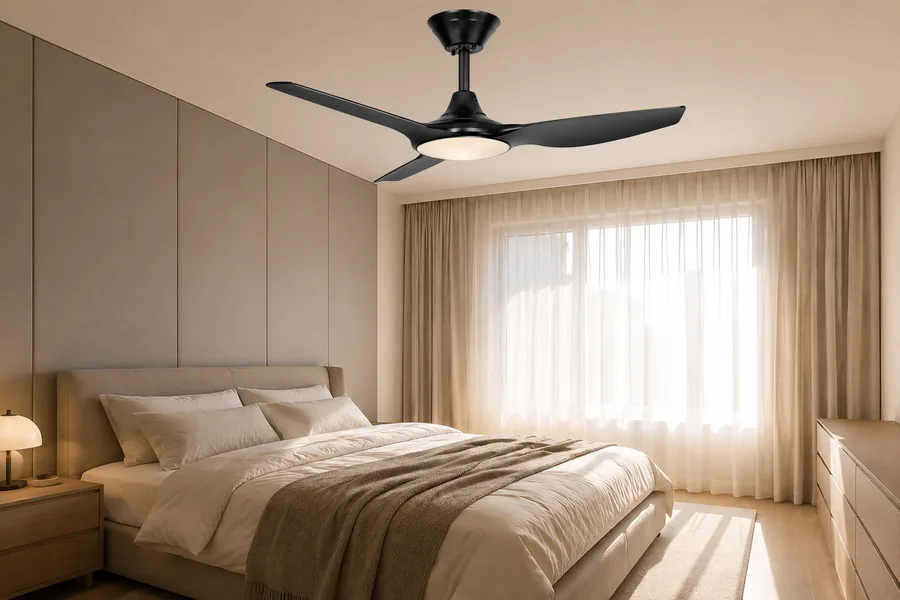
Bedrooms need comfort. Not too much wind. Not too much noise. Just calm, steady airflow.
A bedroom ceiling fan size should match the room, but it should also support sleep.
4-1. Small Bedroom Ceiling Fan Size
For a small bedroom up to 100 sq ft, choose:
This size works well for:
- Guest bedrooms
- Children’s bedrooms
- Small flats
- Nurseries
Avoid a very large fan in a small bedroom. It may sit too close to the bed and feel too strong.
4-2. Standard Bedroom Ceiling Fan Size
For a standard bedroom around 100–200 sq ft, choose:
42–52 inches
A 44-inch or 48-inch fan often works well in a 10×12 room. A 52-inch fan may work better if the room is closer to 12×14 or has a higher ceiling.
This is the most common bedroom range.
4-3. Master Bedroom Ceiling Fan Size
For a master bedroom around 200–400 sq ft, choose:
52–60 inches
A master bedroom often needs more air movement, but it should still feel gentle. Bigger does not mean better if the fan is noisy or too strong.
Look for:
- Quiet motor
- Remote control
- Reversible motor
- Several speed settings
- Soft light, if the fan has a light
4-4. Bedroom Fan Size Tips for Quiet Comfort
For bedrooms, comfort matters more than power.
A fan that is too strong can disturb sleep. A noisy motor can become annoying very quickly.
Choose a fan with low noise, smooth airflow, and at least three speed settings.
If the fan is above the bed, use a low or medium speed for a softer breeze. Gentle is better.
5. Living Room Ceiling Fan Size Guide
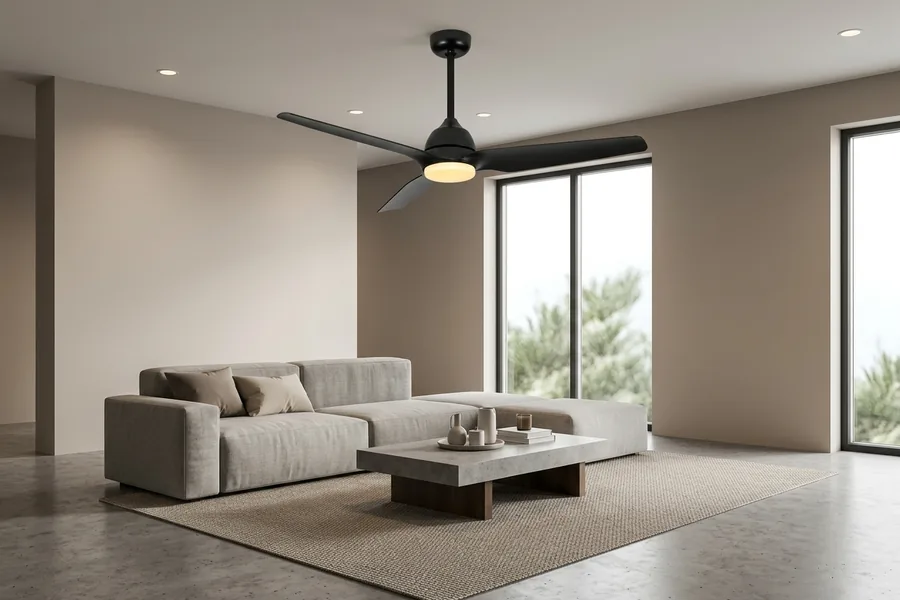
Living rooms usually need wider airflow than bedrooms. People sit, talk, watch TV, and relax there. The fan should cover the main seating area.
5-1. Small Living Room Ceiling Fan Size
For a small living room under 200 sq ft, choose:
44–52 inches
This gives enough airflow without making the room feel crowded.
If the ceiling is low, choose a low-profile fan to keep the space safe and open.
5-2. Standard Living Room Ceiling Fan Size
For a standard living room around 200–400 sq ft, choose:
52–60 inches
A 52-inch fan is a popular choice for many living rooms. It works well in average spaces.
If the living room is closer to 350–400 sq ft, a 56-inch or 60-inch fan may be better.
5-3. Large Living Room Ceiling Fan Size
For a large living room over 400 sq ft, choose:
60+ inches or multiple fans
A small fan in a big living room is a classic mistake. It may look fine, but it will not move enough air.
Large rooms need wider coverage.
5-4. One Large Fan vs. Two Smaller Fans
One large fan can work well in a square room.
Two smaller fans often work better in a long room.
Example:
A 20 ft x 24 ft living room is 480 sq ft. One 60-inch fan may cool the centre. But two 52-inch fans can cover more of the whole room.
The rule is simple: for long rooms, two fans often beat one large fan.
Ready to Find the Right Smart Ceiling Fan for Your Home?
Compare styles, sizes, smart features, and lighting options to find the perfect fan for your space.
Get a Quote6. Ceiling Fan Size Guide for Other Rooms
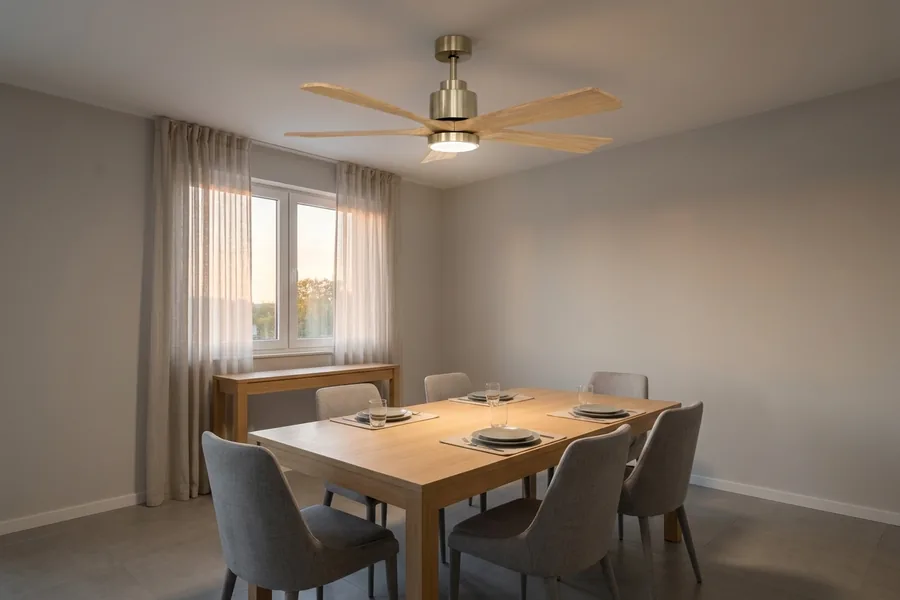
Different rooms need different fan choices. A dining room is not the same as an office. A patio is not the same as a kitchen.
6-1. Dining Room Ceiling Fan Size
For most dining rooms, choose:
44–52 inches
The fan should be centred over the dining area. If there is a pendant light or chandelier, make sure the fan and light do not compete for space.
In a smaller dining room, choose a simple design. It will look cleaner.
6-2. Home Office Ceiling Fan Size
For a home office, choose:
36–44 inches
A home office needs gentle airflow. Too much wind can blow papers around or feel distracting.
If you take video calls, choose a quiet fan. Very important.
6-3. Kitchen Ceiling Fan Size
For a kitchen, choose:
36–48 inches, depending on the room size.
If the kitchen is part of an open-plan space, size the fan for the zone where it will be used.
Avoid placing the fan too close to the hob. Heat, steam, and grease can affect the fan over time.
6-4. Outdoor Patio Ceiling Fan Size
Outdoor patios often need stronger airflow because the air is warmer and more open.
For a small covered patio, choose:
44–52 inches
For a larger patio, choose:
52–60+ inches
Also check the rating:
- Damp-rated fans: for covered outdoor areas
- Wet-rated fans: for spaces exposed to rain
Do not use an indoor-only fan outside. That is a bad buy.
7. Ceiling Height and Mounting Type
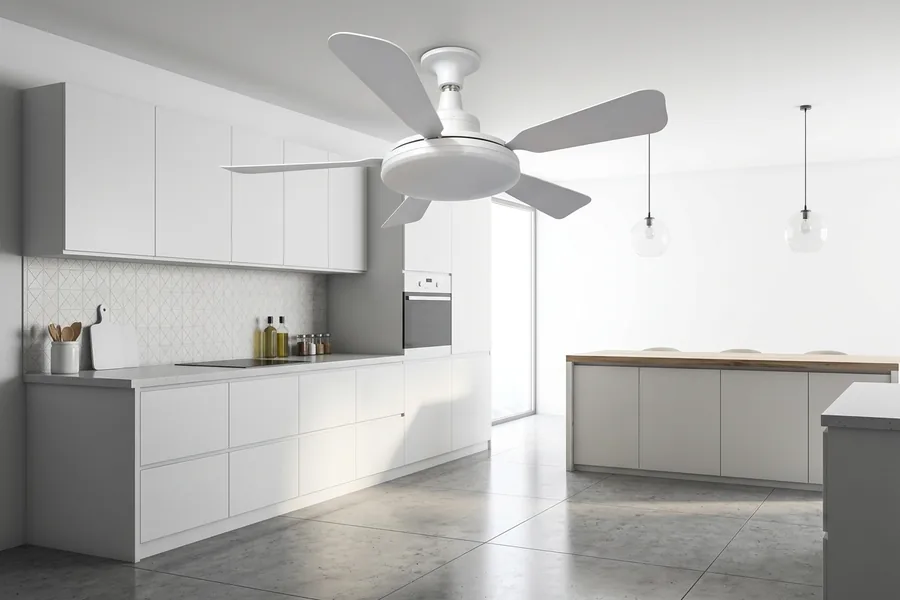
The right fan size can still perform badly if it is mounted at the wrong height.
Ceiling height matters. A lot.
7-1. Low Ceilings and Flush Mount Fans
For ceilings around 8 ft or lower, choose a flush mount or low-profile fan.
These fans sit closer to the ceiling. They help keep enough head clearance.
They are often best for:
- Flats
- Small bedrooms
- Older homes
- Low-ceiling living rooms
7-2. Standard Ceilings and Standard Mount Fans
For ceilings around 8–9 ft, a standard mount usually works well.
The aim is simple: the fan should be low enough to move air, but high enough to be safe.
A good target is:
Fan blades around 8–9 ft above the floor.
7-3. High or Vaulted Ceilings and Downrods
For ceilings over 9 ft, you may need a downrod.
A downrod lowers the fan into the living space. This helps the airflow reach people properly. Without a downrod, the fan may spin too high above the room. It may look good, but you may not feel much breeze.
This also affects energy use. If the fan is mounted too high, you may keep turning it up to a higher speed just to feel the air. That is not ideal. A better setup helps the fan work more effectively at a lower speed.
When comparing models, check airflow and ceiling fan efficiency standards, not just fan size. A well-sized fan, mounted at the right height, can give strong comfort without wasting power.
7-4. Ideal Ceiling Fan Height from the Floor
The ideal fan height is usually:
8–9 ft from the floor to the blades
If the fan is too low, it can be unsafe. If it is too high, the airflow may be weak.
The right height gives both safety and comfort.
8. Fan Blade Span, CFM, and Airflow

Ceiling fan dimensions are important, but size is not the only thing that matters.
You also need to think about airflow.
8-1. What Fan Blade Span Means
Fan blade span is the full width of the fan when the blades are spinning.
For example, a 52-inch ceiling fan has a fan blade span of 52 inches.
This does not mean each blade is 52 inches long. It means the whole fan circle is 52 inches wide.
8-2. Why CFM Matters When Choosing a Fan
CFM means cubic feet per minute. It shows how much air the fan can move.
A higher CFM usually means stronger airflow.
Two fans can both be 52 inches, but one may move much more air than the other. That is why you should not only look at size.
Also check:
CFM, motor quality, and blade pitch.
8-3. Does Blade Count Affect Airflow?
Not as much as many people think.
More blades do not always mean better airflow.
A 3-blade fan can move air very well if it has a strong motor and good blade pitch. A 5-blade fan may look fuller and run quietly, but it is not always more powerful.
The real factors are:
- Motor
- Fan blade span
- Blade pitch
- CFM rating
8-4. Why Bigger Is Not Always Better
A bigger fan can move more air, but it is not always the best fan.
In a small bedroom, a big fan may feel too strong. In a low-ceiling room, it may look heavy. In a narrow room, it may not fit safely.
The best fan is not the biggest fan.
The best fan is the right-sized fan.
9. Common Ceiling Fan Sizing Mistakes to Avoid
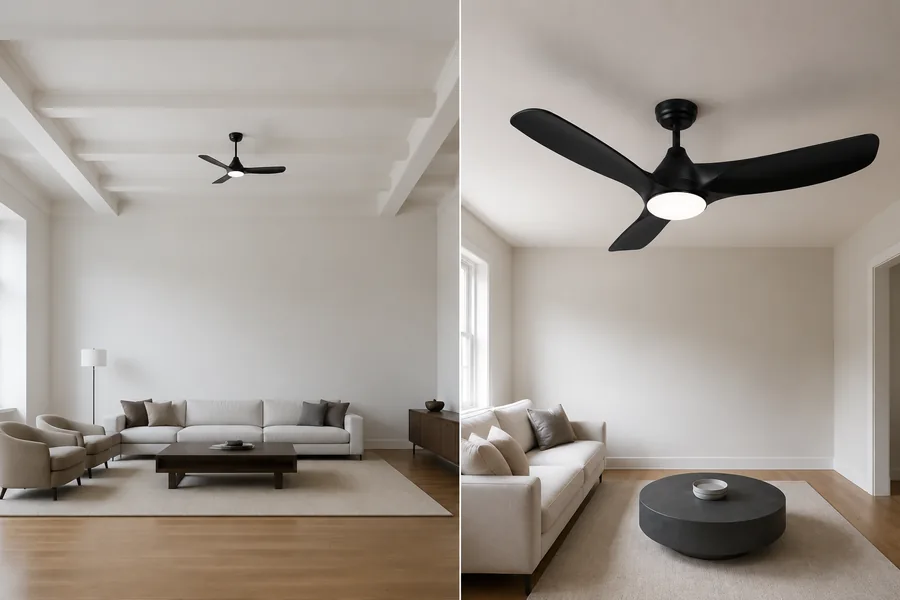
Most ceiling fan buying mistakes are easy to avoid.
You just need to know what to check.
9-1. Choosing by Style Only
A fan can look beautiful and still be wrong for the room.
Do not choose only by colour, shape, or price. Check the ceiling fan dimensions first.
Style matters. But size matters more.
9-2. Ignoring Ceiling Height
This is a big mistake.
A low ceiling may need a flush mount fan. A high ceiling may need a downrod.
If you ignore ceiling height, the fan may be unsafe or weak.
9-3. Installing a Fan That Is Too Small
A small fan in a large room will not move enough air.
You may turn it to the highest speed and still feel warm. That means more noise, less comfort, and poor performance.
Not worth it.
9-4. Installing a Fan That Is Too Large
A fan that is too large can make a room feel crowded. It can also create too much direct airflow.
This often happens in small bedrooms.
A huge fan over a small bed? Not great.
9-5. Forgetting Blade Clearance Around Walls and Furniture
The blades need clear space.
If the fan is too close to a wall, wardrobe, beam, or tall furniture, airflow may suffer. It may also look cramped.
Always check the space around the fan before buying.
10. Ceiling Fan Size Chart: Final Recommendations by Room
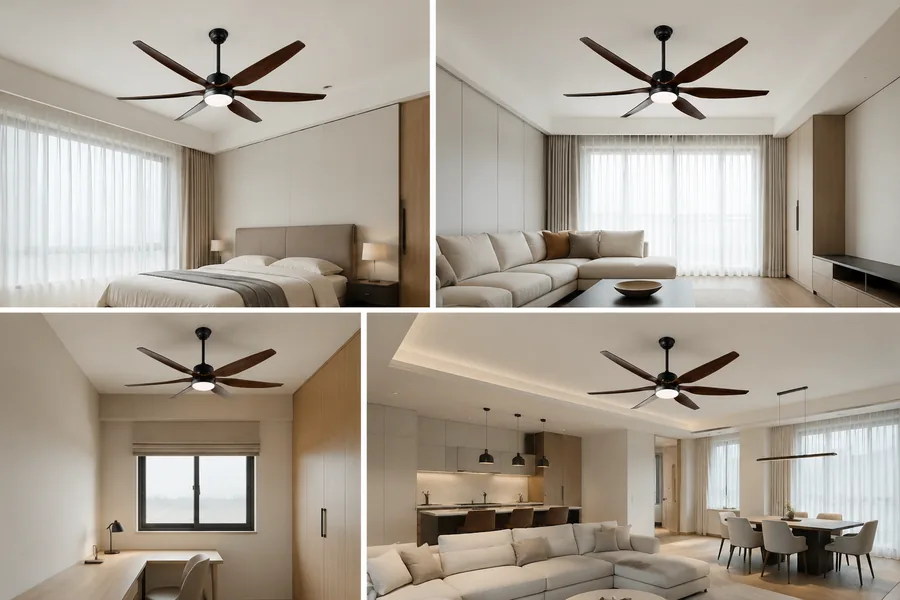
Here is the final room size guide. Keep it simple.
10-1. Bedroom Ceiling Fan Size Summary
| Bedroom Type | Room Size | Recommended Fan Size |
|---|---|---|
| Small bedroom | Up to 100 sq ft | 36–42 inches |
| Standard bedroom | 100–200 sq ft | 42–52 inches |
| Master bedroom | 200–400 sq ft | 52–60 inches |
Best tip:
Choose quiet airflow over maximum power.
10-2. Living Room Ceiling Fan Size Summary
| Living Room Type | Room Size | Recommended Fan Size |
|---|---|---|
| Small living room | Up to 200 sq ft | 44–52 inches |
| Standard living room | 200–400 sq ft | 52–60 inches |
| Large living room | Over 400 sq ft | 60+ inches or multiple fans |
Best tip:
For long living rooms, two fans may work better than one.
10-3. Small Room Ceiling Fan Size Summary
| Room Type | Recommended Fan Size |
|---|---|
| Small office | 36–44 inches |
| Nursery | 36–42 inches |
| Utility room | 29–36 inches |
| Small bedroom | 36–42 inches |
Best tip:
Do not oversize the fan just because it looks impressive.
10-4. Large Room Ceiling Fan Size Summary
| Large Room Type | Recommended Fan Size |
|---|---|
| Master bedroom | 52–60 inches |
| Family room | 52–60 inches |
| Great room | 60+ inches |
| Open-plan space | 60+ inches or multiple fans |
Best tip:
For spaces over 400 sq ft, think about airflow zones, not just total room size.
Conclusion
Choosing the right ceiling fan size does not need to be difficult.
Start with room size. Check the fan blade span. Think about ceiling height. Then look at CFM, layout, and where people spend time in the room.
If you do that, you avoid the big buying mistakes.
No weak airflow. No fan that looks too large. No wasted money.
Just the right fan, in the right room, doing the right job.
Ready to Find the Right Smart Ceiling Fan for Your Home?
Compare styles, sizes, smart features, and lighting options to find the perfect fan for your space.
Get a Quote