


If you are looking for the best quiet ceiling fan for bedroom, the answer is simple: it is not about style or price. It is about performance. A real silent ceiling fan must reduce noise, improve airflow, and support better sleep comfort.
Most people think all ceiling fans are the same. They are not. The difference comes down to five key specs, especially the use of a DC motor, blade design, vibration control, low-speed stability, and installation structure.
If these five points are strong, your bedroom feels calm, quiet, and easy to sleep in. If they are weak, even an expensive fan can feel noisy at night.
So let’s break it down, step by step. Simple.
1. Best quiet bedroom ceiling fan: Why It Matters
1.1 Sleep Comfort and Noise Impact
Sleep comfort is strongly affected by noise levels, even when the sound feels small.
According to the World Health Organization Night Noise Guidelines for Europe, the recommended indoor noise level at night should stay below 30 dB to avoid sleep disturbance. Once noise rises above 40 dB, it can begin to affect sleep quality, especially during light sleep stages.
Simple truth:
30 dB is like a very quiet room or soft whisper
40 dB is like a quiet conversation in the same room
50 dB or more can clearly disturb rest and make it harder to stay asleep
This is why a quiet bedroom ceiling fan matters more than most people think. Even a small increase in noise can break deep sleep cycles and reduce sleep comfort over time.
Many people do not notice the sound at first. But the body does. You may fall asleep, but you wake up during the night without knowing why. In many cases, background noise from a ceiling fan is part of the reason.
That is why engineers focus on reducing motor noise, airflow noise, and vibration. A true silent ceiling fan is designed to stay below the sleep-safe range recommended by WHO, helping the room stay calm and stable through the night.

1.2 What Makes a Fan Quiet or Silent
A fan is not quiet just because it spins slowly or looks modern.
In real use, a quiet bedroom ceiling fan is the result of several small engineering factors working together.
Most of the time, silence comes from five key areas:
- motor system
- blade design
- vibration control
- low-speed stability
- installation structure
Each one plays a different role. If one part is weak, noise will still happen, even if the fan looks high quality.
This is why understanding the real specs matters more than marketing words like “silent” or “whisper quiet”.
In the next, I will break down these five specs one by one, so you can clearly see what actually affects sleep comfort.
2. Specs 1: DC motor
A quiet bedroom ceiling fan starts with one thing,the motor.
Let’s be clear. No fancy design can fix a bad motor.
If the motor is noisy, the whole fan is noisy.
That is why DC motor technology matters so much.
2-1. How DC Motor Reduces Noise
A DC motor ceiling fan runs smoother, quieter, and more stable than traditional AC models. It is not just an upgrade — it is a completely different level of performance.
This difference comes from how the motor is built and controlled.
A DC motor works through low-voltage electronic control instead of heavy mechanical switching, which reduces friction, vibration, and noise.
This means:
- Less internal friction
- Less vibration
- Smoother rotation
In real life:
DC motor = stable sleep environment
AC motor = possible background noise at night
2.2 DC vs AC Motor for Bedrooms
When choosing a quiet bedroom ceiling fan, the motor type makes a big difference.
The two main options are DC motor and AC motor.
Both can move air. But they perform very differently when it comes to noise, stability, and sleep comfort.
DC Motor vs AC Motor (Bedroom Use):
| Feature | DC Motor | AC Motor |
|---|---|---|
| Noise Level | Very low (25–35 dB) | Higher (45–60 dB) |
| Vibration | Minimal | Noticeable |
| Speed Control | Smooth & precise | Smooth & precise |
| Energy Use | Low | Higher |
| Sleep Comfort | Excellent | Average |
| Night Performance | Stable & quiet | Can hum or buzz |
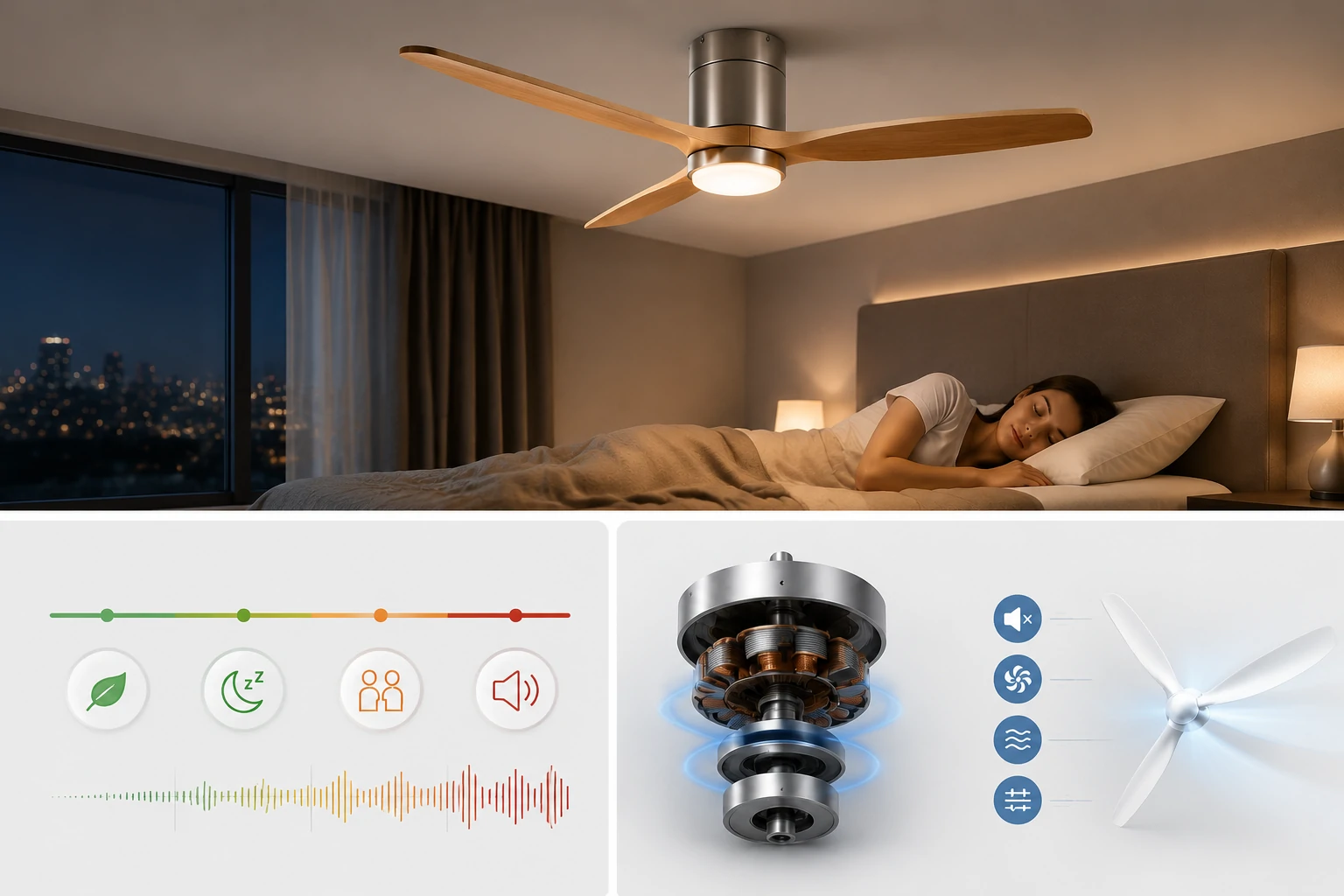
2-3. Why DC Motor Improves Sleep
- Removes mechanical noise spikes
- Keeps airflow stable at low speed
- Reduces vibration transferred to the ceiling
3. Specs 2: Blade Design
3.1 Blade Shape and Air Noise
A quiet bedroom ceiling fan is not only about the motor.
The blade design matters just as much.
A good silent ceiling fan does not just move air. It moves air smoothly, without cutting noise or harsh airflow sounds.
Blade shape directly affects how air moves through the room.
If the blade is flat or poorly designed, it can “cut” the air too sharply. That creates a soft rushing sound, especially at higher speed.
A well-designed blade spreads air more evenly, and this directly reduces air resistance noise, improves airflow smoothness, and enhances sleep comfort at night.

3-2. Curved vs Flat Blades
Curved blades are usually used in modern DC motor ceiling fan designs because they help reduce air cutting noise.
That means less disturbance when you are trying to sleep.
| Blade Type | Airflow | Noise Level | Sleep Comfort |
|---|---|---|---|
| Flat blades | Strong but harsh | Medium noise | Average |
| Curved blades | Smooth airflow | Lower noise | Better sleep |
3-3. Airflow and Sleep Comfort
4. Specs 3: Vibration Control
4-1. Vibration as Main Noise Source
Most people think noise comes from the motor or the wind.
Wrong!
In real use, vibration is often the biggest hidden problem.
Here is why:
Motor spins → small imbalance
Blade rotates → tiny shake
Ceiling structure → amplifies sound

4-2. Motor Balancing and Calibration
Good manufacturers do one important thing.
They balance the motor before it leaves the factory.
This means:
- weight is evenly distributed
- rotation is stable
- vibration is reduced at source
This is especially important in a DC motor ceiling fan, because smooth rotation = quiet operation.
4-3. Structural Stability Over Time
Here is something many people forget.
A fan can be quiet on day one, but not after one year.
Why?
Because poor structure becomes loose over time.
A well-built silent ceiling fan keeps its stability because:
- strong internal frame
- secure mounting system
- stable blade alignment
That means long-term sleep comfort, not just short-term silence.
Ready to Find the Right Smart Ceiling Fan for Your Home?
5. Specs 4: Low-Speed Performance
5-1. Stable Low RPM at Night
Low-speed performance is one of the most important specs for a quiet bedroom ceiling fan.
Many buyers only look at the highest fan speed. That is a mistake. In a bedroom, you do not need strong wind all night. You need soft, steady airflow that helps the room feel fresh without disturbing your sleep.
A good quiet bedroom ceiling fan should run smoothly at low speed. No shaking. No clicking. No loud motor sound. Just calm air movement. That is what really improves sleep comfort.
Low RPM means the fan blades turn slowly. For bedroom use, this matters a lot.
At night, a fan should not feel too strong. It should not blow directly at your face or make the room feel cold. It should move air gently and evenly.
A silent ceiling fan should perform well at low RPM. Some fans are quiet at high speed but unstable at low speed. That is not good for sleep. A better fan should stay smooth even when running slowly.

5-2. Multi-Speed and Night Mode
A fan with more speed options gives you better control.
During the day, you may need stronger airflow. At night, you may only need a soft breeze. Multi-speed control lets you choose the right setting for different times.
Night mode is also useful. It helps the fan run at a lower and quieter speed while you sleep. Some fans can also work with a timer, so the fan turns off after a few hours.
For a bedroom, this is a big advantage. You get comfort when you fall asleep, but you do not need the fan running strongly all night.
5-3. Why Low Speed Matters Most
For bedrooms, low speed matters more than high speed.
High speed is useful when the room feels hot. But when you are sleeping, comfort is different. You need quiet airflow, not strong wind.
A good fan should create a soft breeze at low speed. This helps air move around the room without making noise or disturbing sleep.
This is what separates a basic fan from a truly comfortable bedroom fan. The best quiet ceiling fan for bedroom use is not the one that only looks powerful. It is the one that stays smooth, quiet, and comfortable at low speed.
Great low-speed performance means better sleep comfort, lower noise, and a more peaceful bedroom.
6. Specs 5: Installation Structure
6-1. Flush Mount vs Downrod
Ceiling height can affect both airflow and noise.
If the fan is too close to the ceiling, airflow may be blocked. The fan may need to run at a higher speed to move enough air. More speed often means more noise.
If the fan hangs too low, it may feel too close to the bed. The airflow can feel too strong, and the fan may look uncomfortable in the room.
The best position is simple: high enough for safety, but low enough to move air well. That balance matters.
For bedrooms, this is very important. You want soft airflow, not strong wind. You want calm movement, not a loud machine above your head.
A well-positioned fan can run at a lower speed and still keep the room comfortable. That is better for noise control and better for sleep comfort.
6-2. Ceiling Height and Noise Impact
Ceiling height can affect both airflow and noise.
If the fan is too close to the ceiling, airflow may be blocked. The fan may need to run at a higher speed to move enough air. More speed often means more noise.
If the fan hangs too low, it may feel too close to the bed. The airflow can feel too strong, and the fan may look uncomfortable in the room.
The best position is simple: high enough for safety, but low enough to move air well. That balance matters.
For bedrooms, this is very important. You want soft airflow, not strong wind. You want calm movement, not a loud machine above your head.
A well-positioned fan can run at a lower speed and still keep the room comfortable. That is better for noise control and better for sleep comfort.

6-3. Proper Installation for Quiet Operation
Proper installation is one of the easiest ways to make a ceiling fan quieter.
Even a silent ceiling fan can become noisy if the screws are loose, the mounting bracket is weak, or the blades are not balanced. Small problems can create big noise. It happens all the time.
Before using the fan, check these points:
- Ceiling box should be strong enough for a ceiling fan
- Mounting bracket should be fixed tightly
- Fan body should not shake
- Blades should be balanced
- Screws should not be loose
- Fan should have enough clearance from walls and furniture
7. Recommended Quiet Ceiling Fan Solutions for Bedrooms
7-1. Best DC Motor Fans for Sleep Comfort
For bedroom use, a DC motor fan is often the better choice.
Why? Simple. A DC motor usually runs more smoothly, uses less energy, and gives better speed control. That matters at night.
A quiet bedroom ceiling fan with a DC motor can run at low speed without too much noise. It can create soft airflow instead of strong wind. This is better for sleep comfort.

7-2. Models for Different Bedroom Sizes
Bedroom size also matters.
For a small bedroom, choose a compact fan. A smaller fan can give enough airflow without making the room feel crowded. A flush mount or low profile design can also work well if the ceiling is low.
For a medium bedroom, a 44 inch to 52 inch fan is often a good choice. It gives better airflow coverage without feeling too strong. This size is very common for normal bedrooms.
For a large bedroom or master bedroom, you may need a larger fan or a fan with stronger airflow. But bigger is not always better. The fan should still be quiet at low speed. That is the key point.
The best fan for bedroom size should balance three things: airflow, noise level, and comfort.
7-3. Hotel and Project Applications
For hotels, serviced flats, apartments, and project rooms, quiet operation is even more important.
Guests may not know the fan brand. They may not care about the motor type. But they will notice noise. They will notice shaking. They will notice if the fan feels cheap.
That is why hotels and project buyers should choose quiet ceiling fan solutions with stable motors, balanced blades, and simple controls.
For project use, the best fan should offer:
- Quiet night operation
- Easy remote control
- Stable airflow
- Long service life
- Simple maintenance
- Consistent quality across many rooms
A quiet bedroom ceiling fan can improve guest comfort and reduce complaints. Very important. Especially for hotels, apartments, and rental spaces where sleep quality matters.
8. How to Choose the Best Quiet Bedroom Ceiling Fan
Choosing the right ceiling fan is simple, but many people still make the same mistakes. Big mistakes. Easy to avoid.
8-1. Key Specs Checklist Before Buying
Before buying, check these key specs:
(1)Motor type:
A DC motor is usually better for quiet bedroom use.
(2)Noise level:
The fan should stay quiet at low and medium speeds.
(3)Low-speed performance:
The fan should move air gently at night.
(4)Blade balance:
Poor blade balance can cause wobble and noise.
(5)Fan size:
The fan should match the bedroom size.
(6)Mounting type:
Choose flush mount, low profile, or downrod based on ceiling height.
(7)Speed settings:
More speed options give better comfort control.
(8)Timer function:
Useful for sleep comfort and energy saving.
(9)Remote control:
Easier to use from the bed.
(10)Light function:
Dimmable light is better for bedrooms.
A quiet bedroom ceiling fan is not about one single spec. It is about the whole system working well together.
8-2. Common Mistakes That Increase Noise
Many fan noise problems come from poor choices or poor installation.
Common mistakes include:
- Choosing a fan that is too large for the room
- Choosing a fan with a weak or noisy motor
- Ignoring low-speed performance
- Installing the fan too close to the ceiling
- Using the wrong downrod length
- Not balancing the blades
- Leaving screws loose
- Choosing a cheap fan with poor structure
Even a silent ceiling fan can become noisy if it is installed badly. A good motor helps, but structure matters too.

8-3. Matching Fan Type to Sleep Comfort Needs
The best fan type depends on the bedroom.
For low ceilings, choose a flush mount or low profile ceiling fan. It saves space and keeps the fan closer to the ceiling.
For standard bedrooms, a DC motor ceiling fan with remote control is a strong choice. It gives quiet airflow and easy control from the bed.
For master bedrooms, choose a larger fan with smooth low-speed performance. Make sure it can move enough air without becoming noisy.
9. FAQ: Quiet Bedroom Ceiling Fans
9-1. Are DC Motor Fans Always Quiet?
A DC motor fan is usually quieter than a traditional AC motor fan, but it is not always silent.
The motor is very important, but it is only one part of the fan. A quiet bedroom ceiling fan also needs balanced blades, a strong mounting structure, smooth speed control, and proper installation.
If the blades are not balanced, the screws are loose, or the fan is installed badly, even a DC motor fan can make noise. Very common problem.
9-2. What Noise Level Is Good for Sleep?
For sleep, lower noise is always better. A bedroom should feel calm, not busy.
In general, a quiet bedroom ceiling fan should have very low motor noise and smooth airflow at low speed. You should not hear loud humming, clicking, shaking, or blade wobble while lying in bed.
The best noise level also depends on how sensitive you are. Some people can sleep with soft airflow sound. Others need the room to be almost silent.
For bedrooms, the most important thing is low-speed performance. A fan may sound fine at high speed during the day, but at night, even a small click or hum can feel annoying.
When choosing a silent ceiling fan, look for:
- Quiet DC motor
- Stable low-speed running
- Balanced blades
- No wobble
- Strong ceiling mount
- Multiple speed settings
- Sleep mode or timer function
9-3. What Ceiling Fan Type Is Best for Bedrooms?
The best ceiling fan type for a bedroom depends on ceiling height, room size, and sleep comfort needs.
For low ceilings, a flush mount or low profile ceiling fan is usually a better choice. It saves space and keeps the fan closer to the ceiling.
For standard bedrooms, a DC motor ceiling fan with remote control is often a strong option. It gives quiet airflow, smooth speed control, and easy use from the bed.
For larger bedrooms, choose a fan with a wider blade span and stable low-speed performance. The fan should move enough air without becoming noisy.
For bedrooms with lighting needs, a ceiling fan with dimmable LED light can be very useful. Warm light, low brightness, and timer settings can make the room feel more comfortable at night.
The best bedroom fan is not always the biggest or most expensive one. It is the one that fits the room, runs quietly, moves air gently, and supports better sleep comfort.