

If you are choosing a ceiling fan for a bedroom, the key question is not only which design looks good, but what size ceiling fan actually fits your room.
The right ceiling fan size for a bedroom depends on room area, ceiling height, airflow needs, and sleeping comfort. A fan that is too small may not provide enough airflow, while a fan that is too large can feel overpowering or make the room look crowded.
In this guide, we will explain how to choose the right size ceiling fan for a bedroom, match fan size with bedroom size, compare small, standard, and master bedroom recommendations, and help you choose the right option for low ceilings, quiet operation, and daily comfort.
1. Quick Answer: What Size Ceiling Fan for a Bedroom?
1-1. Standard Bedroom Ceiling Fan Size Recommendation
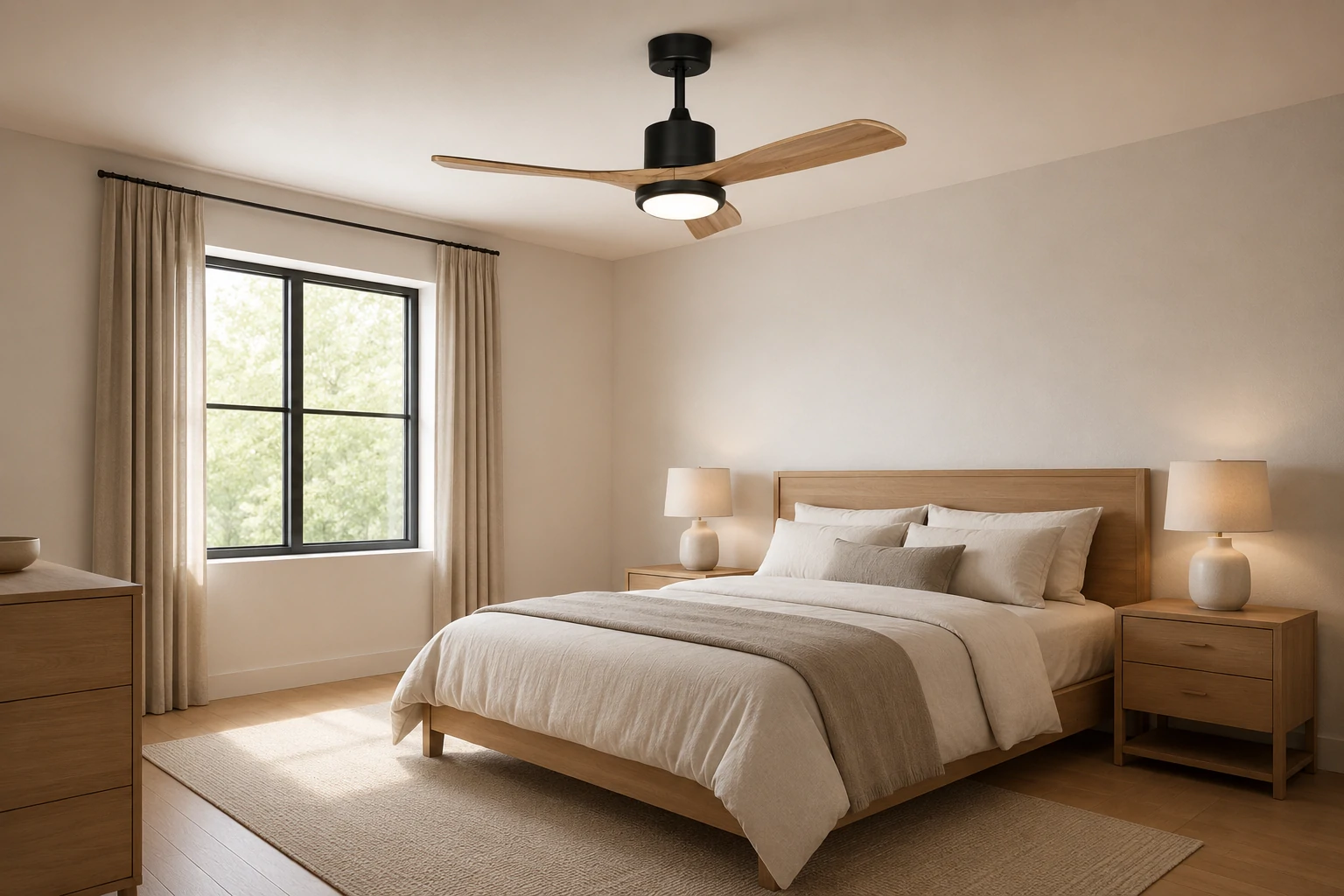
For a normal bedroom, the most common ceiling fan size is usually 44 inches to 52 inches. This range is popular because it gives you a good mix of airflow, comfort, and room balance.
A 44 inch ceiling fan is often a good choice for a standard bedroom or a smaller guest room. It gives enough air for daily use, but it does not look too large.
A 52 inch ceiling fan is better for a larger bedroom or a master bedroom. It can move more air and cover a wider area.
1-2. Quick Rule Based on Bedroom Square Footage
The easiest way to choose the right fan is to measure your bedroom first.
Do this:
Room length × room width = room square footage
For example, if your bedroom is 12 feet long and 12 feet wide, the room size is:
12 × 12 = 144 square feet
For a bedroom around 144 square feet, a fan around 44 inches is usually a good choice. In some cases, you can also choose a 52 inch ceiling fan if the ceiling is high, the room is open, or you want stronger airflow.
Here is the quick rule:
- Under 100 square feet: choose 29″ to 36″
- 100–144 square feet: choose 36″ to 44″
- 145–225 square feet: choose 44″ to 52″
- 225–400 square feet: choose 52″ to 60″
- Over 400 square feet: choose 60″ or larger, or use two fans
This rule is useful because it gives you a clear first answer. You do not need to guess. You do not need to buy only by looks. You measure the room, then choose the fan size. That is the better way.
But remember, square footage is not the only thing. You should also think about ceiling height, room shape, bed position, and airflow needs.
For example, a low bedroom ceiling may need a flush mount ceiling fan. A high ceiling may need a downrod. A narrow bedroom may need careful fan placement. These small details matter.
2. Bedroom Ceiling Fan Size Chart by Room Size
2-1. Ceiling Fan Size Chart for Small, Medium, and Large Bedrooms
Use this chart as a simple starting point:
| Bedroom Size | Room Area | Recommended Fan Size |
|---|---|---|
| Small bedroom | Under 100 sq. ft. | 29" to 36" |
| Standard bedroom | 100–144 sq. ft. | 36" to 44" |
| Medium bedroom | 145–225 sq. ft. | 44" to 52" |
| Large bedroom | 225–400 sq. ft. | 52" to 60" |
| Extra-large bedroom | Over 400 sq. ft. | 60"+ or two fans |
For a small bedroom, you do not need a huge fan. A 29″ to 36″ ceiling fan can be enough.
For a standard bedroom, a 36″ to 44″ ceiling fan is often a smart choice. It gives you good airflow without making the ceiling look too crowded.
For a medium bedroom, a 44″ to 52″ ceiling fan works very well. This is one of the most common size ranges for bedrooms.
For a large bedroom or master bedroom, you may need a 52″ to 60″ ceiling fan. If the room is very large, one fan may not be enough. You may need two ceiling fans for better air movement.
The goal is simple: your fan should move air across the room, not just under the fan.
2-2. Recommended Blade Span by Square Footage
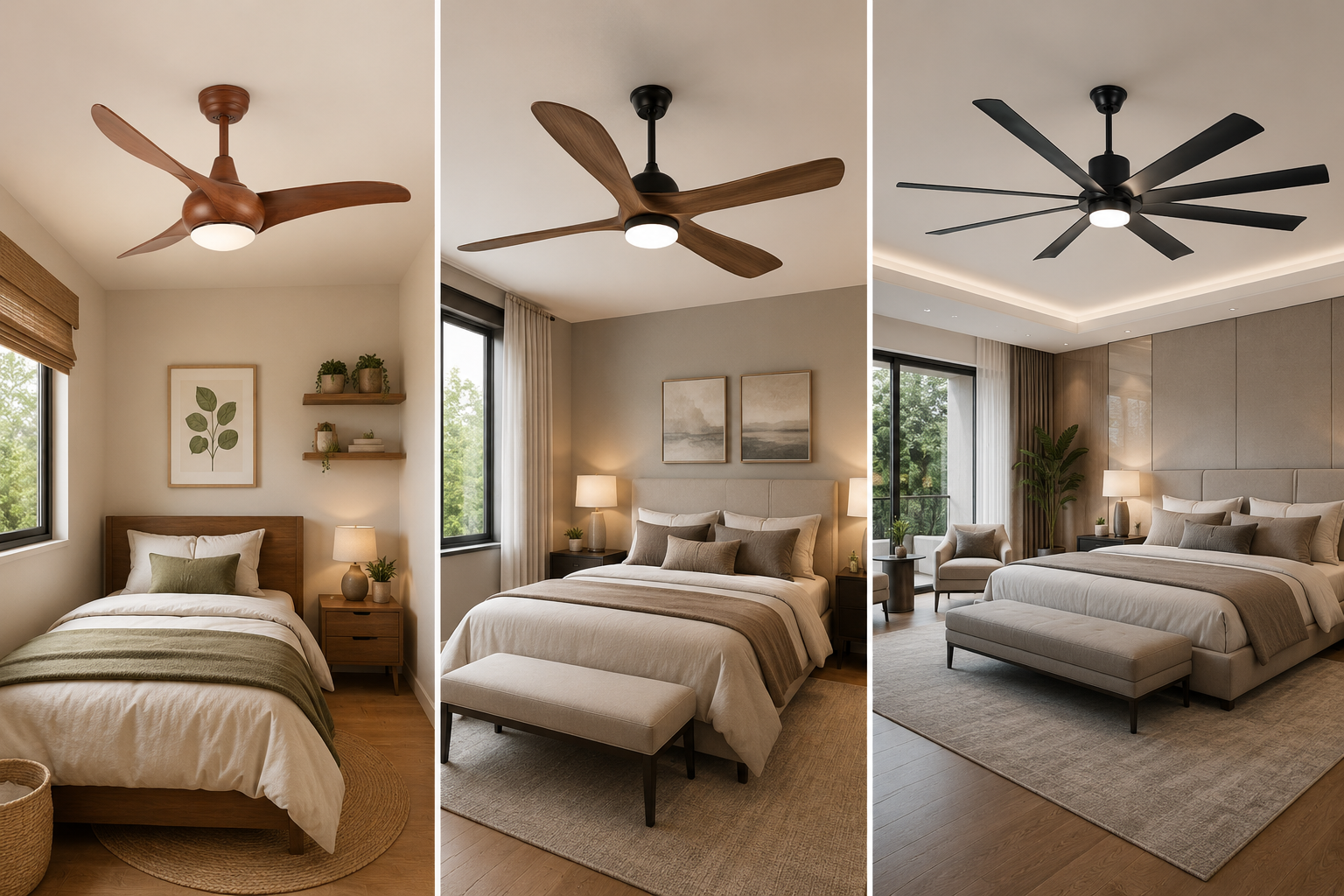
Ceiling fan size usually means blade span. This is the full width of the fan from one blade tip to the opposite blade tip.
So when you see a 44 inch ceiling fan, it means the full blade span is about 44 inches.
2-3. When to Choose a Larger or Smaller Fan
Sometimes your room may sit between two fan sizes. That is normal. In that case, you need to look at your real bedroom, not only the chart.
You can choose a larger fan when:
- Bedroom has a high ceiling
- Room feels hot in summer
- Bedroom is wide or open
- Want stronger airflow
- Bed is large and placed in the centre
- Room has poor air movement
You can choose a smaller fan when:
- Bedroom has a low ceiling
- Room is narrow
- Fan is close to walls or wardrobes
- Want soft airflow for sleeping
- Room already has good air movement
- Want a cleaner ceiling look
For example, if your bedroom is around 140 sq. ft., a 44 inch ceiling fan can be a smart choice.
If your bedroom is around 150 sq. ft., but the ceiling is low, you may still choose a 44 inch fan instead of a larger 52 inch fan.
3. How to Measure Your Bedroom Before Choosing a Ceiling Fan
3-1. How to Calculate Bedroom Square Footage
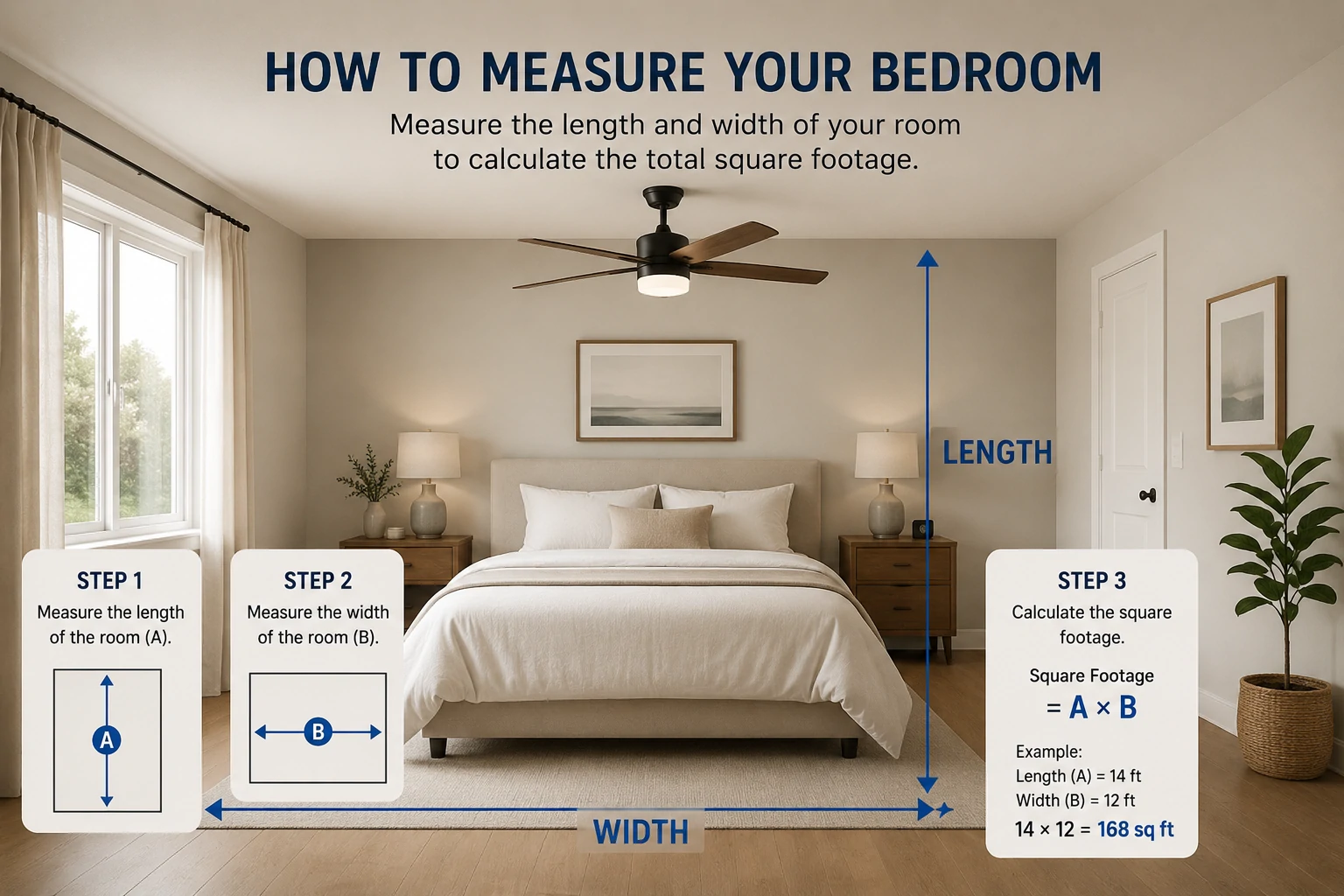
To calculate bedroom square footage, measure the room length and width.
Use this simple formula:
Room length × room width = bedroom square footage
For example:
If your bedroom is 10 feet long and 10 feet wide, the room size is:
10 × 10 = 100 sq. ft.
If your bedroom is 12 feet long and 12 feet wide, the room size is:
12 × 12 = 144 sq. ft.
If your bedroom is 12 feet long and 15 feet wide, the room size is:
12 × 15 = 180 sq. ft.
After you calculate the room size, compare it with the fan size chart to find the right size ceiling fan for a bedroom. You can see the full bedroom ceiling fan size chart in Section 2-1 of this guide.
A 100 sq. ft. bedroom may work well with a 36″ to 44″ ceiling fan.
A 180 sq. ft. bedroom may need a 44″ to 52″ ceiling fan.
3-2. How to Calculate Bedroom Square Footage
Ceiling height is very important. A fan that works well in a high room may not work well in a low room.
For a low bedroom ceiling, you should look for a flush mount ceiling fan or a low profile ceiling fan. These fans sit closer to the ceiling and help keep enough space above your head.
For a normal bedroom ceiling, a standard mount fan usually works well.
For a high ceiling, you may need a downrod ceiling fan. The downrod brings the fan lower, so the airflow can reach you better.
Here is the simple rule:
- Low ceiling: choose a flush mount fan
- Standard ceiling: choose a standard mount fan
- High ceiling: choose a downrod fan
3-3. Why Room Shape and Layout Also Matter
Room size is important, but room shape also matters.
A square bedroom is easy. You can usually place the fan in the centre of the room or above the main area.
A long and narrow bedroom is different. One fan may not move air evenly from one end to the other. In this case, fan placement becomes very important.
You should also look at your furniture layout:
- Where is your bed?
- Where are your wardrobes?
- Is the fan too close to a wall?
- Is the fan centred in the room?
- Will the airflow reach the sleeping area?
- Is there enough space around the blades?
If the fan is too close to a wall, the airflow may not spread well. If the fan is too close to a tall wardrobe, it may look crowded and feel unbalanced.
For most bedrooms, you want the fan near the centre of the main living area. In many cases, this means above the bed or near the centre of the ceiling.
But do not only think about the centre. Think about comfort.
The best fan position is the place where you get smooth airflow, safe clearance, and a balanced look.
That is how you choose the right fan size and the right fan position. Simple. Smart. Very useful.
4. Best Ceiling Fan Size for Small Bedrooms
4-1. Recommended Fan Size for Bedrooms Under 100 Square Feet
For bedrooms under 100 square feet, the right size ceiling fan for a bedroom is usually between 29 inches and 36 inches.
This size works well for small spaces because it provides soft and steady airflow without feeling too strong while you sleep. It also keeps the ceiling area clean and balanced, instead of making the room feel crowded.
A small bedroom may include:
- A small guest room
- A kid’s bedroom
- A compact apartment bedroom
- A small spare room
- A short-term rental bedroom

4-2. Best Fan Options for Guest Rooms, Kids’ Rooms, and Small
For a guest room, you want a fan that is easy to use. A ceiling fan with a remote control is a good choice. Your guest can change the fan speed or light without getting out of bed. Very convenient.
For a kids’ room, you should choose a fan with quiet operation and safe installation. A smaller fan is often better because it gives gentle airflow. You do not want air blowing too strongly over the bed.
For a small apartment bedroom, space is very important. You may want a ceiling fan with light, because it gives you both airflow and lighting in one product. That is smart use of space.
A good small bedroom fan should have:
- Compact size
- Quiet motor
- Soft airflow
- Simple control
- Good lighting
- Safe ceiling clearance
A 36 inch ceiling fan is often a strong choice for these rooms. It is small, but still useful. It gives you comfort without making the room look busy.
4-3. Why Flush Mount or Low Profile Fans Work Well in Small Bedrooms
Small bedrooms often have lower ceilings. That is why a flush mount ceiling fan or low profile ceiling fan can work very well.
A flush mount fan sits close to the ceiling. It does not hang too low. This helps keep more space above your head and makes the room feel more open.
You should choose a flush mount or low profile fan when:
- Ceiling is low
- Bedroom is small
- Want more head clearance
- Want a cleaner ceiling style
- Need a safer fan position
That is why flush mount ceiling fans are often a great choice for small bedrooms. They save space, give useful airflow, and keep the room looking clean.
Ready to Find the Right Smart Ceiling Fan for Your Home?
5. Best Ceiling Fan Size for Medium Bedrooms
5-1. Recommended Fan Size for Standard Bedrooms
For most standard bedrooms, a ceiling fan between 44 inches and 52 inches is a strong choice.

5-2. Recommended Fan Size for Standard Bedrooms
A 44 inch ceiling fan is good for bedrooms that are not too large. It gives good airflow and still looks balanced.
A 52 inch ceiling fan is better if your bedroom is wider, warmer, or more open. It can move more air and cover a bigger area.
Use this simple guide:
- Around 145 sq. ft.44 inch ceiling fan
- Around 180 sq. ft.44″ to 52″ ceiling fan
- Around 225 sq. ft. 52 inch ceiling fan
This is not hard. Measure your room. Check the size. Choose the fan that fits.
For a medium bedroom, you should not go too small. A small fan may run fast but still not move enough air. That is not efficient. It is not comfortable either.
5-3. How to Balance Airflow, Lighting, and Noise Level
To choose the right size ceiling fan for a bedroom, the right fan should balance airflow, lighting comfort, and quiet operation instead of focusing only on diameter.
You also need to think about lighting and noise level. A bedroom should feel calm. It should feel comfortable. It should not feel like a machine is running above your head.
For airflow, choose the right fan size first. A 44 inch to 52 inch fan usually gives good air movement for a medium bedroom.
For lighting, a ceiling fan with light can be very useful. You get airflow and light in one fixture. This is great if your bedroom has only one ceiling outlet.
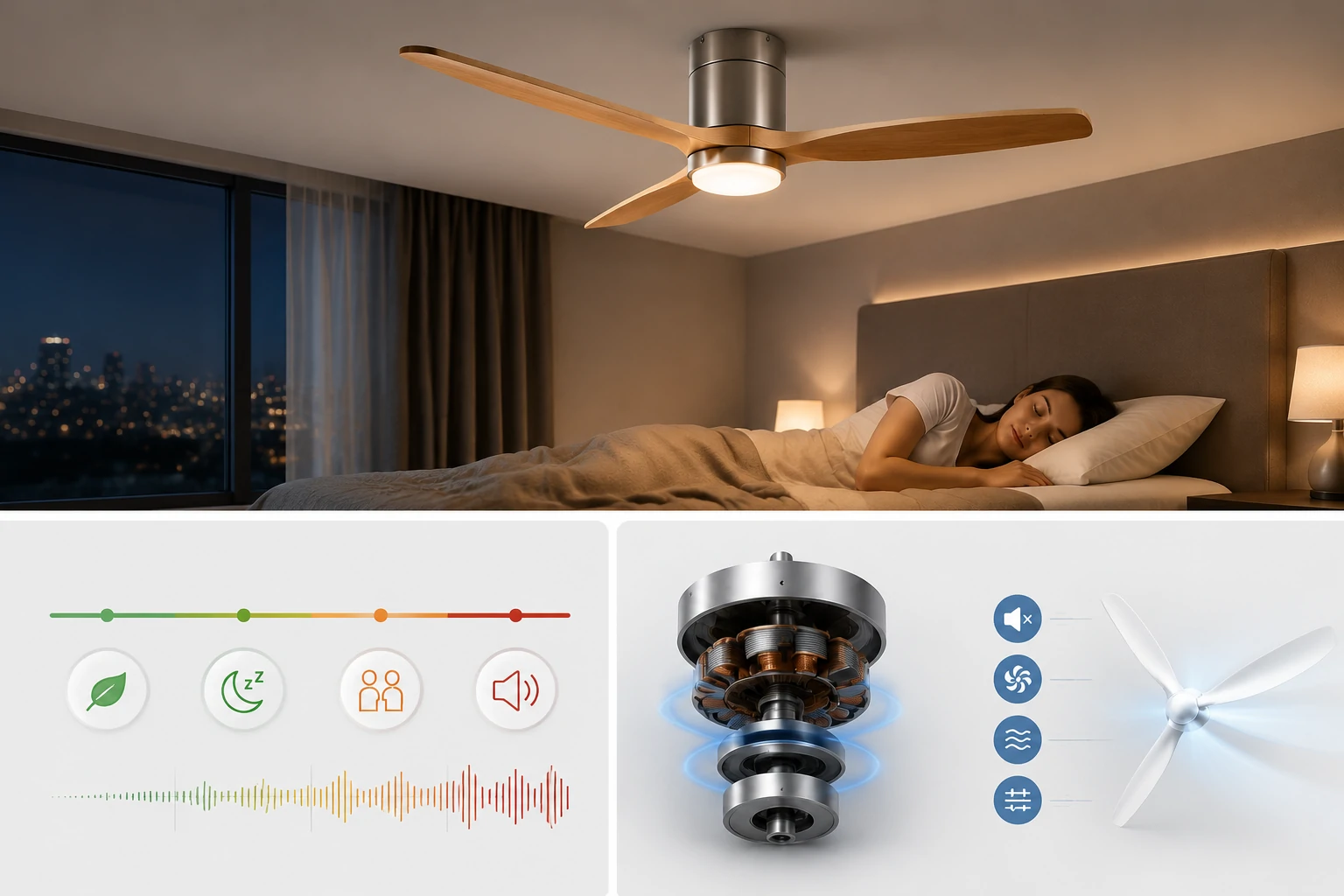
For noise, choose a fan with a quiet motor. A DC motor ceiling fan is often a good option because it can run smoothly and use less energy.
A good medium bedroom fan should give you:
- Enough airflow
- Soft lighting
- Quiet operation
- Easy control
- Good energy efficiency
- A balanced look
6. Best Ceiling Fan Size for Medium Bedrooms
6-1. Recommended Fan Size for Large Bedrooms
For a large bedroom, you should usually choose a ceiling fan between 52 inches and 60 inches.
| Bedroom Area | Recommended Ceiling Fan Size | Suggestion |
|---|---|---|
| 225–300 sq. ft. | 52 inch ceiling fan | Good for large bedrooms and many master bedrooms |
| 300–400 sq. ft. | 56 inch to 60 inch ceiling fan | Better for wider rooms or bedrooms with more open space |
| Over 400 sq. ft. | 60 inch or larger ceiling fan, or two fans | or two fans Best for extra-large bedrooms, bedroom suites, or rooms with separate zones |
6-2. When to Use a 52-Inch, 56-Inch, or Larger Ceiling Fan
A 52 inch ceiling fan is a great choice when your bedroom is large, but not huge. It works well for many master bedrooms. It gives you good airflow and a balanced look.
Choose a 52 inch ceiling fan when:
- Around 225–300 sq. ft.
- Ceiling height is normal
- Strong but comfortable airflow
- Bed is near the centre of the room
- Want a safe and common fan size
Choose a 56 inch ceiling fan when:
- Around 300–350 sq. ft.
- Has more open space
- Want stronger airflow
- Ceiling is higher
- Room feels warm in summer
And then, 60 inch or larger ceiling fan is for big spaces.
Very big spaces. If your master bedroom has a sitting area, high ceiling, or open layout, this size can work well.
Choose a 60 inch or larger ceiling fan when:
- Over 350–400 sq. ft.
- Has a lounge area
- Ceiling is high
- One smaller fan cannot cover the room
- Want airflow across a wide space

6-3. Should You Use One Large Fan or Two Smaller Fans?
Sometimes one large fan is enough. Sometimes two smaller fans are better. It depends on your room shape.
If your bedroom is square or close to square, one large fan in the center can work well. A 52 inch to 60 inch ceiling fan may provide enough airflow for the whole room.
For a large master bedroom, a chandelier ceiling fan can also be a good option if you want both decorative lighting and air circulation. However, you should still choose the fan size based on room area, ceiling height, and airflow needs.
But if your bedroom is long, wide, or has different zones, two smaller fans may work better than one large fan. This can help spread airflow more evenly across the room.
You may use two smaller ceiling fans when:
- Over 400 sq. ft.
- Bedroom is long and narrow
- Has a sleeping area and sitting area
- One fan cannot move air evenly
- Bed is not in the centre
- Want smoother airflow across the space
Two fans can give better air balance. One side of the room will not feel cool while the other side feels warm. That is a big win.
But two fans also need more planning. You need enough ceiling space. You need safe clearance. You may also need more wiring or better control options.
So here is the simple rule:
If your large bedroom is square, choose one large fan.
If your large bedroom is long or divided into zones, consider two smaller fans.
7. Other Factors That Affect Bedroom Ceiling Fan Size
7-1. Blade Span vs. Airflow Performance
Blade span means the full width of the fan from one blade tip to the opposite blade tip. This is why you see fan sizes like 44 inches, 52 inches, or 60 inches when choosing the right size ceiling fan for a bedroom.
But blade span is not the same as airflow.
A bigger blade span can help move more air, but it is not the only factor. Blade shape, motor power, fan speed, and blade angle also matter.
A good 52 inch ceiling fan may move air better than a poor-quality larger fan. This makes a huge difference, especially in summer, when the correct summer ceiling fan direction helps push cool air downward and improves bedroom comfort.
So when you choose a bedroom ceiling fan, do not only ask, “How big is it?” Also ask:
- Does it move enough air?
- Is the airflow smooth?
- Is the motor strong?
- Is it quiet enough for sleeping?
- Does it match the room size?
For a bedroom, smooth airflow is better than harsh airflow. You want comfort, not wind blasting your face at night.
The best fan gives you steady airflow, quiet running, and good room coverage.
7-2. Ceiling Height and Mounting Type
Ceiling height can change your fan choice.
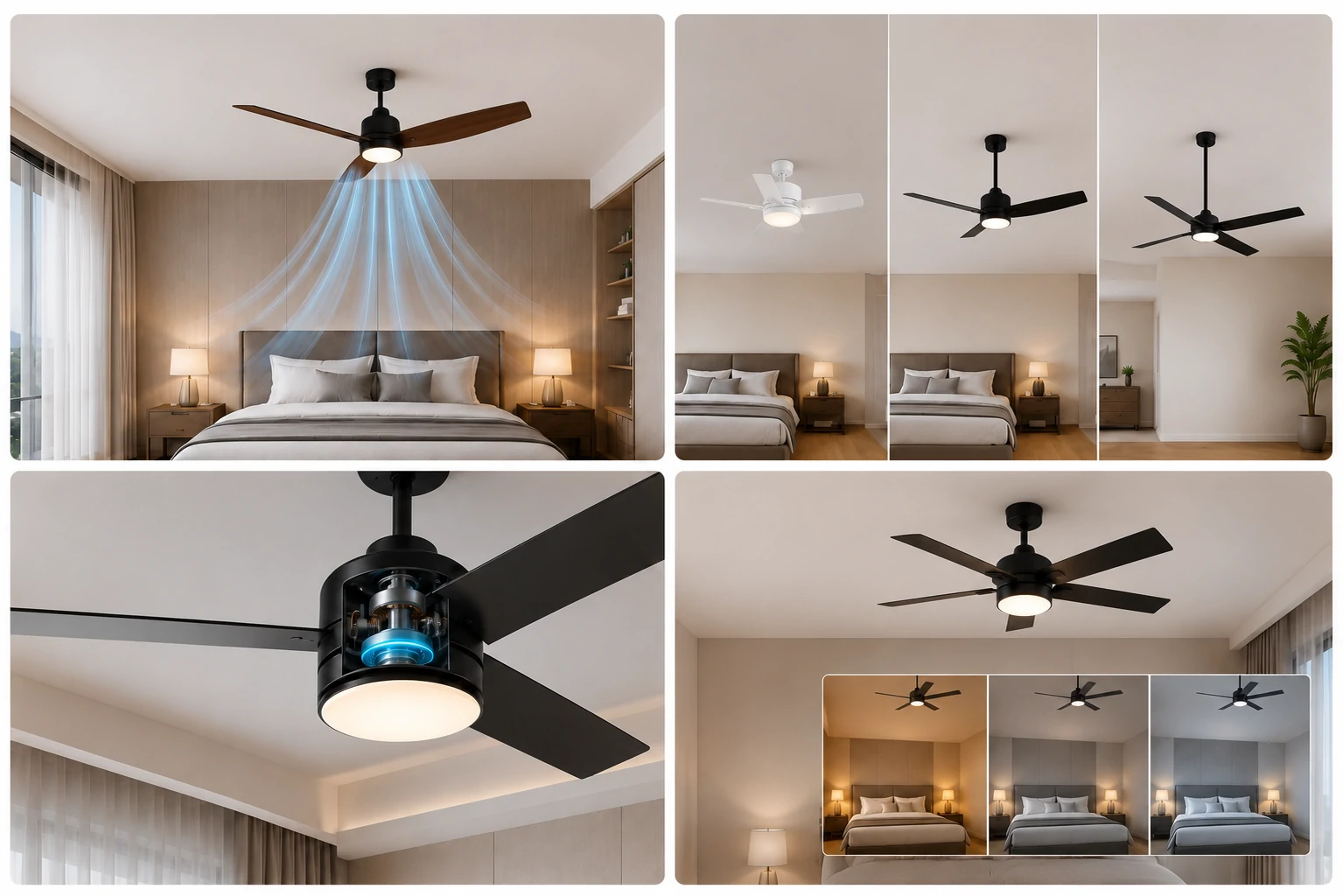
If your bedroom ceiling is low, you should choose a flush mount ceiling fan or a low profile ceiling fan. These fans sit close to the ceiling and help keep more head space.
If your ceiling height is normal, a standard mount ceiling fan can work well.
If your ceiling is high or sloped, you may need a downrod ceiling fan. The downrod brings the fan lower, so the airflow can reach the living area better.
Use this simple guide:
- Low ceiling: choose a flush mount ceiling fan
- Normal ceiling: choose a standard mount ceiling fan
- High ceiling: choose a downrod ceiling fan
- Sloped ceiling: choose a fan with a sloped ceiling adaptor
A fan that sits too high may not give you enough airflow. A fan that hangs too low may feel unsafe and uncomfortable.
So you need the right size and the right mounting type. Both matter.
Good fan size plus good mounting height equals better bedroom comfort.
7-3. Noise Level, Motor Type, and Energy Efficiency
A bedroom should be quiet. Very quiet. You sleep there. You rest there. You do not want a noisy fan above your head.
That is why noise level matters.
A cheap or poor-quality fan may shake, hum, or click. Not good. It can disturb your sleep and make the room feel less comfortable.
For better bedroom use, you should look for a fan with a quiet motor. A DC motor ceiling fan is often a good choice because it runs smoothly, uses less energy, and gives better speed control.
A DC motor can also help reduce power use. That is useful if you run the fan every night.
When choosing a bedroom ceiling fan, look for:
- Quiet operation
- Stable motor
- Low vibration
- Good speed control
- Energy-efficient performance
- Smooth airflow
8. Common Mistakes When Choosing a Bedroom Ceiling Fan
Choosing the right ceiling fan is simple, but many people still make the same mistakes. Big mistakes. Easy to avoid.
8-1. Choosing a Fan That Is Too Small
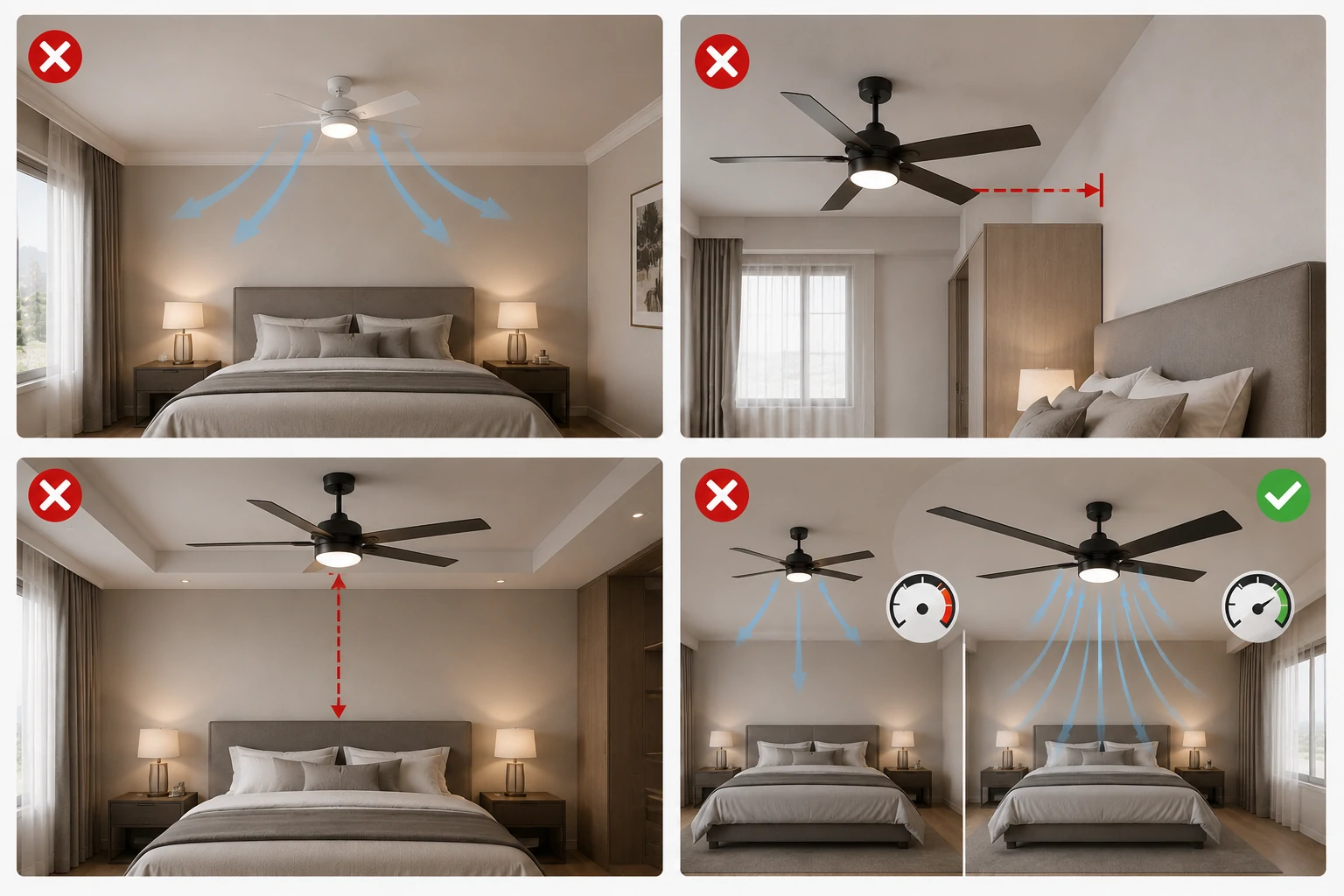
One of the biggest mistakes is choosing a fan that is too small for your bedroom.
A small fan may look neat, but it may not move enough air. Then you turn it to the highest speed. It works harder. It may still not cool the room well. Not a good result.
| Bedroom Area | Fan Too Small | Better Fan Size |
|---|---|---|
| 100–144 sq. ft. | 29" fan | 36" to 44" fan |
| 145–225 sq. ft. | 36" fan | 44" to 52" fan |
| 225–400 sq. ft. | 44" fan | 52" to 60" fan |
8-2. Installing a Fan Too Close to Walls or Furniture
Another common mistake is placing the fan too close to walls, wardrobes, tall cabinets, or other furniture.
When choosing the right size ceiling fan for a bedroom, you also need to think about clearance around the fan. A ceiling fan needs space around it. If the blades are too close to a wall or furniture, airflow cannot spread well. The room may feel uneven. One area feels cool. Another area still feels warm.
You should try to keep the fan near the centre of the main bedroom area. In many rooms, this means the centre of the ceiling or above the bed area.
As a simple guide, try to keep fan blades at least 18 inches away from walls or tall furniture when possible.
This helps the fan run more safely and move air more smoothly.
Good placement gives you:
- Better airflow
- Better room balance
- Safer blade clearance
- Cleaner ceiling design
8-3. Ignoring Ceiling Height and Mounting Clearance
Ceiling height matters a lot. Very important.
A fan that works well in a high bedroom may not work well in a low bedroom. If the ceiling is low, a hanging fan may sit too close to your head. That feels uncomfortable and unsafe.
For low ceilings, you should choose a flush mount ceiling fan or low profile ceiling fan. These fans sit closer to the ceiling and help save headroom.
For standard ceilings, a normal mount fan can work well.
For high ceilings, you may need a downrod ceiling fan. The downrod brings the fan lower, so the airflow can reach you better.
Use this simple guide:
| Ceiling Type | Better Mounting Choice |
|---|---|
| Low bedroom ceiling | Flush mount or low profile fan |
| Standard bedroom ceiling | Standard mount fan |
| High bedroom ceiling | Downrod ceiling fan |
| Sloped ceiling | Fan with sloped ceiling adaptor |
You should also think about the distance between the fan blades and the floor. In many homes, fan blades are commonly installed around 7 to 9 feet above the floor for safe and useful airflow.
The point is simple: the fan should not hang too low, and it should not sit too high. You want the right height. That is how you get better airflow and better comfort.
8-4. Focusing Only on Fan Diameter Instead of Airflow
Fan diameter is important, but it is not the whole story.
A 52 inch ceiling fan may sound powerful, but size alone does not tell you everything. Airflow also depends on blade shape, motor quality, blade pitch, fan speed, and installation height.
When you choose a bedroom ceiling fan, you should look at:
- Blade span
- Airflow performance
- Motor type
- Noise level
- Speed control
- Mounting height
- Room layout

9. Bedroom Ceiling Fan Size FAQs
9-1. What Size Ceiling Fan Is Best for a 10×10 Bedroom?
A 10×10 bedroom is 100 square feet.
For this room size, the right size ceiling fan for a bedroom is usually between 36 inches and 44 inches.
If the room has a low ceiling, a flush mount ceiling fan can help save overhead space. If the bedroom feels warm or has poor airflow, a 44 inch ceiling fan can be a stronger option for better air movement.
9-2. Is a 52-Inch Ceiling Fan Too Big for a Bedroom?
A 52 inch ceiling fan is not always too big for a bedroom. It depends on your room size.
For a small bedroom, yes, a 52 inch fan may be too large. It may feel too strong and look too heavy.
For a medium bedroom or master bedroom, a 52 inch ceiling fan can be a very good choice.
Use this guide:
- Under 100 sq. ft.: a 52 inch fan is usually too big
- 145–225 sq. ft.: a 52 inch fan can work well
- 225–400 sq. ft.: a 52 inch fan is often a strong choice
9-3. What Size Ceiling Fan Do I Need for a Master Bedroom?
When choosing the right size ceiling fan for a bedroom, most master bedrooms usually work best with a 52-inch to 60-inch fan for wider airflow coverage and better comfort.
If your master bedroom is around 225–300 sq. ft., a 52 inch ceiling fan is often enough.
If your master bedroom is around 300–400 sq. ft., you may want a 56 inch to 60 inch ceiling fan.
If your master bedroom is over 400 sq. ft., you may need a fan over 60 inches, or you may need two ceiling fans.
9-4. Can a Bedroom Ceiling Fan Be Too Large?
Yes, a bedroom ceiling fan can be too large.
When choosing the right size ceiling fan for a bedroom, bigger is not always better. A fan that is too large may create airflow that feels too strong while you sleep. It may also look too heavy on the ceiling and make a small bedroom feel crowded.
Signs your fan may be too large:
- The airflow feels too strong on low speed
- The fan looks too wide for the room
- The blades are too close to walls or furniture
- The ceiling feels crowded
- The fan does not match the bedroom style
9-5. What Is the Best Ceiling Fan Size for a Low Ceiling Bedroom?
For a low ceiling bedroom, you should usually choose a flush mount ceiling fan or a low profile ceiling fan.
The fan size still depends on the bedroom area, but the mounting style becomes very important.
For a small low ceiling bedroom, choose around 29 inches to 36 inches.
For a standard low ceiling bedroom, choose around 36 inches to 44 inches.
For a medium low ceiling bedroom, choose around 44 inches to 52 inches, but make sure the fan has enough clearance.