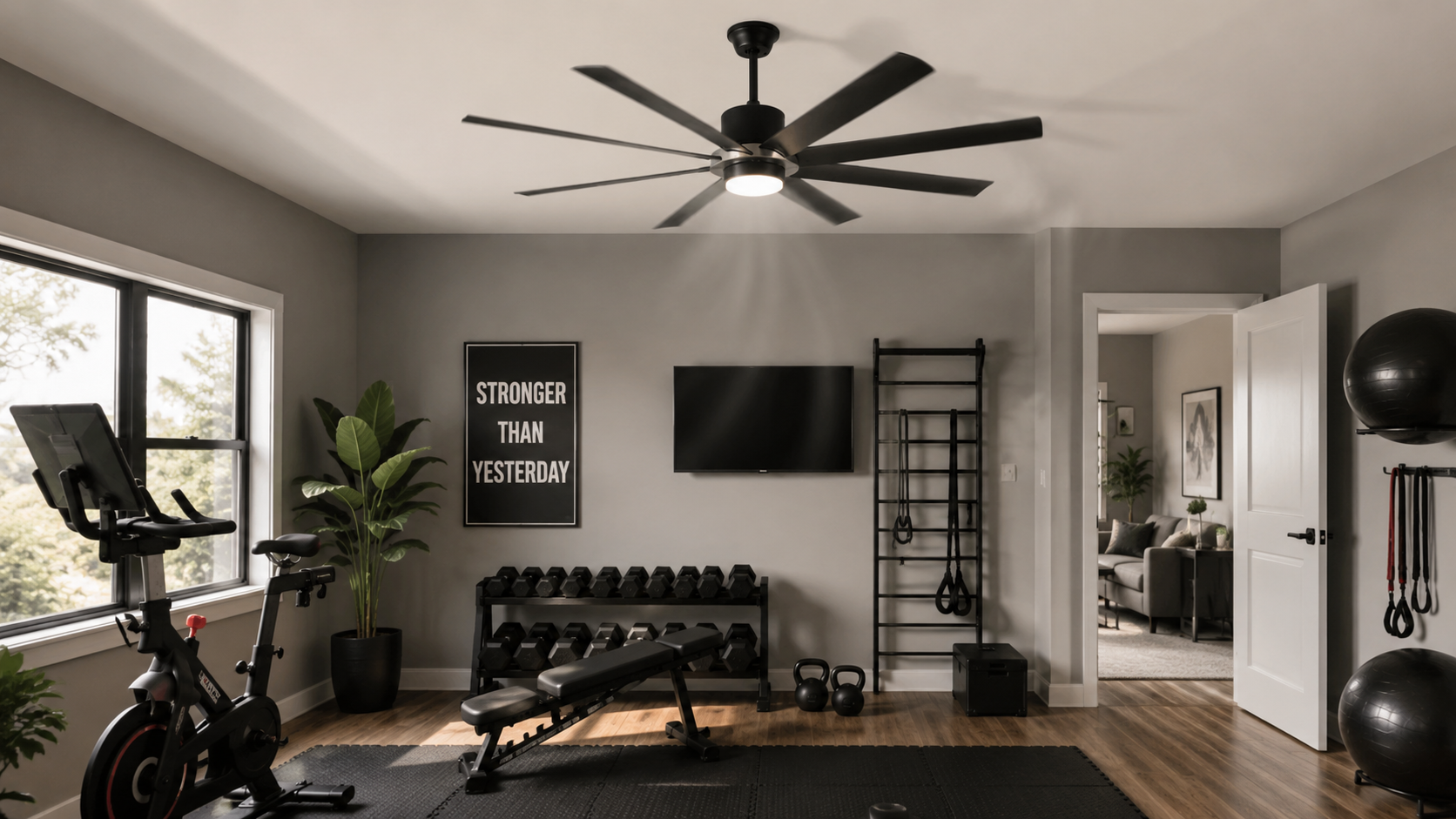


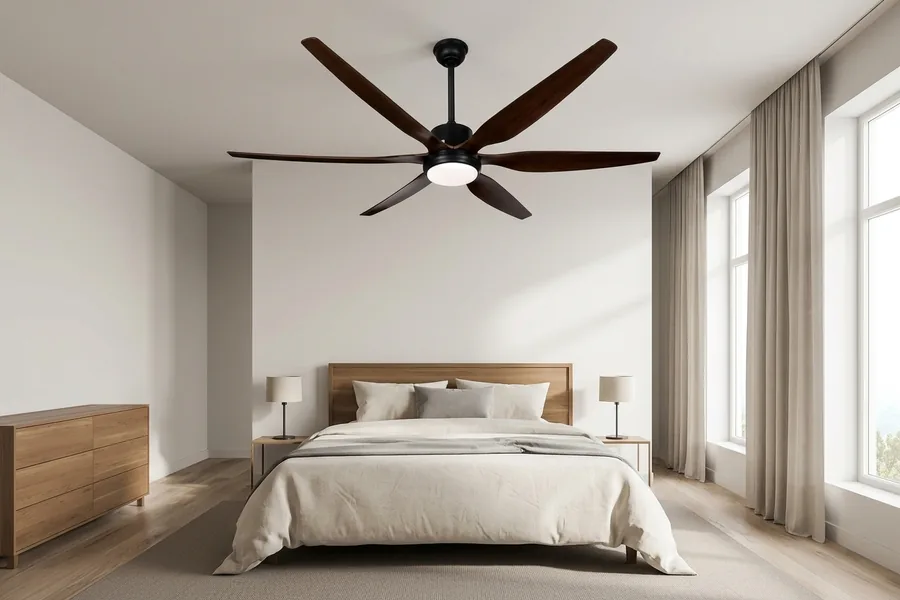
Choosing a ceiling fan for a bedroom sounds easy. Then you start looking. Suddenly there are 42 inch fans, 52 inch fans, 56 inch fans, low profile fans, DC motor fans, fans with lights, fans with remotes, and big fans that look great online but may feel far too strong over your bed.
Here is the simple truth: the best master bedroom ceiling fan is not always the biggest one. It is the one that fits the room, moves air well, runs quietly, and feels comfortable when you are trying to sleep.
For many master bedrooms, a 52 inch ceiling fan is the right choice. For a large bedroom, a 56 inch ceiling fan often gives better coverage. But there are a few details that can change the answer: room size, ceiling height, airflow, motor type, bed position, and how sensitive you are to noise.
This guide keeps it simple. No guesswork. No fancy words. Just a clear way to choose the right ceiling fan size for a master bedroom or large bedroom.
Contents
1. Start With the Bedroom You Actually Have
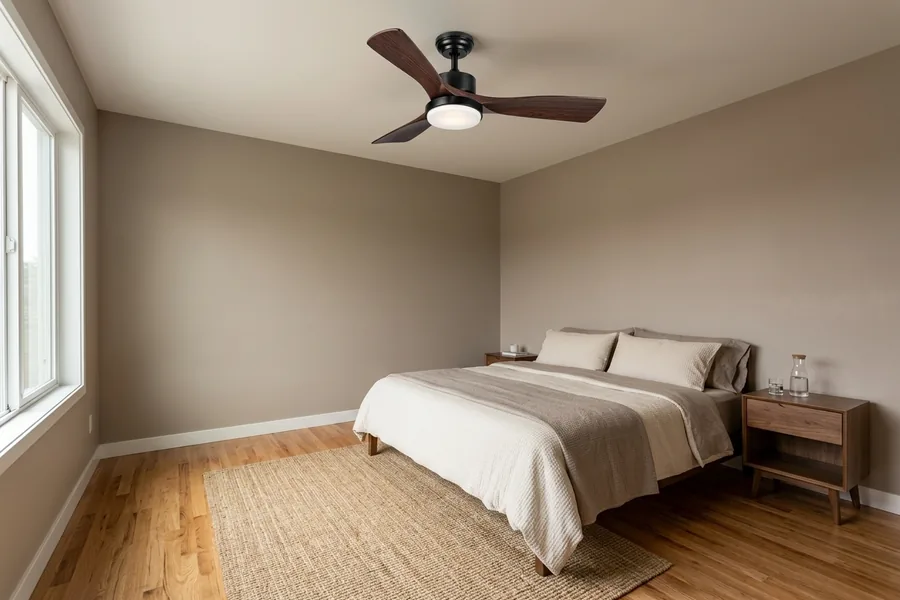
A bedroom is not just a number on a size chart. It is a real space. It has a bed, wardrobes, windows, low or high ceilings, and maybe a sitting area. That is why you should start with your actual room, not a random online rule.
A master bedroom ceiling fan has a different job from a fan in a living room. In a living room, people may want strong airflow during the day. In a bedroom, people want comfort at night. That means soft airflow, low noise, and easy control matter a lot.
1-1. Why master bedrooms need a different ceiling fan decision than standard bedrooms
A standard bedroom may only need a smaller fan. A master bedroom is usually larger. It may also have a king bed, more furniture, and a wider ceiling area. So yes, it often needs a larger fan.
But a master bedroom is still a sleeping space. That changes the decision.
You do not want a fan that blasts cold air straight onto your face at 2 a.m. You do not want a loud motor hum over your head. You do not want a bright white light that makes the room feel like a hospital.
For a master bedroom, look for:
- The right blade span for the room
- Quiet low-speed airflow
- A remote or wall control
- Warm, dimmable light if the fan has a light kit
- A safe mount for your ceiling height
This is where brands such as NEBOLA can fit well. A good bedroom fan is not just about size. It is about the whole experience: airflow, light, silence, and daily use.
1-2. Why “bigger is better” can be misleading in a sleeping space
Many people think a bigger fan must be better. Not always.
A fan that is too small may not move enough air. That is true. But a fan that is too large can also be a problem. It may look too heavy in the room. It may create a strong draft. It may make the bed area feel windy instead of comfortable.
A large bedroom fan should cover the space, not overpower it.
Think of it like buying shoes. Bigger shoes are not better. The right size is better. Ceiling fans work the same way.
1-3. The real question: should your bedroom use a 52 inch or 56 inch ceiling fan?
For this topic, most people are really asking one thing:
Should I choose a 52 inch ceiling fan or a 56 inch ceiling fan for my bedroom?
Here is the short answer:
| Bedroom Type | Better Starting Point | Why |
|---|---|---|
| Standard master bedroom | 52 inch ceiling fan | Balanced size, easy to control, good visual fit |
| Large bedroom | 56 inch ceiling fan | Wider coverage and stronger room circulation |
| Low-ceiling bedroom | 52 inch low profile fan | Safer clearance and less visual weight |
| High-ceiling large bedroom | 56 inch fan with downrod | Better air movement at the right height |
| Very large or long bedroom | 56 inch+ or two fans | More even airflow across the room |
A simple rule works well: choose 52 inches for balanced comfort, and 56 inches for broader coverage.
2. Match Fan Size to Bedroom Square Footage First

Before you look at style, colour, blades, or smart controls, measure the room. This is the boring step. It is also the step that saves people from buying the wrong fan.
A ceiling fan size guide should start with square footage because the fan has to move air across the room. If the fan is too small, the far corners feel still. If the fan is too large, the room can feel windy and odd.
2-1. How to measure your bedroom before choosing a ceiling fan
Measure the length and width of your bedroom in feet. Then multiply them.
For example:
14 ft x 16 ft = 224 sq ft
That is a common master bedroom size. It sits close to the line where a 52 inch fan is often enough, but a 56 inch fan may be better if the room feels open or has high ceilings.
If your room has an alcove, a sitting space, or a long narrow shape, do not only trust the total number. Look at where people actually need airflow. A fan in the wrong place can be the right size and still feel wrong.
2-2. Ceiling fan size guide for common bedroom sizes
Use this table as a simple starting point:
| Bedroom Size | Approx. Square Feet | Recommended Fan Size |
|---|---|---|
| 10 x 10 ft | 100 sq ft | 36-42 inch fan |
| 12 x 12 ft | 144 sq ft | 42-48 inch fan |
| 12 x 14 ft | 168 sq ft | 48-52 inch fan |
| 14 x 16 ft | 224 sq ft | 52 inch fan |
| 15 x 15 ft | 225 sq ft | 52-56 inch fan |
| 16 x 18 ft | 288 sq ft | 56 inch fan |
| 18 x 20 ft | 360 sq ft | 56-60 inch fan or two fans |
| 20 x 20 ft | 400 sq ft | 60 inch+ or two fans |
This table is not a law. It is a strong guide. The final choice also depends on ceiling height, motor power, CFM, and how the room is laid out.
2-3. When a 52 inch ceiling fan is enough for a master bedroom
A 52 inch ceiling fan is enough for many master bedrooms around 175-225 sq ft. It is also a good choice if the room has a standard 8 or 9 ft ceiling.
It gives enough airflow for daily comfort, but it usually does not look too big. It is a safe size. It is popular for a reason.
Choose 52 inches if:
- Your bedroom is medium to large, but not huge
- Your ceiling is 8-9 ft high
- The bed sits near the centre of the room
- You want soft airflow for sleep
- You care about a clean, balanced look
2-4. When a 56 inch ceiling fan makes more sense for a large bedroom
A 56 inch ceiling fan makes more sense when the room is larger, wider, or more open. It is a smart choice for many large bedrooms around 225-350 sq ft.
A 56 inch fan can move air across a wider area, often at a lower speed. That matters. A larger fan running slowly can sometimes feel better than a smaller fan running fast.
Choose 56 inches if:
- Your bedroom is over 225 sq ft
- You have a king bed and extra open space
- The room has high ceilings
- Air feels still in the corners
- You want wider airflow coverage without using high speed all night
2-5. When a bedroom may need a 60 inch fan or two smaller fans instead
Some bedrooms are not normal bedrooms. They are almost like small living rooms. Big primary suites, open layouts, and long rooms may need more than a single 52 inch or 56 inch fan.
If the bedroom is around 350-400 sq ft or larger, consider:
- A 60 inch or larger fan
- Two 52 inch fans
- Two smaller fans for better zone coverage
Here is the key point: one huge fan is not always better than two well-placed fans. In a long room, two fans can spread air more evenly.
3. 52 Inch Ceiling Fans: Best For Most Master Bedrooms
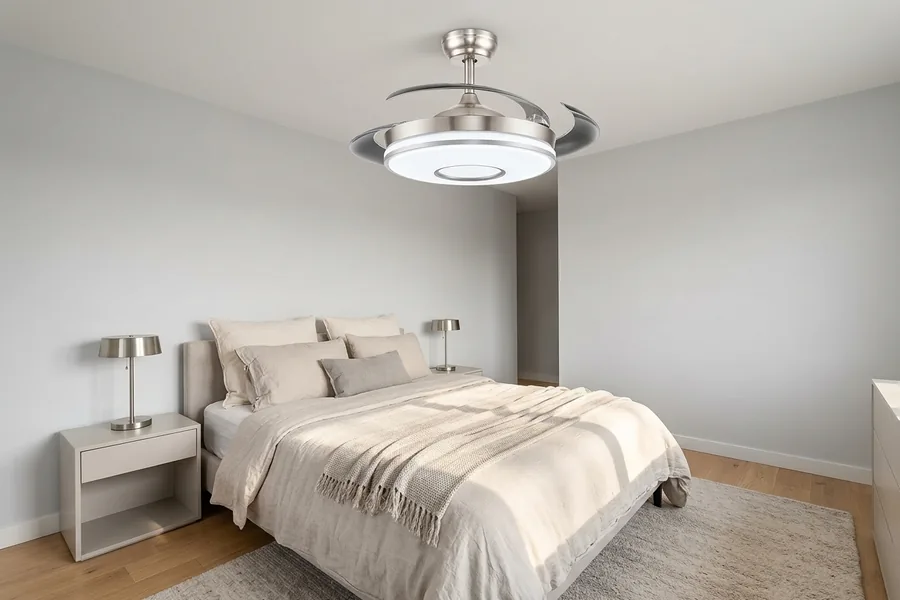
A 52 inch ceiling fan is the classic choice for a master bedroom. It is big enough to move real air. It is not so big that it takes over the room. It also gives buyers many choices in style, motor type, light design, and control.
If you are unsure, 52 inches is often the safe place to start.
3-1. Ideal room size for a 52 inch ceiling fan
A 52 inch fan usually works best in bedrooms around 175-225 sq ft. It can also work in rooms up to about 250 sq ft if the fan has good airflow and the ceiling height is normal.
A common example is a 14 x 16 ft master bedroom. That is about 224 sq ft. In this room, a 52 inch fan often looks right and feels right.
3-2. Why 52 inches is the safest starting point for many master bedrooms
There are three reasons 52 inches is so popular.
First, it has good coverage. It can move enough air for a typical master bedroom.
Second, it looks balanced. It does not usually feel too large above the bed.
Third, it gives better control. Many people use a bedroom fan on low or medium speed. A good 52 inch fan can give a steady breeze without making the room feel windy.
For a brand like NEBOLA, this size is useful because it fits real homes. Not showrooms. Real bedrooms.
3-3. Where a 52 inch fan may feel too weak
A 52 inch fan may feel too weak if the bedroom is large, high, or long.
For example, imagine a bedroom that is 16 x 18 ft. The bed is on one side. There is a sitting area near the window. A 52 inch fan in the centre may cool the bed area, but the sitting area may still feel warm.
That is not the fan’s fault. It is a coverage issue.
A 52 inch fan may also feel weak if:
- The ceiling is over 10 ft high
- The fan has low CFM
- The room is long and narrow
- The fan is not centred well
- You have large windows that bring in heat
3-4. What to check before choosing a 52 inch fan with light and remote
Before you buy a 52 inch ceiling fan, check these details:
- CFM: Is the airflow strong enough for your room?
- Motor: Is it quiet enough for sleep?
- Speeds: Does it have enough low-speed control?
- Light: Is the light dimmable and warm?
- Remote: Can you adjust it from bed?
- Mount type: Does it suit your ceiling height?
A 52 inch fan is a great choice, but only if the full setup is right.
4. 56 Inch Ceiling Fans: Better Coverage for Larger Bedrooms
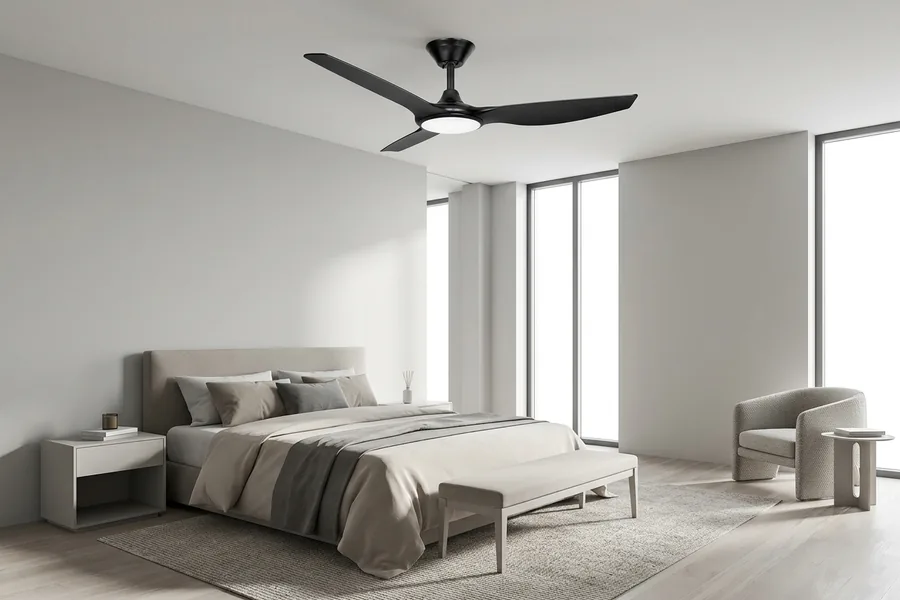
A 56 inch ceiling fan is the next step up. It is not huge, but it gives more reach. That makes it useful for large bedrooms, open primary suites, and bedrooms with higher ceilings.
A good 56 inch fan can move air across the room without needing to run at full speed. That can make the room feel calm and cool.
4-1. Ideal room size for a 56 inch ceiling fan
A 56 inch fan is a strong fit for bedrooms around 225-350 sq ft. It may also work in slightly smaller rooms if the room has high ceilings or a very open layout.
For example, a 16 x 18 ft bedroom is 288 sq ft. That is a clear case where a 56 inch fan often makes more sense than a 52 inch fan.
4-2. Why 56 inches works well in large bedrooms and primary suites
Large bedrooms need wider air movement. If the fan is too small, the air may move well near the centre but not reach the full room.
A 56 inch fan gives broader coverage. It can help with:
- Large king bedrooms
- Bedrooms with a sitting area
- Open primary suites
- Rooms with high or sloped ceilings
- Warm bedrooms with poor air movement
The big win is this: a 56 inch fan can often run slower while still moving enough air. That is good for sleep.
4-3. When a 56 inch fan may feel oversized or too windy
A 56 inch fan is not right for every bedroom.
If the room is only 12 x 12 ft, a 56 inch fan will likely feel too large. It may dominate the ceiling. It may make the room look smaller. It may also push too much air straight down onto the bed.
A 56 inch fan may feel wrong if:
- The room is under 200 sq ft
- The ceiling is low
- The bed is directly under the fan
- You are sensitive to air blowing on your face
- The fan has poor low-speed control
This is why low-speed settings matter. A big fan with poor control is not a good bedroom fan.
4-4. How to balance airflow, appearance, and comfort in a large bedroom
In a large bedroom, do not choose only by size. Look at the full balance.
A good large bedroom fan should:
- Cover the room without harsh wind
- Look in proportion with the bed and ceiling
- Run quietly on low and medium speed
- Include a remote or wall control
- Use a safe mount for the ceiling height
This is where a well-designed NEBOLA 56 inch ceiling fan can work well. It can sit in the large bedroom fan category without making the room feel too heavy.
5. Compare 52 Inch vs 56 Inch Ceiling Fans Side by Side
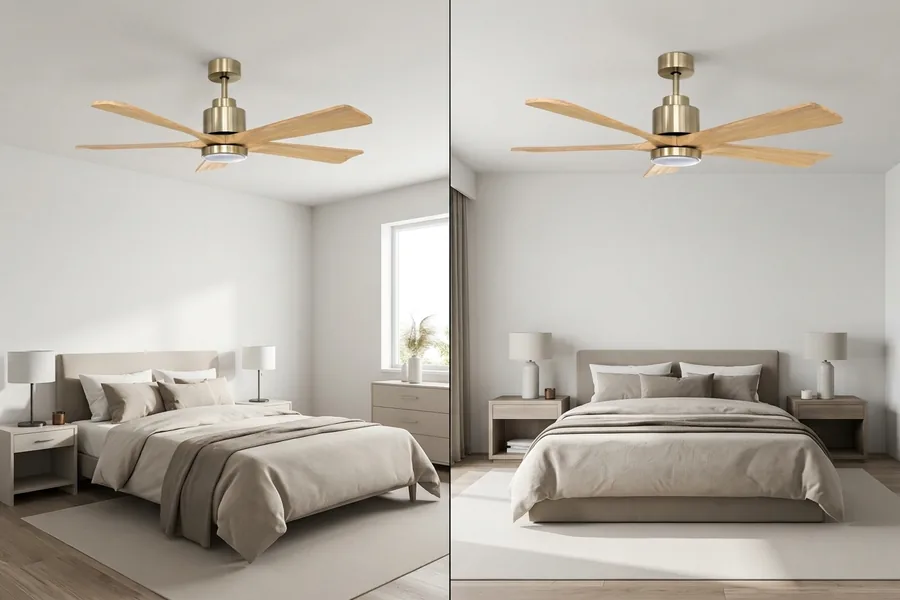
The difference between 52 inches and 56 inches may sound small. It is only 4 inches. But on the ceiling, those 4 inches can change the look and the airflow.
A 52 inch fan is balanced and safe for many master bedrooms. A 56 inch fan gives stronger coverage for larger bedrooms.
5-1. Airflow coverage: which size moves air better?
In most cases, the 56 inch fan has wider coverage. But size alone does not tell the full story. A strong 52 inch fan with good CFM can beat a weak 56 inch fan.
So compare these two things:
- Blade span
- CFM rating
If both fans have similar motor quality, the 56 inch fan usually covers a larger room better.
5-2. Comfort: which size feels better while sleeping?
For sleeping, comfort is not just airflow. It is airflow you can live with for 8 hours.
A 52 inch ceiling fan may feel better in a standard master bedroom because it gives a gentle breeze and does not overpower the bed.
A 56 inch ceiling fan may feel better in a large bedroom because it can run slowly and still move air across the space.
So the right question is not “Which is stronger?”
The right question is: Which one gives enough airflow at a quiet, low speed?
5-3. Visual proportion: which size looks right in a bedroom?
A fan should look like it belongs in the room.
A 52 inch fan often looks right above a queen or king bed in a normal master bedroom. A 56 inch fan looks better in a larger room where there is more ceiling space.
If the fan looks too wide for the ceiling, the room may feel crowded. If the fan looks too small, it may feel weak and out of scale.
5-4. Energy use and speed settings: why bigger does not always mean less efficient
A bigger fan does not always use more energy in real life. A 56 inch fan may move enough air on low speed, whilst a smaller fan may need medium or high speed to do the same job.
That is why motor type matters. A DC motor can often use less power and give more speed choices.
Look for:
- Multiple speed settings
- Quiet low-speed airflow
- Good CFM per watt
- Reliable remote or wall control
5-5. Final rule: choose 52 inches for balanced comfort, 56 inches for broader coverage
Here is the clean rule:
Choose a 52 inch ceiling fan for most master bedrooms. Choose a 56 inch ceiling fan for larger bedrooms that need wider airflow.
That one sentence solves most cases.
Ready to Find the Right Smart Ceiling Fan for Your Home?
Compare styles, sizes, smart features, and lighting options to find the perfect fan for your space.
Get a Quote6. Do Not Judge Bedroom Fans by Blade Span Alone
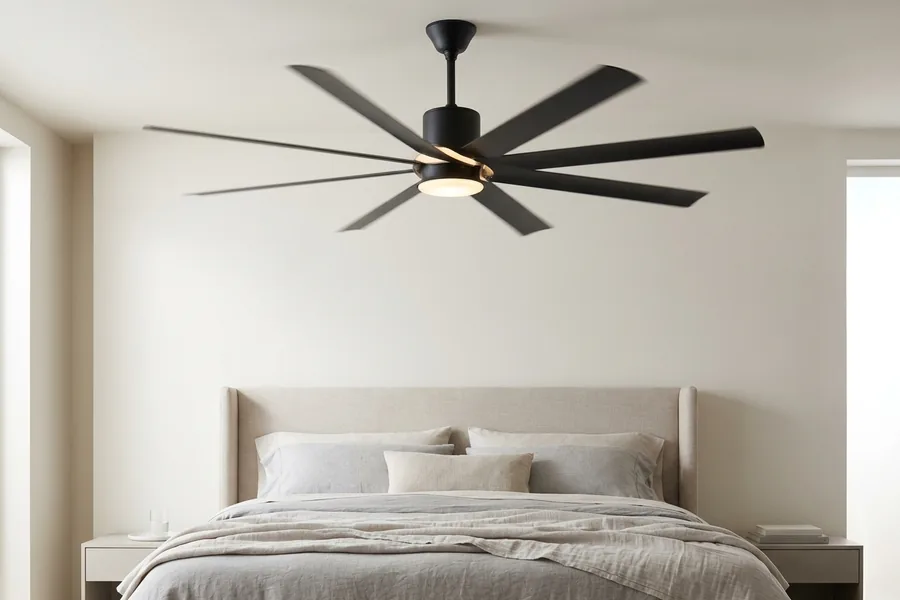
Blade span is important. But it is not the whole story. A fan is a system. The motor, blade shape, blade pitch, speed settings, and installation all affect how it feels.
This is where many buyers make a mistake. They see “52 inch” or “56 inch” and think the job is done. It is not.
6-1. Why CFM matters as much as fan diameter
CFM means cubic feet per minute. It tells you how much air the fan can move.
A fan with a larger blade span but poor CFM may not perform well. A smaller fan with better blade design and motor power may move air better.
For bedrooms, do not chase only the highest CFM. You need useful airflow, not a wind tunnel.
A good target is:
| Bedroom Use | What to Look For |
|---|---|
| Sleeping | Quiet low-speed airflow |
| Large bedroom cooling | Strong but smooth CFM |
| Year-round use | Reversible motor |
| Energy saving | Good CFM per watt |
6-2. Why low-speed airflow is more important in bedrooms than maximum power
Most people do not sleep with a ceiling fan on full speed. If they do, it is usually because the fan is too small or the room is very hot.
For a bedroom, the low setting is the real test.
Ask this before buying: Can this fan move enough air on low speed without noise?
If the answer is yes, it is a good bedroom fan.
6-3. Why blade count does not automatically mean better airflow
Some people think five blades must be better than three. Not always.
Blade count affects style and sometimes sound, but airflow depends more on:
- Motor quality
- Blade pitch
- Blade shape
- Fan speed
- Overall design
A well-designed three-blade fan can move more air than a poor five-blade fan.
6-4. How motor quality and blade design affect real comfort
A cheap motor may hum. Poor blade balance may create wobble. Bad blade design may create a choppy wind sound.
This matters more in bedrooms than in busy rooms. At night, small sounds feel bigger.
A good master bedroom ceiling fan should feel steady, not shaky. Quiet, not buzzy. Smooth, not harsh.
7. Ceiling Height Can Change the Right Fan Size

Ceiling height can change everything. The same fan can feel right in one room and wrong in another.
A fan must sit low enough to move air well, but high enough to be safe. That balance is very important.
7-1. Best fan setup for 8-foot bedroom ceilings
For an 8-foot ceiling, choose a low profile or flush mount fan. This keeps the blades closer to the ceiling and gives better head clearance.
For many 8-foot master bedrooms, a 52 inch low profile fan is a safer choice than a large downrod fan.
Low ceiling rule: keep the fan compact, stable, and close to the ceiling.
7-2. When to choose a flush mount or low profile ceiling fan
Choose flush mount or low profile if:
- The ceiling is around 8 ft
- The room feels low or compact
- The bed is tall
- You want a cleaner look
- You need more headroom
A low profile fan is not only for small rooms. It can also work in a master bedroom if the ceiling height is limited.
7-3. When a downrod is necessary for high or vaulted ceilings
For high ceilings, a fan mounted too close to the ceiling may not move air well where people actually feel it.
If your ceiling is 10 ft or higher, a downrod can bring the fan to a better height. This may matter more than choosing a bigger fan.
A 56 inch fan with the right downrod can perform better than a 60 inch fan mounted too high.
7-4. Why blade clearance matters for both comfort and safety
The fan blades need safe space around them. They should not sit too close to walls, wardrobes, or the floor.
As a practical rule, keep the fan:
- At a safe height above the floor
- Away from walls and tall furniture
- Centred enough to spread air evenly
- Securely fixed to a fan-rated box
Safety is not a detail. It is the foundation.
8. Bedroom Comfort Details Most Size Guides Miss
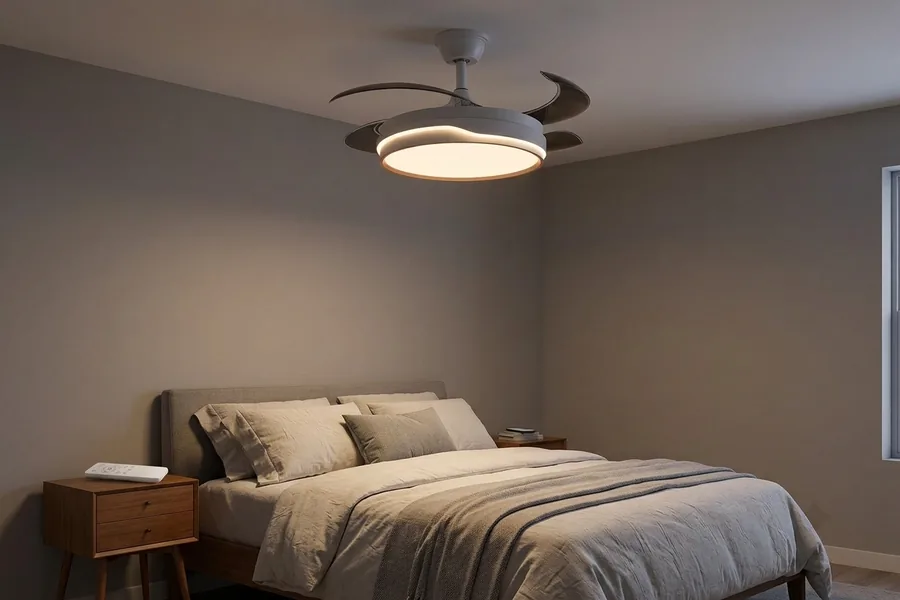
Many size guides stop at square footage. That is useful, but it is not enough. Real people care about how the fan feels at night.
This is where comfort details matter.
8-1. Noise: why humming, clicking, and buzzing matter more at night
A small hum in the shop may sound fine. In a quiet bedroom at midnight, it can feel huge.
Common noise problems include:
- Motor hum
- Clicking blades
- Buzzing controls
- Rattling light kits
- Wobble from poor balance
If you are a light sleeper, choose a fan with a quiet motor, good balance, and several low-speed settings.
8-2. Airflow feel: how to avoid direct wind over the bed
Strong airflow is not always comfortable. Some people wake up with dry eyes or a cold neck because the fan blows straight down on them.
To avoid this:
- Use low speed at night
- Choose a fan with smooth airflow
- Avoid oversizing in a small room
- Consider fan placement if possible
- Use reverse mode correctly by season
A bedroom fan should move the air, not punish the sleeper.
8-3. Lighting: why dimmable warm light is better for bedrooms
If the ceiling fan has a light, make sure it suits a bedroom.
Bright cool light may be useful when cleaning, but it can feel harsh before sleep. Warm dimmable light is better for a calm bedroom.
Look for:
- Dimmable LED light
- Warm colour temperature
- Memory function
- Separate fan and light control
8-4. Remote control: why bedroom fans should be easy to adjust from bed
A remote is not a luxury in a bedroom. It is practical.
Nobody wants to get out of bed to change fan speed. Nobody wants to pull a chain in the dark.
A good remote should control:
- Fan speed
- Light brightness
- Timer
- Reverse mode if supported
NEBOLA fans can be placed naturally here because this is where comfort meets daily use. A bedroom fan should be easy to control when you are already in bed.
8-5. Timer and reverse mode: small features that improve daily use
A timer helps if you like airflow while falling asleep but not all night.
Reverse mode helps in winter. It moves warm air down from the ceiling and can make the room feel more even.
Small features can make a fan feel much better over time.
9. AC vs DC Motor Ceiling Fans for Master Bedrooms
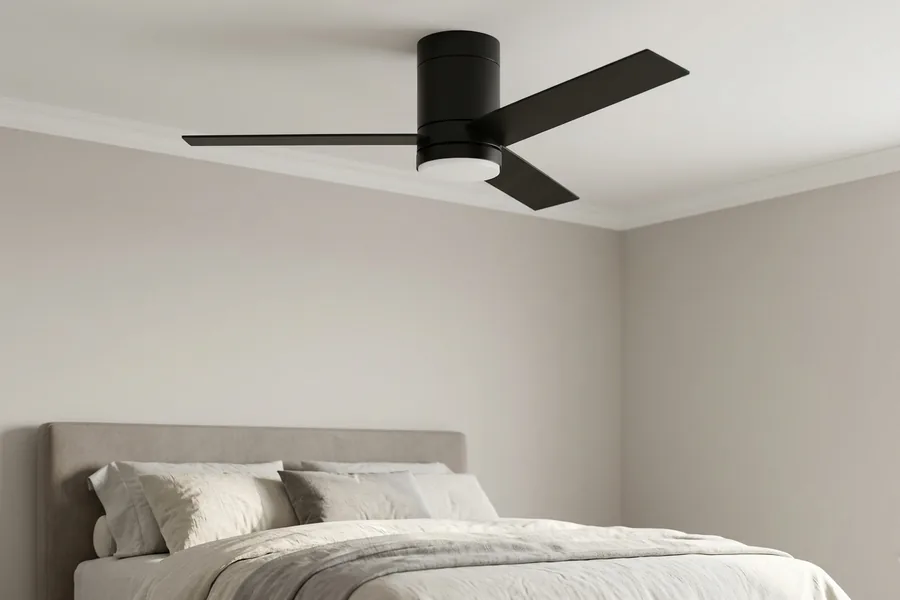
The motor is the heart of the fan. It affects sound, speed control, energy use, and comfort.
For bedrooms, DC motors are often a better choice. But that does not mean every DC fan is perfect.
9-1. Why DC motor fans are usually better for quiet bedrooms
DC motor fans usually offer:
- Quieter running
- More speed settings
- Lower energy use
- Smoother control
- Lighter motor design
This is very useful in a master bedroom, especially if you use the fan every night.
For light sleepers, a DC motor is often worth it.
9-2. Why a DC motor does not guarantee a silent fan
A DC motor can be quiet, but other things can still make noise.
For example:
- Loose screws can click
- Poor blade balance can wobble
- A bad receiver can buzz
- A light kit can rattle
- Wrong wall controls can cause humming
So do not buy only because the product says “DC motor”. Check reviews, installation quality, and control compatibility.
9-3. When an AC motor fan can still be a good choice
An AC motor fan can still work well if it is well made and properly installed. Many classic ceiling fans use AC motors and run for years.
Choose AC if:
- Budget is more important
- You do not need many speed settings
- Reviews confirm quiet use
- The fan is from a reliable brand
But for bedrooms, DC is usually the more comfortable choice.
9-4. What light sleepers should check before buying
If you are sensitive to noise, check:
- Noise reviews from real buyers
- Number of speed settings
- Motor type
- Remote and wall control compatibility
- Whether the fan has a light kit that can rattle
- Whether the brand offers support or warranty
A quiet fan is not one part. It is the whole build.
10. Installation and Safety Checks Before You Buy
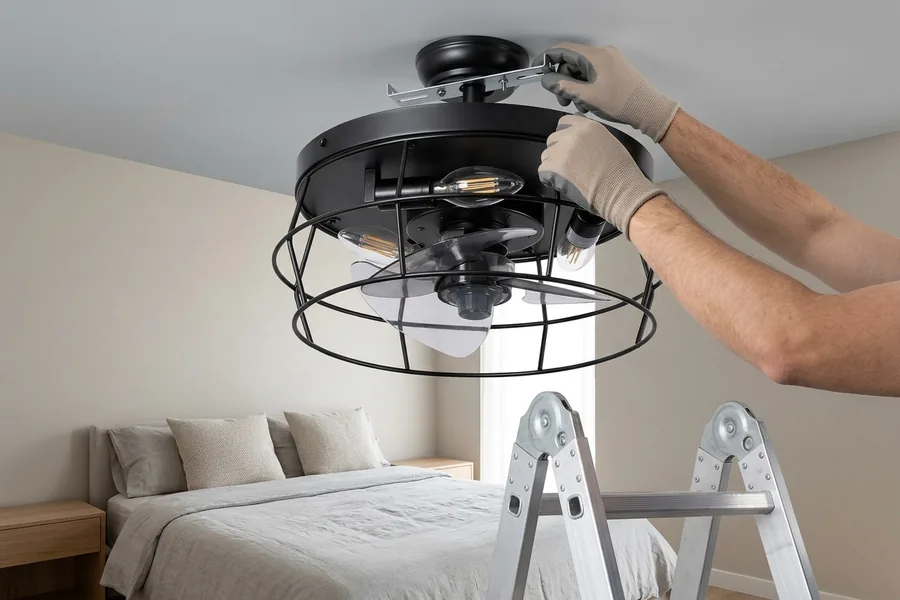
A ceiling fan hangs above your bed. That means installation matters. A lot.
Do not treat it like a normal light fitting. A ceiling fan moves, vibrates, and has weight. It needs proper support.
10-1. Why a ceiling fan needs a fan-rated electrical box
A standard light box may not be safe for a ceiling fan. You need a box rated for fan support.
This is not a small detail. It is a safety rule.
Never install a ceiling fan on a box that is not rated for ceiling fans.
If you are not sure, ask a qualified electrician.
10-2. Why larger fans are more sensitive to poor installation
A larger fan has a wider blade span. That means small balance problems can feel bigger.
A 56 inch fan that is poorly installed may wobble more than a smaller fan. This does not mean 56 inch fans are bad. It means installation must be right.
Check:
- Mounting bracket
- Downrod connection
- Blade screws
- Canopy position
- Ceiling box support
10-3. How wobble, loose screws, and unbalanced blades affect bedroom comfort
A wobbling fan is annoying. It can also be unsafe if the mount is not secure.
Common causes include:
- Uneven blade screws
- Dust on blades
- Bent blade arms
- Loose canopy
- Poor bracket installation
Most small wobble issues can be fixed with tightening and balancing. But if the ceiling box moves, stop using the fan and call a professional.
10-4. What to test after installation before using the fan overnight
After installation, test the fan before you sleep under it.
Run it on:
- Low speed
- Medium speed
- High speed
- Light on and off
- Remote or wall control
- Timer if available
Listen for clicking. Watch for wobble. Check the light. Better to fix issues now than wake up annoyed later.
11. Choose the Right Fan Size for Your Bedroom Scenario
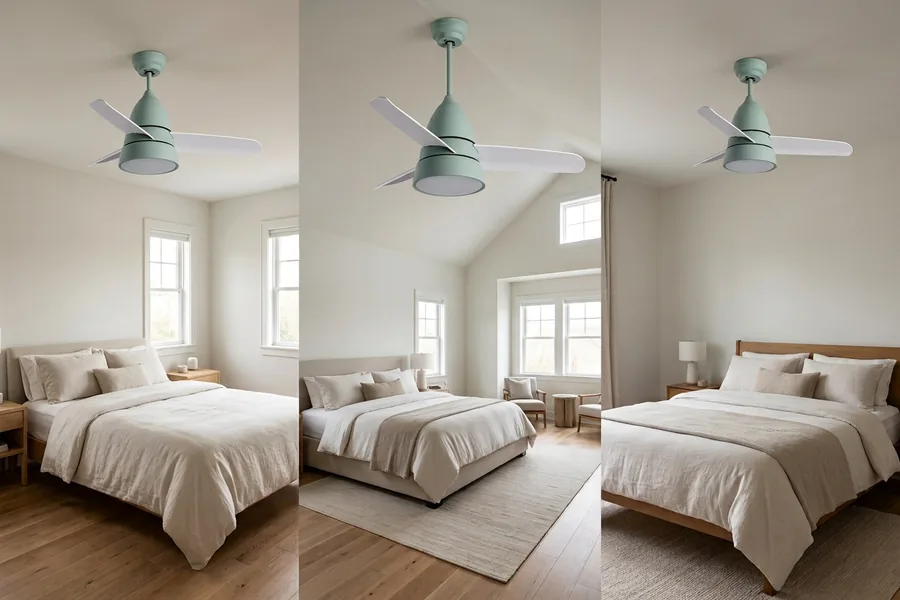
Now let us make the decision simple. Match your room to the closest scenario.
11-1. Standard master bedroom: choose a 52 inch ceiling fan
If your bedroom is around 175-225 sq ft, has a standard ceiling, and the bed is near the centre, choose a 52 inch ceiling fan.
This is the best all-round size for many master bedrooms.
11-2. Large bedroom: choose a 56 inch ceiling fan
If your bedroom is over 225 sq ft, or has extra open space, choose a 56 inch ceiling fan.
This is better for broader airflow and more even comfort.
11-3. Low-ceiling bedroom: prioritise mount type before sizing up
If your ceiling is low, do not rush to a bigger fan. Choose the right mount first.
A low profile 52 inch fan may be better than a 56 inch downrod fan in a low room.
11-4. High-ceiling bedroom: use the right downrod before choosing a larger fan
If your ceiling is high, airflow may stay too high above the bed. A downrod brings the fan to a better position.
In high rooms, a 56 inch fan with the right downrod can be a very strong choice.
11-5. Long or irregular bedroom: consider airflow zones instead of one oversized fan
If your room is long, L-shaped, or has a sitting area, one fan may not cover everything well.
In that case, two smaller fans may work better than one huge fan.
Example:
A couple had an 18 x 20 ft primary bedroom with a small reading area near the windows. They first wanted one large fan. But the bed and reading area were too far apart. A better plan was to use one main fan above the bed zone and improve airflow near the sitting zone. The room felt more even, not just windy in one spot.
That is smart planning.
12. Final Buying Checklist for a Master Bedroom Ceiling Fan

Before you buy, use this checklist. It is simple, but it covers the details that matter.
12-1. Confirm the bedroom square footage
Measure the room. Do not guess.
Length x width = square footage.
Then match the result to 52 inch, 56 inch, or larger options.
12-2. Compare 52 inch and 56 inch options by CFM
If you are choosing between two fans, compare airflow.
A strong 52 inch fan may beat a weak 56 inch fan. CFM matters.
12-3. Check low-speed noise and motor type
For a bedroom, low-speed comfort is the key test.
Look for quiet reviews, DC motor options, and smooth speed control.
12-4. Choose dimmable lighting and bedroom-friendly colour temperature
If the fan has a light, choose warm and dimmable.
A bedroom light should help the room feel calm.
12-5. Make sure remote, wall control, or smart control fits your habits
If you like simple control, choose remote. If you prefer fixed wall control, check compatibility before buying.
The best system is the one you will use every day.
12-6. Confirm mount type, ceiling height, and installation requirements
Low ceiling? Choose flush mount or low profile.
High ceiling? Choose a downrod.
Sloped ceiling? Check if the fan supports angled mounting.
12-7. Review warranty, return policy, and installation instructions before purchase
Do not skip the boring details. They matter if something goes wrong.
Check:
- Warranty length
- Return policy
- Manual quality
- Included downrods
- Remote receiver details
- Customer support
A ceiling fan should last for years. Buy like it matters.
Conclusion: The Best Ceiling Fan Size for Master Bedrooms and Large Bedrooms
For most master bedrooms, a 52 inch ceiling fan is the best starting point. It is balanced, easy to fit, and comfortable for sleep.
For a large bedroom, a 56 inch ceiling fan often gives better coverage. It moves air across a wider space and can work well at lower speeds.
But size is only the first step. The best large bedroom fan also needs quiet operation, good CFM, the right mount, useful lighting, and simple control.
Here is the final rule:
Choose 52 inches for most master bedrooms. Choose 56 inches for larger bedrooms. Choose bigger or use two fans only when the room truly needs it.
If you want a fan that feels right every night, do not just ask, “How big is it?” Ask, “Will it make this bedroom more comfortable?”
That is the real answer. And that is where a well-chosen NEBOLA master bedroom ceiling fan can do its job: quiet air, soft light, easy control, and a bedroom that simply feels better.
Ready to Find the Right Smart Ceiling Fan for Your Home?
Compare styles, sizes, smart features, and lighting options to find the perfect fan for your space.
Get a Quote