

A good living room ceiling fan should feel almost invisible in daily life. You should not have to think about it. You sit down, the room feels fresh, the air moves softly, and the fan looks like it belongs there. That is the point of this ceiling fan size guide: not to make the choice complex, but to make it clear.
The best ceiling fan for a living room depends on three simple things: room size, ceiling height, and airflow. Get these right, and the fan will feel calm, balanced, and useful. Get one of them wrong, and even a beautiful fan can feel too weak, too loud, or too close.
Contents
1. Why Living Room Ceiling Fan Size Needs More Than a Simple Chart
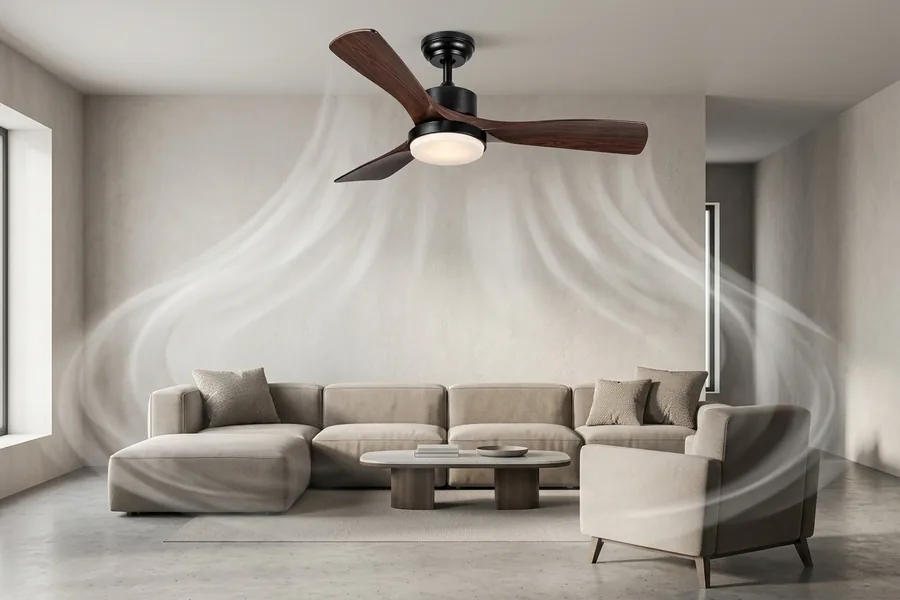
A size chart is a good start. But a living room is not just a number on a floor plan. It is where people talk, watch films, read, rest, and gather. Airflow has to reach people where they actually sit, not just move air somewhere near the ceiling.
1-1. Living rooms have wider airflow needs than bedrooms
A bedroom ceiling fan often has one clear comfort zone: the bed. A living room usually has more than one. There may be a sofa, armchairs, a media wall, and perhaps an open path to a dining area. This means the fan must cover a wider area without making one seat feel windy and another seat feel still.
For many living rooms, a 52 inch ceiling fan is the first useful size to consider. It gives broader coverage than a small fan, while still feeling natural in a standard room. In a larger living room, a 56 inch or 60 inch fan may be a better match.
1-2. Seating layout affects how airflow feels
The fan should support the way the room is used. If the sofa sits directly below the fan, strong downward airflow can feel too sharp. If the seating is spread across the room, a small fan may not reach the edges.
Think of airflow as comfort, not force. The goal is not to create a storm. The goal is to keep the air moving gently across the room, so people feel cooler without noticing the fan too much.
1-3. Ceiling height can change the right fan size
Ceiling height changes how a fan performs. A fan too close to the ceiling may move less air. A fan too low can feel unsafe or visually heavy. This is why the same 52 inch fan can feel right in one living room and wrong in another.
In a low living room, a flush mount fan may be the safest choice. In a high ceiling room, a downrod helps bring the fan to a better working height. Size and height should always be chosen together.
2. Measure the Living Room Before Choosing Fan Size
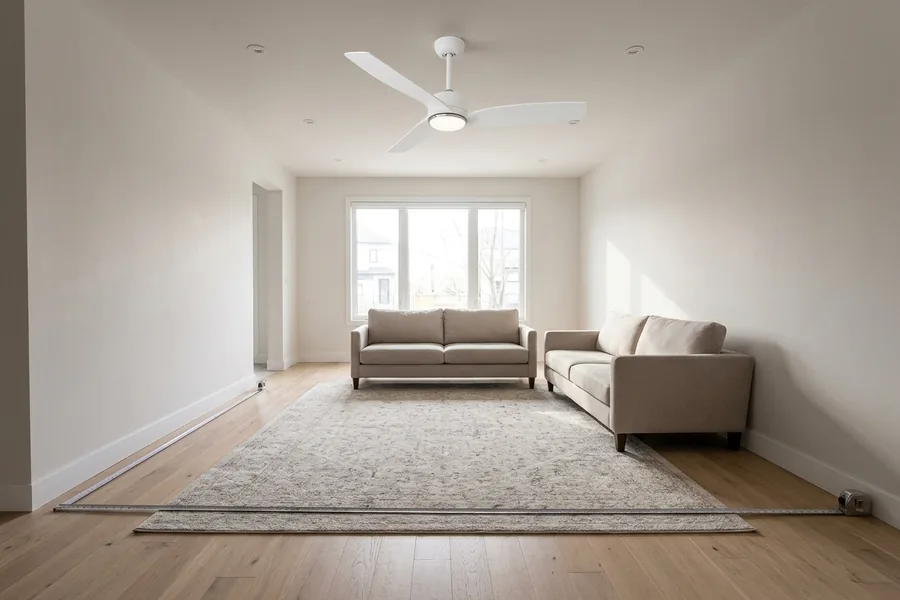
Before choosing a fan, measure the space. It sounds simple, but it prevents most mistakes. A living room fan should be chosen for the room you have, not for the room shown in a product photo.
2-1. How to calculate room square footage
Measure the length and width of the living room, then multiply them.
| Room measurement | Calculation | Room area |
|---|---|---|
| 10 ft x 12 ft | 10 x 12 | 120 sq ft |
| 12 ft x 16 ft | 12 x 16 | 192 sq ft |
| 15 ft x 20 ft | 15 x 20 | 300 sq ft |
| 20 ft x 24 ft | 20 x 24 | 480 sq ft |
This area gives you the first size range. After that, you adjust for ceiling height, room shape, and where people sit.
2-2. Why room shape matters as much as total area
Two rooms can have the same area but feel very different. A square 16 x 16 ft room is easier to cover than a long narrow room with the same square footage. In a long room, one fan may leave air still at each end.
If the living room is narrow, choose a fan that fits the width safely. If the room is wide and open, choose a fan with a wider blade span or consider two fans.
2-3. How open-plan living rooms should be measured
Open-plan spaces need careful thinking. Do not always measure the whole open area as one room. Instead, look at the airflow zones.
For example, if the living area and dining area share one open space, one large fan in the centre may not serve both areas well. Two smaller fans, each placed over a key zone, can sometimes feel better than one oversized fan.
3. Living Room Ceiling Fan Size by Room Area
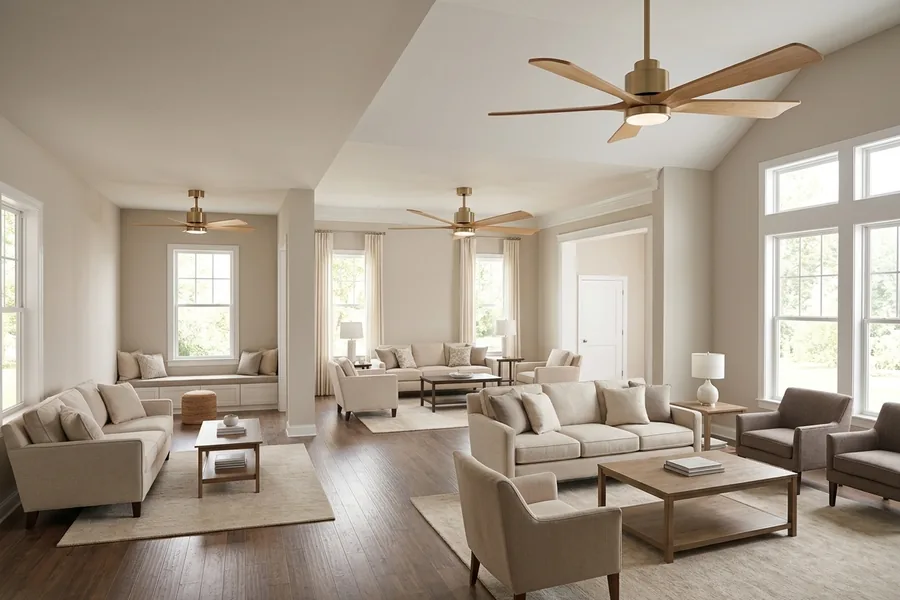
The table below is a practical starting point. It does not replace judgement, but it gives a clear base.
| Living room area | Suggested fan size | Best use case |
|---|---|---|
| Under 150 sq ft | 42-48 inch | Compact living rooms or flats |
| 150-250 sq ft | 52 inch | Most standard living rooms |
| 250-400 sq ft | 56-60 inch | Larger family living rooms |
| Over 400 sq ft | 60 inch+ or two fans | Open-plan or extra-large rooms |
3-1. Small living rooms under 150 sq ft
For a small living room, a 42 inch to 48 inch ceiling fan is often enough. A 52 inch fan can still work if the room is open and the ceiling height is comfortable, but it may look large in a tight space.
The key is balance. A small room does not need aggressive airflow. It needs steady movement that keeps the space fresh.
3-2. Medium living rooms from 150 to 250 sq ft
This is where a 52 inch ceiling fan often makes sense. It gives enough blade span for normal sofa layouts and can usually run at a lower speed, which helps reduce noise.
For many homes, 52 inch is the safe middle choice: not too small, not too strong, and easy to match with standard ceiling heights.
3-3. Large living rooms from 250 to 400 sq ft
Large living rooms need wider coverage. A 56 inch or 60 inch fan is often a better fit than a 52 inch fan, especially if the seating area is broad.
The fan should be able to move air across the main living zone without needing to run at full speed all the time. A larger fan at a calm speed often feels better than a smaller fan working hard.
3-4. Extra-large living rooms over 400 sq ft
For rooms over 400 sq ft, a 60 inch or larger ceiling fan may be needed. In some open spaces, two fans may be better than one very large fan.
The question is not simply, “What is the biggest fan I can buy?” The better question is, “Where do people need to feel airflow?” That question leads to a better answer.
4. Choosing Between 52 Inch, 56 Inch, 60 Inch, and Larger Fans
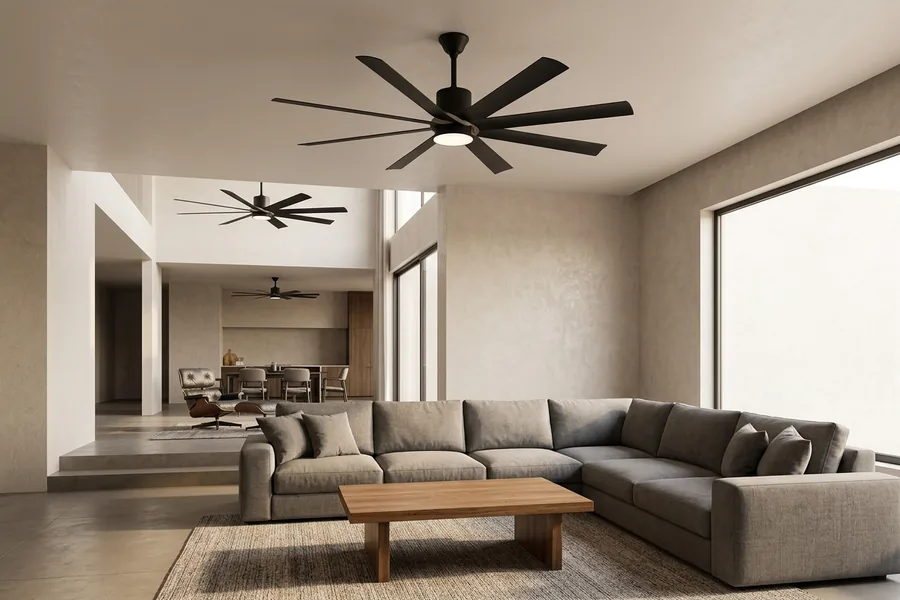
The most common living room fan sizes sit between 52 inch and 60 inch. These sizes work because they cover real living spaces without looking strange in most homes.
4-1. When a 52 inch ceiling fan works well
A 52 inch fan works well in many standard living rooms from about 150 to 250 sq ft. It is also useful when the room has a regular ceiling and the seating area is fairly central.
Choose 52 inch when you want a safe, balanced size for daily comfort. It is often the best starting point for a normal family living room.
4-2. When 56 inch gives better airflow coverage
A 56 inch fan gives a little more reach without feeling as large as a 60 inch model. This can be useful for rooms that feel slightly too large for 52 inch but not large enough for a very wide fan.
It is a strong choice for living rooms with wider seating, higher ceilings, or a more open layout.
4-3. When 60 inch or larger is the better choice
A 60 inch ceiling fan is better for large rooms, open-plan spaces, and rooms where the fan must cover a broad seating area. It can move more air at a lower speed, which often feels smoother.
For extra-large living rooms, 65 inch, 72 inch, or even larger fans may be useful, but only when the room has enough ceiling height and open space.
4-4. Why oversized fans can feel uncomfortable
Bigger is not always better. An oversized fan can make a room feel windy, heavy, or out of balance. It may also sit too close to walls, beams, or tall furniture.
A fan should match the room like a good piece of design: useful, calm, and in proportion. If it calls too much attention to itself for the wrong reason, it is probably not the right size.
5. How Ceiling Height Changes the Best Fan Size

Ceiling height decides how the fan should be mounted. It also affects how well the fan moves air where people sit.
5-1. Low ceilings and flush mount living room fans
For low ceilings, a flush mount ceiling fan is usually the safest option. It sits close to the ceiling and keeps the blades higher above the floor.
This matters because living rooms are active spaces. People stand, walk, stretch, and move around. A low fan can feel unsafe even if it technically fits.
5-2. Standard ceilings and regular downrod fans
For standard 8 to 9 ft ceilings, many ceiling fans work with a short downrod or standard mounting system. The goal is to keep the blades high enough for safety but low enough to move air well.
If the fan sits too close to the ceiling, airflow can become weaker. If it hangs too low, the room may feel crowded.
5-3. High ceilings and longer downrods
High ceilings often need a longer downrod. Without it, the fan may spin high above the living space while people below feel little benefit.
In a high ceiling living room, the fan should be brought down to a useful working height. This helps airflow reach the seating area and makes the fan look more connected to the room.
5-4. Vaulted ceilings and angled mounting
Vaulted ceilings need special care. The fan may require an angled mounting kit and a suitable downrod. The blades must have enough clearance from the ceiling slope.
For this type of room, do not guess. Check the fan’s mounting limits, ceiling angle, downrod length, and clearance before buying.
Ready to Find the Right Smart Ceiling Fan for Your Home?
Compare styles, sizes, smart features, and lighting options to find the perfect fan for your space.
Get a Quote6. Blade Height and Clearance Rules for Living Rooms
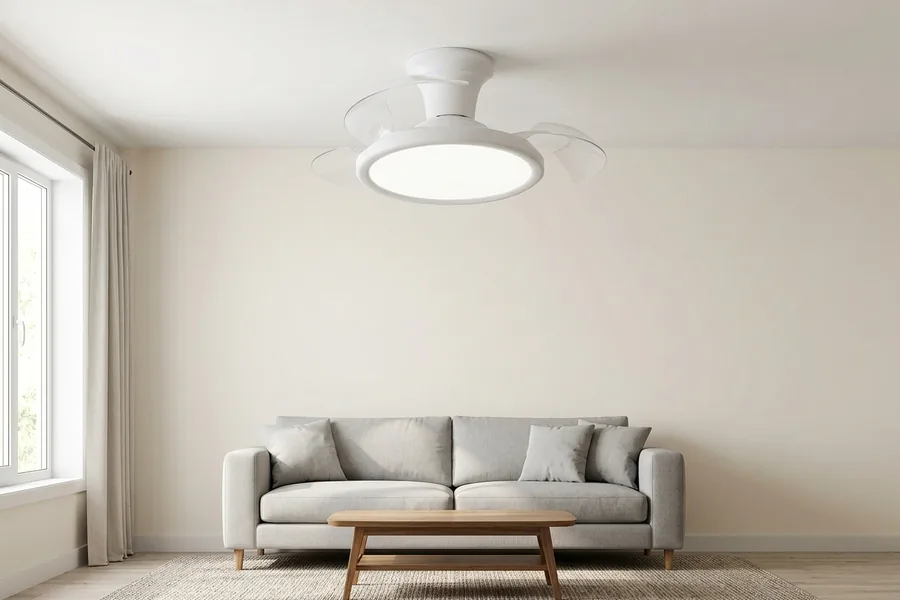
Fan size is not only about diameter. It is also about where the blades sit in the room.
6-1. Recommended blade height above the floor
A common rule is to keep fan blades at least 7 ft above the floor. Many rooms feel best when the blades sit around 8 to 9 ft above the floor.
This height gives a good mix of safety and airflow. It keeps the fan out of the way while still allowing air to reach people.
6-2. Clearance from walls, beams, and tall furniture
The fan should have clear space around the blades. Keep it away from walls, beams, tall cabinets, and high shelving. If the blades are too close to obstacles, airflow becomes uneven and noise may increase.
Clearance also helps the fan look right. A wide fan squeezed into a tight ceiling area rarely feels calm.
6-3. Why fan position affects airflow coverage
The best position is often near the centre of the main living zone. In a simple square living room, that may be the centre of the room. In an open-plan space, it may be the centre of the seating area.
Do not place the fan only where it is easiest to install. Place it where the air needs to move.
6-4. Safety checks before installation
Before installation, check the ceiling box, mounting hardware, blade clearance, and ceiling height. The electrical box must be fan-rated. A light fixture box is not always strong enough for a moving fan.
Good installation is part of good performance. A well-sized fan can still wobble or feel unsafe if the support is poor.
7. Airflow Guide: CFM, Blade Span, and Speed Settings
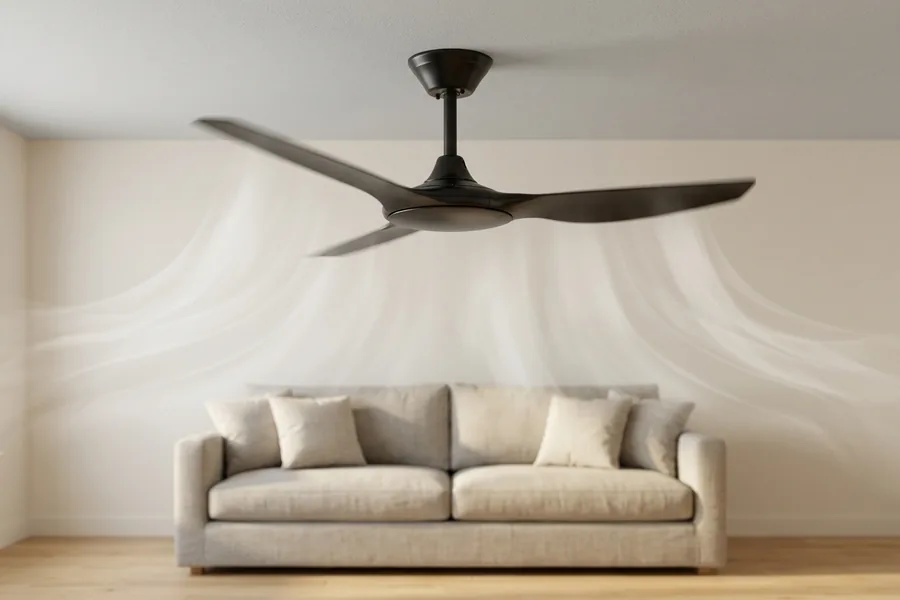
Airflow is where size becomes comfort. A fan is not just a circle on the ceiling. It is a machine designed to move air in a way people can live with.
7-1. What CFM means for a living room ceiling fan
CFM means cubic feet per minute. It tells you how much air the fan can move. A higher CFM can be useful in a large room, but it is not the only number that matters.
For a deeper technical reference, the U.S. Department of Energy explains how ceiling fan efficiency is measured and regulated across fan types.
For a living room, look for airflow that is strong enough for the space but still smooth at lower speeds. That is what people feel in real life.
7-2. Why blade span affects airflow coverage
Blade span affects how wide the airflow can reach. A small fan may have high speed, but it may still fail to cover a wide room.
This is why large rooms often need wider fans. The wider blade span helps spread air across the space instead of pushing it only straight down.
7-3. Why low-speed airflow matters for comfort
Most people do not run a living room fan on high all day. They use low or medium speed while watching TV, talking, or resting. So low-speed comfort matters.
A good fan should feel useful even at a gentle setting. If it only works when it is loud, it is not the right fan for a living room.
7-4. How motor quality affects noise and airflow stability
Motor quality affects noise, speed control, and wobble. A good motor keeps airflow steady. A poor motor can make the fan hum, shake, or feel uneven.
For living rooms, quiet operation matters because the room is social. You should hear the conversation, not the fan.
8. Large Living Rooms and Open-Plan Spaces
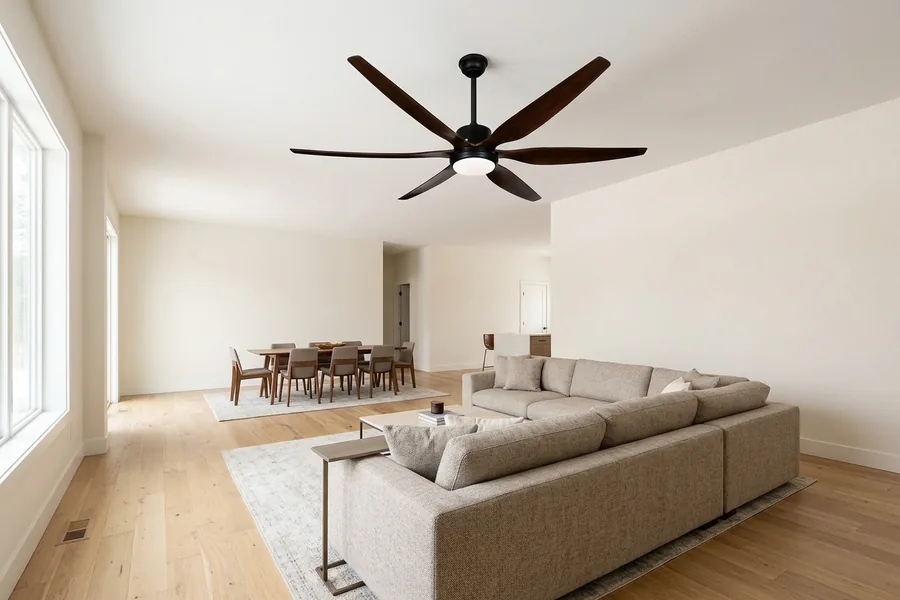
Large rooms need a different way of thinking. The aim is not simply to fill the ceiling with the biggest fan. The aim is to give each useful part of the room enough air.
8-1. When one large room fan is enough
One large fan can work well when the room is open, square, and the seating area is central. A 60 inch or larger fan can cover a broad area if the ceiling height and clearances are right.
This approach works best when the room has one main comfort zone.
8-2. When two smaller fans work better
Two smaller fans can work better in a long room, an L-shaped room, or an open-plan space with separate zones. One fan can serve the seating area while another supports the dining or reading area.
This can feel more natural than one oversized fan trying to do everything.
8-3. How to divide airflow zones in open layouts
Look at where people spend time. Mark the sofa zone, dining zone, and any open walkway. Then decide whether one fan can reach those areas evenly.
If one zone feels far from the fan, it may need its own airflow plan.
8-4. Fan sizing for living and dining combined spaces
In a combined living and dining room, avoid placing one fan halfway between both zones if it serves neither well. It may be better to place one fan over the living zone and use another solution for the dining zone.
Airflow should follow the way people use the room. That is the simple rule.
9. Common Sizing Mistakes in Living Rooms
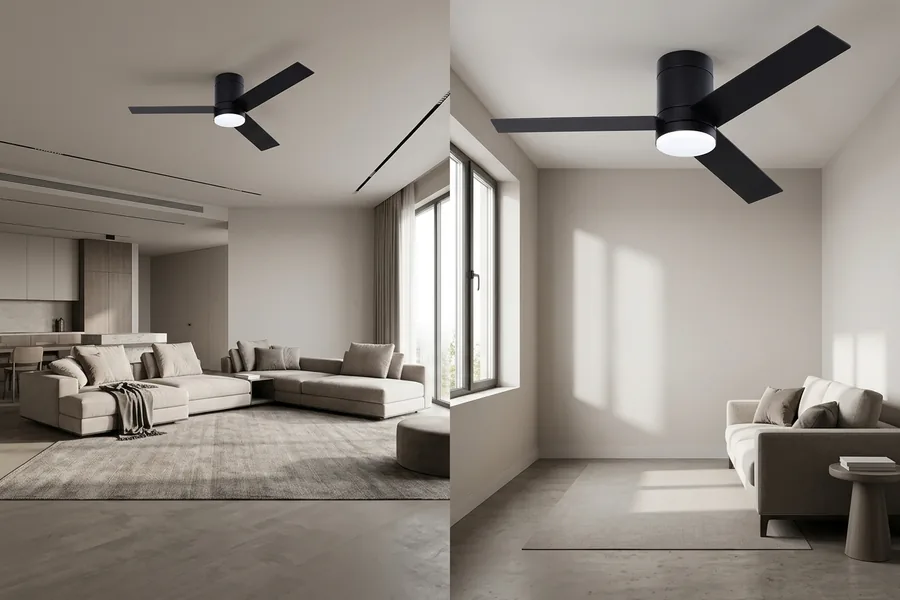
Most fan problems are not caused by one bad choice. They come from choosing by one factor and ignoring the rest.
9-1. Choosing only by fan diameter
Diameter matters, but it does not tell the whole story. A 60 inch fan with poor airflow may perform worse than a better 56 inch fan. Always look at size, CFM, motor quality, and speed range together.
9-2. Ignoring ceiling height
A fan that fits the room area may still be wrong for the ceiling height. Low ceilings need safe clearance. High ceilings need proper downrod length.
This is one of the most common mistakes because people choose the fan before checking where it will sit.
9-3. Using a small fan in a wide room
A small fan in a wide living room often creates a small comfort zone. The air moves near the fan, but people at the edges feel little difference.
If the room is wide, choose a wider blade span or think about more than one fan.
9-4. Choosing a large fan without checking clearance
A large fan needs breathing room. If it sits too close to walls or beams, airflow can become uneven. It may also look crowded.
Before choosing a large fan, check the blade sweep area and make sure the room can carry the size.
9-5. Forgetting noise and low-speed comfort
A fan can look right and still feel wrong if it is noisy. Living rooms need quiet airflow because people use them for rest and conversation.
Choose a fan that performs well at low and medium speed. That is where daily comfort lives.
10. Living Room Ceiling Fan Size Checklist Before Buying
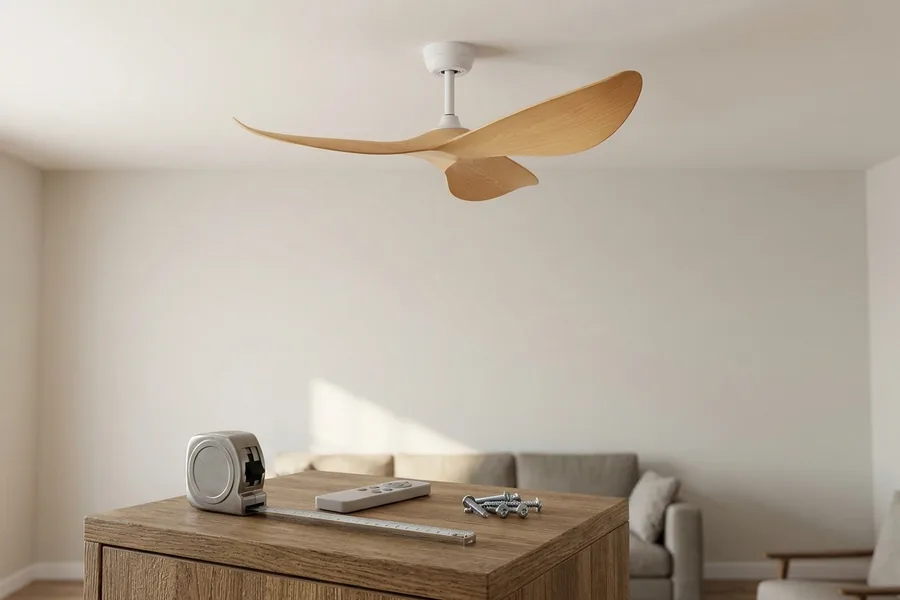
Before you buy, slow down and check the essentials. A few minutes here can save a poor choice later.
10-1. Room area and room shape
Measure the room and note the shape. A square room, long room, and open-plan room each need a slightly different airflow plan.
10-2. Ceiling height and mounting type
Check whether the room needs a flush mount fan, a standard mount, a longer downrod, or an angled mount. The mounting type can decide whether the fan works well.
10-3. Fan diameter and blade span
Match blade span to the living room area. For many standard living rooms, start around 52 inch. For larger rooms, consider 56 inch, 60 inch, or more.
10-4. CFM and speed range
Look for enough airflow, but also check speed control. A living room fan should move air gently at low speed and strongly when needed.
10-5. Clearance and installation position
Check floor clearance, wall clearance, and position over the main living zone. The fan should serve the people in the room, not just fill ceiling space.
10-6. Noise level and motor type
Choose a quiet, stable motor. A calm living room needs steady airflow, not hum, wobble, or harsh wind.
The right living room fan is not the biggest one on the page. It is the one that fits the room with care. Measure the space, respect the ceiling height, choose airflow that feels natural, and the fan will do what good design should do: make life feel simpler.
Ready to Find the Right Smart Ceiling Fan for Your Home?
Compare styles, sizes, smart features, and lighting options to find the perfect fan for your space.
Get a Quote