

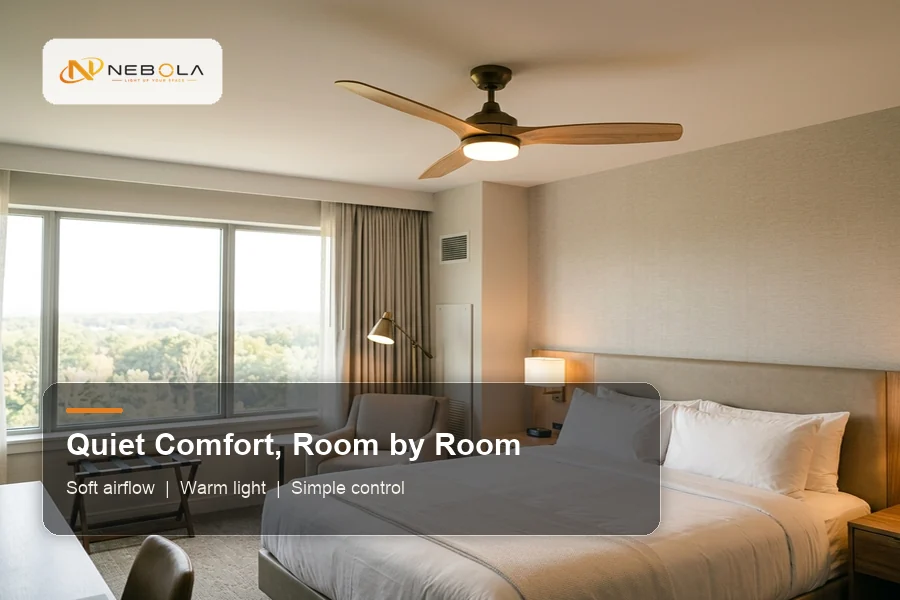
A hotel ceiling fan is judged quietly. Guests may not notice a good fan when it works well, but they will notice a fan that hums at night, wobbles above the bed, gives harsh light or feels difficult to control.
A resort ceiling fan has to solve the same comfort problem across more demanding spaces: guest rooms, suites, villas, covered balconies, lounges, restaurants and humid coastal areas. The fan must look calm, run quietly and stay practical for housekeeping and maintenance teams.
This guide explains how to choose hotel and resort ceiling fans by room size, airflow zone, night noise, mounting type, lighting, controls, outdoor suitability, energy use and bulk procurement. For wider project sourcing, compare models inside the commercial ceiling fans category instead of choosing by appearance alone.
1. What Should Hotel and Resort Ceiling Fans Solve for Guests?
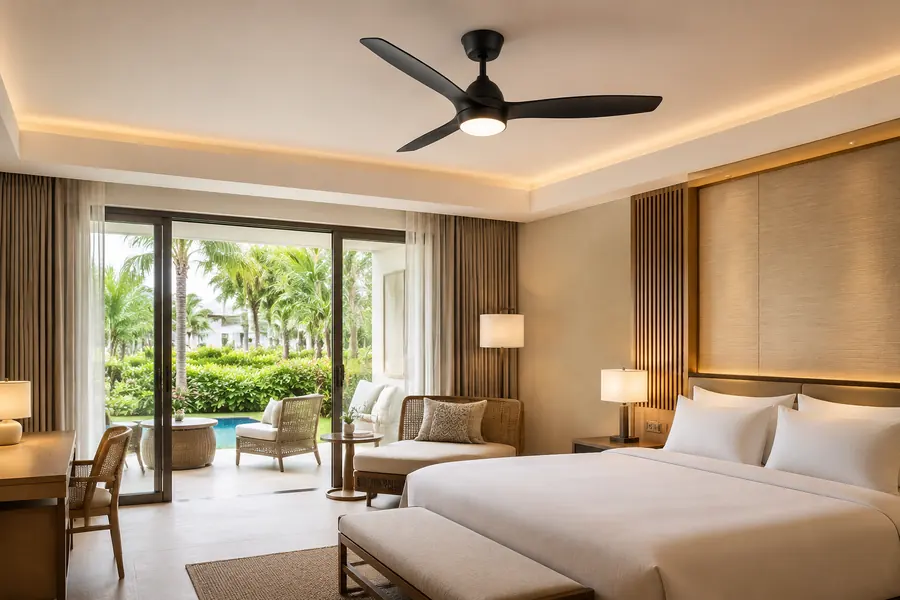
The first job is not to make the room look decorative. The first job is guest comfort. A hotel fan should help the room feel fresh, calm and easy to control without creating distractions. In a hospitality room, small problems become very visible because guests are sleeping, reading, working or relaxing in a quiet space.
1-1. Why should a hotel fan feel quiet rather than powerful?
A powerful fan can look impressive in a showroom, but hotel guests usually use fans at low or medium speed. They want soft movement of air, not strong wind across the face or bed. A fan that only feels useful at high speed is often the wrong fan for hospitality because high speed can add noise, visual movement and discomfort.
The better goal is a wide speed range with a stable low-speed setting. Guests should be able to leave the fan running while sleeping without thinking about it. The fan should support comfort in the background, like good bedding or good blackout curtains.
1-2. How does personal control affect guest satisfaction?
Guests have different comfort preferences. One guest may want more air movement after a shower, while another may turn the fan down before sleeping. A fan gives personal comfort control without asking the HVAC system to solve every small preference.
The control method should be obvious. A simple remote, clear wall control, useful timer and memory function can improve the room experience. Over-complex app-only control can create support calls if the guest cannot find the correct setting quickly.
1-3. What makes hospitality fan selection different from home use?
A home buyer may choose one fan for one room. A hotel buyer may repeat one model across dozens or hundreds of rooms. That changes the decision. Noise, packaging, spare remotes, LED parts, installation consistency and cleaning access become just as important as style.
2. How Should You Size Fans for Guest Rooms Suites and Villas?
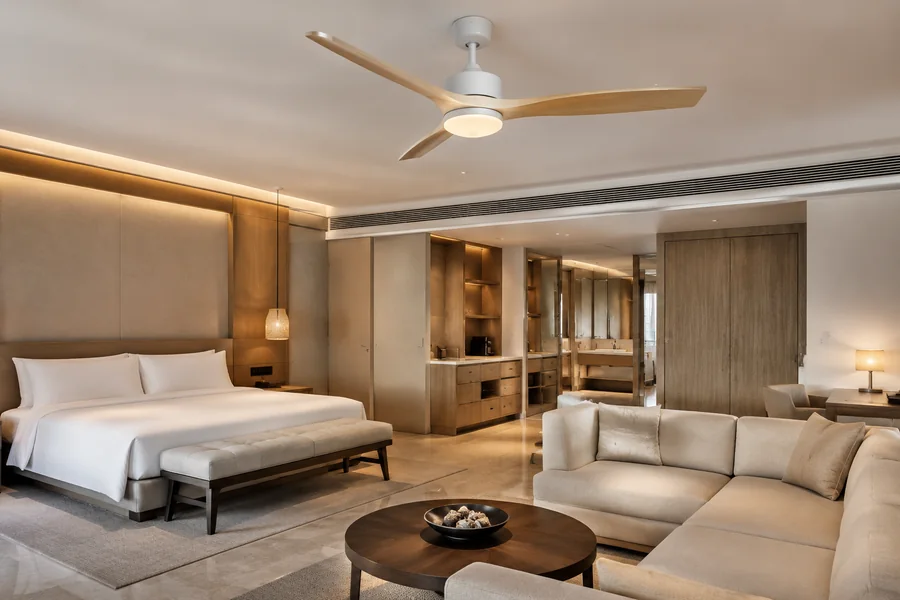
Fan size should follow the active room zone, not only the total room name. A standard guest room, suite bedroom and resort villa living area may all be called hotel rooms, but they need different airflow planning.
| Hospitality space | Typical direction | What to check |
|---|---|---|
| Standard guest room | 42 to 52 inch fan | Soft airflow over the sleeping and desk zone without direct wind |
| Large suite bedroom | 52 to 60 inch fan | Coverage across bed, seating area and circulation path |
| Villa living room | 60 inch+ or several fans | Open-plan scale, ceiling height and separate comfort zones |
| Covered balcony | Damp or wet suitable fan | Humidity, finish durability and corrosion resistance |
2-1. Should the fan size follow square footage only?
Square footage is a starting point, but it is not enough. A long narrow guest room may need a different fan position than a square room of the same size. A room with a sofa area, desk and balcony door may need airflow across more than one zone.
Measure the space where guests actually stay. In many rooms, that means the bed, desk and small sitting area. The fan should serve those zones without being visually too large for the ceiling.
2-2. Why can oversized fans be a problem in guest rooms?
Oversized fans can dominate the ceiling and make the room feel lower. They may also push too much air directly over the bed. A fan that is technically larger may still create a worse guest experience if low-speed airflow is not soft enough.
For most standard hotel rooms, proportion matters. The fan should look integrated with the room, not like a commercial fan forced into a bedroom. Blade span, blade colour, motor housing size and light kit thickness should all be considered together.
2-3. When do resorts need larger or multiple fans?
Resorts often use larger suites, villas and open living areas. In these spaces, one compact fan may leave still air in corners. A larger fan can work if the ceiling is high enough and the motor is quiet. Several fans can work better when the room is long or divided into separate seating and sleeping zones.
3. Where Should Airflow Be Directed in Sleeping Seating and Balcony Areas?
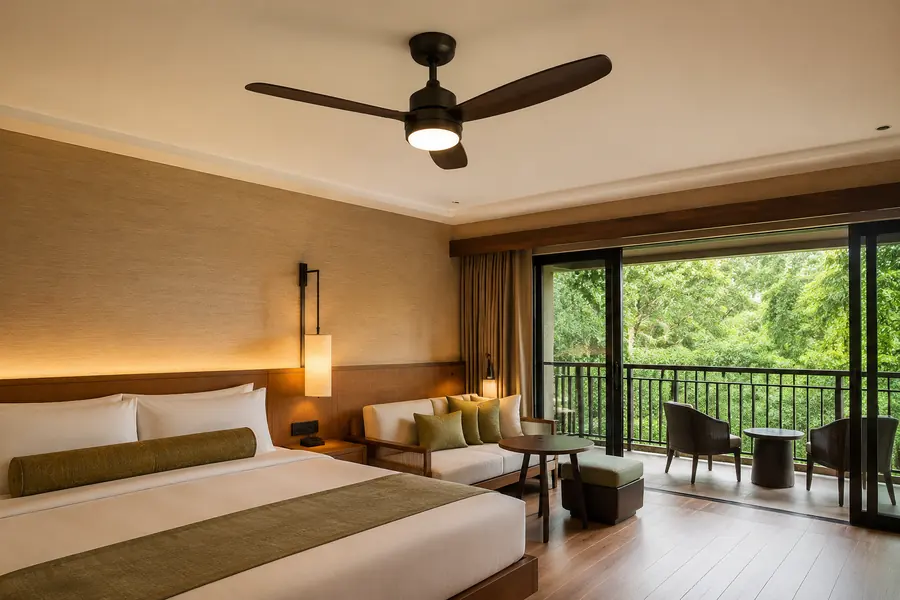
Airflow placement is a major difference between a comfortable hotel fan and a fan that guests turn off. The fan should move air through the occupied zone, but it should not create a cold draft directly on the face, food, paperwork or bedside area.
3-1. Should the fan be centered over the bed?
Centering over the bed can look balanced, but it is not always the best comfort choice. If the fan is too low or too strong, guests may feel direct wind while sleeping. In many rooms, a slightly broader airflow path across the sleeping and sitting zone feels better than a strong column of air over the pillow.
During sample testing, stand at the doorway, sit at the desk and lie on the bed. Check whether the airflow feels calm in all three positions. This practical test often reveals problems that a floor plan cannot show.
3-2. How should suites and open-plan villas be zoned?
Suites and villas often combine sleeping, seating, dining and balcony access. One fan should not be expected to solve every corner if the layout is large or irregular. Divide the room into comfort zones and decide which zones need airflow most often.
A living area may use a larger fan, while the bedroom area may need a quieter and softer fan. If the ceiling has beams or sloped sections, the airflow zone should also respect structural limits and safe clearance.
3-3. What changes for balconies and semi-outdoor areas?
Covered balconies and semi-outdoor resort spaces need air movement that feels natural, not aggressive. The fan should help reduce stale air and heat buildup, but it should not push napkins, menus or curtains around. Outdoor suitability and finish durability matter more in these spaces than in indoor guest rooms.
4. How Quiet Should Hotel Ceiling Fans Be at Night?
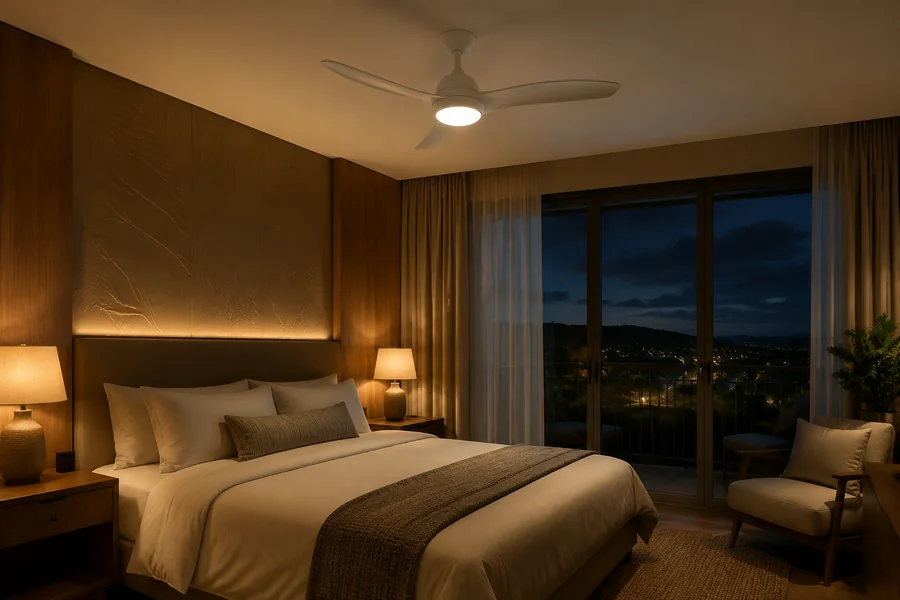
Night noise is one of the most important hospitality tests. A fan that sounds acceptable in the afternoon can become annoying at 2 a.m. when the room is quiet. Hotels should test noise before bulk ordering, not after guests start complaining.
4-1. What types of fan noise should hotels test?
- Motor hum at low and medium speed.
- Clicking from light covers, blade holders or trim rings.
- Buzzing from LED drivers, receivers or dimmers.
- Remote control beep volume and response delay.
- Wobble, blade vibration or visual shaking after several hours of use.
Do not test only the highest speed. Most guests will use the lower speeds, so low-speed motor sound matters most. Also test with the light on, the light dimmed and the fan reversing if reverse function is offered.
4-2. How should a sample room noise test be done?
Install the sample in a real guest-room ceiling condition. Run it for several hours, then check the sound when the room is quiet. Listen from the bed, desk and bathroom doorway. A fan can sound different depending on where the guest is standing.
The test should include warm-up time. Some motors, drivers or receivers change sound after running. If the fan becomes louder after one hour, that is a risk for night comfort.
4-3. Why do light kits and controls affect noise?
Sometimes the fan motor is quiet, but the light kit or receiver creates buzzing. LED drivers, dimmers and loose covers can all add noise. Hotels should test the whole fan-light-control system, not only the motor specification.
5. What Mounting and Ceiling Height Details Matter?
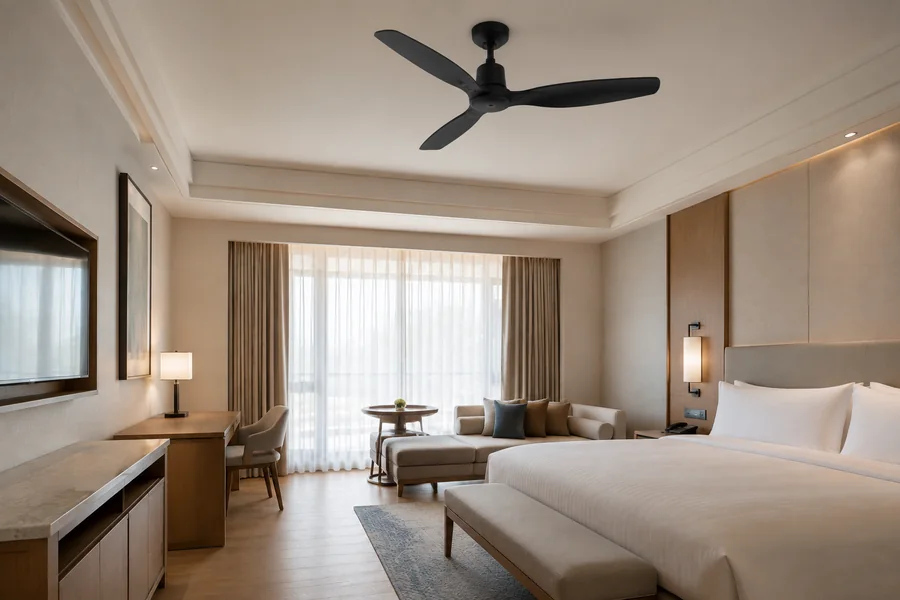
Mounting affects safety, airflow and appearance. A fan with the right blade span can still perform poorly if it is mounted too high, too low or too close to a beam. Hotel rooms also need a clean ceiling appearance, so mounting type should be planned early.
5-1. When are flush mount fans useful?
Flush mount or low-profile fans are useful in lower guest rooms because they protect head clearance and keep the ceiling clean. They can also reduce the visual drop of the fixture. The trade-off is that some flush mount designs may move less air because the blades sit close to the ceiling.
If using flush mount fans, check low-speed airflow carefully. The fan should not rely on high speed to feel useful, because high speed can be too noisy for sleeping.
5-2. When should hotels use downrods?
Downrods are useful in suites, villas, lobbies and high-ceiling resort rooms. They bring the fan closer to the occupied zone so airflow can reach people. A downrod also helps the fan look proportionate in tall rooms.
The downrod length must still protect clearance. Consider bed height, walking paths, furniture, balcony doors and cleaning tools. In public areas, also check clearance around beams, lights, sprinklers and decorative ceilings.
5-3. What should be checked on sloped or special ceilings?
Vaulted ceilings, exposed beams and decorative ceiling panels need special planning. The canopy must support the angle, the blade path must be clear and the mounting point must carry the load. These details should be checked before the purchase order, not during installation.
Need Help Choosing Hotel and Resort Ceiling Fans?
Share your space size, ceiling height, use case and lighting needs. We can help match the right commercial fan for your project.
Get a Quote6. Should Hotel Fans Include Lights and Simple Controls?
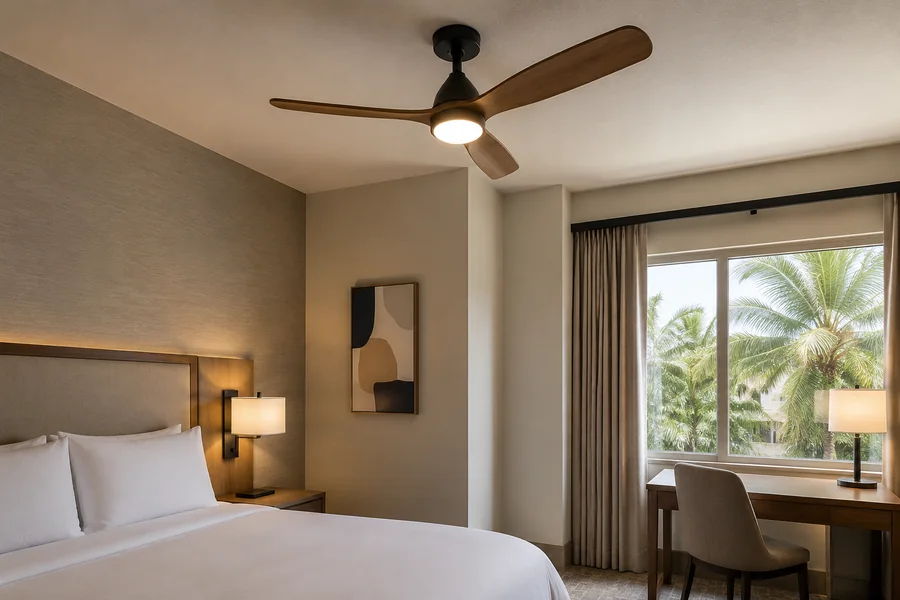
Fan lights can simplify a hotel room ceiling, but they must support the room lighting plan. A fan light that creates glare, wrong colour temperature or uneven dimming can hurt the guest experience even if the fan motor is good.
6-1. What light quality matters in hotel rooms?
Warm colour, soft diffusion, stable dimming and low glare are important. The light should make the room feel restful, not like a utility space. For layout decisions, compare a ceiling fan light vs ceiling light approach before replacing all ceiling lights with fan lights.
Check the fan light together with bedside lamps, desk lamps and bathroom lighting. The fan light may be used for general room light, but it should not be the only comfortable light source for every activity.
6-2. Integrated LED or replaceable LED for hotels?
Integrated LED can look cleaner and reduce visible parts. Replaceable LED can simplify service in large projects. The better choice depends on ceiling height, spare parts, warranty, installation access and how long the hotel wants to standardise the model. This integrated LED ceiling fan guide explains the trade-off in more detail.
For high-volume hotel projects, ask how the LED driver, light board, lens and remote receiver can be replaced. A beautiful fan becomes expensive if one small light part cannot be serviced.
6-3. What control setup is easiest for guests?
The best control is simple enough for a tired guest to understand immediately. Useful controls include clear speed steps, light on/off, dimming, timer, memory and reverse where needed. If smart controls are used, they should support the hotel system instead of replacing basic guest control.
7. How Should Resorts Choose Fans for Humid Coastal and Semi-Outdoor Spaces?
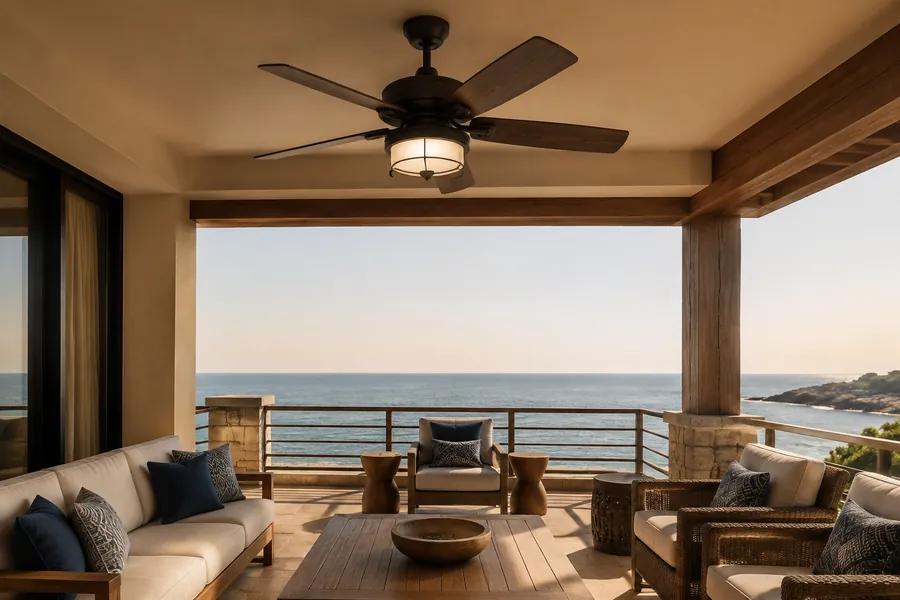
Resort environments can be tougher than normal hotel rooms. Humidity, salt air, heat, dust and semi-outdoor airflow can age a fan quickly. A normal indoor fan may look good when installed but show corrosion, warped blades or finish changes after a season.
7-1. What materials and ratings should resorts check?
- Damp or wet suitability for covered outdoor areas.
- Corrosion-resistant screws, canopy and motor housing.
- Blade materials that resist warping in humidity.
- Finishes that stay stable under moisture and heat.
- Light covers and seals that can be cleaned without damage.
If the fan is used near a coast, corrosion resistance becomes more important. Ask the supplier where the fan can be installed and where it should not be installed. Covered outdoor does not always mean safe for every outdoor condition.
7-2. Should balconies use the same fan as guest rooms?
Usually no. Guest rooms can prioritise quiet sleep comfort, interior style and soft lighting. Balconies and covered terraces need tougher finishes, moisture-ready construction and stable mounting under changing air conditions.
Using one indoor model everywhere may simplify purchasing, but it can create maintenance risk. It is often better to standardise two or three approved models by zone: guest room, public indoor space and covered outdoor space.
7-3. How should resort restaurants and lounges be handled?
Resort restaurants need gentle airflow that does not disturb plates, menus or conversation. Lounges need quiet, even comfort across seating zones. For restaurant-specific airflow and noise planning, use the restaurant ceiling fan guide as a companion reference.
8. How Can Fans Support HVAC Comfort and Energy Efficiency?
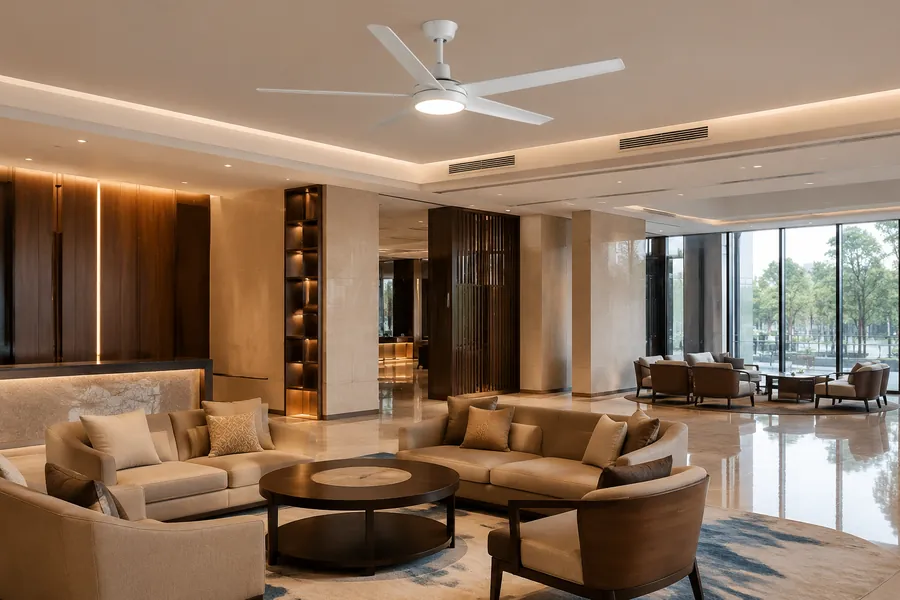
Ceiling fans do not replace HVAC, but they can support comfort by improving perceived air movement. In warm climates, guests often appreciate air movement because it makes the room feel fresher and less stagnant.
8-1. Why does air movement change comfort?
Thermal comfort depends on temperature, humidity, activity, clothing and air speed. ASHRAE’s thermal comfort standard is a useful external reference because it shows why air movement can change how warm or cool a person feels.
For hotels, this matters because guests may want slightly different comfort settings. A fan gives guests a small personal comfort adjustment without asking the central HVAC system to respond to every preference.
8-2. What motor type works for long daily use?
DC or BLDC motors often provide smoother low-speed control and lower running cost than basic AC motors. They can be useful in hotels because fans may run for many hours across many rooms. However, motor quality, receiver quality and supplier support are still important.
Do not choose only by wattage. A low-watt fan that moves too little air may disappoint guests. The best choice balances useful low-speed airflow, quiet operation, reliable controls and serviceable parts.
8-3. How should hotels operate fans with HVAC?
Set expectations clearly. Fans cool people through air movement; they do not lower room temperature by themselves. In guest rooms, the fan should support the HVAC setting and make the room feel comfortable faster. In lobbies or lounges, fans can help reduce stagnant warm layers when planned with air-conditioning outlets.
9. What Maintenance and Spare Parts Details Protect Hotel Operations?
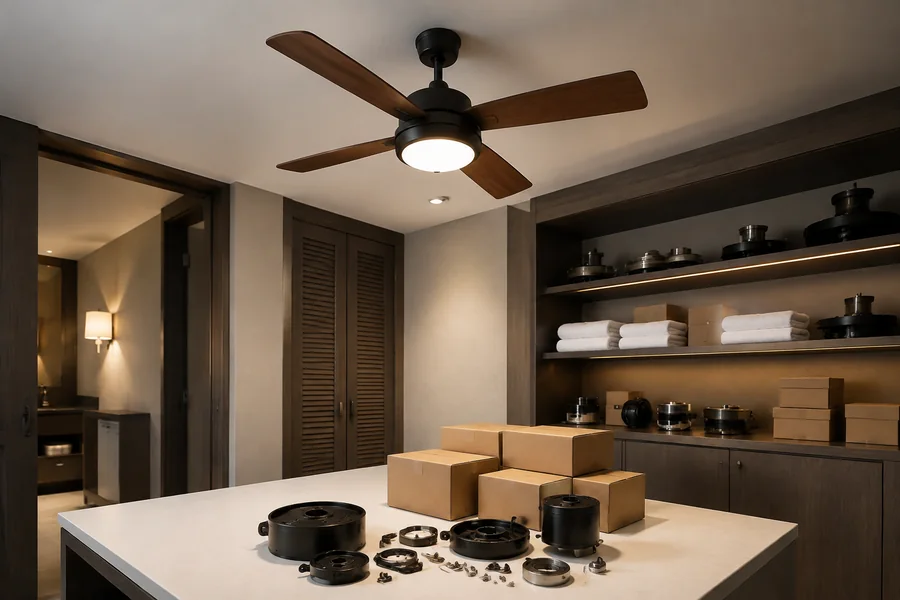
Maintenance is where hotel fan decisions become real. A fan may look beautiful in a sample room, but if cleaning is slow, parts are hard to get or remotes are easily lost, the model becomes expensive across many rooms.
9-1. What should housekeeping check before approval?
- Blade surfaces that wipe clean without special tools.
- Light covers that can be removed and replaced without cracking.
- No dust-catching decorative details in hard-to-reach areas.
- Stable finish that does not show fingerprints too easily.
- Safe access for cleaning around the motor housing and blades.
Housekeeping teams should be included in sample approval. They will see cleaning problems before procurement does. A fan that saves five minutes per room can matter across hundreds of rooms and repeated cleaning cycles.
9-2. What spare parts should be planned?
Hotels should ask for spare remotes, receivers, LED drivers, light covers, downrods, screws and installation parts. The exact list depends on the model, but the principle is simple: the parts most likely to fail or be lost should be available quickly.
Spare parts protect revenue. If one fan fails and parts take weeks, a room may be unavailable or guests may experience a poor room condition. This is more costly than planning spares at the beginning.
9-3. How should maintenance records be organised?
Keep model numbers, installation locations, control types and spare part codes organised by room or zone. This helps maintenance teams replace parts quickly and helps procurement reorder the correct model later.
10. What Should Procurement Teams Confirm Before Bulk Ordering?
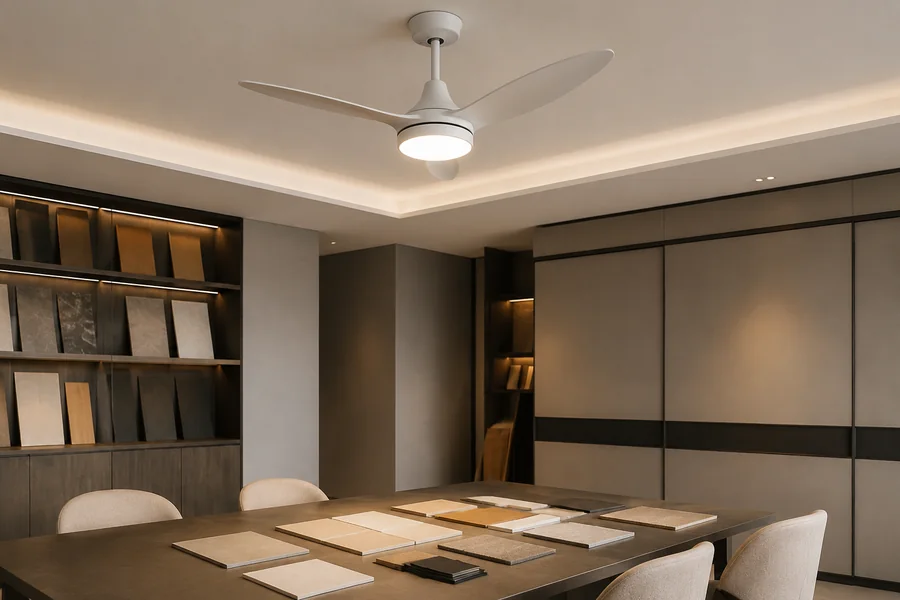
Procurement should not confirm a hotel fan order from a product photo alone. A hospitality fan order needs sample testing, installation checks, service planning and supplier confirmation. Small weaknesses repeat across many rooms.
10-1. What should the sample approval process include?
Install the fan in a real or realistic sample room. Test low-speed noise at night, light comfort, remote response, wobble, cleaning access and installation time. Check the fan from the bed, desk, doorway and bathroom entrance. A fan that looks good from one angle may feel wrong from another.
For resorts, test the hardest spaces too: humid balconies, high-ceiling villas, lobbies, lounges and rooms with unusual ceiling angles. Do not assume one standard guest-room test covers every installation condition.
10-2. What should be in the hotel buying checklist?
- Room-by-room size and mounting plan.
- Noise test at guest-room speeds.
- Light colour, dimming and glare test.
- Remote, wall control and replacement receiver plan.
- Outdoor suitability where needed.
- Packaging strength for project delivery.
- Warranty, spare parts and after-sales support.
For wider commercial sourcing, use a commercial ceiling fan buying guide before confirming the order. The right hotel fan should feel calm to the guest, repeatable for the installer and manageable for the operations team.
10-3. How should hotels avoid supply risk?
Ask whether the supplier can keep the model, finish, remote system and LED parts consistent across repeat orders. Hotels often renovate in phases, so a discontinued finish or changed receiver can create mismatch problems later. For project buyers, continuity matters as much as the first delivery.
Need Help Choosing Hotel and Resort Ceiling Fans?
Share your space size, ceiling height, use case and lighting needs. We can help match the right commercial fan for your project.
Get a QuoteFAQ About Ceiling Fans for Hotels and Resorts