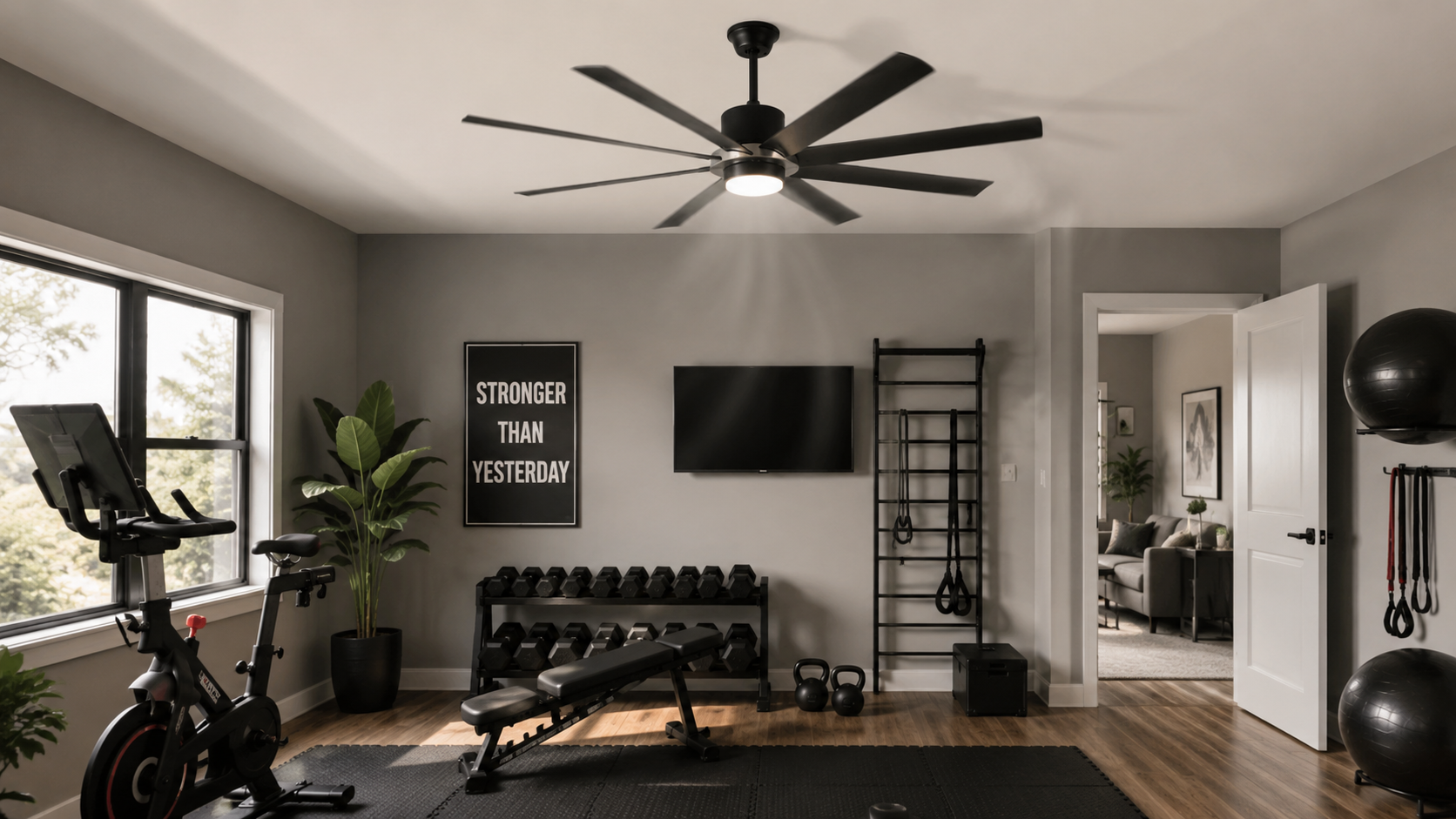



Can a low-ceiling bedroom use a ceiling fan? Usually yes at 8 feet or higher, but 7 feet and 7.5 feet need much more caution. For an 8-foot ceiling, choose a flush mount or ultra-thin fan and keep the total fan drop preferably within 12 inches. For 7 feet or below, a traditional ceiling fan is usually not suitable; a wall fan or another air circulation device is often safer.
Use this simple formula before buying: ceiling height − fan drop height = blade-to-floor clearance. The fan drop height means the full installed depth from ceiling to the lowest blade position, including canopy, motor body, blade position and light kit if included.
This guide gives clear answers by ceiling height first, then explains flush mount, low profile and hugger fan differences, CFM airflow, safety checks and alternatives when a ceiling fan is not the right choice.
| Ceiling Height | Can You Install a Ceiling Fan? | Best Choice |
|---|---|---|
| 7 ft and below | Usually not suitable for a traditional ceiling fan. | Use a wall fan, tower fan, air circulator or another non-ceiling airflow solution. |
| 7.5 ft | Most ceiling fans still struggle to meet comfortable safety clearance. | Check local code and only consider an extremely shallow approved model if clearance works. |
| 8 ft | Usually possible with the right close-to-ceiling design. | Choose flush mount; keep total drop preferably within 12 inches. |
| 9 ft | More flexible. | Low profile, flush mount or short-downrod fans may work depending on room size. |
Contents
- Can You Use a Ceiling Fan in a Low-Ceiling Bedroom?
- What Counts as a Low-Ceiling Bedroom?
- Flush Mount vs Low Profile vs Hugger Ceiling Fans
- How to Choose the Right Fan Size for a Low-Ceiling Bedroom
- Do Flush Mount Ceiling Fans Move Enough Air?
- Bedroom Comfort Factors to Consider Before Buying
- Safety and Installation Checks for Low-Ceiling Bedrooms
- Common Mistakes When Buying a Low Profile Ceiling Fan
- Final Buying Checklist for a Low-Ceiling Bedroom Ceiling Fan
1: Can You Use a Ceiling Fan in a Low-Ceiling Bedroom?

Short answer: most 8-foot bedrooms can use a ceiling fan if the fan is a flush mount or low-profile model and the total installed drop is controlled. Bedrooms around 7 to 7.5 feet are much harder because the blades may not leave enough safe clearance. Always calculate the installed result before choosing the fan.
Clearance formula:
Ceiling height − fan drop height = blade-to-floor clearance
Example: an 8 ft ceiling minus a 10 inch fan drop leaves about 7 ft 2 in under the blades. If the same ceiling uses a 16 inch deep fan, the remaining clearance is much tighter.
1-1: Yes, If You Choose the Right Fan Type
The best fan for a low ceiling is usually one made to sit close to the ceiling.
This is where a flush mount ceiling fan or low profile ceiling fan comes in. These fans are designed for rooms where height is limited. They do not hang far down, so they save space.
If your bedroom ceiling is low, do not start with style first. Start with height. Then look at airflow, noise, light, and controls.
1-2: Why Standard Downrod Ceiling Fans Usually Do Not Work
A standard downrod fan hangs from a rod. That rod lowers the fan away from the ceiling.
In a room with a high ceiling, this is fine. In a low-ceiling bedroom, it is often a problem. The blades may sit too close to your head. The fan may also make the room feel lower than it already is.
That is not what you want in a bedroom. You want comfort. You want space. You want the fan to feel like it belongs there.
1-3: When a Flush Mount Ceiling Fan Is the Better Choice
A flush mount ceiling fan is often the better choice when the ceiling is low and flat.
It sits tight to the ceiling, with no long downrod. This helps keep the blades higher and gives the room a cleaner look.
It is a smart choice for small bedrooms, guest rooms, children’s rooms, and flats where ceiling height is limited.
2: What Counts as a Low-Ceiling Bedroom?
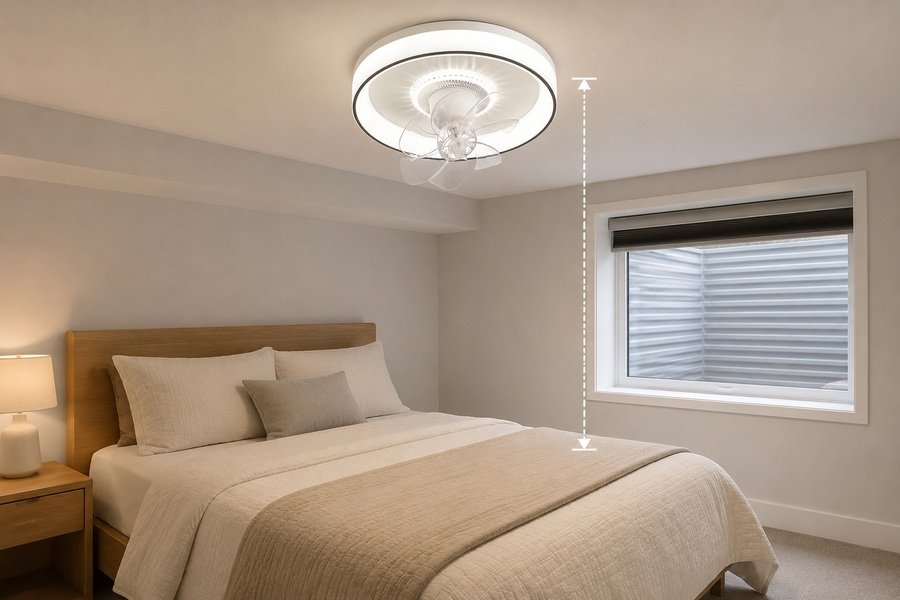
A low-ceiling bedroom is usually a room where there is not much vertical space between the floor and ceiling.
It may still feel cosy and lovely. But when you add a ceiling fan, every inch matters. A fan takes up space, so you need to plan before buying.
2-1: Common Ceiling Heights in Low-Ceiling Bedrooms
Many standard ceilings are around 8 feet high. A room may feel low if the ceiling is around 7 to 8 feet.
Some older homes, loft rooms, basement rooms, and flats may have lower ceilings. Sloped ceilings can also make a bedroom feel lower in some areas.
If your ceiling feels close above your head, treat it as a low-ceiling room when shopping for a fan.
2-2: The 7-Foot Blade Clearance Rule
A common safety rule is that fan blades should be at least 7 feet above the floor.
This is important. Very important. If the blades are too low, the fan can feel unsafe and uncomfortable.
Before buying, check the fan’s installed height. Do not only look at the product photo. Photos can be misleading. Look for the actual distance from the ceiling to the bottom of the fan or blade.
2-3: How to Measure Installed Fan Height Before Buying
First, measure your ceiling height from the floor to the ceiling.
Then check the fan’s drop height. This is how far the fan hangs down once installed.
Subtract the fan drop from your ceiling height. That tells you how much clearance you will have under the fan.
For example, if your ceiling is 8 feet high and the fan drops 10 inches, the blades should still be around 7 feet 2 inches above the floor. That may work. If the fan drops too far, choose a lower profile model.
3: Flush Mount vs Low Profile vs Hugger Ceiling Fans
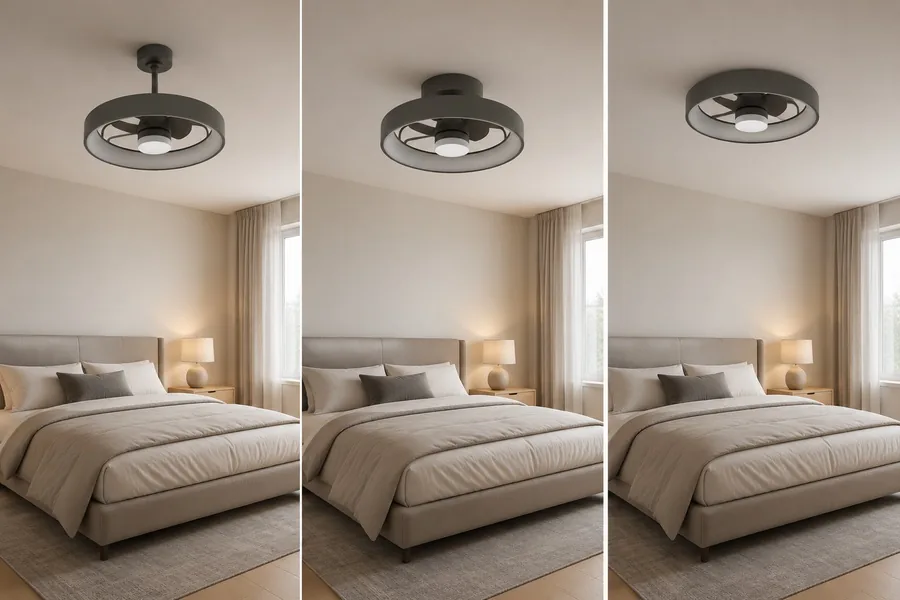
These three terms are close, but they are not always identical. The simplest way to understand them is this: flush mount describes how the fan mounts to the ceiling, low profile describes how shallow the full fan is after installation, and hugger is a common market name for a fan that sits very close to the ceiling.
| Term | Plain Meaning | Common Overall Height | Best Use |
|---|---|---|---|
| Flush mount | No long downrod; the canopy/body mounts close to the ceiling. | Often about 8-12 inches, depending on light kit. | 8 ft bedrooms that need maximum headroom. |
| Low profile | A shallow fan by total installed height; it may be flush mount or use a very short connector. | Often about 10-14 inches. | Low rooms where style and shallow depth both matter. |
| Hugger | A fan marketed as “hugging” the ceiling; usually similar to flush mount. | Often about 7-12 inches. | Rooms where the fan must sit as tight to the ceiling as possible. |
3-1: What Is a Flush Mount Ceiling Fan?
A flush mount ceiling fan is about the installation method. It mounts directly to the ceiling or very close to it, normally without a long downrod. For an 8-foot bedroom, this is usually the first type to consider because it protects headroom better than a standard hanging fan.
The important number is still the total installed height. A flush mount fan with a thick motor and deep light can still hang too low, while a simpler flush mount design may stay within the preferred 12-inch drop range.
3-2: What Is a Low Profile Ceiling Fan?
A low profile ceiling fan is about the final shape and depth. It means the fan is designed to look and install shallow, but it does not always mean the fan is the thinnest option.
Some low profile fans are also flush mount. Others may include a short connector or a deeper decorative light. That is why the product name alone is not enough. Check the measurement drawing and confirm the installed height from ceiling to blade line.
3-3: What Is a Hugger Ceiling Fan?
A hugger ceiling fan is a close-to-ceiling fan. In everyday buying language, it often means the same thing as a flush mount fan, but brands may use the term differently.
For a low-ceiling bedroom, treat “hugger” as a clue, not proof. It may be suitable, but you still need to check the fan drop height, blade position and light kit depth before deciding.
3-4: Which Type Is Best for a Low Ceiling Bedroom?
For most 8-foot low-ceiling bedrooms, the safest starting point is a flush mount or hugger-style fan with a total drop of about 12 inches or less. For 7.5-foot bedrooms, even many hugger fans may still be too low, so the calculation must come first.
If the bedroom is very small, a compact ceiling fan may be better than a wide decorative model. The best fan is not the one with the best product name. It is the one that leaves enough clearance, moves air quietly and fits the real room height.
4: How to Choose the Right Fan Size for a Low-Ceiling Bedroom

Fan size matters. A lot.
A fan that is too large may look heavy and feel too strong. A fan that is too small may not move enough air.
The goal is balance. Good airflow, good comfort, good fit.
4-1: Match Blade Span to Bedroom Size
Blade span means the width of the fan from one blade tip to the opposite blade tip.
Small bedrooms usually need smaller fans. Medium bedrooms can use wider fans. Large bedrooms need stronger airflow and a wider blade span.
Do not choose a fan only because it looks nice online. Match it to the room size first.
4-2: Why Bigger Is Not Always Better in Bedrooms
A bigger fan can move more air, but that is not always better in a bedroom.
Bedrooms need calm comfort. You do not want harsh wind while you sleep. You want soft, steady airflow.
A very large fan in a small low-ceiling bedroom can also look too bold. It may make the ceiling feel even lower.
4-3: When to Choose a Compact Ceiling Fan
A compact ceiling fan is a smart choice for small bedrooms, box rooms, guest rooms, and children’s rooms.
It takes up less visual space. It can still move enough air if the room is not too large.
For low ceilings, compact can be excellent. Small room, low ceiling, close-fit fan — that is often a winning mix.
5: Do Flush Mount Ceiling Fans Move Enough Air?
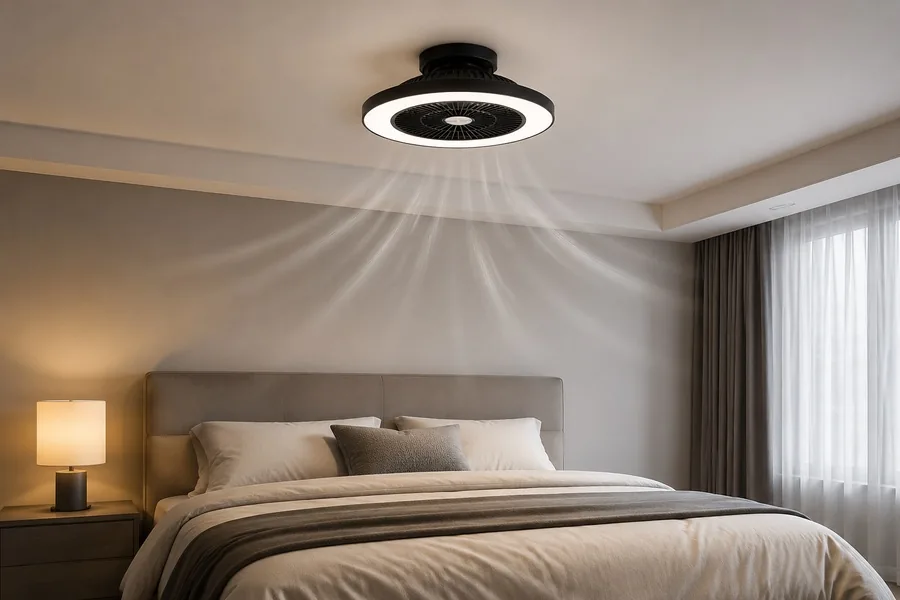
Yes, many flush mount fans can move enough air.
But not all of them do. Some ultra-thin fans look great but may feel weak, especially in larger bedrooms.
That is why you should check airflow before buying.
5-1: What Does CFM Mean?
CFM means cubic feet per minute. It tells you how many cubic feet of air the fan can move in one minute. In simple words, CFM represents airflow volume.
CFM/W means CFM per watt. It tells you how much airflow the fan produces for each watt of electricity. In simple words, CFM/W represents efficiency.
For a bedroom, do not judge only by maximum CFM. Also check low-speed airflow, low-speed noise and whether the air feels too strong when the fan sits close to the bed. A low-ceiling bedroom needs comfortable airflow, not a windy feeling over your face at night.
5-2: Why CFM/W Matters for Energy Efficiency
CFM/W helps compare how efficiently different fans use power. The U.S. Department of Energy (DOE) also uses CFM/W as the efficacy metric for air-circulating fans, with testing based on the AMCA 230 method.
A higher CFM/W usually means the fan can deliver more airflow with less electricity. That can be useful in bedrooms where the fan runs for long periods at night, but efficiency should still be balanced with noise, control quality and real comfort.
5-3: Why Ultra-Thin Fans May Feel Weak in Larger Bedrooms
Some very thin fans are made mainly for looks. They save height, yes, but they may not move much air.
In a small room, that may be fine. In a larger bedroom, it can be disappointing.
So do not pick the thinnest fan without checking the airflow. Thin is good. Weak is not.
5-4: Balance Airflow, Clearance, and Comfort
The best fan gives you three things: safe clearance, useful airflow, and quiet comfort.
If a fan is too low, it is not right. If it is too weak, it is not right. If it is too loud, it is not right either.
A good flush mount ceiling fan should feel easy, safe, and comfortable every day.
Ready to Find the Right Smart Ceiling Fan for Your Home?
Compare styles, sizes, smart features, and lighting options to find the perfect fan for your space.
6: Bedroom Comfort Factors to Consider Before Buying
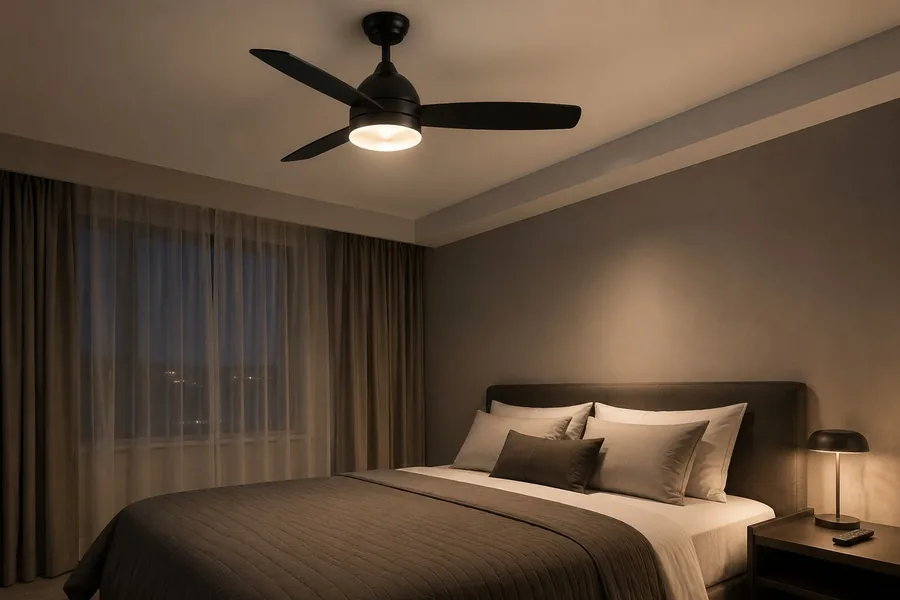
A bedroom fan is not just about cooling. It is about sleep, light, sound, and daily use.
You want a fan that works quietly and feels simple to live with.
6-1: Quiet Operation for Sleep
Noise matters in a bedroom.
Look for a quiet motor, stable blades, and smooth speed settings. DC motors are often quiet and energy-saving.
A fan that hums, clicks, or rattles can become annoying very quickly, especially at night.
6-2: Low-Speed Airflow Matters More Than Maximum Speed
Maximum speed sounds impressive, but low speed is often more important in a bedroom.
At night, most people want gentle airflow. Not strong wind. Not noise. Just a soft breeze.
A good low-speed setting can make the room feel fresh without disturbing sleep.
6-3: Dimmable Lighting and Warm Color Temperature
If the fan has a light, check the light quality.
For bedrooms, warm light usually feels better than cold white light. Dimmable lighting is also useful because you may want soft light at night.
A fan can be great, but bad lighting can ruin the whole experience.
6-4: Remote Control, Wall Switch, and Smart Control Compatibility
Many bedroom fans come with remote controls. That is useful, especially when you are in bed.
Some fans also work with wall switches or smart home systems. But be careful. Not every remote-control fan works well with every smart switch.
Check compatibility before buying, not after installation.
6-5: Reversible Motor for Year-Round Air Circulation
A reversible motor lets the fan change direction.
In summer, it helps create a cooling breeze. In winter, it can help move warm air around the room.
This makes the fan useful for more than just hot days.
7: Safety and Installation Checks for Low-Ceiling Bedrooms
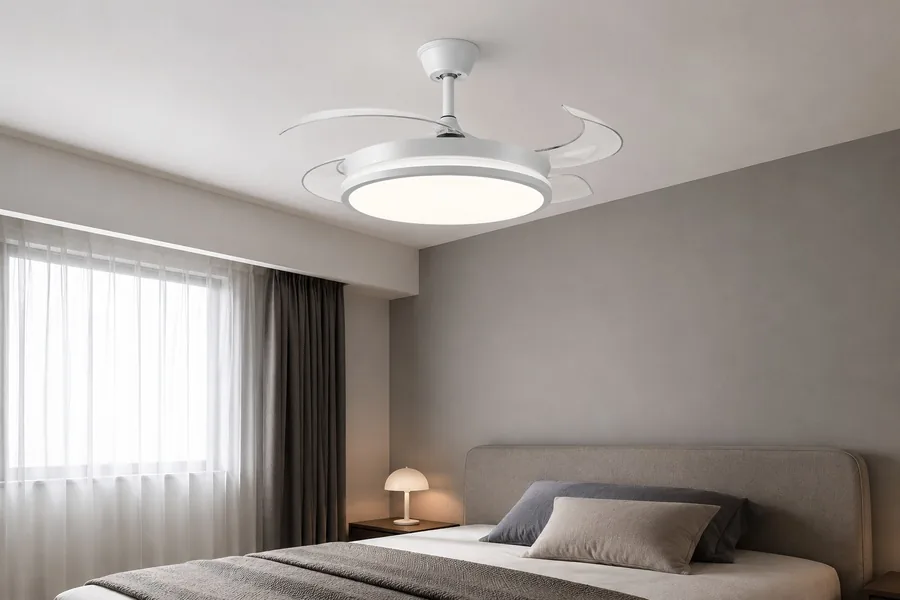
Safety comes first. Always.
A ceiling fan is heavier and moves more than a normal light fitting. It needs the right support and the right installation.
7-1: Make Sure the Electrical Box Is Fan-Rated
The ceiling electrical box must be fan-rated.
A normal light box may not be strong enough to hold a moving fan. That can be dangerous.
If you are not sure, ask a qualified electrician to check it.
7-2: Check Whether Your Ceiling Is Flat or Sloped
Many flush mount fans are designed for flat ceilings only.
If your bedroom has a sloped ceiling, check the product details carefully. You may need a different mounting system.
Do not assume every fan will fit every ceiling.
7-3: Avoid Installing Fans Too Close to Beds or Bunk Beds
In a low-ceiling bedroom, placement matters.
Avoid fitting the fan too close to bunk beds, loft beds, or any raised sleeping area. The blades need safe space around them.
Also think about where people walk, stand, and stretch.
7-4: Watch for Wobble, Clicking, Humming, and Remote Beeps
After installation, check how the fan runs.
A good fan should feel stable. It should not wobble badly. It should not click, buzz, or hum loudly.
Some remotes also beep every time you press a button. That may sound small, but in a bedroom, it can be annoying.
8: Common Mistakes When Buying a Low Profile Ceiling Fan
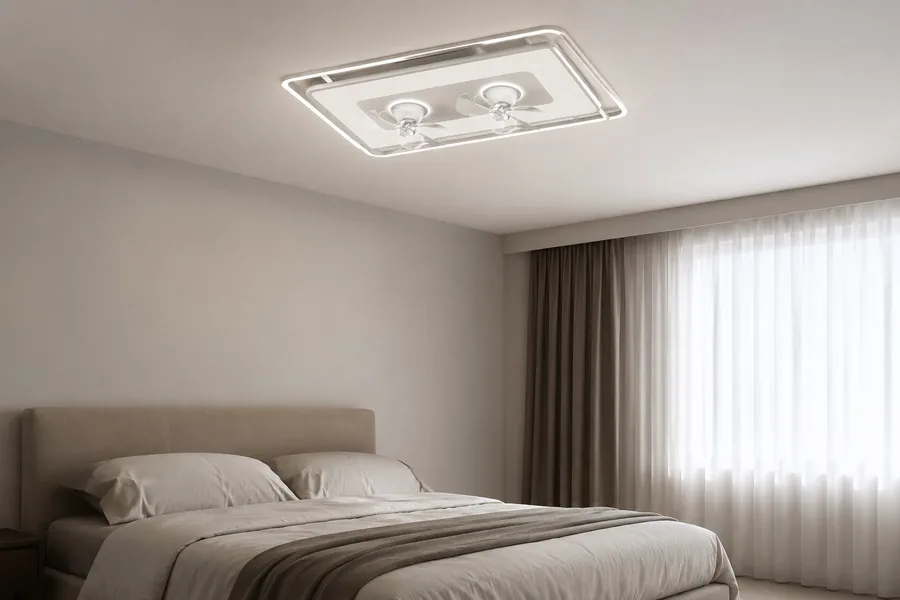
Buying a fan is simple when you know what to check.
Most mistakes happen when people focus only on looks or price. The better move is to check height, airflow, size, noise, and light.
8-1: Choosing the Thinnest Fan Without Checking Airflow
A very thin fan can look amazing. But if it does not move enough air, it will not help much.
Always check airflow. A slim fan should still do the job.
8-2: Ignoring the Actual Installed Height
Product names can be confusing. “Low profile” does not always mean ultra-low.
Check the installed height. This is one of the most important numbers for a low ceiling bedroom.
8-3: Buying a Fan That Is Too Small for the Room
A small fan can be great in a small bedroom. But in a larger room, it may struggle.
If the fan is too small, you may need to run it on high speed all the time. That can mean more noise and less comfort.
8-4: Overlooking Lighting Quality in the Bedroom
Many ceiling fans include lights, but not all lights are good for bedrooms.
Check brightness, colour temperature, and dimming options. Soft warm light is usually best for a calm bedroom.
8-5: Assuming Every Remote-Control Fan Works With Smart Switches
Remote fans and smart switches do not always work well together.
Some fans need their own remote or receiver. Some may not support wall dimmers or smart controls.
Check this before you buy, especially if you want a smart bedroom setup.
9: Final Buying Checklist for a Low-Ceiling Bedroom Ceiling Fan
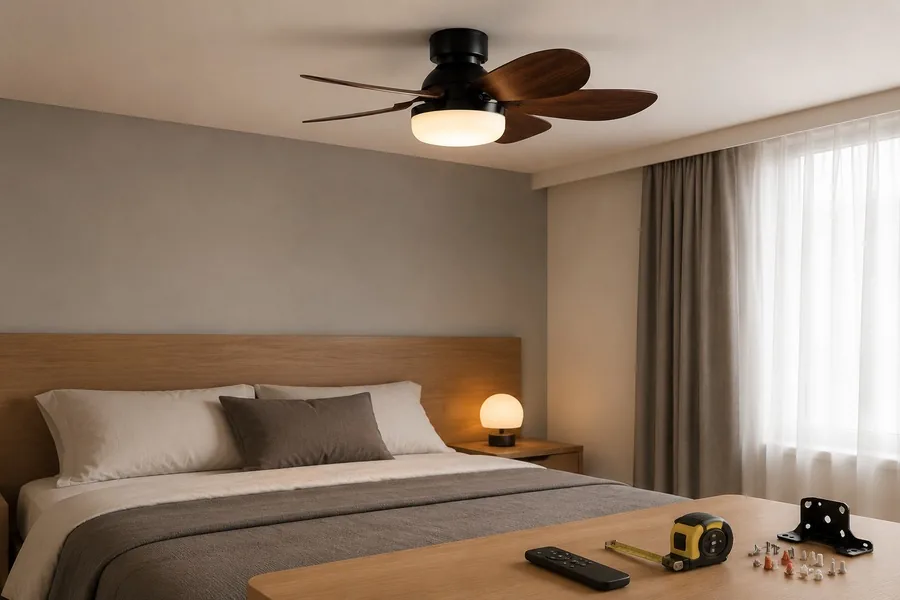
Before you buy, use this simple checklist.
It will help you avoid mistakes and choose a fan that feels right in the room.
9-1: Clearance and Installed Height
Check your ceiling height. Check the fan’s drop height. Make sure the blades will have safe clearance.
For a low ceiling, this is the first thing to check.
9-2: Fan Size and CFM
Choose a blade span that matches your bedroom size.
Then check the CFM to make sure the fan can move enough air. A compact ceiling fan can be ideal for a small room, but larger bedrooms may need stronger airflow.
9-3: Noise Level and Motor Type
Look for quiet running, smooth speed control, and a reliable motor.
For bedrooms, quiet comfort is a big deal. Huge deal. You will notice noise at night.
9-4: Lighting and Control Features
Check if the light is warm, dimmable, and bright enough.
Also check the controls. Remote control is useful. Wall switch control may be better for some people. Smart control is great if it is compatible.
9-5: Installation Requirements and Warranty
Make sure the fan suits your ceiling type and electrical box.
Also check the warranty. A good warranty gives more peace of mind.
A low-ceiling bedroom can use a ceiling fan only when the ceiling height, fan drop and blade clearance work together. As a practical rule, 8-foot bedrooms can usually consider a flush mount fan with total drop controlled within about 12 inches, while 7-foot and many 7.5-foot bedrooms need alternatives or very careful code and clearance checks.
If a ceiling fan is not suitable, choose another airflow plan instead of forcing the installation. Wall fans, tower fans, compact air circulators and improved cross-ventilation can all make a bedroom feel fresher without reducing safe headroom.
NEBOLA is a ceiling fan light manufacturer in China with experience in flush mount, low profile and compact residential fan light development. Based on our product design and manufacturing experience, low-ceiling selection should never rely only on labels such as “Flush Mount” or “Low Profile”. Buyers should confirm overall installed height, blade-to-floor clearance, room size, actual airflow, low-speed noise and whether the ceiling junction box is rated to support a fan.
Frequently Asked Questions
If you are looking for a better ceiling fan light solution for your project, NEBOLA can provide one-stop support from product selection to customization. We focus on ceiling fan light R&D and manufacturing, helping brands, importers, and distributors find products that better match real space needs.
Ready to Find the Right Smart Ceiling Fan for Your Home?
Compare styles, sizes, smart features, and lighting options to find the perfect fan for your space.