

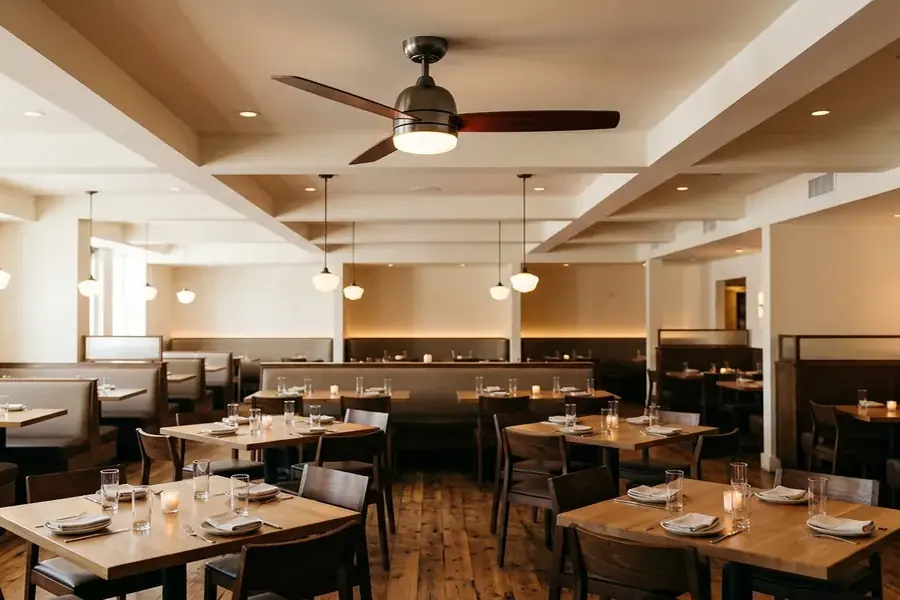
A restaurant ceiling fan should do more than move air. In a dining room, it has to protect comfort, conversation, table presentation, lighting quality and daily operating cost at the same time.
That is why restaurant fan selection needs more care than a simple room-size chart. A fan that works well in a living room may be too noisy for dinner service, too weak for a busy cafe, too low for safe clearance, or too hard to clean above food-service areas.
This guide explains how to choose a commercial fan for restaurants by size, noise, airflow, ceiling height, light quality, energy efficiency and maintenance. The goal is not to choose the biggest fan. The goal is to choose the fan that quietly supports the dining experience every day.
1. What Problem Should a Restaurant Ceiling Fan Solve First?
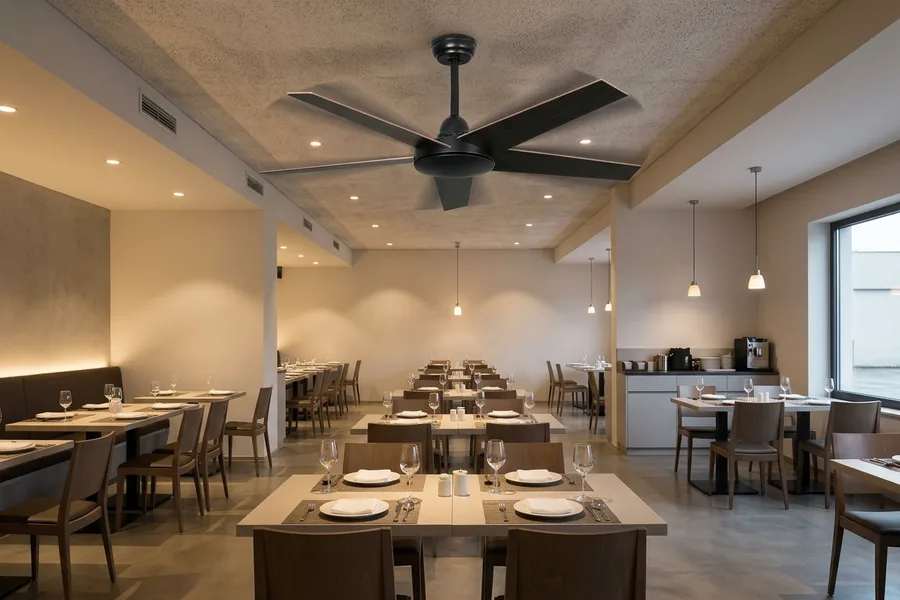
The first job of a restaurant ceiling fan is comfort control. Guests should feel the room is fresh, but they should not notice a strong wind across the table. If the fan becomes the centre of attention, it is probably doing too much.
Restaurants are sensitive spaces. A fan can affect how long guests stay, how comfortable staff feel, how hard the air conditioning works, and whether the dining room feels calm or restless. This is why a commercial fan should be chosen around the real service environment.
1-1. Should the fan cool people or support the whole room?
In most restaurants, the fan should support the whole room. Direct wind over one table can feel refreshing for a moment, but it can quickly become annoying. It can dry food surfaces, move napkins, cool dishes too fast, and disturb guests who are sitting directly below the fan.
A better goal is gentle air circulation. The fan should reduce stuffiness, help mix conditioned air, and make the dining area feel lighter. Guests should be able to talk, eat and relax without adjusting seats to escape the airflow.
1-2. Why is a restaurant different from a home dining room?
A home dining room may use one fan for short periods. A restaurant may run fans for many hours every day, with more people, more heat, more door movement and more background noise. That is why a commercial vs residential ceiling fans comparison matters before choosing a model for business use.
Commercial buyers should think about consistency. The fan must perform on quiet weekday lunches, busy weekend dinners, cleaning hours and hot seasonal peaks. A fan that only looks good in a catalogue is not enough.
2. How Should You Measure a Restaurant Before Choosing Fan Size?
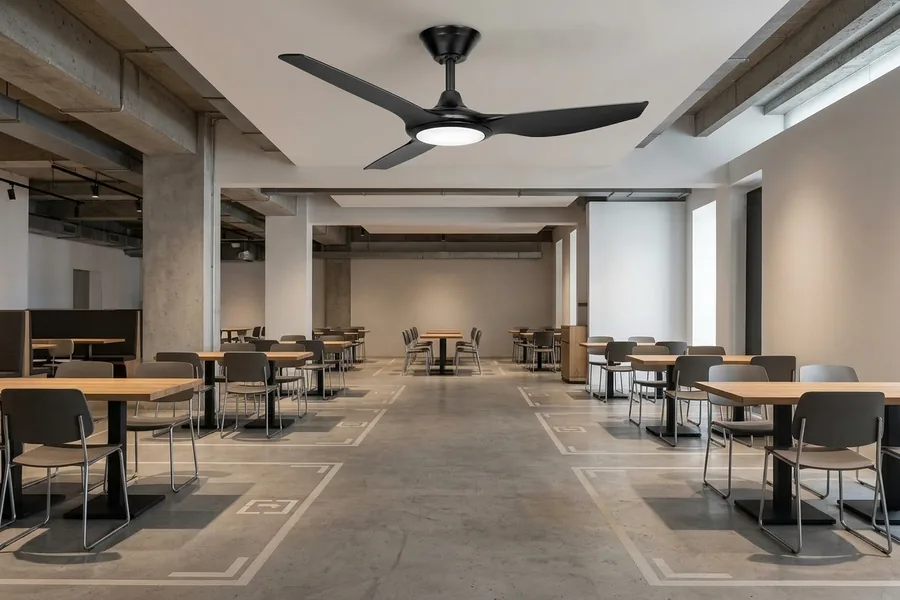
Do not begin with the total restaurant area. Begin with the areas where people actually need comfort. A restaurant may include a dining room, bar, private room, service aisle, waiting zone, entrance, kitchen pass and storage area. They do not all need the same fan plan.
Measure each dining zone separately. Then check the shape of the zone, the ceiling height, the distance between tables, and where guests sit for the longest time. This gives a much better result than using one fan size for the whole floor.
2-1. Which measurements matter most?
- Length and width of each seating zone.
- Ceiling height from finished floor to ceiling surface.
- Distance from fan blades to walls, beams, lights and sprinklers.
- Distance from fan blades to the floor and to table level.
- Location of kitchen pass, doors, windows and air-conditioning vents.
- Main seating areas, waiting areas and staff movement paths.
2-2. Why should long restaurants be planned by airflow zones?
Long restaurants often perform poorly with one centre fan. The tables near the fan may feel too much air, while the far end still feels still and warm. In this case, two or more smaller commercial fans can create a calmer result than one oversized fan.
The same idea appears in large commercial spaces. A detailed large space ceiling fan plan starts with zones, not only square footage. Restaurants need that same thinking, just at a more guest-sensitive scale.
3. What Size Restaurant Ceiling Fan Fits Different Dining Areas?
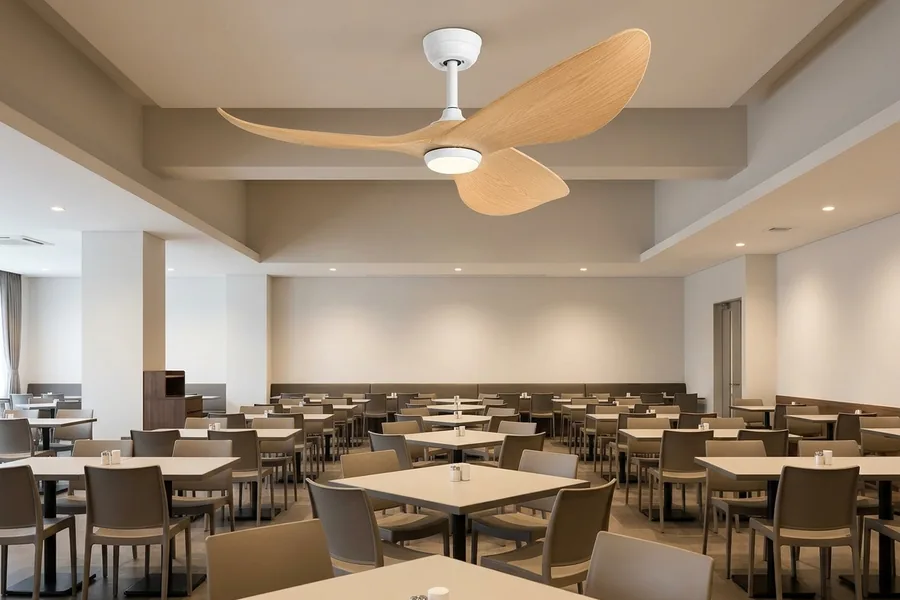
Restaurant fan size should balance coverage and comfort. A small fan may need to run fast, which can increase noise. A fan that is too large can feel heavy, create too much direct air, or sit too close to pendant lights and beams.
| Dining area type | Typical fan direction | What to check before choosing |
|---|---|---|
| Small cafe corner or private room | 42 to 52 inch fan | Low-speed comfort, table clearance and light glare |
| Medium dining room | 52 to 60 inch fan | Even airflow across several tables without strong wind |
| Large open dining room | 60 inch+ fan or multiple fans | Airflow zones, ceiling height and sound level |
| Long narrow dining room | Several smaller fans | Spacing, sightline and coverage at both ends |
| High-ceiling restaurant hall | Larger fan with downrod | Blade height, support point and safe clearance |
3-1. Is 52 inch enough for a restaurant?
A 52 inch fan can work in a small or medium dining zone, especially if the ceiling is standard height and the seating area is compact. It is often a safer choice for cafes, private rooms and smaller casual dining areas.
But 52 inch may feel weak in a wide dining room. If the fan has to run at high speed just to be felt, it may become noisy and uncomfortable. In that case, a larger fan or more than one fan is usually better.
3-2. When should restaurants use 60 inch or larger fans?
Use a 60 inch or larger fan when the seating zone is wide, the ceiling is high, or guests are spread across a broad area. Larger fans can often run at lower speed while still moving enough air. That can reduce both noise and harsh wind.
4. How Many Ceiling Fans Does a Restaurant Need?
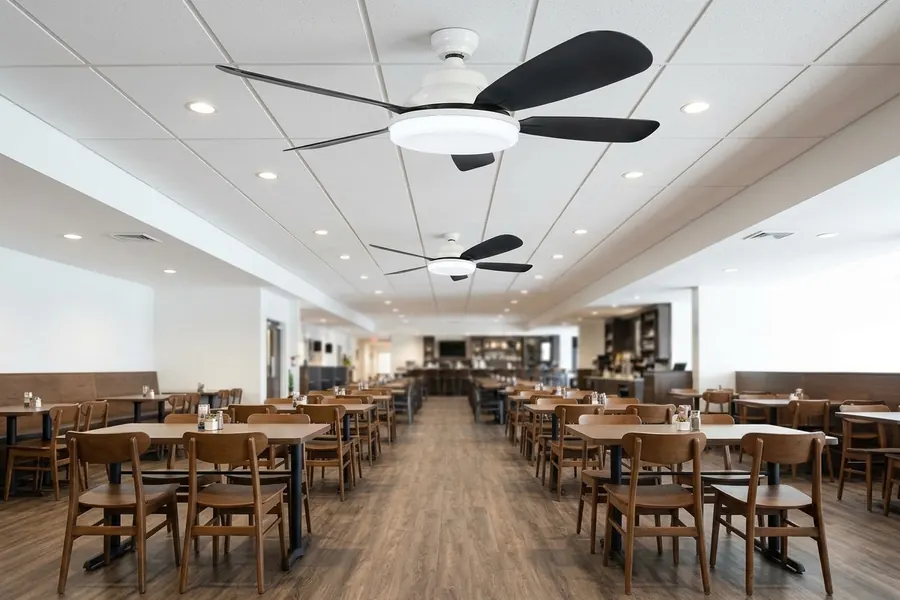
The number of fans depends on shape, not only size. A square dining room may work with one well-placed fan. A long room, an L-shaped room or a restaurant with divided booths may need several fans.
Think of fans as comfort zones. Each fan should serve a group of tables without fighting the airflow from another fan. Poor spacing can create uneven air movement, dead zones and uncomfortable draughts.
4-1. How should fans be spaced across dining zones?
Place fans so their airflow areas overlap gently, not aggressively. Leave enough distance from walls, pendant lights, exposed beams and sprinkler heads. If two fans are too close, guests may feel confused air movement rather than smooth circulation.
4-2. Should every table sit directly under a fan?
No. In many restaurants, it is better for the fan to sit above the centre of a seating zone, not directly above every table. Direct placement above a table can create stronger wind on food and guests. Slightly wider, softer coverage is usually more comfortable.
| Restaurant shape | Fan layout idea | Risk to avoid |
|---|---|---|
| Square dining room | One central fan or two balanced fans | Oversizing the centre fan |
| Long dining room | Two or more fans in a line | Dead zones at both ends |
| Dining room plus bar | Separate fan zones | Airflow conflict between areas |
| Booth-heavy layout | Fans centred over aisles or zones | Direct wind into one booth |
5. How Quiet Should a Restaurant Ceiling Fan Be During Service?
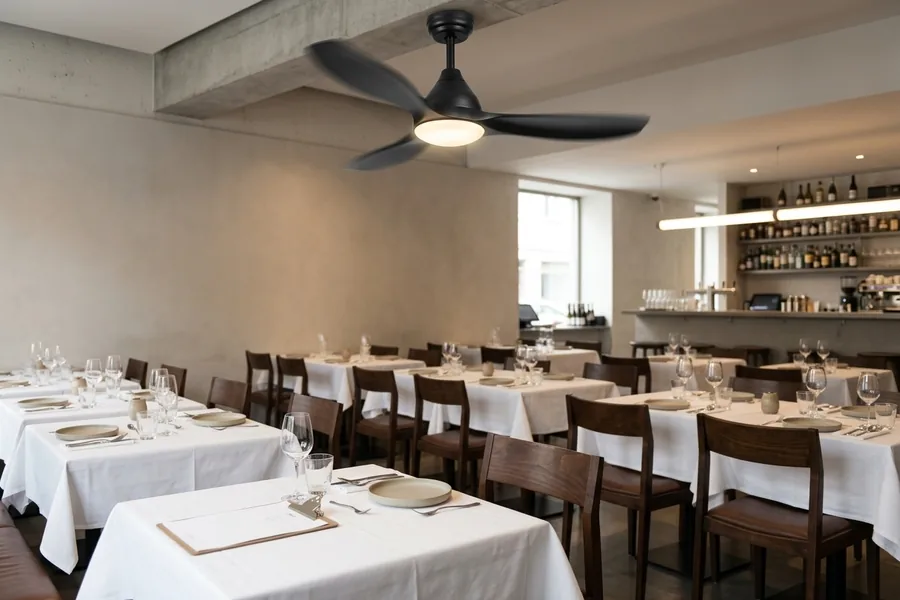
Restaurant noise is already layered. Guests hear conversation, music, plates, glassware, coffee machines, kitchen sounds and staff movement. A ceiling fan should not add hum, clicking, scraping or unstable blade noise.
The most important sound test is not full speed. It is the speed the fan will use during normal service. A fan that is quiet at low and medium speed is more useful than a fan that only looks powerful at maximum speed.
5-1. What fan noises cause complaints?
- Motor hum at low speed.
- Clicking from loose trim or light covers.
- Blade wobble that creates visual anxiety.
- Buzzing from poor light drivers or dimmers.
- Air noise from running too fast for the room.
5-2. How can buyers reduce noise before installation?
Request a sample and test it in a quiet room. Listen at low, medium and high speed. Then run it for several hours to check whether noise changes as the motor warms up. For restaurants, a short showroom test is not enough.
Installation also affects sound. A strong mounting point, correct downrod, balanced blades and secure light cover can all reduce noise. Many fan complaints are not caused by the motor alone; they come from poor matching between fan, ceiling and installation.
Need Help Choosing Restaurant Ceiling Fans?
Share your dining area size, ceiling height, seating layout and lighting needs. We can help match the right commercial fan for your restaurant project.
Get a Quote6. How Do Ceiling Height and Mounting Type Affect Comfort?
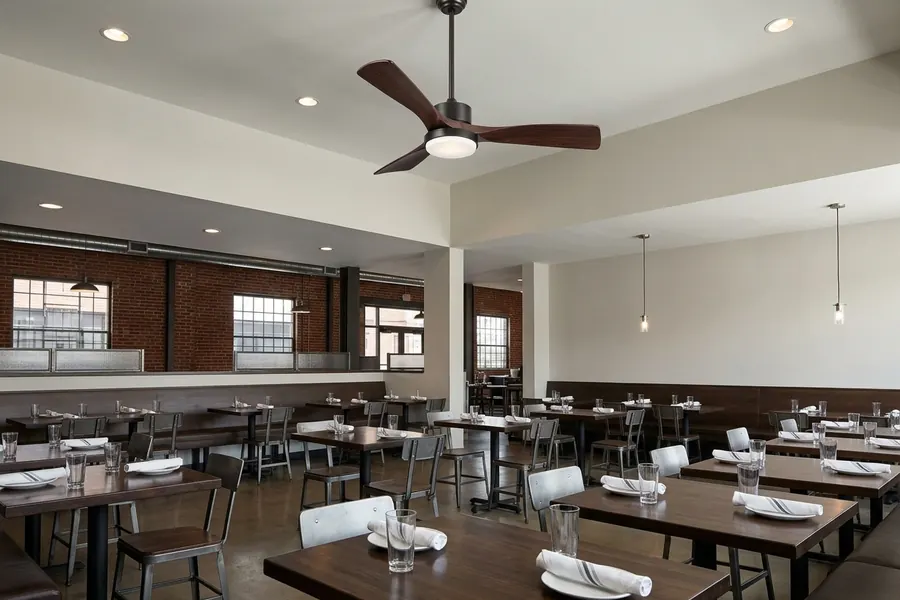
Ceiling height decides how the fan should be mounted and how comfortable the airflow will feel. If the fan sits too low, it can feel unsafe and visually heavy. If it sits too high, guests may feel little airflow at table level.
6-1. When should restaurants use flush mount fans?
Flush mount or low-profile fans are useful in lower ceiling areas where safe clearance is the priority. They keep the blades closer to the ceiling and help avoid a crowded feeling above tables.
However, low-profile fans may move less air than downrod fans because the blades sit close to the ceiling. For a low ceiling restaurant, choose a model designed for compact spaces rather than forcing a large fan into the room.
6-2. When does a downrod improve airflow?
A downrod helps when the ceiling is high. It brings the fan into a better working position so air reaches guests instead of circulating only near the ceiling. In high dining rooms, a downrod can also make the fan look more proportional.
6-3. What clearances should be checked?
- Blade height above finished floor.
- Blade distance from walls and beams.
- Distance from pendant lights and track lights.
- Distance from sprinklers and fire-safety equipment.
- Access for cleaning and future maintenance.
7. How Should Airflow Work Around Kitchens Doors and Seating?
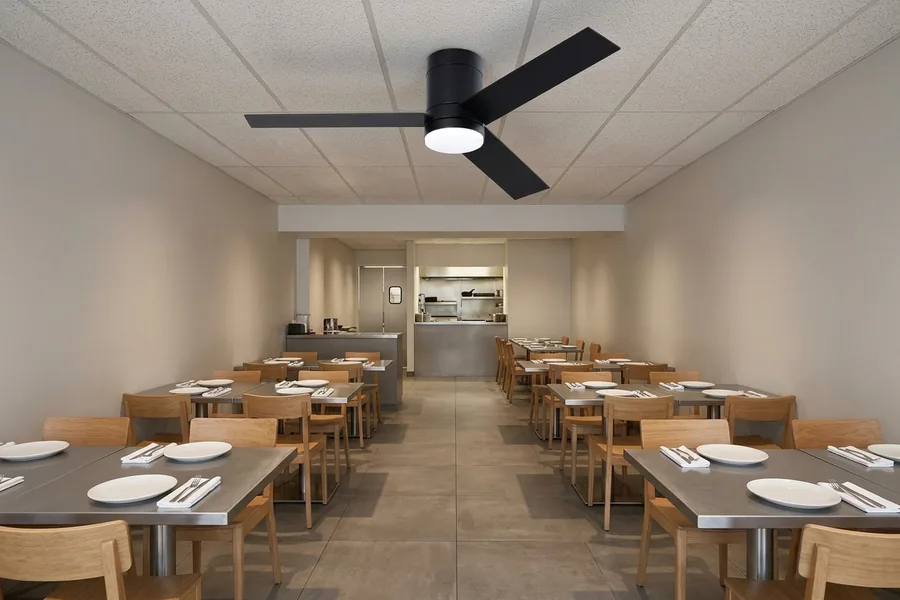
Restaurants have heat and air movement problems that homes do not. Kitchen heat, open doors, delivery traffic, busy staff movement and air-conditioning vents can all affect how the fan feels.
A fan should not push kitchen odours across the dining room or blow air directly from a doorway onto one group of guests. It should support gentle mixing in the dining area while respecting the existing ventilation design.
7-1. Should ceiling fans be placed near the kitchen pass?
Usually, avoid placing a strong fan too close to the kitchen pass. The air may disturb plated food, carry heat or smells into the dining area, or conflict with kitchen ventilation. Place fans where guests sit, not where hot air begins.
7-2. How do doors and windows affect fan planning?
Doors can create warm or cold air streams. If a fan is placed in the wrong position, it may pull that air across nearby tables. In restaurants with frequent door opening, the entrance area may need a separate comfort plan from the main dining room.
Ventilation and air quality should be considered with professional HVAC design. ASHRAE’s ventilation standards for acceptable indoor air quality are a useful external reference when restaurants are planning occupancy, outdoor air and air distribution.
8. How Can Restaurant Ceiling Fans Improve Energy Efficiency?
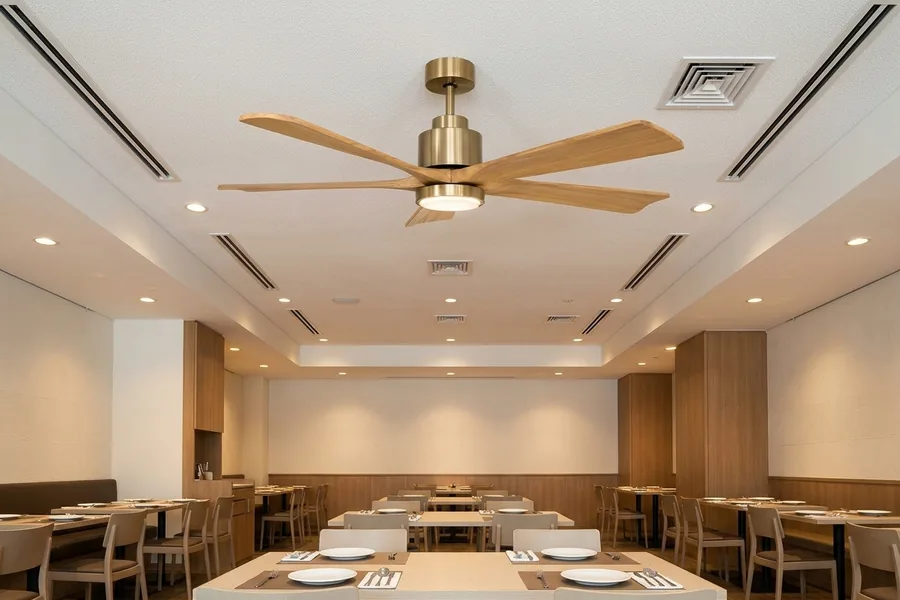
Ceiling fans do not lower air temperature by themselves. They improve perceived comfort by moving air across the skin and helping mix conditioned air. Used well, they can let a restaurant feel comfortable with less aggressive cooling.
This is why energy efficiency should be judged in two ways: how much electricity the fan uses, and how well the fan supports the wider HVAC system. A cheap fan that needs high speed all day may not be efficient in practice.
8-1. Why does motor type matter for restaurants?
DC or BLDC motors often provide smoother speed control and lower power use than basic AC motors. They can also help reduce low-speed hum, which matters in dining rooms. For restaurants with long daily hours, motor quality can affect operating cost and guest comfort at the same time.
8-2. Is CFM/W enough to compare commercial fans?
CFM/W is useful because it compares airflow to energy use. But it is not enough by itself. A restaurant also needs the right blade span, quiet low-speed operation, stable mounting and useful control options. High airflow that feels harsh is not good restaurant comfort.
8-3. How should restaurants use fans with air conditioning?
Use fans to support gentle air mixing rather than replacing the HVAC system. In many dining rooms, a fan can make the room feel fresher at a moderate thermostat setting. The best result comes from matching fan speed to occupancy, season and service time.
9. Should Restaurant Ceiling Fans Include Lights?
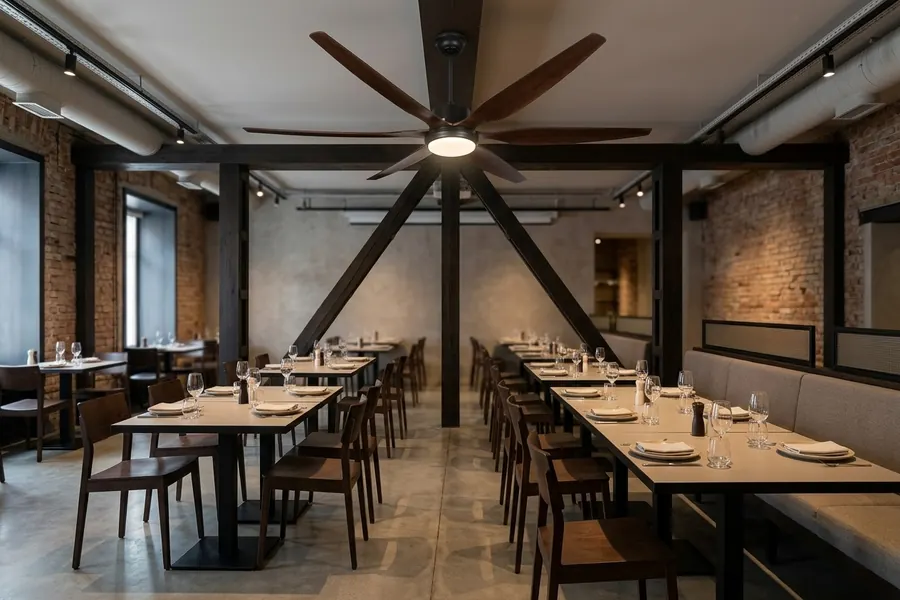
A ceiling fan with light can be very useful in restaurants, especially casual dining rooms, cafes, private rooms and hospitality spaces where ceiling space is limited. But the light must support the dining mood.
Restaurant lighting should flatter food, faces and interior materials. A fan light that is too cold, too bright or badly diffused can make the room feel cheaper. Airflow and lighting need to be judged together.
9-1. When is a fan light better than a separate ceiling light?
A fan light is useful when the room needs both air movement and general lighting from the same ceiling position. It can simplify the ceiling and reduce fixture clutter. For a wider comparison, read this ceiling fan light vs ceiling light guide.
9-2. Should restaurants choose integrated LED or replaceable LED?
Integrated LED can look clean and modern, but serviceability matters in restaurants with many fixtures. Replaceable LED modules or bulbs can reduce downtime when a light fails. The best choice depends on access height, spare parts, warranty and maintenance skill. This integrated LED vs replaceable LED ceiling fan lights guide explains the trade-off in more detail.
9-3. What light details should be checked?
- Warm or adjustable colour temperature.
- Soft diffusion with low glare.
- Stable dimming without buzz or flicker.
- Easy cleaning around the light cover.
- Clear spare part availability for LED boards, drivers or bulbs.
10. What Should Buyers Check Before Ordering Commercial Fans?
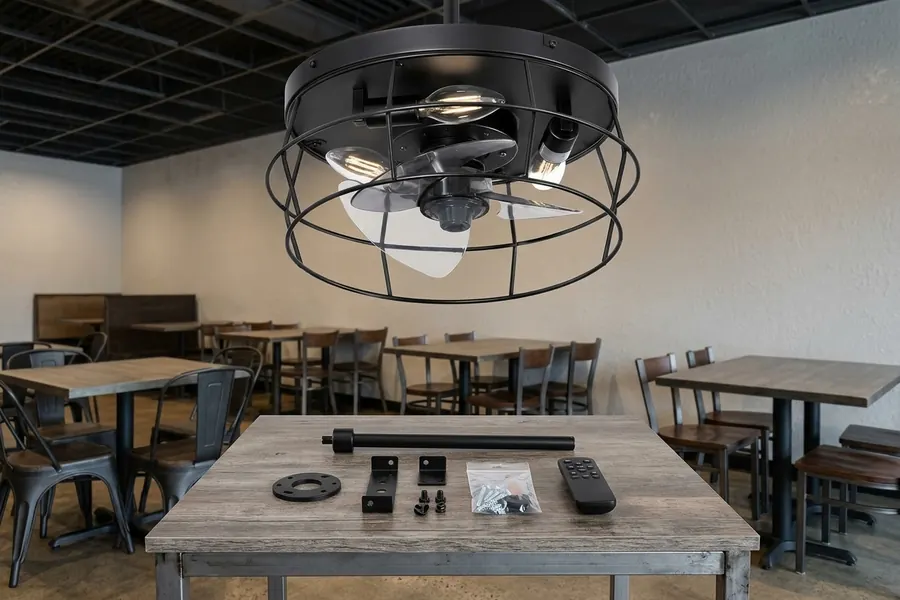
Before ordering restaurant fans, buyers should check the product as both a comfort fixture and a business asset. A good restaurant fan should be quiet, easy to clean, stable, efficient and realistic for bulk installation.
10-1. What should be tested with a sample?
- Low-speed and medium-speed noise.
- Blade balance and wobble after several hours.
- Remote control response and wall-control options.
- Light colour, glare, dimming and flicker.
- Motor temperature after long running.
- Cleaning access around blades and light covers.
- Packaging strength for project delivery.
10-2. What should be confirmed with the supplier?
Ask for motor details, warranty terms, spare parts, lead time, mounting hardware, certification information and replacement light parts. For a broader project checklist, use this commercial ceiling fan buying guide for businesses before placing a bulk order.
10-3. How should restaurants make the final decision?
Choose the fan that fits the real dining environment, not the one that only looks impressive online. For restaurants connected to hotels, resorts or hospitality projects, it is also worth comparing ideas from this hotel ceiling fan size noise and energy guide.
The safest choice is usually a balanced commercial fan: the right size for the dining zone, quiet at service speed, efficient for long hours, easy to clean, and supported by a supplier who understands commercial ceiling fans for business spaces.
Need Help Choosing Restaurant Ceiling Fans?
Share your dining area size, ceiling height, seating layout and lighting needs. We can help match the right commercial fan for your restaurant project.
Get a Quote