

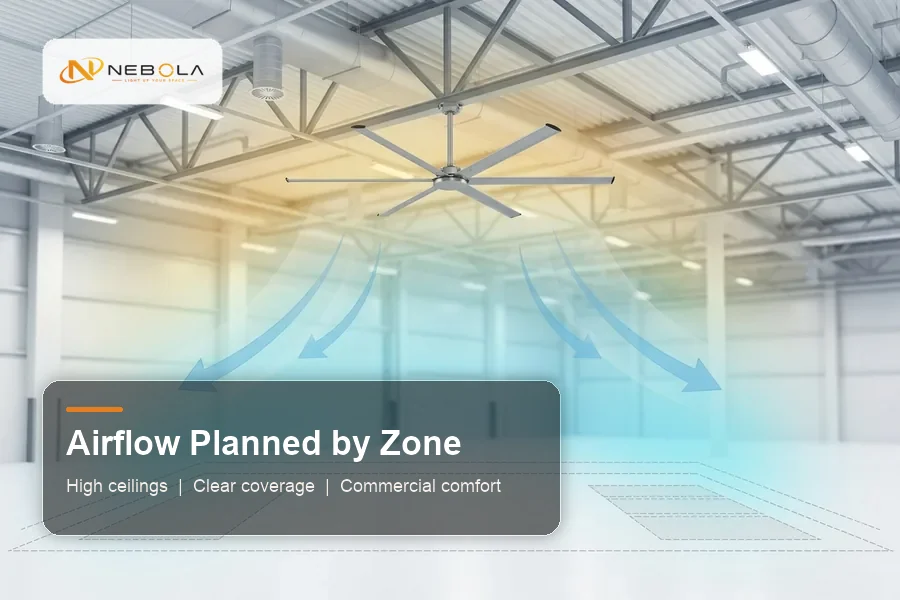
A large space ceiling fan is not chosen like a normal room fan. Large spaces have higher ceilings, wider coverage zones, heat layers, equipment, lighting, racks and people zones that change how airflow should be planned.
A warehouse ceiling fan also has to run for long hours without creating unsafe clearance problems, uneven airflow or extra noise. The best fan is not simply the widest fan. It is the fan that fits the building and supports the people below it.
This guide explains how to choose large commercial fans by coverage, ceiling height, airflow, CFM, noise, motor type, lighting, installation safety and procurement checks.
1. What Counts as a Large Space for Ceiling Fan Selection?
A large space is any room where a standard residential fan cannot create useful, even comfort across the occupied zone. This may include warehouses, showrooms, halls, gyms, restaurants, hotel lobbies, workshops, public rooms and open commercial areas.
1-1. Is every warehouse a large fan space?
Most warehouses require large-space thinking because ceilings are high and air can collect above people. However, the right fan still depends on the work zone, racking layout, loading doors, ceiling structure and daily activity.
A small warehouse with low ceilings and one packing bench may need several medium commercial fans. A tall open warehouse may need a larger fan or HVLS-style planning. The space type gives a clue, but the building layout decides the answer.
1-2. Can hotels and restaurants also count as large spaces?
Yes. Large dining rooms, hotel lobbies and resort lounges often need the same zone-based planning. For related hospitality spaces, compare the restaurant ceiling fan guide and the hotel and resort ceiling fan guide.
The comfort target changes by space. A warehouse may prioritise broad circulation and long operating hours. A lobby or restaurant may prioritise quiet airflow, visual proportion and soft comfort over guests.
1-3. Why should buyers avoid choosing by diameter alone?
Fan diameter is important, but it is only one part of performance. Blade design, motor torque, speed range, mounting height and room obstruction all change how much airflow people actually feel.
2. How Should You Map Coverage Zones Before Choosing Fan Size?
Start by mapping the zones where people actually need airflow. In a warehouse, this may include packing benches, loading doors, workstations, aisles and storage areas. In a showroom, it may include customer paths, display zones and staff desks.
2-1. Which measurements matter most?
- Floor area of each active work or seating zone.
- Ceiling height and available mounting structure.
- Distance to beams, lights, racks, sprinklers and doors.
- Heat sources, HVAC outlets and loading-door airflow.
- People density, working hours and comfort expectations.
The goal is to understand how the room is used. A fan should serve people, not just fill the ceiling. If people spend most of the day in one area, that area should receive the most careful airflow planning.
2-2. Why is total square footage not enough?
A large room may need several airflow zones instead of one central fan. This is the key idea behind choosing ceiling fans for large spaces: airflow should follow the active parts of the room, not only the outer walls.
For example, a showroom may have a large floor area but only a few customer paths. A warehouse may have tall racks that block air movement. A restaurant hall may need gentle airflow over seating but not over service counters. Each space needs a zone map.
2-3. How should obstructions be recorded?
Mark beams, lights, sprinklers, shelving, tall equipment, doors and signs before selecting a fan. These objects can reduce airflow, create safety conflicts or limit where the fan can be mounted. This step is practical, not decorative; it prevents expensive installation surprises.
3. What Size Fan Works for Warehouses Showrooms and Halls?
Large commercial spaces often need 60 inch+ fans, HVLS fans or several coordinated fans. The correct size depends on ceiling height, open floor width, fan placement and how far useful air needs to travel.
| Space type | Typical fan direction | Main risk |
|---|---|---|
| Large office or showroom | 60 to 72 inch | Fan looks large but still misses divided zones |
| Warehouse open floor | Large commercial or HVLS fan | Ignoring racks, beams and mounting height |
| Restaurant or hotel hall | 60 inch+ or multiple fans | Too much direct wind over guests |
| Long commercial room | Multiple fans | Dead zones at both ends |
3-1. When is a 60 inch fan enough?
A 60 inch fan can work in many medium-large commercial rooms with moderate ceiling height and a clear central zone. It may suit showrooms, offices, restaurants or public rooms where the room is not extremely tall or wide.
However, a 60 inch fan should not be treated as a universal commercial answer. If the ceiling is very high or the floor plan is long, one 60 inch fan may look correct but fail to move useful air across the whole occupied zone.
3-2. When should buyers consider larger commercial fans?
Consider larger fans when the occupied area is broad, the ceiling is high, or people are spread across several zones. Larger fans can move air more slowly and widely, which can feel calmer than a smaller fan running at high speed.
For warehouses, large-diameter fans may help reduce heat layers and stale air. For public commercial spaces, the size must still fit the visual scale of the ceiling and avoid harsh airflow directly over people.
3-3. When are multiple fans better than one large fan?
Multiple fans are often better in long, divided or irregular spaces. They allow airflow to be tuned by zone. They also reduce the need to push one fan too hard just to reach a distant corner.
4. Is One Large Fan Better Than Several Smaller Fans?
One large fan can be efficient and visually clean in an open square space. Several smaller fans can be better when a room is long, divided, crowded with equipment or used by different groups of people at different times.
4-1. When does one large fan work well?
One large fan works best when the space is open, square and free from major obstructions. The fan should sit over the main occupied zone with enough clearance around the blade sweep. This is common in some halls, open showrooms and simple warehouse spaces.
The fan should also have a wide speed range. A large fan running slowly can create comfortable circulation. A large fan with poor speed control may still feel too strong or too weak.
4-2. When are multiple fans the safer choice?
Multiple fans are safer when the room has several work areas, aisles, seating groups, columns or barriers. Each fan can serve a zone without forcing one large fan to cover everything. This improves comfort and reduces dead spots.
Multiple fans also help when usage changes during the day. A warehouse may need airflow near packing benches in the morning and near loading doors in the afternoon. Zone control allows more practical operation.
4-3. What layout mistakes should buyers avoid?
Avoid placing fans in a decorative row without checking real airflow zones. Also avoid placing fans too close together. Dense fan layouts can look unrealistic, waste energy and create uneven air patterns. Fan spacing should be planned from coverage, not from ceiling symmetry only.
5. How Does Ceiling Height Downrod Length and Clearance Change Performance?
Ceiling height changes almost every part of large fan selection. A fan mounted too high may circulate air above people. A fan mounted too low may create clearance and safety problems. Downrod length helps connect the fan to the useful airflow zone.
5-1. When does a downrod matter?
A downrod can place the fan at a more effective height, especially in high-ceiling halls and warehouses. The fan must still respect safe clearance from people, forklifts, shelving, lighting and building structure.
The downrod should not be chosen by appearance only. It should place the blades where airflow can reach people while keeping the installation stable. In very tall rooms, professional installation guidance is important.
5-2. What ceiling structures should be checked?
- Beam position and load capacity.
- Sprinkler and fire-safety clearance.
- Lighting layout and cable routes.
- Racking height and forklift movement.
- Maintenance access for cleaning and repair.
Large fans are installed equipment, not small decorative fixtures. The mounting point must carry the load and control vibration. Electrical routing and controller placement should also be planned before ordering.
5-3. Why does clearance matter beyond safety?
Clearance also affects airflow. If blades are too close to beams, ducts or lights, performance can suffer and noise can increase. A fan that looks correctly sized on paper may become a poor choice if the ceiling structure blocks the airflow path.
Need Help Choosing Large Space Ceiling Fans?
Share your space size, ceiling height, use case and lighting needs. We can help match the right commercial fan for your project.
Get a Quote6. How Should Airflow CFM and Noise Be Compared?
CFM matters, but it is not the whole decision. A large fan should move useful air quietly and evenly. Harsh air from one point can feel worse than softer air across a larger zone.
6-1. Why ask for verified performance data?
For commercial projects, buyers should ask for airflow and sound data that can be compared. AMCA’s certified ratings programme is a useful reference for why verified performance data matters in air movement products.
If a supplier provides only vague claims such as strong wind or super quiet, ask for more detail. Useful data includes speed range, wattage, airflow, sound level direction and test condition. The data does not replace sample testing, but it helps compare options fairly.
6-2. Is higher CFM always better?
No. Higher CFM only helps if airflow reaches the correct zone and stays comfortable. A fan with high CFM but poor low-speed control can be unpleasant in restaurants, showrooms or work areas where people stay in one place.
For warehouses, more airflow may be useful, but noise and dust movement still matter. For public spaces, comfort and conversation are often more important than maximum air volume.
6-3. How should noise be tested in large spaces?
Test noise at the speeds people will actually use. Listen near workstations, customer seating, reception desks and quiet corners. Also check for vibration through the ceiling structure. A fan may be quiet in open air but louder when installed on a specific beam or roof structure.
7. What Motor Control and Runtime Features Matter for Long Operating Hours?
Large space fans may run for long shifts, especially in warehouses, gyms, restaurants and commercial halls. Motor quality, control range and reliability therefore matter as much as blade size.
7-1. Why choose DC or BLDC motors?
DC and BLDC motors often provide smoother speed control and lower running cost. They can also make low-speed airflow easier to tune for daily comfort. This is useful when the fan runs for many hours or when different zones need different settings.
Motor type alone is not enough. Ask about driver quality, receiver reliability, heat management and warranty terms. A motor is only as reliable as the control system supporting it.
7-2. What controls should commercial buyers request?
- Clear wall control or remote control.
- Useful speed steps, not only high power.
- Timer or schedule options where needed.
- Reverse function when useful for air mixing.
- Replaceable receivers and control parts.
Controls should match the space. A warehouse may prefer wall controls or central scheduling. A restaurant or hotel lobby may need quiet speed changes and staff-only control access. A showroom may need simple daily operation without training.
7-3. How should runtime affect product choice?
A fan used occasionally in a home has a different duty cycle from a fan running through long commercial shifts. Ask how the fan performs under long operation, how heat is managed and how spare parts are supplied. Long runtime makes reliability a buying requirement, not a bonus.
8. Should a Large Space Ceiling Fan Include a Light?
Some large space fans include lights, but not every commercial space needs a fan light. The choice depends on ceiling layout, maintenance access, task lighting requirements and the existing lighting plan.
8-1. When is a fan light useful?
A fan light can reduce ceiling clutter in showrooms, restaurants, lounges and public commercial rooms. It can be useful when the room needs both general air movement and soft general illumination. For layout decisions, compare a ceiling fan light vs ceiling light setup.
Fan lights should be checked for colour temperature, glare and dimming. A light that looks fine in a product photo can create shadows or glare once the blades rotate.
8-2. When should lighting stay separate?
Warehouses and work areas often need separate lighting because safety, brightness and beam angle are more demanding. A fan light alone may not provide enough even coverage for work tasks. Separate lighting can also make maintenance easier at high ceilings.
High ceilings make service access more expensive. A replaceable LED fan light can be easier to maintain in some projects, while integrated LED can look cleaner when warranty and access are strong.
8-3. How do blades affect lighting comfort?
Large blades can create moving shadows if lights are placed poorly. Check the fan with the room’s actual lighting plan. In public spaces, avoid glare, flicker and visible shadow patterns over tables, counters, desks or waiting areas.
9. What Installation and Safety Checks Come Before Ordering?
Large fans must be checked as installed equipment. The fan, mounting hardware and building structure must work together safely. Installation planning should happen before purchase, because some problems cannot be fixed by changing the fan after delivery.
9-1. What should be checked before purchase?
- Ceiling load capacity.
- Blade clearance from walls, beams and racks.
- Sprinkler and fire-system requirements.
- Electrical supply and control wiring.
- Access for maintenance teams.
- Local installation rules and qualified installer availability.
A fan may look suitable by size but fail because the building cannot support the mounting point or because the blade path conflicts with lights, racks or sprinklers. These conflicts are easier to solve before ordering.
9-2. Why should safety be checked before final model selection?
Safety checks can change the model choice. A heavier fan may need stronger mounting. A larger blade span may conflict with beams. A downrod may improve airflow but create clearance issues. These details decide whether the fan can actually be installed.
Commercial buyers should request installation drawings, mounting instructions and hardware details. If the project has unusual ceilings, ask for technical confirmation before approving the order.
9-3. What should be prepared for maintenance access?
Large fans are harder to reach than small room fans. Plan how teams will clean blades, inspect hardware, replace receivers and service lights if included. If maintenance access is difficult, choose a model with longer service intervals and reliable spare parts.
10. What Buying Checklist Helps Commercial Buyers Avoid Mistakes?
A large space fan should be selected through a project checklist, not only a product image. The more complex the building, the more important the checklist becomes. The checklist should connect the room, fan and installation plan into one decision.
10-1. What belongs in the checklist?
- Coverage zones and ceiling height.
- Fan diameter and blade clearance.
- Airflow and noise data.
- Motor type and controls.
- Lighting requirements if any.
- Mounting hardware and installation support.
- Warranty, spare parts and delivery packaging.
Use the checklist to compare real project risk. A cheaper model may cost more if it needs extra units, creates noise at useful speeds, requires difficult installation hardware or does not support replacement controls.
10-2. How should buyers compare two similar commercial fans?
Compare the two fans in the actual building layout. Check which fan reaches the right zones at a lower speed, which one is easier to install, which has better controls and which supplier can support spare parts. Do not choose only by the largest number on the specification sheet.
For warehouses, check shift length, dust exposure, loading-door airflow and maintenance access. For showrooms or public halls, also check appearance, light quality and whether the fan can run quietly during conversations.
10-3. What final step should come before bulk ordering?
Before ordering, compare the fan with a commercial ceiling fan buying guide for businesses and understand the difference between commercial vs residential ceiling fans. A good large fan should fit the building, support the people below and run quietly enough to become part of daily operation.
For important projects, test one sample or one zone before confirming the full order. A sample can reveal airflow reach, low-speed sound, light comfort, finish quality, packaging and installation details that a product page cannot show.
Need Help Choosing Large Space Ceiling Fans?
Share your space size, ceiling height, use case and lighting needs. We can help match the right commercial fan for your project.
Get a QuoteFAQ About Large Space Ceiling Fan Selection Guide