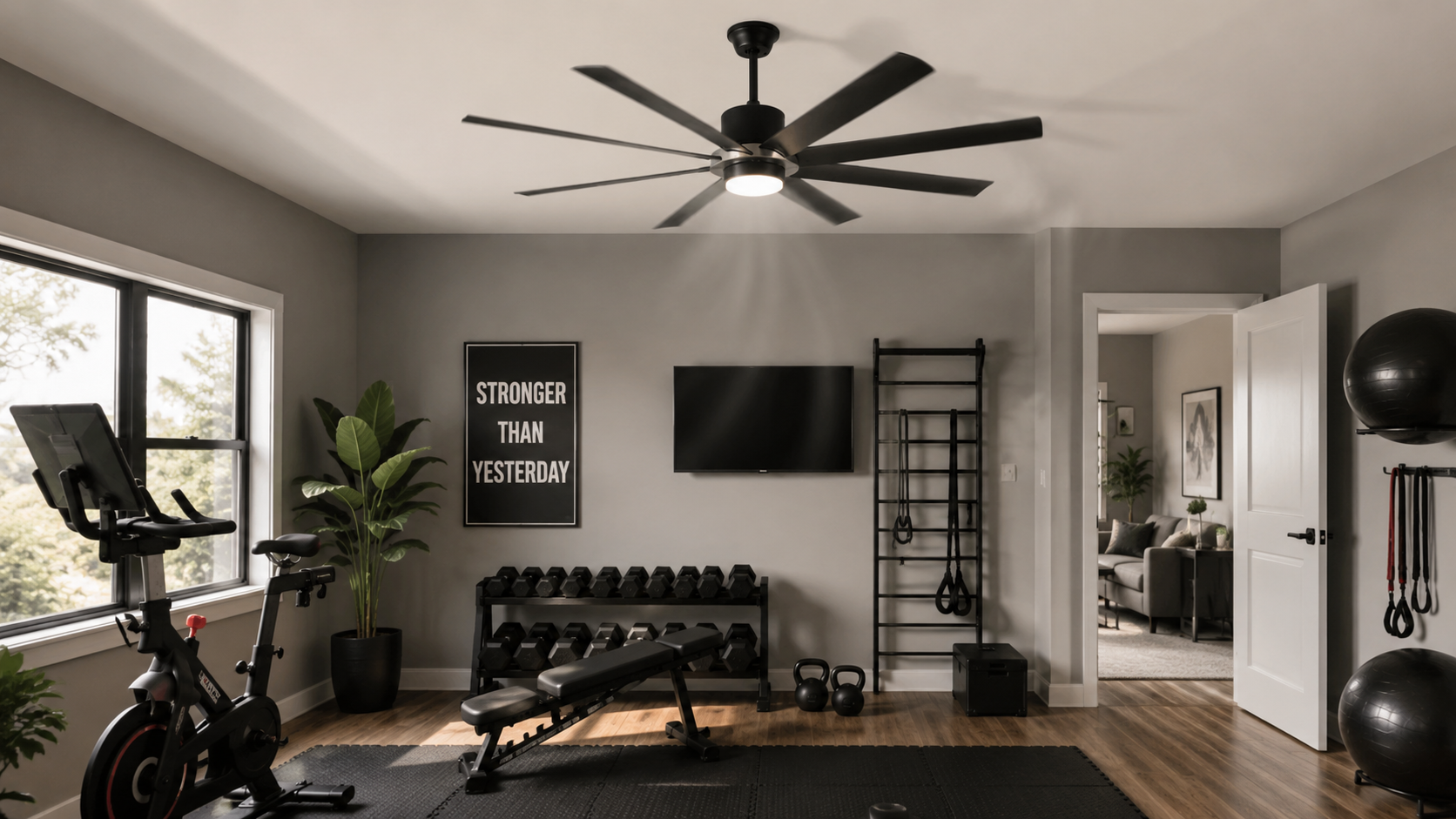


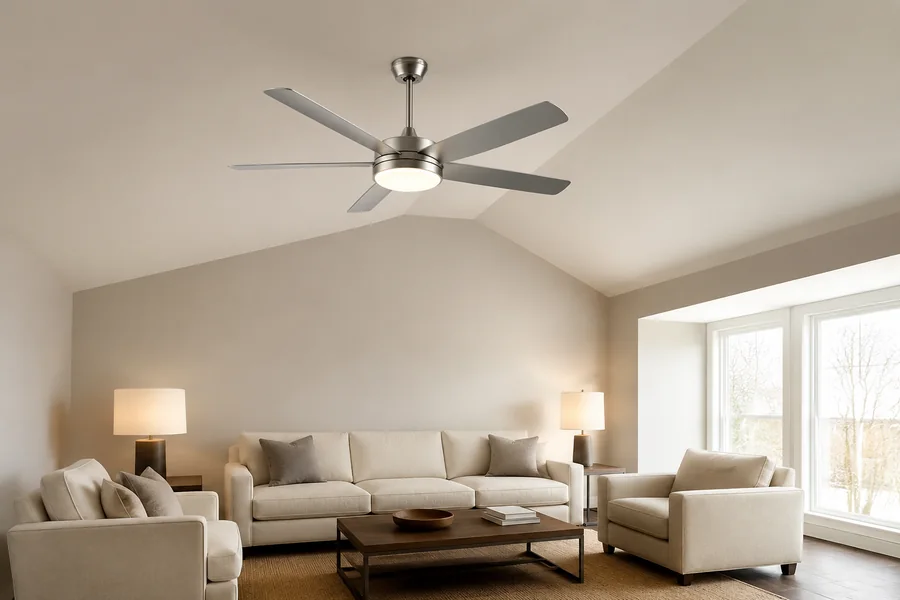
Yes, you can install a ceiling fan on a sloped ceiling, but only when the mounting parts, downrod length, blade clearance, and ceiling angle are suitable. A ceiling fan mount types check should come before style, because a vaulted or angled ceiling changes how the fan hangs, how air moves, and how safely the blades can turn.
The short answer is simple, but the real decision needs care. A sloped ceiling fan must hang level, clear the ceiling slope, and sit low enough to move air where people actually use the room. If the fan is forced onto the wrong mount, it may wobble, look uneven, or fail to deliver useful airflow.
1. Why Sloped Ceilings Need Special Fan Planning
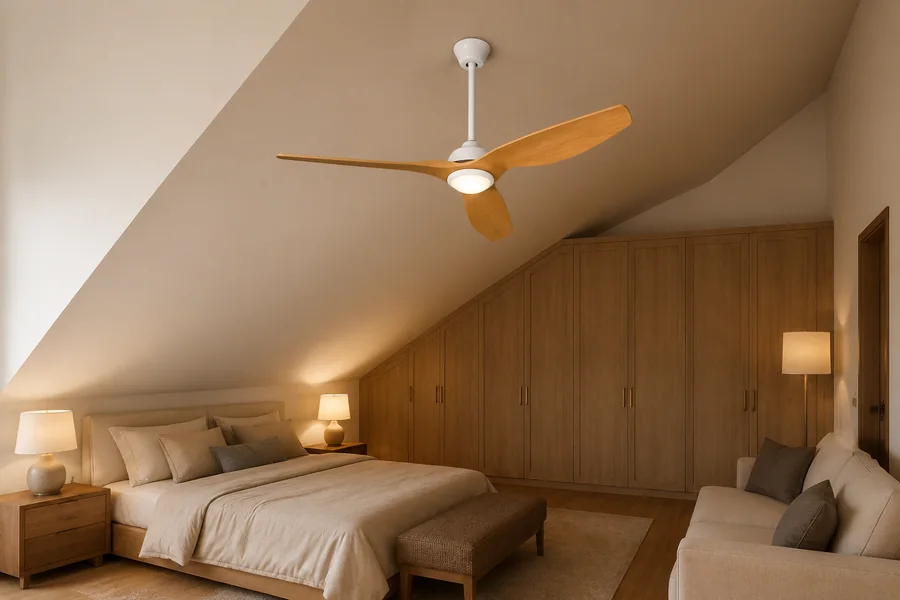
A flat ceiling lets the fan canopy sit evenly and the motor hang straight down. A sloped ceiling does not. The ceiling angle can push the canopy, motor, or blades into an awkward position, especially if the fan is mounted with the wrong hardware.
This is why a ceiling fan for vaulted ceiling spaces is not chosen by diameter alone. You need to think about the ceiling pitch, the distance from the slope, the blade path, and the final hanging height. A beautiful fan can still be wrong if it cannot hang level.
1-1. The fan motor must hang level
The motor housing should sit straight, not tilted with the ceiling. A tilted motor can put uneven stress on the ball joint, canopy, and downrod connection, especially after months of daily use. When the fan hangs level, the blades rotate evenly, the light kit looks centered, and later balancing work becomes much easier.
1-2. Blade clearance is harder on an angle
On a flat ceiling, blade clearance is easier to judge because every blade passes under the same ceiling plane. On a sloped ceiling, the high side of the blade path may sit much closer to the surface, beams, or trim. This is why fan size, downrod length, and adapter angle must be checked together instead of as separate decisions.
1-3. Airflow must reach the living area
Vaulted ceilings are often tall, so a fan mounted too high may move air near the peak instead of near the sofa, bed, or dining area. A longer downrod can bring the fan into a better airflow zone, but the final height still needs to feel visually balanced in the room. In practice, the best position is usually where the fan can circulate air across the occupied area without becoming a low obstacle.
2. Check the Ceiling Angle Before Choosing a Fan
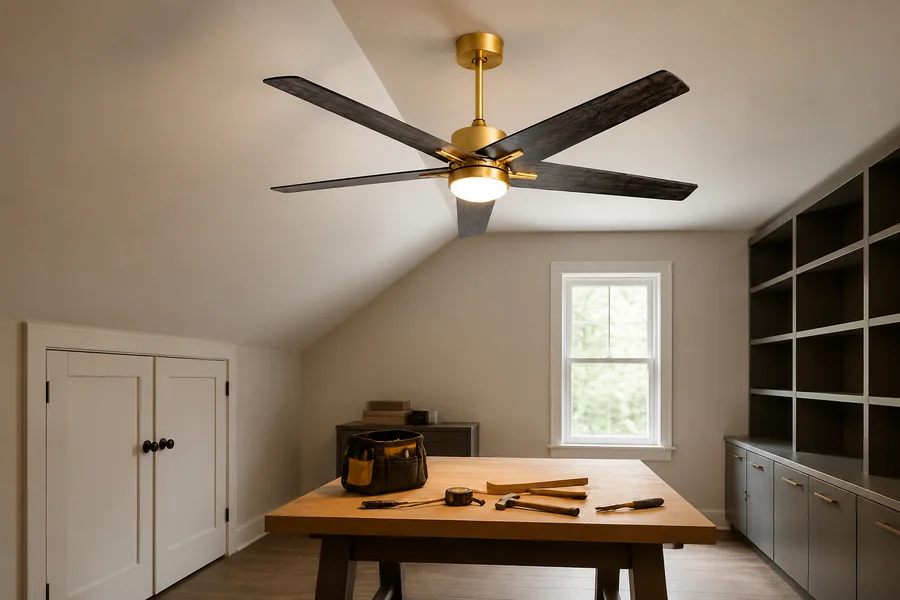
Before choosing a sloped ceiling fan, measure or estimate the ceiling angle. Many fans can handle a mild slope with their standard canopy, but steeper ceilings may need a special adapter. Do not assume every fan works on every angled ceiling.
The best starting point is to ask two questions: what is the ceiling pitch, and what maximum angle does the fan mount support? If those two points do not match, the fan may need a different adapter or a different model.
2-1. Mild slopes may use a standard canopy
Some ceiling fans include a canopy that can handle a modest angle. This is common in standard downrod fans, but the supported angle is not universal. Before choosing the product, check the installation guide or supplier specification and confirm whether the included canopy can handle the actual ceiling pitch without an extra adapter.
2-2. Steep vaulted ceilings need extra care
Steeper ceilings often need an angled ceiling adapter because the standard canopy may run out of movement before the fan becomes level. This part helps the downrod hang vertically while the upper canopy sits against the angled surface. It is especially important in high vaulted living rooms, loft bedrooms, and A-frame spaces where a small angle error becomes very visible.
2-3. The mount type should be checked first
If you are comparing mounting methods, start with a full ceiling fan mount type guide. It explains why flush mount, downrod, and angled mounting solve different ceiling problems.
3. What an Angled Ceiling Adapter Does
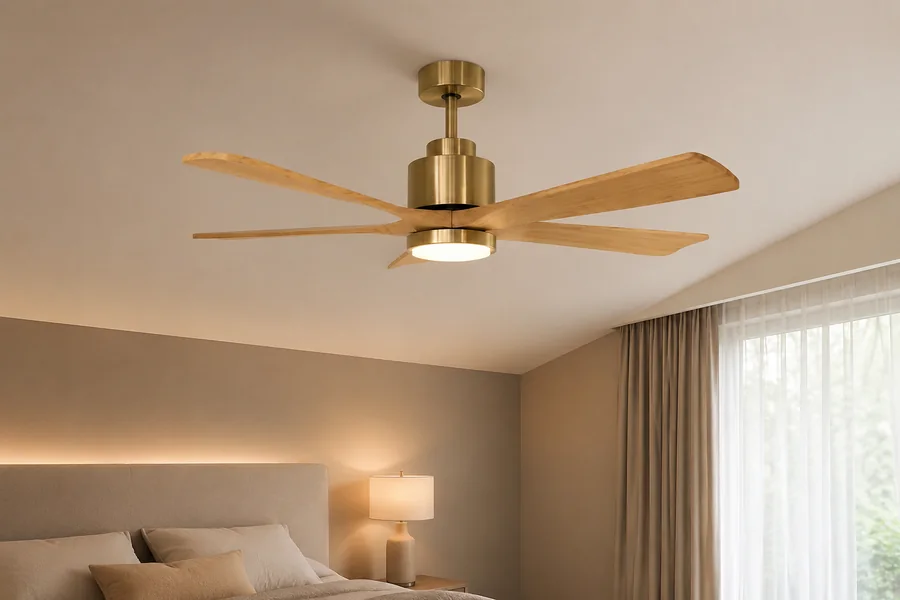
An angled ceiling adapter is a mounting accessory that allows a ceiling fan to hang vertically from a sloped ceiling. It does not make the fan stronger by itself. It simply helps align the fan correctly when the ceiling surface is not flat.
This part is small, but it can decide whether the installation feels clean or awkward. If the adapter is missing or not matched to the angle, the fan may sit too close to the slope or fail to hang properly.
3-1. It helps the downrod hang straight
The adapter lets the downrod drop vertically even when the ceiling is angled. This keeps the fan motor level and helps the blades rotate evenly, which reduces visible wobble and makes the fixture look intentional. It also helps the light kit sit flat, which matters in living rooms and bedrooms where the fan is always in view.
3-2. It increases clearance from the slope
A suitable angled adapter creates more usable space between the fan assembly and the sloped ceiling surface. This matters most on steeper ceilings, where the canopy and upper blade path can sit close to the roof plane. The adapter does not replace the need for correct downrod length, but it gives the installer a better starting point.
3-3. It must match the fan and ceiling angle
Not every adapter fits every fan. Check the fan brand, canopy style, downrod diameter, hanging ball size, wire space, and maximum slope limit before ordering. A mismatch can create installation problems that are hard to solve on-site, especially when the installer has already opened the ceiling box.
4. Downrod Length Matters on Vaulted Ceilings
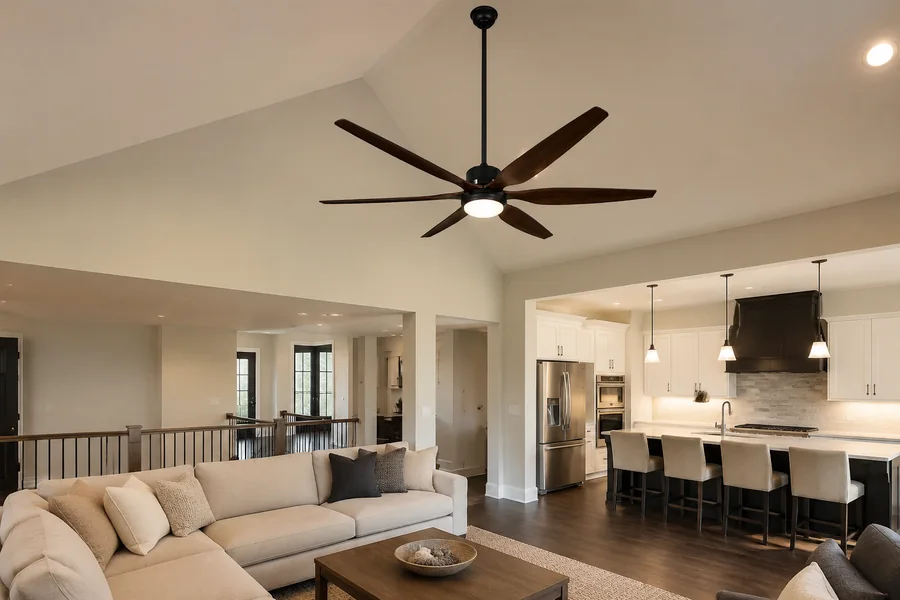
Most sloped ceiling installations need a downrod. The downrod lowers the fan away from the angled surface and helps place the blades at a better working height. Without enough drop, the fan may sit too close to the ceiling and move air poorly.
The right length depends on ceiling height, slope, fan size, and room use. A downrod ceiling fan guide can help you think through this before choosing a rod.
4-1. Higher ceilings usually need longer rods
If the ceiling is high, a short rod may leave the fan too far above the living area. Longer rods help bring airflow down to where people sit or sleep, but they also change the visual proportion of the fixture. For vaulted rooms, it is useful to mark the estimated fan height before purchase so the final position does not feel too high to work or too low to feel comfortable.
4-2. Large fans need more clearance
A larger fan has a wider blade path. On a slope, that wider path increases the chance of getting too close to the ceiling. A big 66 inch wood ceiling fan light needs careful mount height planning in tall open rooms.
4-3. The fan should not hang too low
More drop is not always better. The fan still needs safe floor clearance and should not feel too close to people, tall furniture, loft railings, or cabinet doors. The aim is useful airflow in the occupied zone, not a low-hanging fixture that creates visual pressure or installation risk.
5. Fan Size and Blade Clearance on a Sloped Ceiling
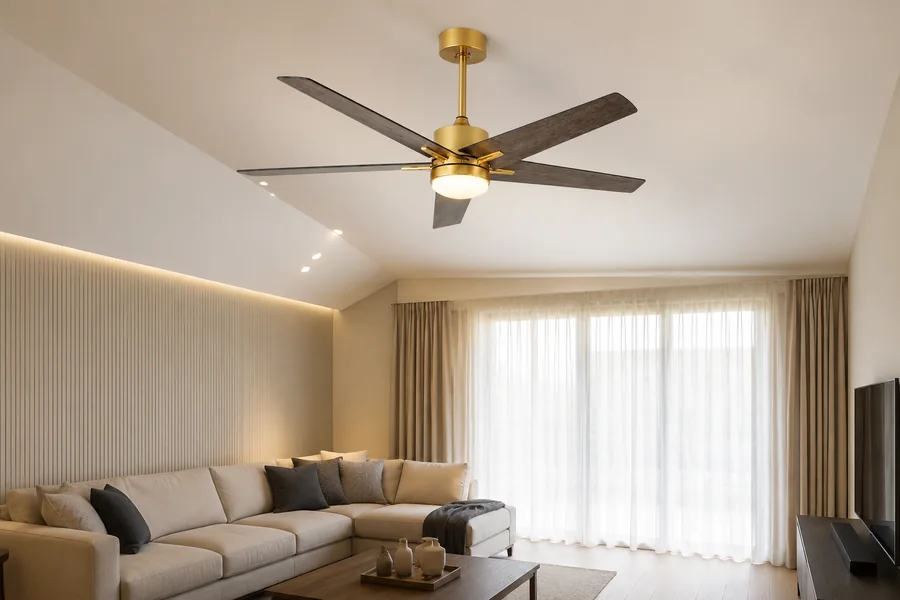
Fan size becomes more sensitive on a sloped ceiling. A fan that fits a flat room may become too wide when one blade edge moves close to the angled surface. Always check the full blade sweep, not only the motor position.
In vaulted rooms, buyers often choose larger fans because the space feels open. That can be correct, but only if the fan has enough clearance from the ceiling, walls, beams, and tall furniture.
5-1. Check the highest blade side
On a sloped ceiling, one side of the rotating blade path may sit closer to the ceiling. This is the side that usually creates the clearance risk, so it should be checked with the full blade sweep in mind. If the fan has wide blades, thick blade tips, or a large light kit, leave extra margin instead of relying on a tight fit.
5-2. Keep distance from beams and walls
Vaulted rooms often include beams, rafters, high windows, sloped trim, or pendant lights. The fan should not sit where blades pass too close to these features, even if the motor itself looks centered. In open rooms, also check whether the fan position aligns with the seating area rather than only the roof peak.
5-3. Match size to the open space
A vintage ceiling fan with remote may suit a vaulted living room if the blade span, finish, and rod length all match the room scale. In this type of space, decorative style should still be checked against clearance and airflow needs before the model is confirmed.
Need the Right Ceiling Fan for a Home, Project, or Commercial Space?
Tell us your space type, ceiling height, airflow needs, lighting options, certification direction, and order plan. We’ll help match the right solution.
Get a Quote6. Can Flush Mount Fans Work on Sloped Ceilings?
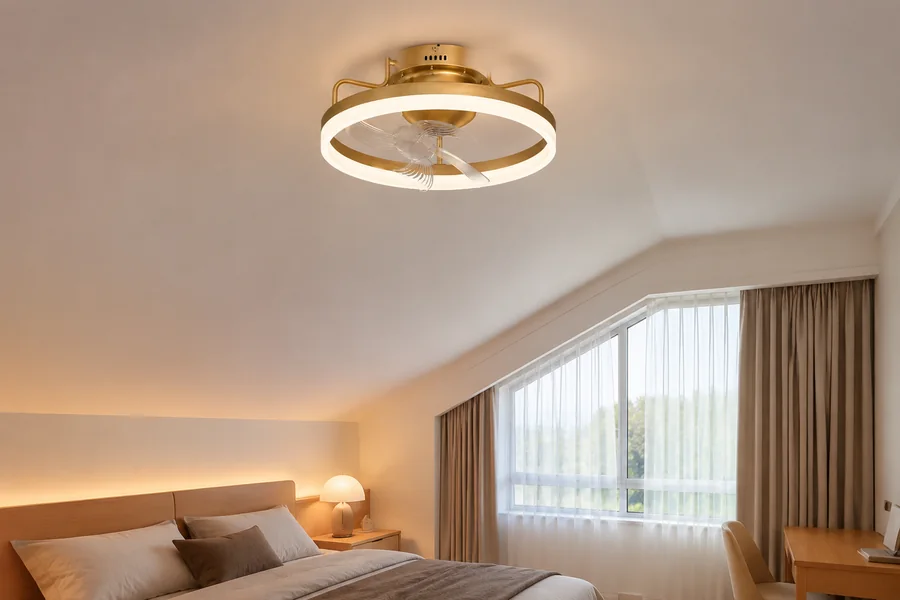
Usually, no. A flush mount fan is designed to sit close to a flat ceiling. On a sloped ceiling, it often cannot hang level, and the blades may sit too close to the angled surface. Flush mount fans are better for low, flat ceilings.
If your room has a low ceiling rather than a sloped ceiling, a flush mount ceiling fan guide is more relevant. If your room is sloped and tall, a downrod fan is usually the better direction.
6-1. Flush mount saves height but limits angle use
The main benefit of flush mount is reduced drop, which is useful for low flat ceilings. That benefit becomes a problem on a slope because there is less space to correct the angle, clear the blades, and hide the mounting hardware. If the ceiling is both low and sloped, the safest direction is usually to verify the exact product manual instead of assuming a flush mount will solve both issues.
6-2. Fan lights add more depth
A fan with light has extra fixture depth. On a sloped ceiling, this can make the fan feel more crowded if the mount is wrong. A flush mount ceiling fan with light guide is useful for flat low rooms, not steep vaulted ceilings.
6-3. Downrod mounting is usually safer for slopes
A downrod gives more room to position the fan below the angled ceiling plane. It also makes angled adapters more useful because the fan can hang level while still leaving blade clearance above. For most vaulted ceiling projects, downrod mounting gives the installer more control over both safety and airflow comfort.
7. Wiring and Support Box Requirements
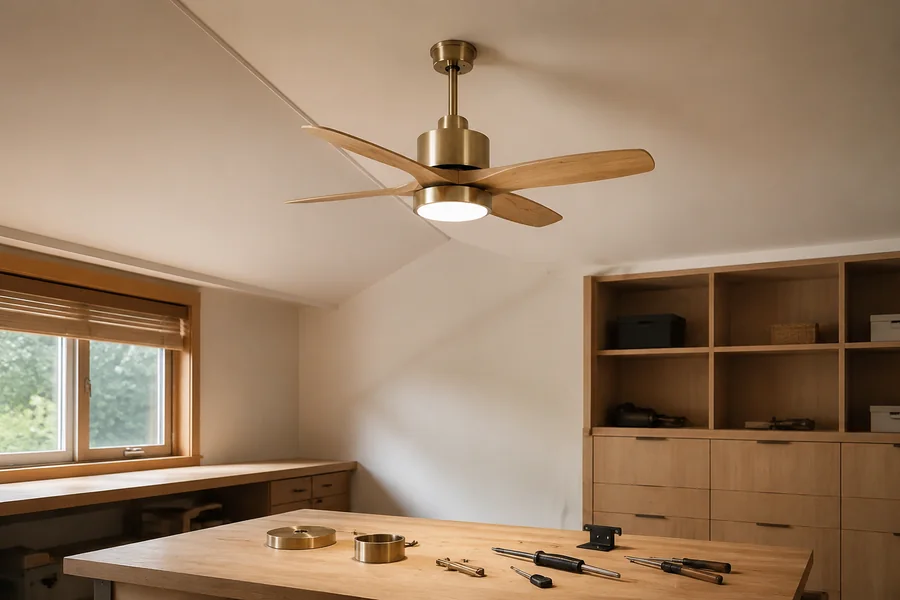
This is not the place to guess. If you are not sure about the box, wiring, or ceiling structure, use a qualified installer. Safe support matters more than saving time on installation.
7-1. Use a fan-rated support point
The support must hold the fan’s weight and movement, not just the static weight of a light fixture. A fan can vibrate during use, and that movement becomes more noticeable when the downrod is longer. A fan-rated box or structural brace helps prevent loosening, noise, and long-term safety concerns.
7-2. Check the downrod connection
The downrod, canopy, adapter, and motor coupling should all fit firmly. Loose connections can create noise, wobble, or unsafe movement.
7-3. Plan wiring before ordering
Remote control, wall control, light dimming, and smart control may need different wiring or receiver space. Confirm this before buying the fan, because sloped ceiling canopies and adapters may leave less room for bulky receivers. It is also important to check whether the wall switch, remote receiver, and LED driver are compatible with the chosen control method.
8. Best Rooms for Sloped Ceiling Fans
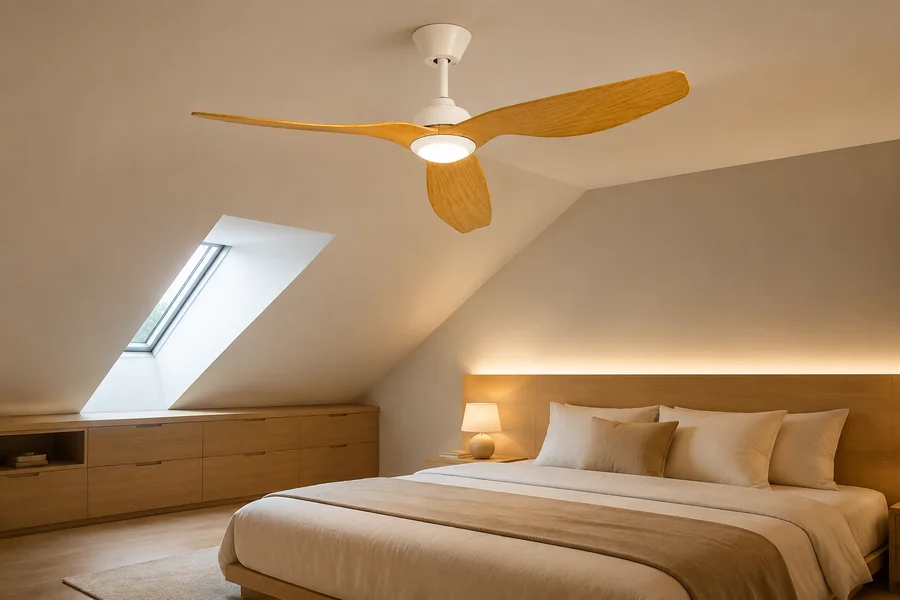
Sloped ceiling fans are most useful in rooms where the ceiling height and shape create trapped warm air or uneven comfort. They can improve air movement in spaces that feel beautiful but difficult to cool.
The key is not only choosing a fan that fits the slope. The fan should also match the way the room is used. A high dining space, bedroom loft, and covered patio may each need different size and control choices.
8-1. Vaulted living rooms
Vaulted living rooms often need stronger air circulation because the ceiling volume is large and warm air can collect above the seating area. A larger fan with the right downrod can make the room feel more even without forcing the air conditioner to do all the work. The fan should be centered over the main activity zone, not only under the highest ceiling point.
8-2. Loft bedrooms
Loft bedrooms can feel warm near the ceiling because heat rises into the sleeping zone. A quiet motor and suitable blade height matter because the fan may sit closer to the bed than it would in a standard room. Low-speed comfort is often more important here than maximum speed, especially for night use.
8-3. Covered outdoor areas
Covered patios and verandas may have sloped roofs. An outdoor ceiling fan with lights and oak blades can work well when the location, moisture rating, and mount angle are suitable.
9. Common Sloped Ceiling Fan Mistakes
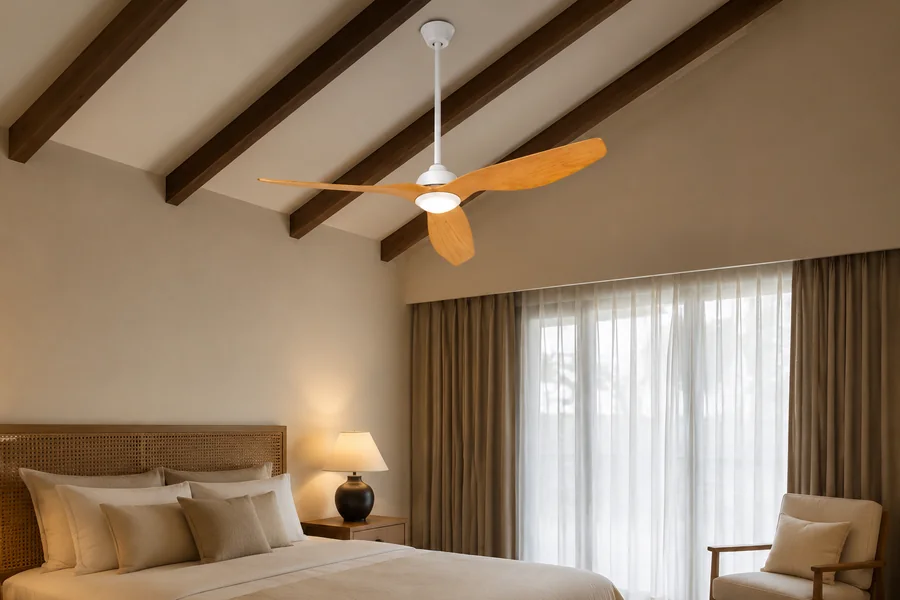
The biggest mistake is buying a fan first and checking the ceiling later. The ceiling angle, mount limit, downrod length, and blade clearance should be checked before the product style is finalised.
Another common mistake is using a fan that is too small because the ceiling feels difficult. A small fan may be easy to install, but it may not move enough air in a large vaulted room.
9-1. Ignoring the maximum slope rating
Every fan mount has limits, and the maximum slope rating is not a detail to skip. If the ceiling angle is beyond the supported range, the fan needs another adapter or another model. For project orders, record the slope requirement in the product brief so the same mistake does not repeat across multiple rooms.
9-2. Choosing a short downrod for a high ceiling
A short downrod may look neat, but it can leave the fan too high to be useful. Airflow should reach the occupied zone, not only the ceiling peak. If the room has a tall center ridge, a rod that looks long on paper may still be moderate once installed in the real space.
9-3. Forgetting the light kit depth
Fan lights can hang lower than expected because the LED diffuser, decorative shade, or receiver housing adds extra depth below the motor. Check the lowest point of the fixture, especially if the room has balconies, loft edges, bunk beds, or tall furniture. This is also important for visual comfort because a bulky light kit can feel heavy when it hangs too low.
10. Final Checks Before Installing a Sloped Ceiling Fan
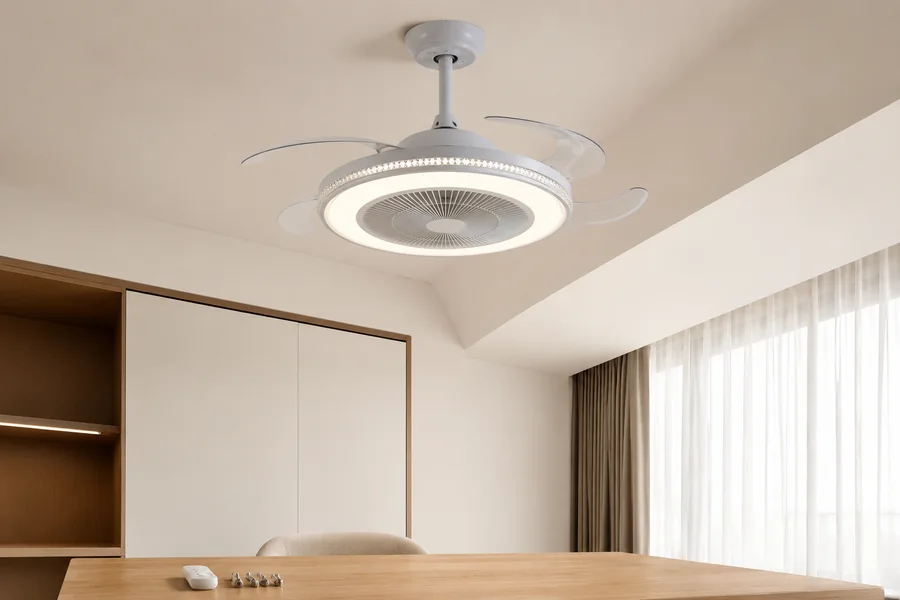
Before installation, check the ceiling angle, fan mount limit, adapter type, downrod length, blade clearance, support box, wiring, and final hanging height. These details decide whether the fan will feel safe, quiet, and useful.
10-1. Confirm the ceiling angle and adapter fit
Start with the physical ceiling, not the product style. Confirm the ceiling pitch, the fan’s maximum slope rating, and whether the standard canopy is enough or an angled ceiling adapter is required. If the adapter, canopy, and downrod do not match, the fan may look tilted even when the wiring and motor are correct.
10-2. Recheck blade clearance and final hanging height
After the mount type is confirmed, check the full blade sweep against the sloped ceiling, beams, walls, windows, and tall furniture. The fan should sit low enough to move air through the occupied area, but not so low that it feels unsafe or visually heavy. This is especially important for fan lights because the LED diffuser adds depth below the motor.
10-3. Review wiring, controls, and installation support
Remote control, wall control, dimming, and smart functions should be confirmed before installation, because receiver space can be limited inside angled mounting hardware. As a ceiling fan light manufacturer, NEBOLA often recommends starting with the room structure first, then choosing size and style. For more installation planning options, review the ceiling fan mount types page before choosing.
Need the Right Ceiling Fan for a Home, Project, or Commercial Space?
Tell us your space type, ceiling height, airflow needs, lighting options, certification direction, and order plan. We’ll help match the right solution.
Get a QuoteFAQ
Can you install a ceiling fan on a sloped ceiling?
Yes, you can install a ceiling fan on a sloped ceiling if the fan supports angled mounting or uses a suitable angled ceiling adapter. The fan must hang level and have enough blade clearance.
Do I need an angled ceiling adapter?
Yes, you may need an angled ceiling adapter if the ceiling slope is steeper than the fan’s standard canopy can handle. Always check the fan’s maximum slope rating first, then confirm whether the adapter matches the canopy, downrod diameter, and installation hardware.
Can a flush mount fan go on a vaulted ceiling?
No, a flush mount fan is usually not the right choice for a vaulted or sloped ceiling. It is designed for low, flat ceilings and often cannot hang level on a slope. For angled ceilings, a downrod fan with the correct adapter usually gives safer clearance and better airflow positioning.
Is a longer downrod always better on a sloped ceiling?
No, a longer downrod is only better when it improves airflow and clearance without making the fan hang too low. The right length depends on ceiling height, slope, and room use.
Can a ceiling fan with light work on a sloped ceiling?
Yes, a ceiling fan with light can work on a sloped ceiling if the mount, adapter, downrod, and wiring are suitable. You must also check the extra depth of the light kit.
Should I hire an installer for a sloped ceiling fan?
Yes, professional installation is strongly recommended if you are unsure about wiring, support box strength, ceiling angle, or adapter compatibility. A fan is a moving electrical fixture, so safety matters.