

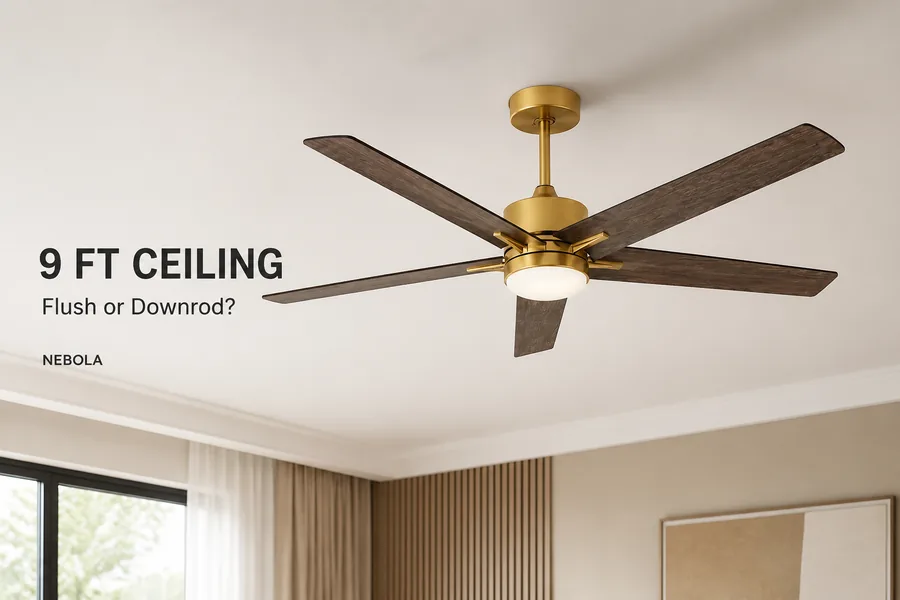
If you have a 9-foot ceiling, the answer is usually not “flush mount only” or “downrod only.” A living room ceiling fan can work in either style at this height, but the safer and more comfortable choice depends on installed drop, blade-to-ceiling distance, room size and where people actually sit or walk.
Here is the direct answer: choose flush mount when the room is compact, the fan sits near a walkway, or you want the ceiling to look clean. Choose a short downrod when the room is larger, airflow performance matters more, and the finished blade height still feels comfortable. For a 9-foot ceiling, the “best” option is usually the one that keeps enough clearance below the blades without pressing the blades too close to the ceiling.
Should a 9-Foot Ceiling Fan Use Flush Mount or a Short Downrod?

For most 9-foot living rooms, the real comparison is between a true flush mount fan and a short downrod fan, not a long hanging fan. Flush mount gives you the most headroom and the quietest ceiling profile. A short downrod usually gives the blades more breathing room, which can improve airflow and make the fan look more proportional in a larger space.
If the room is small to medium, has a low sofa zone, or already feels visually busy, flush mount is often the cleaner answer. If the room is wide, open, or has a defined seating area in the center, a short downrod may feel better because the fan can sit slightly lower without becoming intrusive.
| 9-Foot Room Condition | Better Starting Point | Why It Makes Sense |
|---|---|---|
| Compact living room or apartment | Flush mount | Keeps more open head space and reduces visual weight. |
| Large seating zone | Short downrod | Improves blade position and airflow over the main comfort area. |
| Fan near walkway or door swing | Flush mount | Reduces the feeling of a hanging object in traffic areas. |
| Open-plan room with higher visual scale | Short downrod or larger low-profile fan | Helps the fan feel intentional instead of undersized. |
| Unclear ceiling box or beam condition | Verify first | Mount type should follow structure, wiring and manufacturer instructions. |
1-1. Start with installed height, not the product name
Product names can be misleading. “Low profile,” “hugger,” “flush mount” and “short downrod” all sound simple, but each model has its own installed depth. Two fans with the same blade span can sit at very different heights once the motor body and light kit are included.
Before choosing, ask for the drawing or specification sheet and calculate the finished blade height. This gives you a real answer instead of relying on a product photo taken in an ideal showroom.
1-2. Use the room function to make the final call
A formal living room, a media room and an open family room do not use airflow in the same way. If people sit directly below the fan for long periods, airflow comfort matters more. If the fan is partly decorative or supports occasional air movement, a cleaner flush mount style may be enough.
This is why 9 feet is a flexible height. It gives you room to choose, but it still requires a practical clearance check before the design decision feels safe.
How Much Clearance Does a 9-Foot Ceiling Fan Really Need?
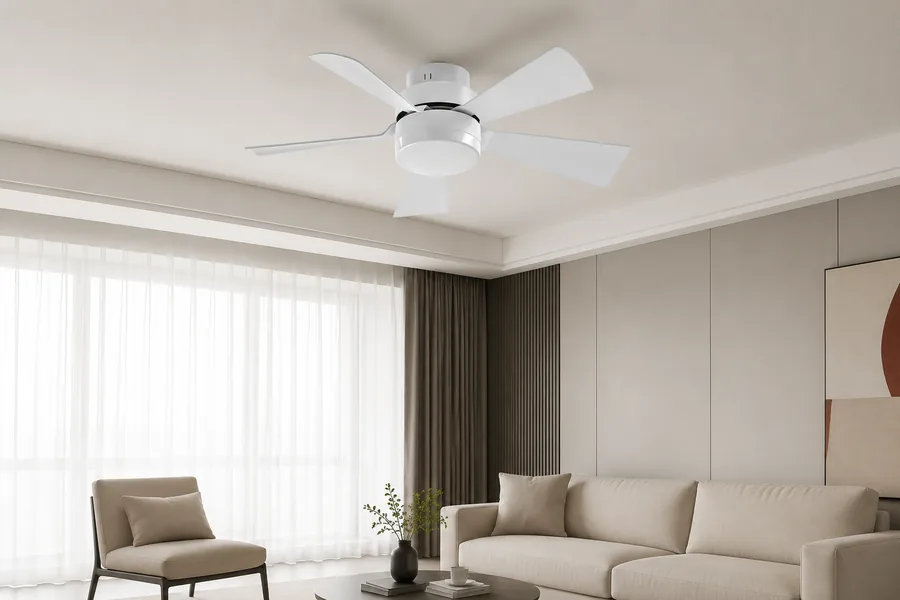
A 9-foot ceiling gives you 108 inches from floor to ceiling. From that number, subtract the fan’s total drop to estimate where the lowest blade edge will sit. This simple calculation is more useful than asking whether flush mount or downrod is “better” in general.
The basic formula is: ceiling height minus total fan drop equals blade height above the floor. Total fan drop should include the canopy, motor housing, blade plane and any lower light kit if it affects the lowest visible point.
| Example on a 9-Foot Ceiling | Estimated Blade Height | Practical Meaning |
|---|---|---|
| 108 in ceiling – 8 in flush fan drop | About 100 in / 8 ft 4 in | Very comfortable clearance; airflow depends on blade-to-ceiling space. |
| 108 in ceiling – 12 in low-profile fan drop | About 96 in / 8 ft | Still comfortable for most living rooms. |
| 108 in ceiling – 18 in short downrod setup | About 90 in / 7 ft 6 in | Often workable if the fan is not over a walkway. |
| 108 in ceiling – 24 in deeper hanging setup | About 84 in / 7 ft | Needs careful checking and may feel low in many rooms. |
2-1. Do not forget the light kit
Many mistakes happen because buyers only check the downrod length. The fan body, blade brackets and light diffuser also affect how low the fixture feels. A slim fan without a deep light kit can work where a decorative fan light with the same rod length feels too heavy.
If your fan includes lighting, judge the whole fixture from ceiling to lowest visible point. This is especially important in rooms where people stand, stretch, move furniture or walk under the fan regularly.
2-2. Keep local rules and instructions in the decision
Clearance expectations can vary by region, product type and building condition. Treat the calculation as a first screening tool, then confirm the final installation with local code, the installer and the manufacturer’s manual.
For rooms close to the limit, compare the more restrictive guidance in the 8 foot ceiling fan guide. It helps show why the extra foot at 9 feet creates more options, but does not remove the need for careful measurement.
Why Does Ceiling Fan Blade-to-Ceiling Distance Change Airflow?
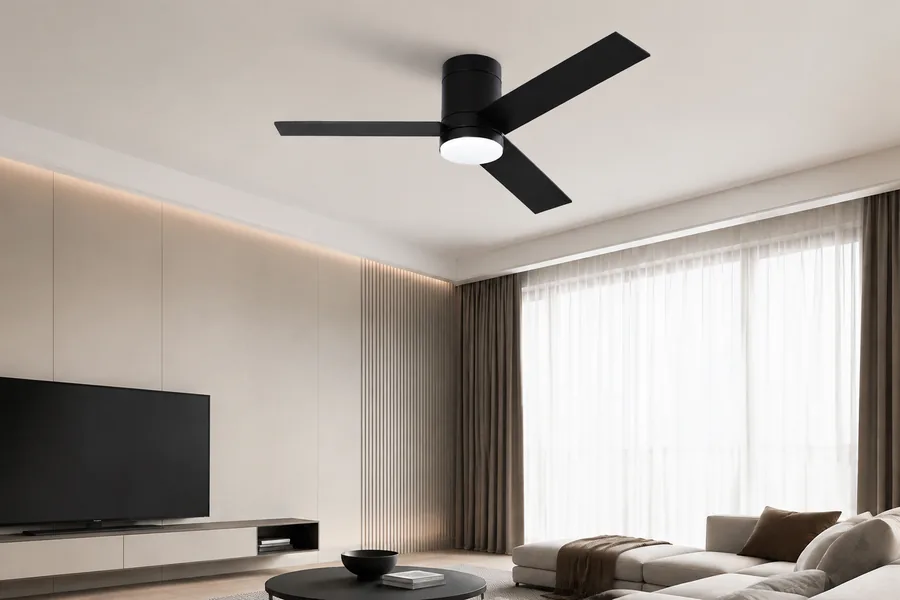
Blade-to-ceiling distance matters because ceiling fans need air above the blades as well as below them. When blades sit too close to the ceiling, the fan can look compact but may struggle to pull enough air smoothly. This is the main performance reason a short downrod can beat a flush mount fan on some 9-foot ceilings.
At the same time, dropping the fan too low can make the room feel crowded. The right answer is not maximum drop; it is balanced drop. You want enough space above the blades for airflow while keeping the fan safely and visually comfortable below.
3-1. Flush mount can trade airflow space for headroom
Flush mount fans are useful because they stay close to the ceiling. The trade-off is that some models leave less space above the blade plane. If the motor is weak or the blade design is shallow, the fan may feel gentler than expected.
That does not mean flush mount is wrong. It means you should check motor type, blade shape and real airflow data instead of assuming every flush design performs the same. A well-designed flush fan can still be a strong choice for a moderate room.
3-2. Short downrods can improve airflow without feeling too low
A short downrod can move the blades away from the ceiling enough to improve air intake. On a 9-foot ceiling, this can be useful above a sofa group, dining-adjacent living zone or wider family room where comfort coverage matters.
If you are comparing multiple spans, the large living room fan guide explains why airflow coverage depends on more than diameter alone. Mounting height and room shape also matter.
When Should You Choose a Flush Mount Ceiling Fan for a 9-Foot Ceiling?
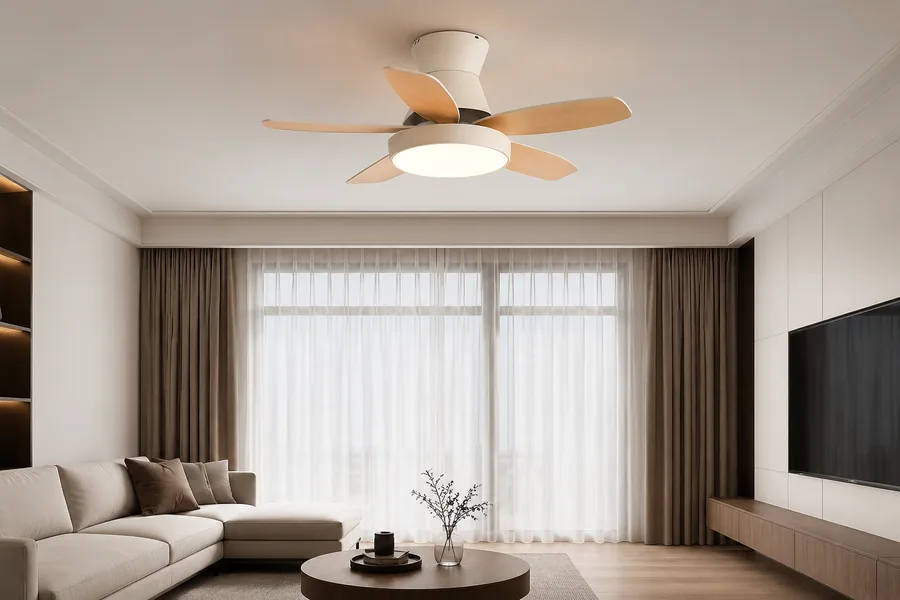
Choose flush mount when the room needs a clean ceiling line, more open visual space or extra confidence around head clearance. This is common in compact living rooms, apartments, rooms with recessed lighting, and spaces where the fan is close to circulation paths.
A flush fan also works well when the design goal is quiet integration. Instead of becoming the main ceiling feature, it supports airflow and lighting while letting furniture, wall finishes or windows carry the room.
4-1. Use flush mount when the fan should visually disappear
If your ceiling already has beams, recessed lights, pendant fixtures or a strong architectural detail, a low-profile fan often feels calmer. It reduces the chance that the ceiling looks crowded.
A product such as an air multiplier flush mount ceiling fan can suit rooms where the fan needs to stay compact while still combining light and air movement in one fixture.
4-2. Use flush mount when people pass under the fan often
Walkways change the decision. A fan over a sofa can sit differently from a fan near a hallway opening or door path. If people move under the fan frequently, flush mount often feels more comfortable even when a short downrod is technically possible.
Flush mount is also easier to accept in rental spaces or smaller homes where users want practical comfort without the ceiling fixture feeling like a large hanging object.
When Should You Choose a Short Downrod Ceiling Fan for a 9-Foot Ceiling?

Choose a short downrod when the room is large enough for the fan to have presence and when airflow performance matters more than the lowest possible profile. On a 9-foot ceiling, a short downrod can place the blades in a more effective position while still keeping the fixture usable in a normal living room.
The key word is short. This is not the same as using a long downrod for a tall vaulted room. A 9-foot ceiling usually benefits from restrained drop, careful proportion and a fan body that does not hang too deeply.
5-1. Use a short downrod for wider seating areas
If the room has a broad sofa group, open-plan seating zone or larger furniture scale, a flush fan may look undersized or feel weak. A short downrod helps the fan relate to the furniture below and can improve air movement across the seating area.
For example, a 66 inch wood ceiling fan light may make sense only when the room width, fan drop and visual scale all support it. The ceiling height alone is not enough reason to choose a larger fan.
5-2. Use a short downrod when blade spacing matters
If you care about stronger comfort at low or medium speed, the blade position can matter. Short downrod installation may allow the fan to move air more smoothly than a very tight hugger design, especially when the ceiling is flat and uninterrupted.
This is why many 9-foot living rooms sit in a middle category: not low enough to force flush mount, but not high enough to ignore drop height. The final choice should balance both sides.
What Ceiling Fan Size Works Best for a 9-Foot Living Room Ceiling?
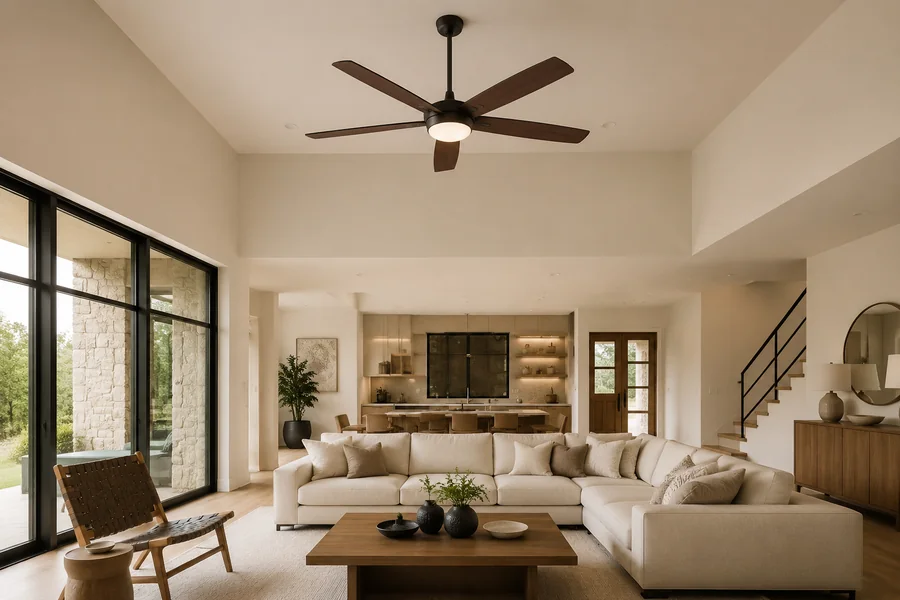
Fan size should follow room size, not only ceiling height. A 9-foot ceiling can support a range of spans, but the right span depends on the room’s square footage, shape and furniture layout. A small fan may clear the room perfectly but fail to cover the comfort zone. A large fan may move air well but feel too dominant.
For many standard living rooms, 52 to 60 inches is a common comparison range. Larger open spaces may move toward 60, 66 or 72 inches, but only when there is enough room around the blades and the fan does not conflict with lights, beams or walls.
| Room Situation | Common Fan Direction | Mounting Note for 9 Feet |
|---|---|---|
| Small living room or apartment zone | 42-48 inch fan | Flush mount or very slim profile usually feels best. |
| Standard living room | 52-56 inch fan | Flush mount or short downrod can both work after drop check. |
| Larger family room | 56-60 inch fan | Short downrod may improve coverage if clearance remains comfortable. |
| Wide open living room | 60-72 inch fan or two fans | Check room width, placement and visual scale before choosing one large fan. |
6-1. Do not make 42 inches do a large fan’s job
A 42 inch flush mount ceiling fan can be useful in a smaller room or defined zone, but it is usually not enough for a large living room. If you choose it only because it looks safe on a 9-foot ceiling, you may solve clearance and lose comfort.
For a more complete size baseline, use the 42 to 72 inch fan size guide to compare span against real room needs.
6-2. Large fans need room width and correct placement
A larger fan can be suitable on a 9-foot ceiling when the room is wide enough and the fan is centered over the main living zone. But large span alone does not guarantee comfort. Placement, blade pitch, speed range and mounting height all affect how the airflow feels.
For bigger rooms, compare the 60 inch vs 72 inch ceiling fan guide and the 52 inch living room fan guide before assuming one size fits every 9-foot ceiling.
How Do Living Room Layout and Furniture Change Ceiling Fan Placement?
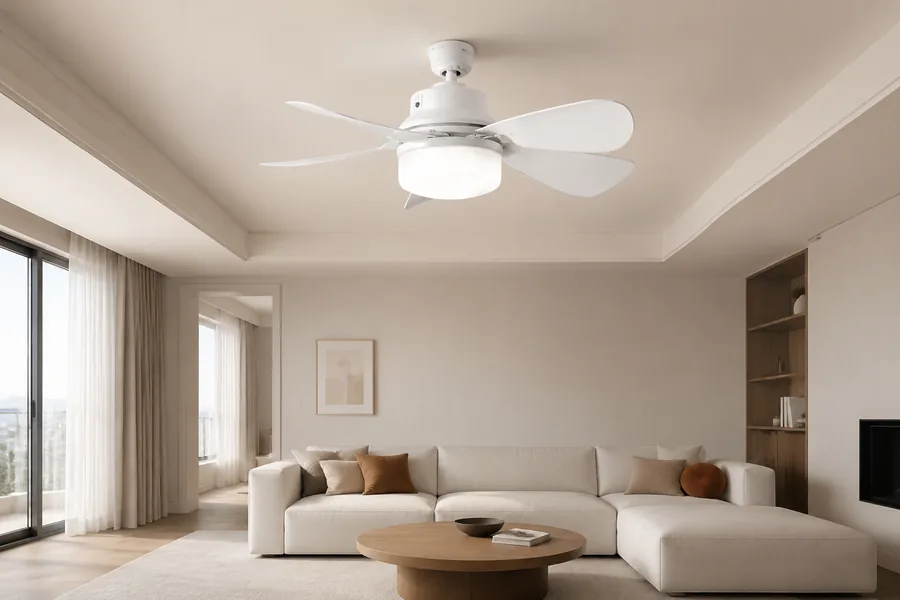
Room layout often changes the answer more than the ceiling height does. The same 9-foot ceiling can need different fan choices in a square living room, a long narrow room or an open concept layout. Your goal is not only to center the fan on the ceiling; it is to place airflow where people actually need comfort.
Furniture also matters. A fan above a sofa group can feel comfortable at a different height than a fan above a walkway. A fan near tall cabinets, beams or recessed lighting may need a different span or mount type to avoid visual conflict.
7-1. Center the fan over the comfort zone, not just the room
If the seating area is off-center, placing the fan in the exact center of the ceiling may miss the people using the room. A better plan is to align the fan with the sofa group or the main occupied zone while still respecting structural support and blade clearances.
For open rooms, the open concept ceiling fan guide helps decide whether one fan can cover the space or whether multiple smaller fans make the airflow more even.
7-2. Use two fans when one large fan cannot cover the shape
Long rooms are a common problem. One large fan may look impressive but leave the far end still and uncomfortable. Two smaller fans can sometimes give better coverage, especially when the room has two seating areas or a living-dining combination.
The guide to one large fan or two smaller fans is useful when the question is coverage rather than ceiling height alone.
What Ceiling Fan Installation Checks Matter Before You Buy?
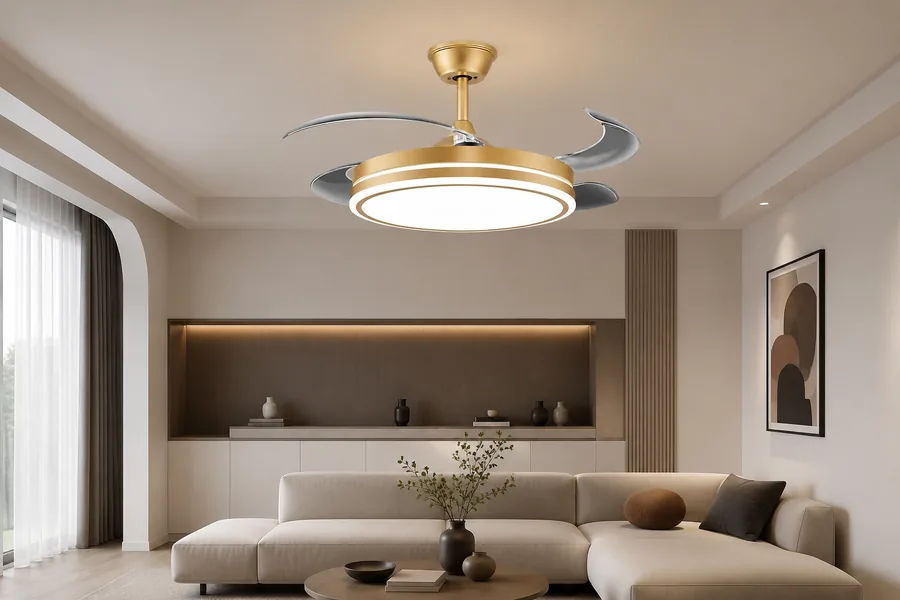
Before buying, check the installation conditions as carefully as the style. A fan needs a suitable ceiling box, proper support, compatible wiring and a mounting system that matches the ceiling surface. This is especially important when changing from an old light fixture to a fan.
A 9-foot ceiling does not automatically make installation simple. The room may still have beams, sloped areas, weak boxes, unusual wiring or lighting locations that affect where the fan can safely go.
8-1. Confirm ceiling support and electrical conditions
The fan should be mounted to a fan-rated support system, not just a standard light fixture box. If you are unsure, ask an installer to check the structure before ordering. Building conditions matter, and FEMA’s building science resources are a useful reminder that structure and installation context should not be treated as decoration details.
For project orders, ask for installation drawings, carton specifications, downrod options and mounting diagrams. These documents help prevent mismatches between the selected fan and the actual site.
8-2. Check conflicts with lights, beams and doors
Measure more than ceiling height. Check the distance to recessed lights, walls, upper cabinets, door swings and tall furniture. A fan can be technically installable but still feel wrong if it crowds other ceiling elements.
If the room is close to a great-room scale, the great room ceiling fan guide can help separate normal 9-foot living room decisions from larger architectural space planning.
What 9-Foot Ceiling Fan Buying Mistakes Should You Avoid?
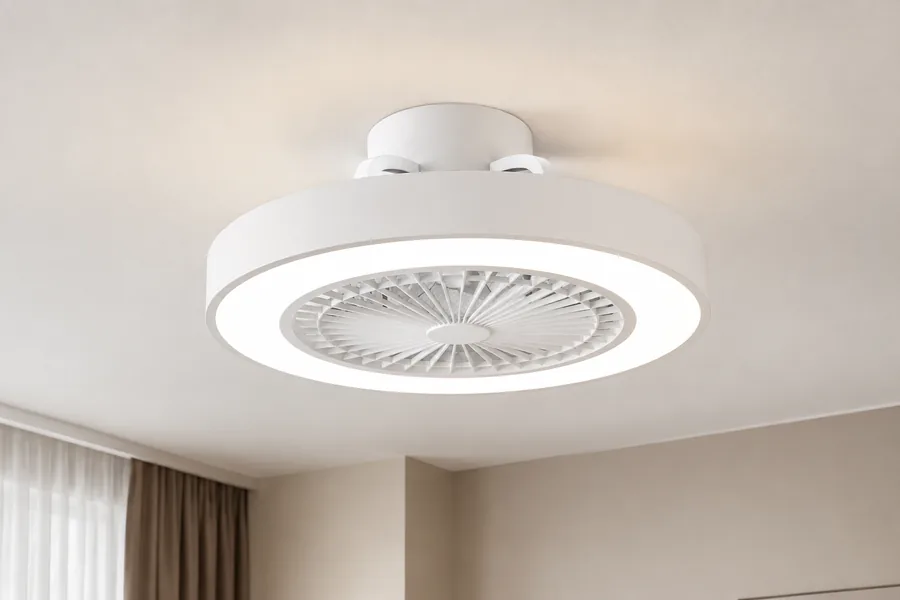
The biggest mistake is treating a 9-foot ceiling as a high ceiling. It is more forgiving than 8 feet, but it is still a normal residential height. Long downrods, deep light kits and oversized fan bodies can make the room feel lower and heavier than expected.
The second mistake is choosing flush mount only because it feels safe. A poor flush mount fan can sit close to the ceiling and still disappoint on airflow. Safety, comfort and performance need to be checked together.
9-1. Do not choose by downrod length alone
Downrod length is only one part of total drop. The canopy, motor housing, blade brackets and light kit can add depth. Always compare total installed height across products, especially when the room has a sofa, coffee table or walkway below the fan.
If you are considering a heavier or wider fan, a large 70 inch ceiling fan should be reserved for spaces where the room scale truly supports it. It is not automatically the right answer just because the ceiling is 9 feet high.
9-2. Do not ignore low-speed comfort
Many living rooms use ceiling fans at low or medium speed, not maximum speed. A fan that only looks strong on paper may feel harsh, noisy or uneven in daily use. Check whether the fan can provide gentle airflow across the seating area without making people feel blasted.
This is also where motor quality, blade balance and control options matter. The best 9-foot setup should feel comfortable in normal use, not only impressive in a specification table.
Final Recommendation: Which Ceiling Fan Mount Should You Choose?
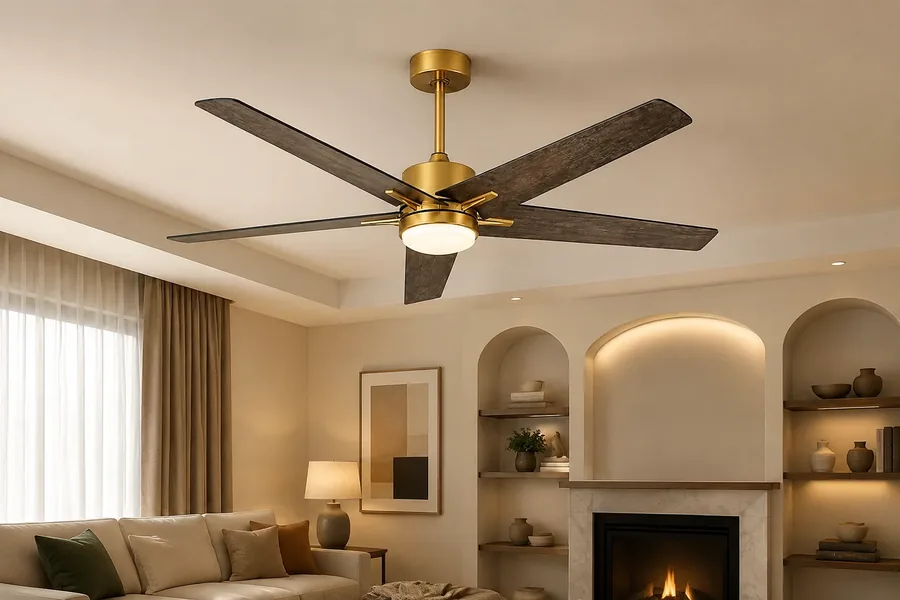
Use this final rule: if the room is compact, busy, close to walkways or design-focused, start with flush mount. If the room is larger, the seating area is central and airflow is the main concern, start with a short downrod. Then confirm the decision with total drop height, blade clearance, room size and installation drawings.
For a 9-foot ceiling, the best answer is usually a restrained one. Avoid long rods unless the product and room clearly support them. Avoid tiny fans in large rooms. Choose the mount that gives enough clearance below, enough breathing room above and enough airflow across the actual living zone.
10-1. Choose flush mount when clearance and clean design matter most
Flush mount is the safer visual choice when you want the fan to stay quiet in the ceiling design. It works well in smaller living rooms, apartments and spaces where lighting and air movement need to come from one compact fixture.
It is also the better starting point when people regularly pass under the fan or when you want the room to feel taller and less crowded.
10-2. Choose a short downrod when airflow and proportion matter most
A short downrod is often the better comfort choice when the room is wide enough and the fan needs to move air across a larger seating area. It can help the fan feel more intentional and improve airflow compared with a very tight mount.
If you are looking for a better ceiling fan light solution for your project, NEBOLA can provide one-stop support from product selection to customization. We focus on ceiling fan light R&D and manufacturing, helping brands, importers, and distributors find products that better match real space needs.
Need Help Choosing the Right Ceiling Fan Light?
Tell us your room size, ceiling height, lighting needs and project plan. NEBOLA can help match the right fan light style and configuration.
Get a QuoteFAQ About Flush Mount vs Downrod Fans for 9 Foot Ceilings
Can a 9-foot ceiling use a downrod ceiling fan?
Yes. A 9-foot ceiling can often use a short downrod ceiling fan, but the final answer depends on total fan drop, blade clearance, furniture location and local installation rules. Avoid long downrods unless the product drawings prove the blade height remains comfortable.
Is flush mount better for every 9-foot living room?
No. Flush mount is better when you want a clean ceiling line or extra head clearance, but a short downrod can perform better in larger living rooms because the blades have more space above them to pull and move air.
What downrod length is usually practical on a 9-foot ceiling?
A short downrod is usually the practical direction. Many buyers look at 4- to 6-inch downrods first, then check the actual installed height because motor housings and light kits can add more depth than expected.
How much clearance should I keep under the fan blades?
A common practical target is to keep the fan blades around 7 feet or more above the floor, while also checking local code and the manufacturer's instructions. The blade height should be calculated from the finished floor to the lowest blade edge, not guessed from ceiling height alone.
Can a large ceiling fan work on a 9-foot ceiling?
Yes, but only when the room is wide enough and the fan does not feel visually heavy. Large spans can suit open living rooms, but compact rooms usually need a smaller fan or a different layout plan.
Can NEBOLA help choose the correct mount type?
Yes. NEBOLA can help compare flush mount depth, short downrod options, blade span, motor type, light configuration and project installation requirements for brands, importers and distributors.