

A bigger ceiling fan can move more air, but only when the fan is well matched to the room, motor, blade design, and ceiling height. Size matters, but it is not the whole story. A wide fan with weak motor control can feel lazy. A smaller fan with strong airflow can feel sharp but limited. The best ceiling fan is the one that gives steady air circulation where people actually sit, sleep, walk, and live.
This guide explains the link between ceiling fan airflow, CFM, air circulation, and fan performance. It is written for buyers who want a clear answer before choosing a fan for a bedroom, living room, dining area, apartment, or open-plan space.
1. Why Bigger Does Not Always Mean Better Airflow
Many people look at a ceiling fan and think, “bigger fan, stronger wind.” That sounds simple. In real life, it is only partly true.
A larger blade span can move air across a wider area. This is useful in a living room, open-plan space, or large bedroom. But airflow is not only about the width of the fan. It also depends on the motor, blade pitch, blade shape, speed setting, and how high the fan is installed.
Think of it like opening a large window. A large window can let in more air, but only if there is enough breeze outside. In the same way, a large fan can cover more space, but it still needs the right motor and blade design to move air well.
1-1. The common belief about larger ceiling fans
The common belief is that a bigger ceiling fan always moves more air. This is why many buyers choose a 56 inch or 60 inch fan even when the room is not very large.
Sometimes this works. A larger fan can spread air more gently than a small fan running at high speed. But if the room is small, the same fan may feel too strong, too close, or visually heavy.
1-2. Moving more air vs feeling more comfortable
Moving more air is not the same as feeling more comfortable. Comfort depends on how the air reaches your body.
A fan that pushes too much air directly over a bed can disturb sleep. A fan that only moves air near the ceiling may look powerful but feel weak at sofa height. The goal is not maximum wind. The goal is even, steady air circulation.
1-3. Why fan size, room size, and fan performance must be judged together
Fan size should never be judged alone. A good decision combines:
| Factor | Why it matters |
|---|---|
| Blade span | Decides how wide the airflow can spread |
| CFM | Shows how much air the fan can move |
| Motor type | Affects speed control, noise, and stability |
| Ceiling height | Changes how well airflow reaches people |
| Room layout | Decides whether air can move evenly |
When these factors work together, the fan feels calm and useful. When they do not, even a large fan may disappoint.
2. What Ceiling Fan Airflow Really Means

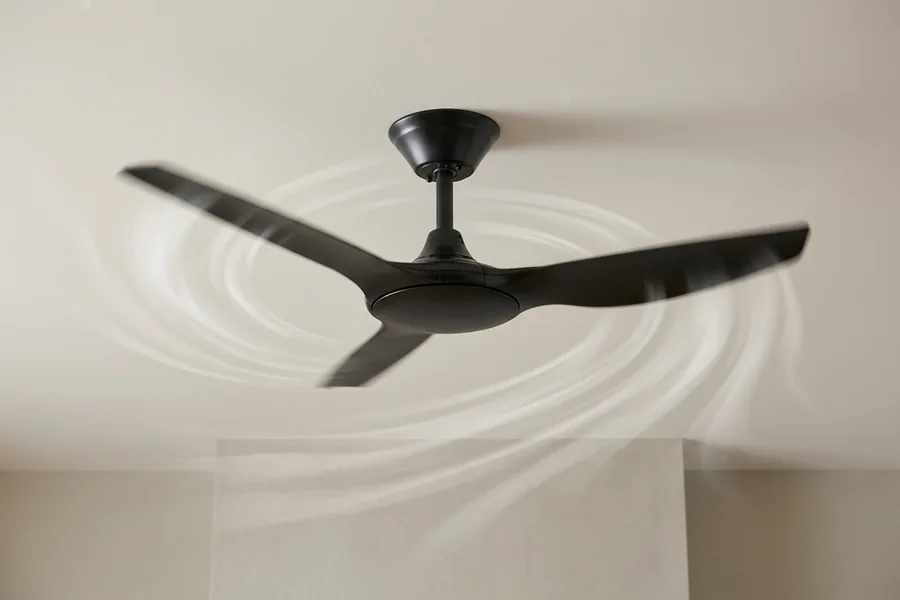
Ceiling fan airflow is the movement of air created by the spinning blades. It does not cool the room like an air conditioner. Instead, it moves air across your skin and helps your body feel cooler.
That is why ceiling fan airflow is more about comfort than temperature. The room may still be the same temperature, but the moving air helps heat leave your body faster.
2-1. How a ceiling fan moves air around a room
A ceiling fan pulls air from above and pushes it down or moves it around the room, depending on blade direction and speed. In summer, most fans run counterclockwise to create a downward airflow. This makes the room feel fresher.
In winter, some fans can reverse direction. This helps move warm air down from the ceiling without creating a strong draft.
2-2. Why air circulation is different from lowering room temperature
Air circulation does not lower the actual room temperature. It changes how the room feels.
This matters because some buyers expect a fan to work like cooling equipment. A ceiling fan is better understood as a comfort tool. It helps distribute air, reduce stillness, and support better ventilation when used with windows or air conditioning.
2-3. Why airflow comfort is felt at body level
Good airflow must reach the people in the room. If the fan is too high, too small, or blocked by beams and furniture, the air may not reach the seating area.
For a bedroom, airflow should feel soft over the bed. For a living room, it should reach the sofa and main seating area. For a dining room, it should be gentle enough not to disturb food, papers, or table settings.
3. What CFM Tells You About Fan Performance
CFM means cubic feet per minute. It tells you how much air a ceiling fan can move in one minute. In simple words, CFM is the airflow number.
A higher CFM usually means stronger air movement. But it should not be read alone. A fan with high CFM may also create more noise, use more energy, or feel too strong in a small room.
3-1. What CFM means in ceiling fan airflow
CFM gives a clearer picture than size alone. Two 52 inch fans may look similar, but one may move much more air than the other.
This can happen because of motor design, blade angle, blade material, and speed range. So if you want to compare fan performance, CFM is one of the first numbers to check.
3-2. Why higher CFM is useful but not always better
Higher CFM is useful in large rooms, high ceilings, open spaces, and warm climates. But in a small bedroom, very high airflow can feel harsh.
For daily comfort, moderate airflow at low or medium speed is often better than strong airflow at full speed. A good fan should give options, not only power.
3-3. CFM vs airflow efficiency
Airflow efficiency compares how much air the fan moves against how much energy it uses. A fan with good efficiency can move a useful amount of air without wasting power.
This is where DC motor ceiling fans often perform well. They can offer smoother speed control and lower energy use than many older AC motor fans.
3-4. Why test conditions and speed settings matter
CFM ratings are often measured under test conditions. Real rooms are different. Ceiling height, furniture, room shape, and installation height can all change how airflow feels.
So use CFM as a guide, not a promise. The real question is: will this fan move air well in your room?
4. How Fan Size Affects Air Movement
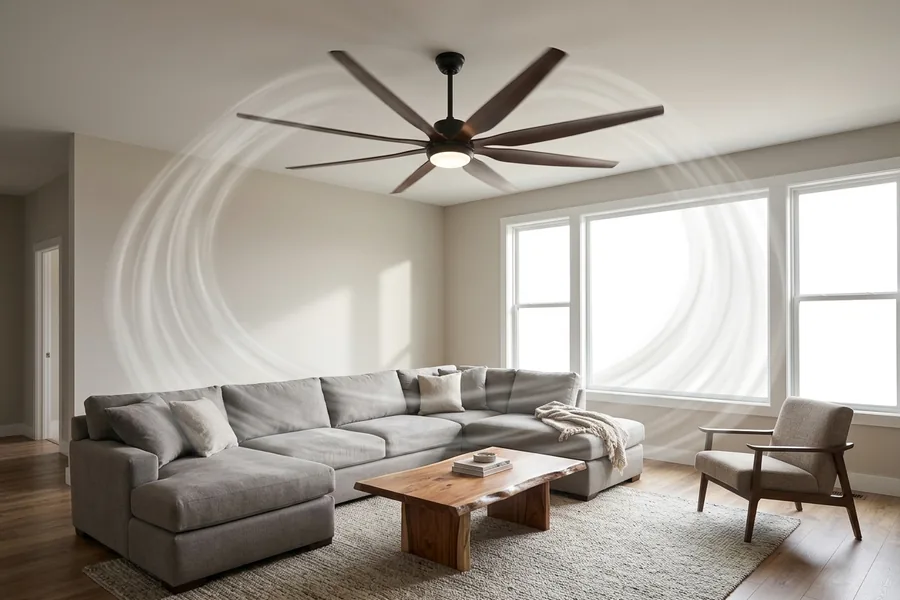
Fan size affects how wide the airflow can spread. A larger fan does not just push air down. It can also move a broader column of air, which helps in wider rooms.
This is why a 60 inch fan can feel better in a large living room than a 42 inch fan running at high speed. The larger fan can cover more space with less effort.
4-1. Blade span and the width of the air column
Blade span is the diameter of the circle made by the spinning blades. A wider blade span usually creates a wider air column.
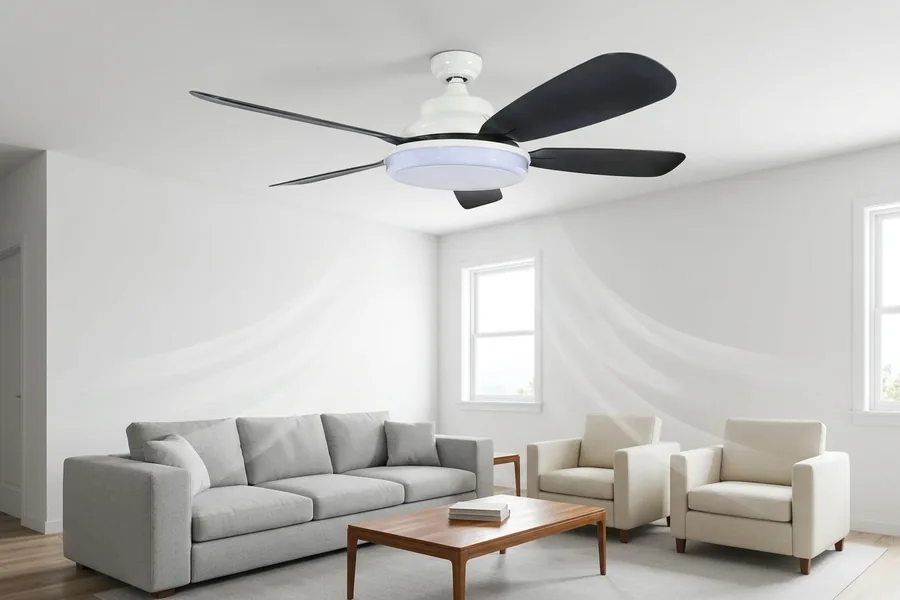
This helps air reach more parts of the room. It is especially important in square rooms, large bedrooms, open living rooms, and spaces where people sit away from the centre.
4-2. Why larger fans can cover wider rooms
Larger fans are useful because they cover more area. A small fan may create strong airflow directly below it, but the corners of the room may still feel still.
A larger fan can spread air more evenly. This is why large room fans are often designed with wider blades, stronger motors, and smoother low-speed control.
4-3. Large low-speed airflow vs small high-speed airflow
A large fan running slowly can feel calmer than a small fan running fast. This is one reason many people like bigger fans in living rooms and master bedrooms.
Small high-speed airflow can feel sharp. Large low-speed airflow can feel smooth. The second option is often better for comfort, especially in rooms used for rest.
4-4. When a bigger fan can feel too strong or unbalanced
A fan can be too big for the room. If the blade span is much wider than the space needs, the airflow may feel too direct. The fan may also look heavy on the ceiling.
This is common in small bedrooms and low-ceiling rooms. Bigger is not always better. Balanced is better.
5. Motor Power, Blade Pitch, and Blade Shape
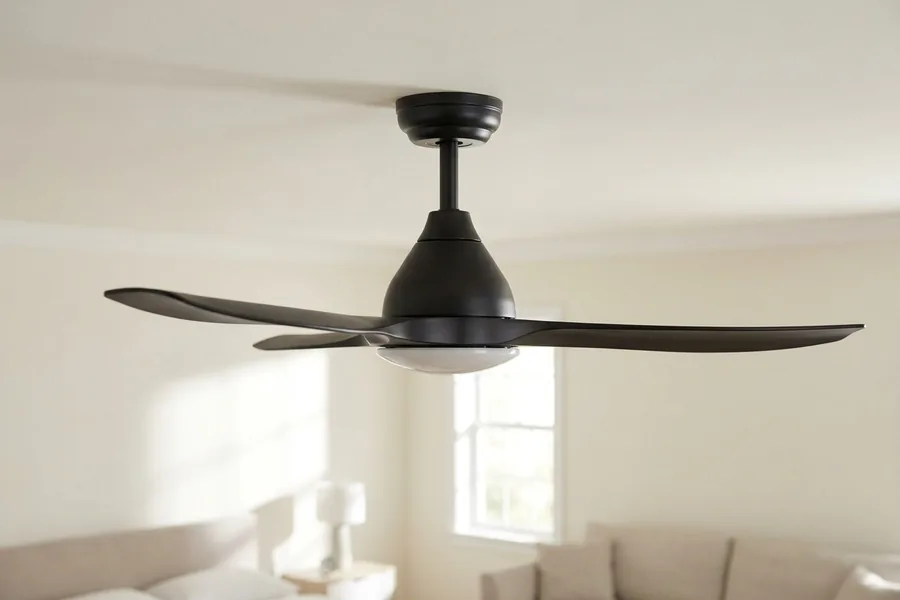
Fan performance depends on more than blade span. The motor must be able to turn the blades smoothly. The blade pitch must push air well. The blade shape must guide the air in a useful direction.
This is why two fans of the same size can feel very different.
5-1. How motor quality supports steady airflow
A good motor gives stable airflow across different speed levels. It also reduces wobble, vibration, and noise.
DC motors are popular in modern ceiling fan lights because they support smoother speed control and lower energy use. For bedrooms, this is especially useful because quiet low-speed airflow matters more than maximum power.
5-2. Why blade pitch affects how much air the fan pushes
Blade pitch is the angle of the blades. A flat blade may spin quickly but move less air. A blade with a better angle can push more air with each turn.
However, more pitch also needs enough motor strength. If the motor is weak, the fan may slow down or feel unstable.
5-3. How blade shape changes airflow direction and smoothness
Blade shape affects how air leaves the fan. Some blades are designed for broad, gentle airflow. Others are shaped for stronger downward movement.
Curved blades, wider blades, and aerodynamic blade profiles can all change the feel of the air. This is why design is not only about appearance. It affects performance too.
5-4. Why blade count alone is not the main performance factor
Many buyers ask whether more blades mean more airflow. Not always.
Blade count can affect style, noise, balance, and airflow feel, but it is not the main performance factor. A three-blade fan with a strong motor and good blade shape may outperform a five-blade fan with weaker engineering.
Ready to Find the Right Smart Ceiling Fan for Your Home?
Compare styles, sizes, smart features, and lighting options to find the perfect fan for your space.
Get a Quote6. Speed Settings and Everyday Comfort
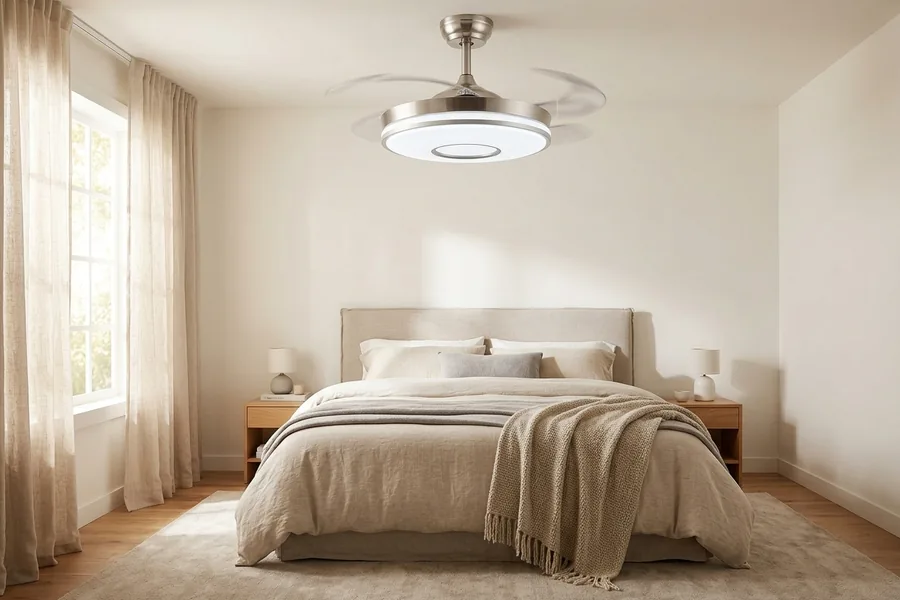
Speed settings decide how flexible the fan feels in daily life. A fan that only feels good on one speed is not ideal.
The best ceiling fan should feel useful in different seasons, different times of day, and different activities.
6-1. Why maximum airflow is not always the best setting
This is also why DOE Large Diameter Fan Performance matters when comparing bigger fans. A large fan may be designed to move a high volume of air, but that does not mean full speed is always the best choice. In bedrooms and living rooms, low or medium speed often works better because it keeps air moving gently without making the space feel windy or loud.
6-2. Why low-speed airflow matters in bedrooms and living rooms
Low-speed airflow is important because these rooms are used for rest. You want the air to move, but you do not want to feel blown at.
A fan with smooth low-speed control can run longer, feel quieter, and support comfort without becoming distracting.
6-3. Noise, wobble, and energy use at higher speeds
Higher speed can bring more noise. It can also reveal poor balance or weak installation.
If a fan only performs well at high speed, it may not be the best choice. A better fan should feel stable across the full speed range.
6-4. How DC motors improve speed control and quiet operation
DC motor fans often provide more speed levels than traditional AC motor fans. They also tend to use less energy and produce less motor noise.
For buyers comparing fan performance, this matters. A fan that gives six quiet speeds may feel better than a fan that only offers three rough settings.
7. Room Size and Air Circulation Coverage
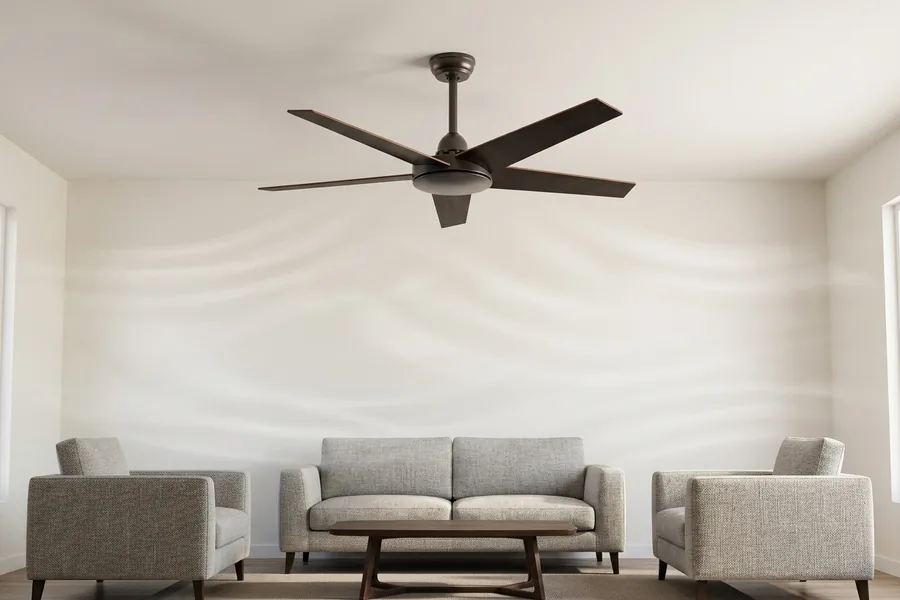
Room size decides how much coverage you need. A fan is not chosen only for how strong it is. It is chosen for how well it covers the space.
A small room needs gentle circulation. A large room needs wider coverage. An open-plan room may need more than one airflow zone.
7-1. Small rooms and compact airflow needs
Small rooms do not need very large fans. A compact fan can create enough airflow without making the space feel crowded.
For small bedrooms, study rooms, and apartments, a 36 inch or 42 inch fan can often work well. Low-profile or flush mount designs may also be better when the ceiling is low.
7-2. Medium rooms and balanced ceiling fan airflow
Medium rooms often work well with 48 inch or 52 inch fans. These sizes can give enough coverage without feeling oversized.
For a standard bedroom or living room, the key is balance. Look for enough CFM, quiet speed control, and a blade span that suits the room width.
7-3. Large rooms and wider air circulation zones
Large rooms need wider air circulation. A 56 inch, 60 inch, or larger fan may be more suitable if the room is wide and open.
But placement still matters. A large fan in the wrong position may leave seating areas with weak airflow.
7-4. Open-plan spaces and why one fan may not cover everything
Open-plan spaces are not always solved by one large fan. If the room has a dining zone, sofa zone, and kitchen zone, air may not move evenly everywhere.
In long or divided spaces, two smaller fans may work better than one very large fan. Think in airflow zones, not only total square footage.
8. Ceiling Height and Mounting Position
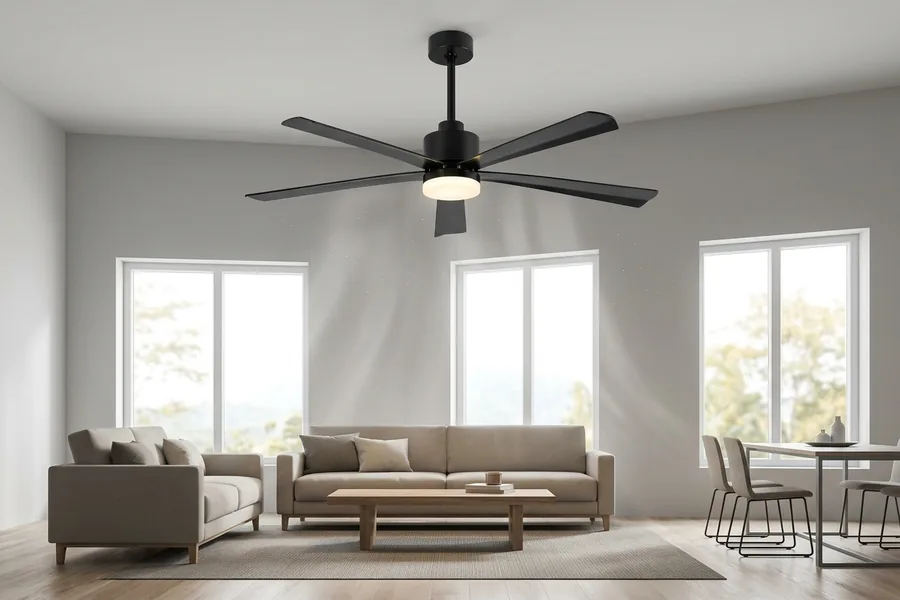
Ceiling height changes airflow performance. The fan must sit at the right height so air can reach people safely and comfortably.
If the fan is too close to the ceiling, airflow may be restricted. If it is too high, the air may not reach the living area.
8-1. Why blade height changes airflow performance
Blade height affects how the air spreads. A fan installed too high may move air near the ceiling but feel weak below. A fan installed too low can feel unsafe and uncomfortable.
For many homes, the ideal blade height is around 8 to 9 feet from the floor, depending on local rules and room design.
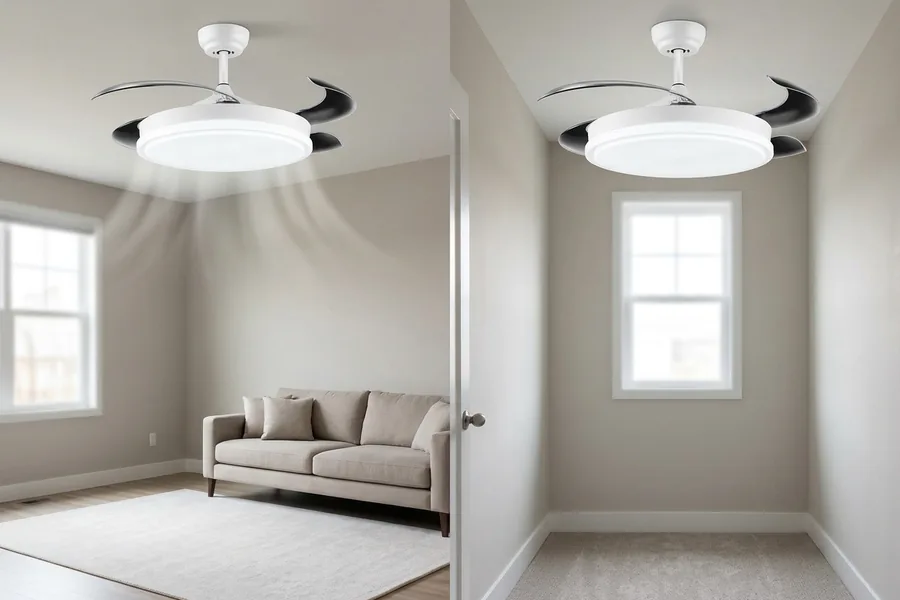
8-2. Low ceilings and flush mount fans
Low ceilings usually need flush mount or low-profile fans. These designs keep the blades closer to the ceiling while still leaving safe head clearance.
However, some low-profile fans have weaker airflow than downrod fans. Always check CFM and room size before choosing.
8-3. High ceilings and downrod length
High ceilings often need a downrod. The downrod brings the fan lower into the living zone, where airflow can be felt.
Without the right downrod, even a large fan may feel weak because it is moving air too far above the people in the room.
8-4. Why poor placement can weaken airflow even with a large fan
Poor placement can ruin fan performance. If the fan is too close to a wall, beam, tall cabinet, or sloped ceiling, the airflow may be uneven.
The best position is usually near the centre of the main use area, not always the exact centre of the whole room.
9. Bigger Fan or Better Fan: How to Decide
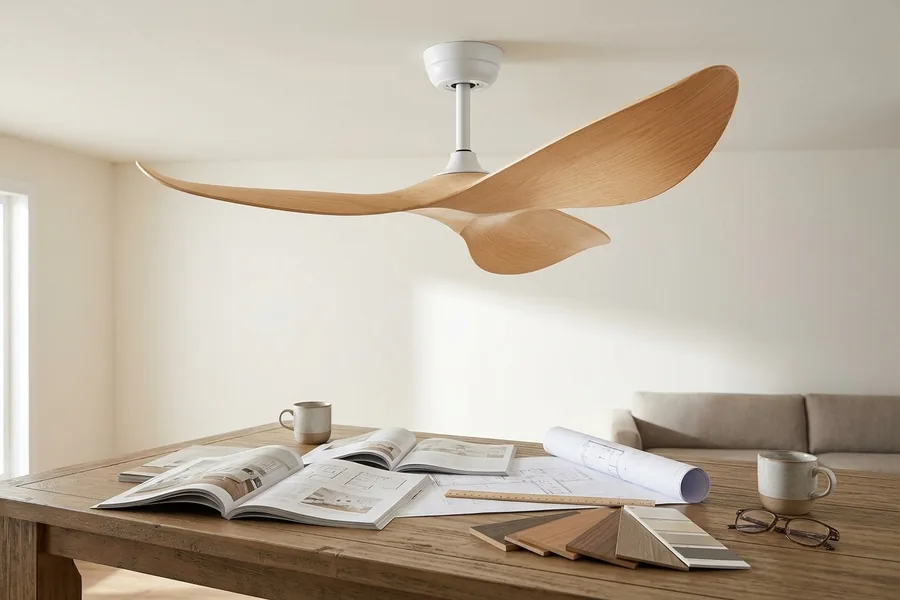
The best choice is not always the biggest fan. It is the fan that fits the room and moves air well at the speeds you will actually use.
Before buying, compare size, CFM, motor type, mounting style, and noise level together.
9-1. When choosing a larger ceiling fan makes sense
A larger fan makes sense when:
- The room is wide or open
- The ceiling is high enough
- The seating area is spread out
- You want gentle low-speed airflow
- The fan has enough CFM and good motor control
In these cases, a larger fan can improve air circulation without needing to run at full speed.
9-2. When a smaller fan with better CFM is enough
A smaller fan can be enough when the room is compact, the ceiling is low, or people sit close to the centre of the fan.
If the smaller fan has good CFM, quiet operation, and smooth speed control, it may feel better than a large fan that overpowers the room.
9-3. When two fans work better than one oversized fan
Two fans may work better in long rooms, open-plan layouts, or spaces with separate zones.
For example, one fan can serve the sofa area while another serves the dining area. This can create more even air circulation than one oversized fan placed in the middle.
9-4. How to balance size, airflow, noise, and room layout
A good decision asks four questions:
- Is the fan wide enough for the room?
- Is the CFM suitable for the space?
- Will the fan be quiet at low and medium speeds?
- Is the fan mounted where people need airflow?
If the answer is yes, the fan is likely a good fit.
10. Ceiling Fan Airflow Buying Checklist
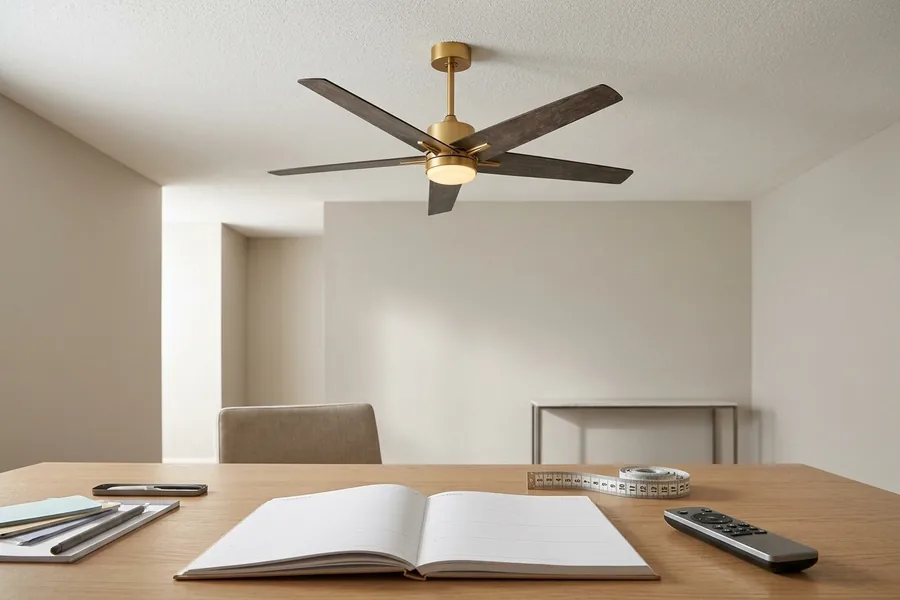
Before choosing a ceiling fan, use this simple checklist. It helps you avoid buying only by size or style.
| Check | What to ask |
|---|---|
| Room size | How wide is the space? |
| Blade span | Does the fan cover the room properly? |
| CFM | Is the airflow strong enough? |
| Motor type | Is it quiet and efficient? |
| Speed range | Does it offer comfortable low speeds? |
| Ceiling height | Does it need flush mount or downrod? |
| Placement | Is it above the main use area? |
| Noise | Will it be calm enough for daily use? |
10-1. Blade span and room size
Start with room size, then choose the blade span. A small room needs compact airflow. A large room needs wider coverage.
Do not choose a fan only because it looks impressive. Choose it because it matches the space.
10-2. CFM and airflow efficiency
Check CFM to understand airflow. Then check energy use and motor type to understand efficiency.
A good fan should move enough air without wasting energy or creating noise.
10-3. Motor type and speed range
Look for a motor that supports smooth speed control. For modern homes, DC motor ceiling fans are often a strong choice because they are quiet and efficient.
More speed options also give better comfort control.
10-4. Ceiling height and mounting type
Choose the mounting type after checking ceiling height. Low ceilings usually need flush mount designs. High ceilings usually need downrods.
The right mount helps airflow reach the people in the room.
10-5. Noise level and low-speed comfort
Noise matters because ceiling fans often run for hours. A fan should not hum, rattle, or wobble.
Low-speed comfort is especially important in bedrooms, living rooms, and hotel rooms.
10-6. Real air circulation in the whole room
The final test is simple: does the whole room feel better?
A good ceiling fan should move air evenly, support comfort, and fit the room visually. A bigger fan may move more air, but the right fan moves air where it matters.
Final Thoughts
A bigger ceiling fan can move more air, but size alone does not guarantee better airflow. CFM, blade span, motor quality, blade pitch, speed settings, ceiling height, and room layout all work together.
For small rooms, a compact fan with good control may be better. For medium rooms, a balanced 48 inch or 52 inch fan often works well. For large rooms, a 56 inch, 60 inch, or larger fan can improve air circulation when it is installed at the right height and placed in the right zone.
The best ceiling fan is not the biggest one. It is the one that makes the room feel calm, fresh, and comfortable every day.
Ready to Find the Right Smart Ceiling Fan for Your Home?
Compare styles, sizes, smart features, and lighting options to find the perfect fan for your space.
Get a QuoteFAQ
Does a bigger ceiling fan always move more air?
Yes, a bigger ceiling fan can move more air when the motor, blade pitch, and speed settings are strong enough. But size alone is not a guarantee. A poorly designed large fan may feel weaker than a smaller fan with better CFM and smoother airflow.
Is CFM more important than ceiling fan size?
Yes, CFM is often more important when comparing fan performance because it shows how much air the fan can move. However, CFM should still be matched with room size, ceiling height, noise level, and everyday comfort.
Can a ceiling fan be too powerful for a room?
Yes, a ceiling fan can be too powerful if the room is small or the fan is installed too close to the people below. Too much airflow can feel windy, noisy, and uncomfortable, especially in bedrooms or low-ceiling rooms.
Do large room fans need to run at high speed?
No, large room fans do not always need to run at high speed. A well-sized larger fan can often move air gently at low or medium speed, which may feel quieter and more comfortable than a small fan running fast.
Does ceiling height affect airflow performance?
Yes, ceiling height can strongly affect airflow performance. If the fan is too high, the air may not reach the seating or sleeping area. If it is too low, it can feel unsafe or too direct. The right mounting type helps airflow reach the room properly.
Should I choose one big fan or two smaller fans?
No, one big fan is not always the better choice. In long, wide, or open-plan rooms, two smaller fans can create more even air circulation across different zones than one oversized fan in the centre.