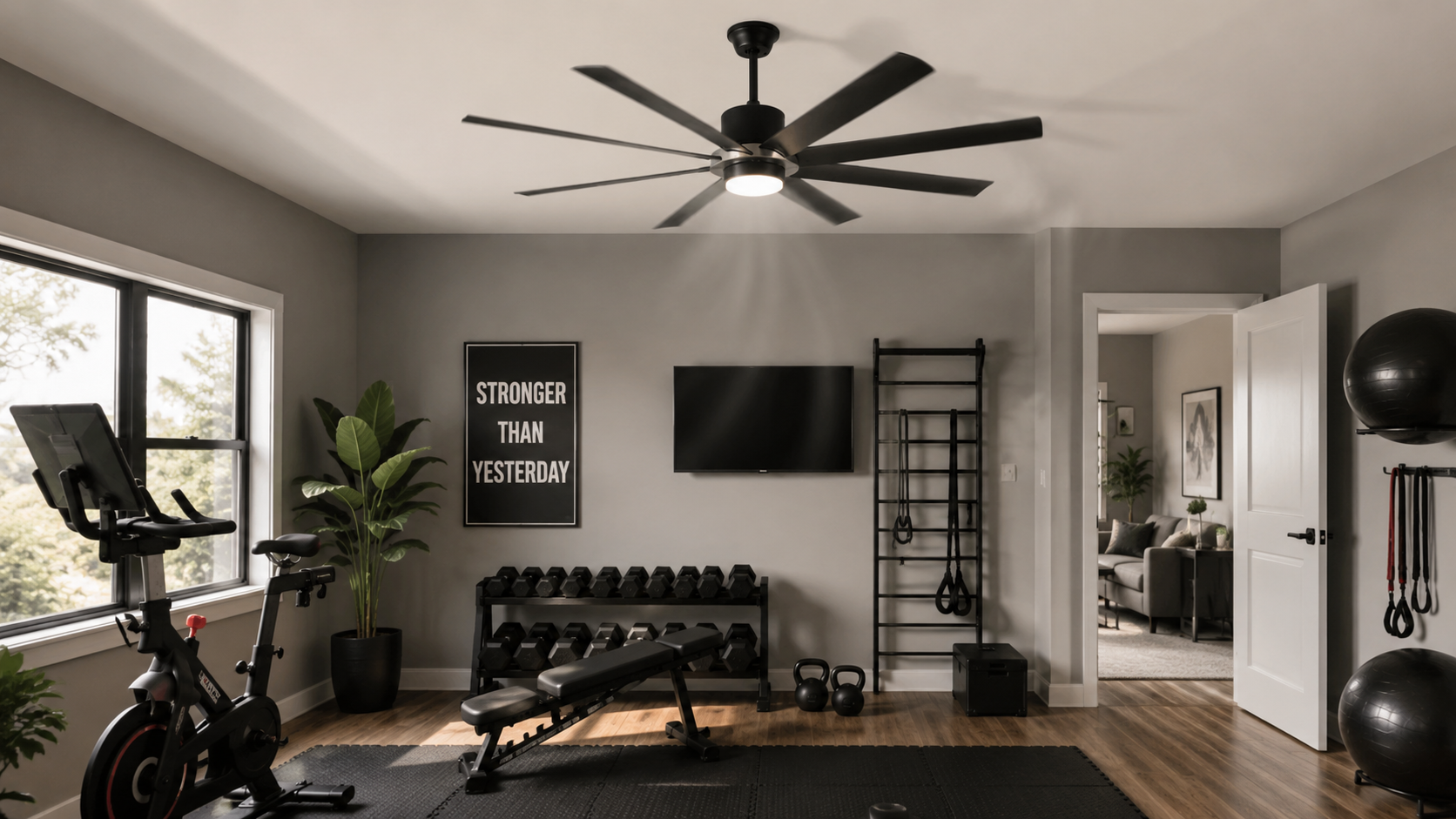



A ceiling fan importer needs more than a full catalogue. A strong product range should cover the main room sizes, support wholesale ceiling fan demand, and protect cash flow. If every size, colour, motor, and light option is stocked too early, inventory planning becomes heavy and slow. The better approach is to build a clear size range around real market demand.
This guide explains how importers, distributors, online sellers, and project buyers can plan a ceiling fan range without filling the warehouse with slow-moving stock.
Contents
1. Why Ceiling Fan Importers Need a Smarter Size Range Strategy

Many importers think a bigger product range creates more sales. Sometimes it does. But in ceiling fans, too many SKUs can also create dead stock.
The goal is not to stock every possible fan. The goal is to stock the right sizes, styles, and configurations for the market.
1-1. Why more SKUs do not always mean more sales
More SKUs can give buyers more choice, but they also split sales across too many products. If ten similar models compete with each other, none of them may sell fast enough.
A focused product range is easier to present, easier to reorder, and easier for sales teams to explain.
1-2. How overstocking hurts cash flow and warehouse space
Overstocking locks money into products that may sit for months. It also uses warehouse space, increases storage costs, and makes stock management harder.
For a ceiling fan importer, slow-moving fan sizes and colours can become a quiet drain on cash flow.
1-3. Why size range planning should start from market demand
Size range planning should begin with the rooms your customers actually serve. Apartments, bedrooms, living rooms, villas, and hotel projects do not need the same fan mix.
Before adding a new model, ask which room type, sales channel, and buyer group it will serve.
2. Understand Your Target Market Before Building the Product Range

Different markets buy ceiling fans for different reasons. Some want compact fans for apartments. Some want decorative ceiling fans with light. Some want large fans for open homes, hospitality projects, or commercial spaces.
Importers should map the market before ordering inventory.
2-1. Retail, wholesale, project, and online sales channels
Retail buyers often look for style, price, and easy installation. Wholesale buyers may care more about repeatable SKUs and stable supply. Project buyers need model consistency, lead time, certification, and after-sales support.
An online seller may test more styles in small batches. A traditional distributor may prefer a tighter core range.
2-2. Climate, room size, and housing type differences
Hotter climates may need stronger airflow. Apartment markets may need low-profile fans. Detached homes may need larger fans for living rooms and open-plan spaces.
Housing type affects fan size demand. This is why inventory planning should be based on local room layouts, not only on global product trends.
2-3. How customer habits affect ceiling fan size demand
Some buyers use ceiling fans mainly at night. Some use them with air conditioning. Some want fan lights because the ceiling has only one fixture point.
These habits affect which sizes and functions should be stocked first.
3. Start With Core Ceiling Fan Sizes First

A good product range starts with core sizes. These are the sizes most likely to sell repeatedly across common room types.
For many importers, the safest first range is not very wide. It is clear and practical.
3-1. Why 36 inch and 42 inch fans cover small-room demand
Small rooms, children’s rooms, apartments, and compact bedrooms often need 36 inch or 42 inch fans. These sizes are useful where ceiling height and room width are limited.
Importers should not overstock too many small fan styles, but a few reliable small-room options can serve a steady part of the market.
3-2. Why 48 inch and 52 inch fans are the safest middle range
The 48 inch and 52 inch range is often the safest middle category. These fans can fit many standard bedrooms, dining rooms, and living rooms.
For wholesale ceiling fan planning, this middle range usually deserves the strongest stock focus because it has broad use and repeat demand.
3-3. When 56 inch, 60 inch, and larger fans are worth adding
Large fans are useful for villas, open living rooms, high-ceiling homes, hospitality projects, and some commercial fan applications.
For airflow, do not judge large fans only by diameter. CFM and motor stability still decide whether the fan performs well in a real open room.
But large sizes should be added carefully. They need more carton space, higher shipping cost, and clearer buyer demand.
3-4. How to avoid carrying too many slow-moving sizes
Do not add every size just because the supplier can make it. Start with the sizes that match your main sales channels.
Then use sample orders, pre-orders, or project demand to test less common sizes before stocking them deeply.
4. Build a Balanced Product Range by Room Type

Room type is a useful way to plan a product range. It helps importers avoid random SKU growth.
Instead of asking, “How many fan models should we buy?” ask, “Which rooms do we need to cover?”
4-1. Small bedroom and apartment ceiling fans
Small bedroom and apartment fans should be compact, quiet, and easy to install. Low-profile designs are often useful for these markets.
Stock a few simple finishes first, such as white, black, or wood-tone options, before adding more decorative versions.
4-2. Standard bedroom and living room ceiling fans
Standard bedrooms and living rooms usually need balanced airflow and simple design. A 48 inch or 52 inch fan with light can work well for many homes.
This category is often the centre of the range because it can serve many buyers without needing too much explanation.
4-3. Large room and open-space ceiling fans
Large rooms and open spaces need stronger coverage. A 56 inch, 60 inch, or larger fan may be necessary when the room is wide, high, or open-plan.
However, these models should be linked to real demand. They are better stocked when there are villa buyers, project customers, or proven retail demand.
4-4. Hotel, villa, and project-use ceiling fan options
Hotel, villa, and project-use fans need more planning than regular retail items. Buyers may need the same design across many rooms, with different sizes or mounting options.
These products can be handled as project SKUs instead of normal warehouse stock.
5. Choose Product Categories That Reduce Inventory Risk

Importers can reduce inventory risk by choosing categories with broad use. A category that fits many rooms and buyer types is usually safer than a very narrow style.
The aim is to build a product range that can sell through several channels.
5-1. Ceiling fans with light as a high-demand base category
Ceiling fans with light are often a strong base category because they solve two needs at once: airflow and lighting.
They are especially useful in apartments, bedrooms, hotel rooms, and homes where one ceiling point must serve both functions.
5-2. Flush mount fans for low-ceiling markets
Flush mount fans are useful in markets with low ceilings, compact apartments, and small rooms.
They can be a good inventory choice because ceiling height is a common issue in many housing markets.
5-3. DC motor fans for energy-conscious buyers
DC motor fans are useful for buyers who care about quiet operation and energy efficiency.
They can support a more modern product range and help importers move beyond basic low-price competition.
5-4. Decorative and smart fans as selective upgrade SKUs
Decorative and smart fans can improve margins, but they should be added selectively. Too many special styles can create slow inventory.
Use these models as upgrade SKUs, not as the whole range.
Ready to Find the Right Smart Ceiling Fan for Your Home?
Compare styles, sizes, smart features, and lighting options to find the perfect fan for your space.
Get a Quote6. Use Sales Tiers Instead of Stocking Every Model

A smart importer does not treat every SKU the same. Some models should be stocked deeply. Some should be tested lightly. Some should only be made for projects.
Sales tiers help keep the range under control.
6-1. Core SKUs for stable wholesale ceiling fan demand
Core SKUs are the products you expect to sell repeatedly. They should have reliable supply, simple finishes, standard packaging, and clear reorder rules.
For many importers, core SKUs include 42 inch, 48 inch, and 52 inch fan lights in neutral colours.
6-2. Growth SKUs for testing new styles and sizes
Growth SKUs are products with potential but unproven demand. They may include new colours, smart controls, decorative lighting, or larger sizes.
These should be ordered in smaller quantities first.
6-3. Project SKUs for hotel, villa, and commercial orders
Project SKUs are used when a buyer needs a specific finish, size, control method, or packaging. These products may sell well in one project but slowly in general stock.
Keep them separate from regular inventory planning.
6-4. Custom SKUs that should not be overstocked
Custom SKUs should be handled carefully. A special colour or design may be perfect for one customer but difficult to sell elsewhere.
For custom products, use deposits, confirmed orders, or small trial batches before larger production.
7. Match MOQ and Inventory Planning With Real Demand

MOQ can shape the whole product range. A high MOQ can push importers to buy too much too early.
This is why flexible supply is important, especially for new markets and new product lines.
7-1. Why low MOQ matters for new importers
Low MOQ allows importers to test sizes and styles without heavy stock pressure. It also helps them learn which products sell before committing to large orders.
For a new ceiling fan importer, this can be the difference between a flexible range and a warehouse full of uncertain stock.
7-2. How to test market response before large orders
Start with samples, small batches, or selected pilot SKUs. Track enquiries, conversion, returns, customer feedback, and reorder speed.
Real sales data is better than guessing.
7-3. When to reorder and when to stop a slow SKU
Set reorder rules before stock arrives. For example, reorder a SKU when sell-through reaches a certain level within a set period.
If a SKU needs heavy discounting to move, it may not deserve another order.
7-4. How seasonal demand affects ceiling fan inventory
Ceiling fan demand is often seasonal. Importers should prepare before hot seasons, not after demand has already peaked.
Plan production, shipping, customs, and local distribution time early.
8. Plan Colours, Motors, Lights, and Controls Carefully

Size is only one part of the range. Colour, motor type, lighting, and control method can multiply SKUs quickly.
A small size range can still become too complex if every model has too many variants.
8-1. Why too many colour options can create dead stock
White, black, and wood finishes often cover many markets. Special colours should be tested before deep stock.
Too many finishes can split demand and create slow-moving inventory.
8-2. Choosing standard DC motor configurations
Standard DC motor configurations can simplify the range. They support quiet operation, energy efficiency, and modern buyer expectations.
Use a few stable motor platforms across several fan sizes when possible.
8-3. LED lighting and remote control as practical defaults
LED lighting and remote control are practical default features for many modern fan lights.
They increase product value without making the range too complicated, especially when the same control system can be used across several models.
8-4. When smart control should be added to the range
Smart control can be useful in higher-end markets, smart apartments, and project solutions. But it should not be added to every SKU too early.
Start with a small number of smart models and expand only when demand is proven.
9. Use Project Orders to Expand the Range Safely

Project orders can help importers expand their range without overstocking. A hotel, villa, or commercial project may justify a special size or finish.
The key is to connect the product to a real order.
9-1. Why hospitality and commercial fan projects need different planning
Hospitality and commercial projects often need consistency, certification, spare parts, and planned delivery.
They may also need larger fans, stronger motors, or special finishes that are not needed for regular retail stock.
9-2. How project demand can justify larger sizes
Large ceiling fans take more space and cost more to ship. But they can make sense when a project requires them.
For example, villas, lobbies, restaurants, and open living spaces may justify 56 inch, 60 inch, or larger fans.
9-3. Keeping project models separate from regular warehouse stock
Project models should not automatically become normal stock. A model that works for one hotel may not sell well in general wholesale channels.
Keep project orders separate unless repeat demand is proven.
9-4. How suppliers can support made-to-order project solutions
Suppliers can help importers by offering flexible sizes, finishes, motors, lighting options, packaging, and sample support.
This allows the importer to serve projects without turning every special request into warehouse inventory.
10. Work With the Right Supplier for Flexible Range Planning

The right supplier can help importers build a product range step by step. This is better than forcing the importer into large orders across too many uncertain SKUs.
As a ceiling fan manufacturer, NEBOLA supports importers with size options, DC motor platforms, LED fan light configurations, remote control, smart control, and low MOQ testing for selected projects.
10-1. Why importers need more than a product catalogue
A catalogue shows what is available. It does not automatically show what should be stocked.
Importers need supplier support for range planning, sample selection, packaging, certifications, and project matching.
10-2. Sample testing before building the full range
Sample testing helps importers check quality before committing to stock. Test airflow, noise, light quality, control response, packaging strength, and installation.
One well-tested sample can prevent a large inventory mistake.
10-3. Packaging, spare parts, and batch consistency
Good packaging reduces transport damage. Spare parts support after-sales service. Batch consistency keeps repeat orders stable.
These details matter in wholesale ceiling fan business because importers must protect both product quality and customer trust.
10-4. How NEBOLA can support flexible ceiling fan importer solutions
NEBOLA can support ceiling fan importers with different sizes, blade styles, finishes, LED options, motor systems, and project-based customisation.
This helps importers build a product range that is broad enough to sell, but controlled enough to avoid heavy overstocking.
11. Common Overstocking Mistakes Ceiling Fan Importers Should Avoid

Overstocking often comes from good intentions. Importers want to offer more choice, serve more buyers, and look more complete.
But without structure, the range can become too wide too fast.
11-1. Buying too many similar designs
If several fans have the same size, colour, price, and style, they may compete with each other.
Choose clear differences between models.
11-2. Stocking large sizes before demand is proven
Large fans can be profitable, but they need demand. They also need more storage space and higher shipping budgets.
Use project orders or market testing before deep stock.
11-3. Ignoring low-ceiling and apartment markets
Many markets have compact homes and low ceilings. Ignoring this demand can leave importers with products that look good but do not fit real rooms.
Flush mount and compact fan lights can reduce this gap.
11-4. Choosing styles without checking installation needs
Some fans look good online but may be difficult to install, clean, or service.
Check mounting type, ceiling height, wiring, control method, and spare parts before placing large orders.
11-5. Treating project models as regular inventory
A project model may be perfect for one hotel or villa development. That does not mean it belongs in regular stock.
Separate project planning from normal inventory planning.
12. Ceiling Fan Importer Product Range Checklist

A checklist helps keep the product range focused. It turns buying from a guessing game into a repeatable process.
| Check | What to Decide |
|---|---|
| Core sizes | Which sizes should always be in stock? |
| Room types | Which rooms does each SKU serve? |
| Sales channel | Retail, wholesale, online, or project? |
| Motor and light | Which configurations are standard? |
| MOQ | How much stock is safe for testing? |
| Reorder rule | When should the SKU be repeated? |
| Slow stock rule | When should the SKU be stopped? |
| Supplier support | Can the supplier support samples and custom projects? |
12-1. Core size range
Start with a core size range that covers the largest share of demand. For many importers, this means small-room, standard-room, and selected large-room options.
Do not expand until the core range is selling clearly.
12-2. Main room applications
Each SKU should have a clear room application. If the sales team cannot explain where the fan fits, the customer may not understand it either.
Room-based planning makes the range easier to sell.
12-3. Motor and lighting configuration
Choose standard configurations that can work across several models. This can reduce training, spare parts, and after-sales complexity.
DC motor fan lights with practical controls are often a useful base for modern markets.
12-4. MOQ and reorder plan
MOQ should match risk. Use smaller orders for new styles and larger orders for proven core SKUs.
Reorder plans should be based on sell-through, not only on hope.
12-5. Fast-moving and slow-moving SKU review
Review SKUs regularly. Fast-moving products deserve support. Slow-moving products need a decision: improve, discount, replace, or stop.
Inventory planning is not a one-time task. It is a cycle.
12-6. Supplier support for custom and project orders
Custom and project orders can help importers serve more customers without overstocking every special model.
Choose suppliers who can support flexible development, stable quality, and practical project communication.
Final Thoughts
A ceiling fan importer does not need the largest product range. The importer needs the right product range.
For importers who want to test a controlled ceiling fan light range before committing to deep stock, NEBOLA can be a practical partner to consider. With MOQ starting from around 10 units, buyers can test different fan sizes, DC motor options, LED lighting, finishes, and control systems in smaller batches, then expand the range only after real market feedback is clear.
Ready to Find the Right Smart Ceiling Fan for Your Home?
Compare styles, sizes, smart features, and lighting options to find the perfect fan for your space.
Get a Quote