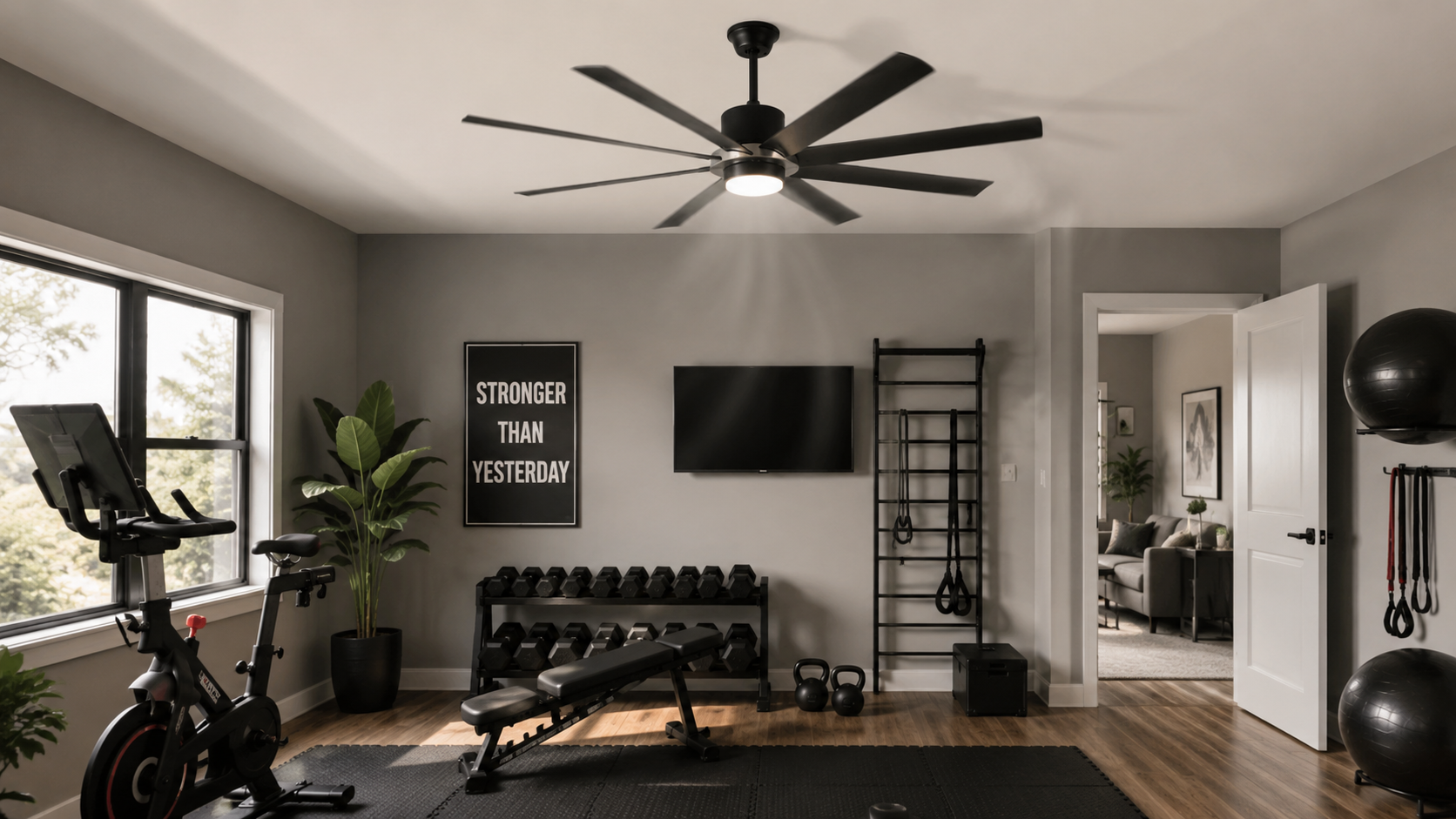


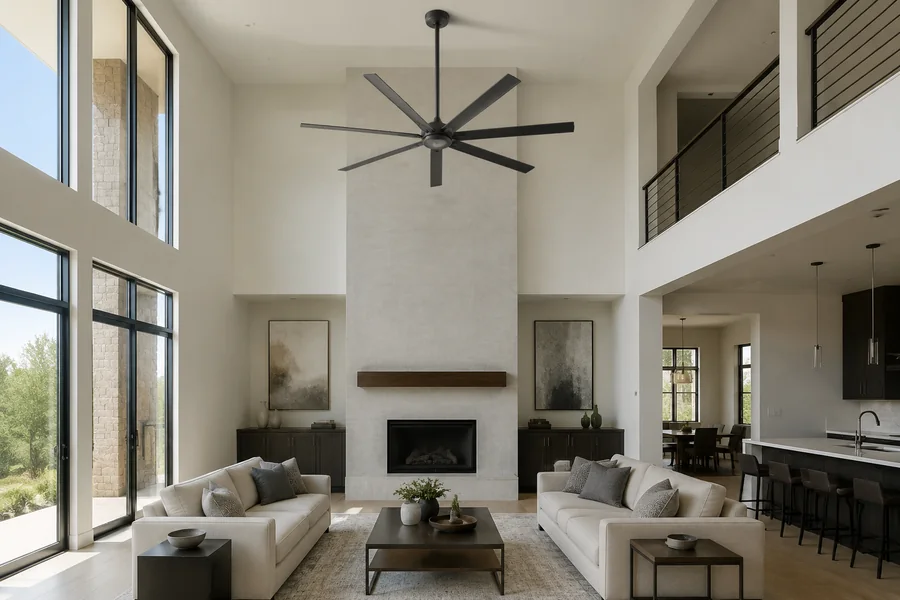
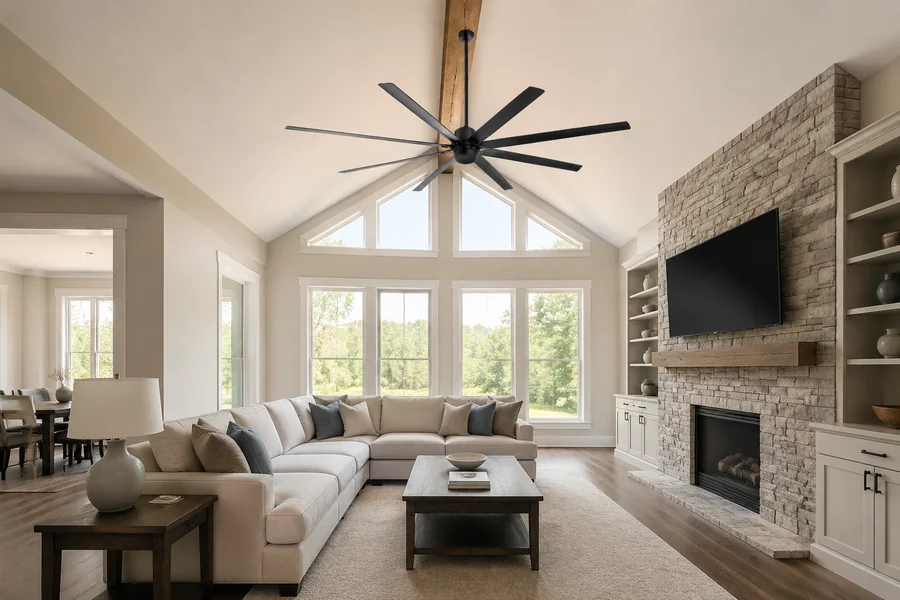
A high-ceiling living room usually needs more than a larger fan. The fan must hang at a useful height, move enough air across the occupied area, and stay visually balanced with the room. If the blades remain close to a 12-, 15-, or 20-foot ceiling, the fan can look impressive while the sofa area still feels still.
For a practical starting point, compare the room with our living room fans collection, then check height, blade span, motor performance, and mounting method together. The best ceiling fan for a high ceiling living room is the one that serves the people and furniture below it, not simply the largest model on a product page.
Why Do High Ceilings Need Different Fan Planning?
Why does ceiling height change fan performance?
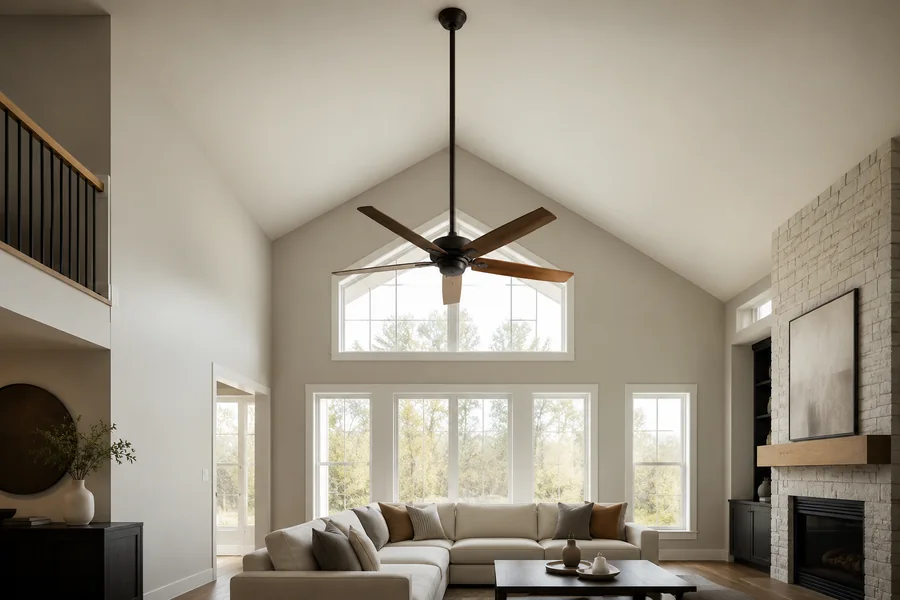
In a standard room, the fan is already close enough to the occupied zone for its airflow to be felt. In a tall room, the distance between the blades and the sofa becomes the main problem. Air can circulate high above the room while the people below notice very little movement.
That is why a high ceiling fan living room guide should begin with mounting height rather than product appearance. The room volume matters, but the practical question is where the blades will sit in relation to the people who use the space.
The ceiling peak is also not always the best mounting point. In a living room with a vaulted centre, the most comfortable position may be above the main seating area rather than exactly at the highest point, provided the support structure and clearances allow it.
Think about the room from the height of a seated person. A fan that looks perfectly centred from the floor can still be too far from the sofa, while a fan placed slightly toward the activity zone may create a more useful and even breeze.
What does useful airflow feel like from the sofa?
Research on personally controlled air movement supports a simple comfort principle: moving air is useful when people can feel it where they sit or work. For a living room, that means checking the main sofa, reading chair, dining edge, and walking path instead of judging airflow from directly below the ceiling point.
A high ceiling also changes how you service the product. The remote, reverse function, receiver access, and long-term stability matter more because the fan will not be easy to reach after installation. These are not separate extras; they are part of whether the selected fan remains comfortable to use.
This is why a powerful motor alone does not solve every high-ceiling problem. If the fan is mounted too high, some of its output is lost before the air reaches the occupied area. Correct height can make a moderately sized fan feel more effective than an oversized fan installed near the roof line.
Tall rooms can also hold warmer air near the upper part of the ceiling, especially when the space is heated or receives strong afternoon sun. A fan can help mix that air, but only when its circulation pattern reaches down into the living zone. The goal is not to chase the highest air pocket; it is to improve comfort where the room is occupied.
What Blade Height Is Right for a High Ceiling?
How far below the ceiling should the blades sit?
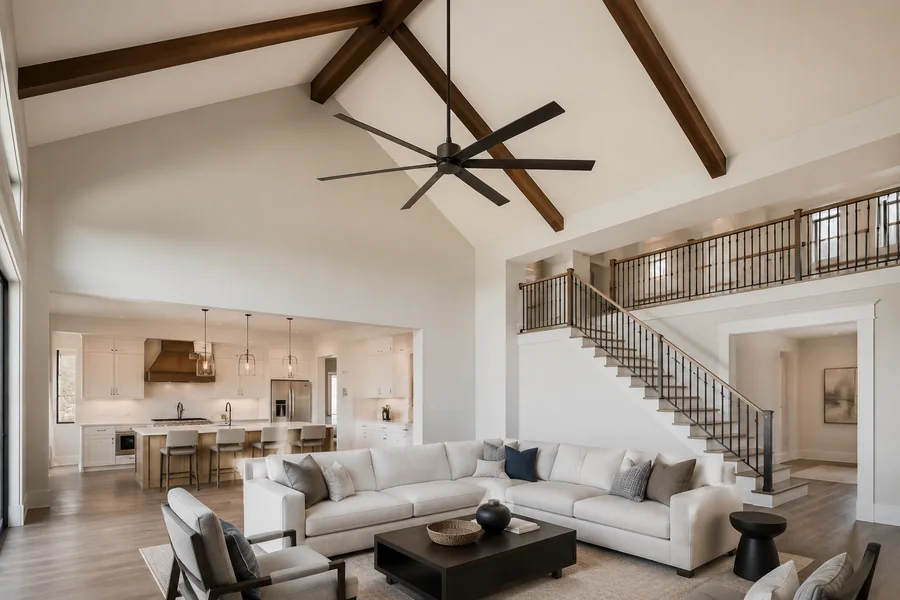
For many residential living rooms, a useful planning target is to place the blades roughly 8 to 10 feet above the finished floor, subject to local clearance rules, the fan body height, furniture, and the manufacturer’s instructions. The exact number is less important than making sure the fan is not trapped at the peak of the room.
On an 8-foot ceiling, the installation logic is very different from a 15-foot ceiling. This 8-foot ceiling guide explains why a short or flush installation may be appropriate in a low room, while a tall room usually needs a downrod to bring the fan into the occupied zone.
How can you estimate the required drop?
Start with the ceiling height, subtract the total fan drop, and check where the blades will sit above the floor. Total fan drop includes the canopy, downrod, motor housing, and any light assembly. Do not calculate from the downrod alone, because two fans with the same rod length can finish at different heights.
For example, a 15-foot ceiling with a 5-foot total drop leaves the blades around 10 feet above the floor. That may be a sensible starting point, but the final decision still depends on blade clearance, furniture, the fan’s body height, and the local installation requirements.
| Ceiling Height | Typical Planning Direction | Main Check |
|---|---|---|
| 10-11 ft | Short downrod or compact drop | Keep blades below the upper air pocket |
| 12-14 ft | Medium downrod | Confirm blade height and total drop |
| 15-20 ft | Longer downrod, large fan, or two fans | Check stability and occupied-zone coverage |
| Over 20 ft | Project-specific layout | Review structure, maintenance, and airflow zones |
If you are comparing a flush mount with a short downrod in a 9-foot room, this 9-foot ceiling comparison is the more relevant reference. A high-ceiling installation should not copy a low-ceiling solution simply because the fan model looks similar.
A longer downrod should also be selected as a complete assembly. Check whether the canopy, coupler, wiring, safety cable, and balancing hardware are designed to work with that length. A rod that appears long enough in isolation may still produce the wrong finished height or create unnecessary movement.
If the fan includes an integrated light, include the light assembly in the measurement. The blades may sit at a safe height while the lower light housing hangs too far into the room, changing the visual balance and the clearance around the fixture.
Do not lower the fan simply to make it easier to feel. The blades still need safe separation from people, furniture, doors, and nearby fixtures, and the support must be able to carry the moving load. Height is a balance between reach, appearance, and safe installation.
How Do You Choose Fan Size for the Room and Seating Zone?
How should blade span relate to floor area?
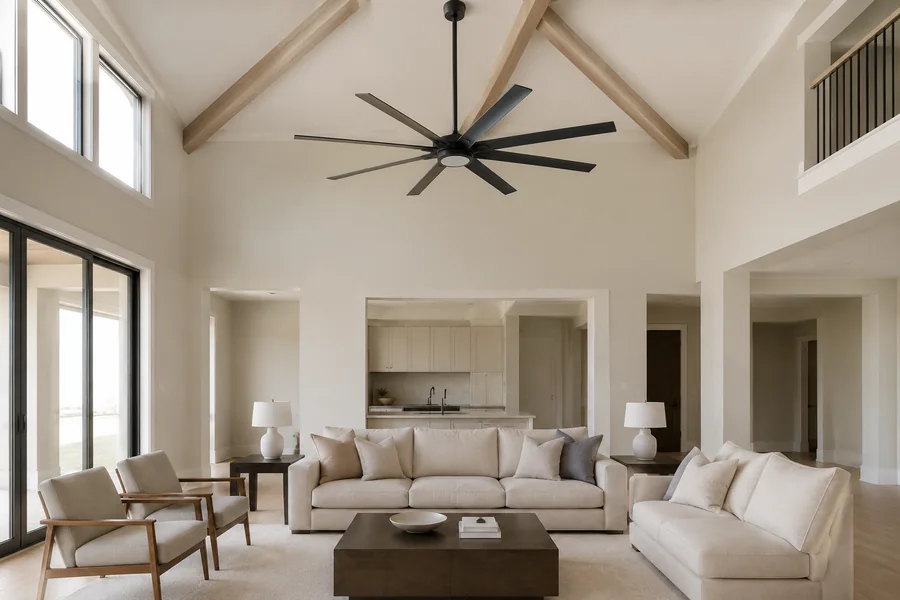
Blade span should be selected from the room’s floor area and the zone you want to cover. In a broad living room, 56-, 60-, 66-, or 70-inch fans may make sense, but only when the ceiling support, furniture layout, and visual scale also allow them.
A 52-inch model may be enough for a defined seating zone even when the ceiling is tall. Use this 52-inch living room guide to separate room coverage from ceiling height; a high ceiling does not automatically turn every room into a large-room application.
When is the room too wide for a single medium fan?
If the room has several furniture zones, compare the large living room fan guide and the fan size range guide. The key question is whether the fan’s useful airflow footprint reaches the places where people actually sit, not whether its diameter looks large enough from the doorway.
Leave practical clearance from walls, beams, tall cabinets, and pendant lights. In an open living room, a fan that is technically centred in the building footprint may be off-centre from the seating zone, which can make the room feel uneven even when the blade span is correct on paper.
For a simple rectangular room, mark the centre of the seating area on the floor and project that point up to the ceiling. Then check the fan’s blade tips against the nearest wall or beam. This quick layout test often gives a better answer than choosing a size from square footage alone.
Very large blades are not automatically the best answer. An oversized fan can dominate a room with a modest seating area, create stronger visual movement than you want, or sit too close to a wall. In a long room, two well-positioned medium fans may cover the useful zones more naturally.
As a practical example, a 52-inch fan can suit a defined seating group, while a 60- or 66-inch fan may be more appropriate when the seating area is broad and the walls are farther away. The ceiling height changes the drop you need, but the floor plan still determines the coverage target.
How Do Motor, Blade Pitch, and Airflow Affect the Result?
Why can two same-size fans move different amounts of air?
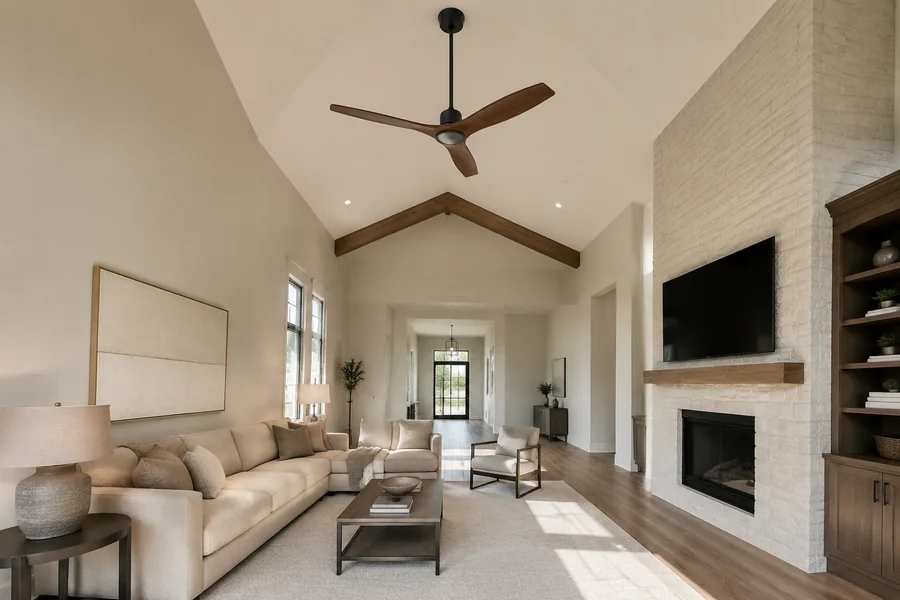
Blade span is only one part of performance. Motor type, blade pitch, blade shape, RPM, control curve, and the distance from the floor all affect how much air reaches the occupied area. A fan with a larger diameter can still feel disappointing if it runs too slowly or is mounted too high.
For a tall living room, look for stable low- and medium-speed operation as well as the headline maximum airflow. A remote-controlled DC motor can make it easier to adjust comfort through the day, while reverse mode can help redistribute warm air when the room is heated.
How should you compare airflow claims?
Compare models under the same conditions: blade span, speed setting, mounting height, motor type, and whether the test refers to a lighted or non-lighted configuration. Ask for the rated airflow or CFM where available, but also consider noise, control response, and whether the airflow reaches the seating zone.
If the room is unusually tall or open, use the room volume and the occupied zones as the starting point instead of choosing by diameter alone. The fan specification should explain how the motor, blade profile, speed range, and mounting height work together.
Blade pitch deserves attention because it changes how the blades meet the air. A steeper pitch can support stronger movement at an appropriate speed, but it also places more demand on the motor. The best combination depends on the fan’s engineering, not on pitch as a single winning number.
Noise is worth checking at low and medium speed, especially when the living room opens to a bedroom, study, or television area. A fan that produces strong airflow but has an annoying hum may be used less often, which makes its headline performance less valuable in daily life.
For rooms with heating, reverse mode can help mix warmer air that collects near the ceiling, but it should not be treated as a substitute for correct blade height. The fan still needs to sit where its circulation pattern can influence the part of the room people occupy.
When comparing CFM figures, remember that the highest number is usually measured at the highest speed. A more useful everyday choice may be the model that gives a steady, comfortable breeze at a lower setting without excessive noise or a sharp draft across the room.
Should You Use One Large Fan or Two Fans?
When does one large fan make more sense?
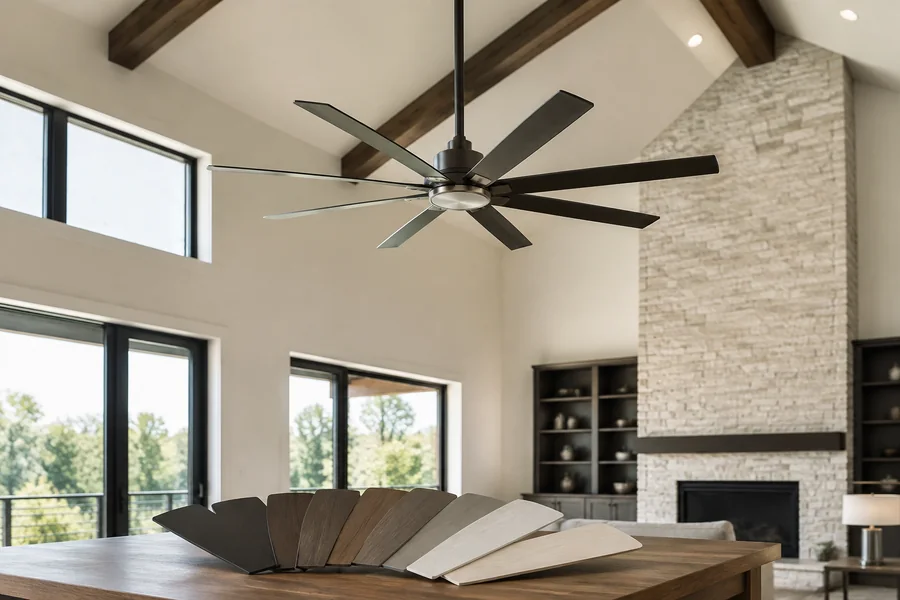
One large fan usually works best when the sofa, coffee table, and primary activity zone are centred under one structural mounting point. It gives the room a clear visual centre and keeps speed, light, and reverse controls simple. This is the situation discussed in the one-versus-two fan comparison.
For a great room with one dominant seating area, a 60- or 66-inch fan may offer a cleaner result than two smaller fixtures. The 60-inch versus 72-inch guide can help you compare coverage and visual scale before choosing the larger option.
When are two fans better than one?
Two fans are often more practical when the living room is long, open to a kitchen or dining area, or divided into two activity zones. Each fan can be centred over a useful zone instead of forcing one oversized fixture to serve the whole footprint from the middle. See the open-concept fan layout guide for this type of plan.
Two fans also make sense when structural points already exist at two locations or when a single large fan would sit too close to a wall, beam, or chandelier. The trade-off is more wiring, more visual elements, and the need to coordinate both controls so the room does not feel over-equipped.
The distance between two fans matters. They should cover separate zones with enough overlap to avoid a dead strip, but they should not be so close that the blades and airflow compete visually. Furniture placement is usually the best guide for deciding where the two centres belong.
One large fan is simpler to install and easier to make visually quiet. Two smaller fans can offer better distribution, but they require two suitable support points, two sets of wiring, and a layout that still looks intentional when the fans are switched off.
The choice also affects lighting. One central fan can leave more room for a chandelier or pendant arrangement, while two fans may require the lighting plan to be split around both mounting points. Decide the fan layout and the ceiling-light layout together so the fixtures do not compete for the same visual centre.
Which Ceiling Fan Type Fits a High-Ceiling Living Room?
Which product direction suits a tall living room?
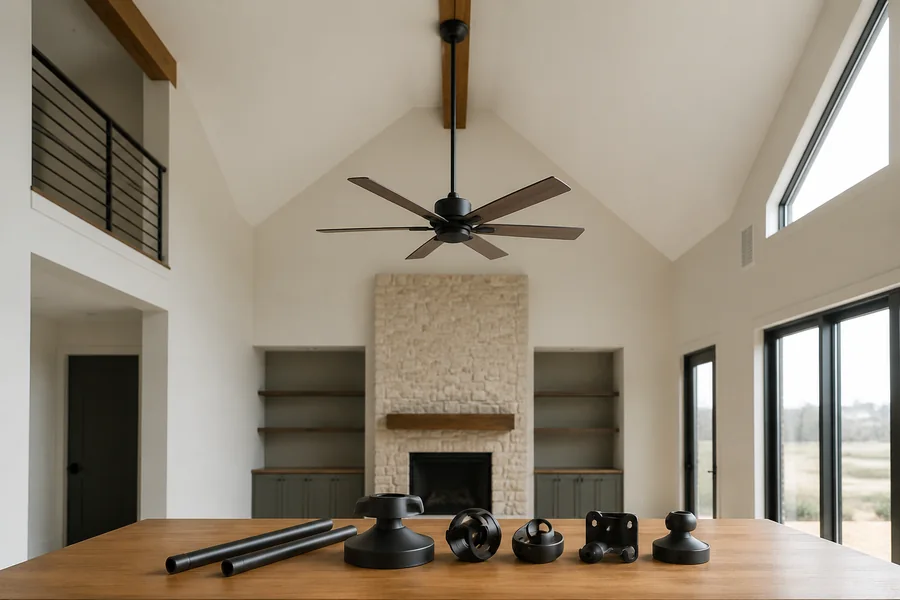
Choose the product type from the room’s lighting plan and the desired visual weight. A high ceiling can carry a larger decorative fan, but it does not always need an integrated light. If recessed lighting, a pendant, or a chandelier already defines the room, a no-light fan may create a cleaner composition.
For a clean, light-coloured look, compare the white ceiling fan range. If you need connected controls or OEM/ODM discussion, the smart fan manufacturer direction is more relevant. For rooms where lighting is already handled by recessed fixtures or a pendant, a ceiling fan without a light can keep the high ceiling visually quieter.
How should product selection match the installation plan?
A white fan can reduce visual weight in a bright room, while smart control is useful when the fan is difficult to reach. A fan without a light may be the better fit when recessed lighting, wall lights, or a pendant already provide enough illumination.
Before you choose a model, check its total assembled height, supported downrod lengths, blade span, motor type, control method, installation angle limits, and spare-part availability. Those details tell you whether the fan will work in the room you have, rather than only looking right in a product image.
A fan with integrated lighting can be useful when the room needs both circulation and overhead illumination, but the light should match the rest of the scheme. Check whether the colour temperature, dimming range, and light distribution suit the seating area instead of assuming that every built-in LED will feel comfortable.
In a tall room, controls should be easy to use from the floor. A reliable remote can be more practical than a wall switch alone because it lets you adjust speed, light output, and reverse mode without walking to another part of the room.
What Should You Check Before Ordering and Installing?
What should you measure before choosing the model?
Record the finished floor-to-ceiling height, the mounting point, the room length and width, the main seating zone, nearby beams, the location of lights, and the distance to walls. In a vaulted or unusually tall space, also record the ceiling angle and the high-side and low-side clearance.
If the room is open to other spaces, decide whether the fan should serve the whole footprint or only the living zone. A long room often benefits from separate coverage zones, while a compact seating group usually needs one well-centred fixture.
Which product specifications matter before you buy?
Check the recommended room size, total drop with the selected light or no-light configuration, available downrod lengths, fan-rated mounting requirements, slope compatibility, control options, and installation instructions. These details are especially important when the fan will be installed far above the floor.
If you are deciding between a medium and large model, compare the blade span with the seating area, wall clearance, and visual scale. A larger model should solve a real coverage problem, not simply fill the empty space above a tall ceiling.
What installation details prevent common problems?
Use a fan-rated electrical box or structural support, confirm the downrod and canopy are compatible, follow the manufacturer’s clearance requirements, and have a qualified installer check the wiring and balance. A long downrod should not be treated as a simple decorative extension; the support system must be suitable for the moving load.
Before ordering, write down one clear reason for the choice: the fan is suitable because of this ceiling height, this occupied-zone layout, this blade span, and this mounting method. If that sentence cannot be explained from the specification sheet, the product is not yet ready for a confident recommendation.
Plan access for cleaning and future service before the ladder is put away. Tall installations collect dust where it is difficult to reach, and a failed receiver or light component can become inconvenient if there is no practical way to access it.
Finally, check the finished view from the sofa, not only from the floor beneath the mounting point. The fan should look proportionate, clear nearby lighting, and create a comfortable movement of air where the room is actually used.
If you are looking for a better ceiling fan light solution for your project, NEBOLA can provide one-stop support from product selection to customization. We focus on ceiling fan light R&D and manufacturing, helping brands, importers, and distributors find products that better match real space needs.
NEBOLA Ceiling Fan Light Support
Need help planning a high-ceiling fan?
Share the ceiling height, room size, and furniture layout, and NEBOLA can help match the fan size, downrod, and product direction.
FAQ
Can a ceiling fan work in a 12-foot or taller living room?
Yes, a ceiling fan can work well in a tall living room when a suitable downrod brings the blades into the occupied zone and the fan is sized for the floor area.
Does a high ceiling always require a larger ceiling fan?
No, ceiling height alone does not determine blade span. Room width, seating zones, motor output, and whether the room is long or open plan also affect the correct size.
Should a high-ceiling living room use a downrod?
Yes, most high-ceiling living rooms need a downrod because it keeps the fan closer to the people below and helps the airflow feel useful.
Can one ceiling fan cover a large high-ceiling room?
Yes, one fan can work when the seating zone is centred and the blade span provides enough coverage, but a long or divided room may feel better with two fans.