

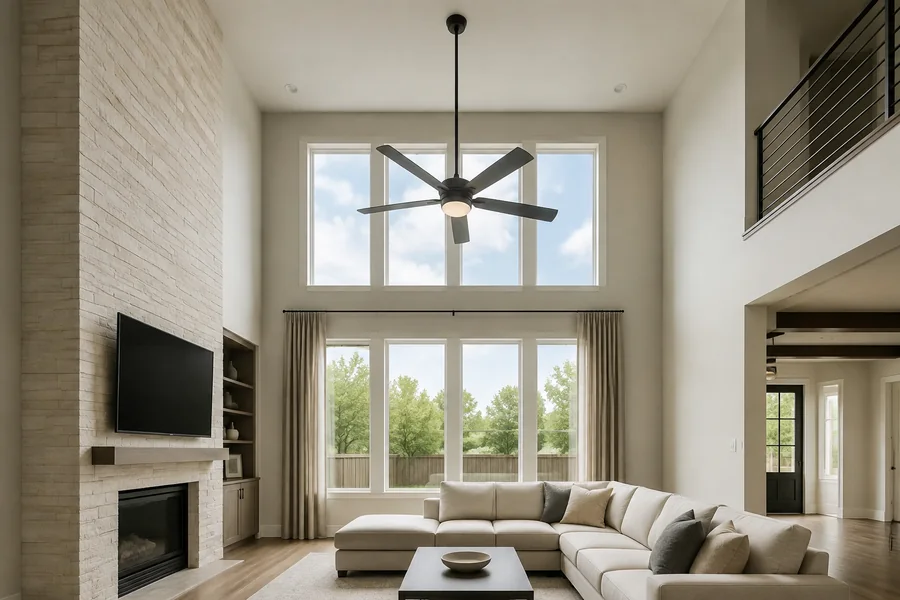
If you have a 12-, 15-, or 20-foot ceiling, the downrod length decides whether your fan moves air where you sit or stays too close to the ceiling. A useful starting point is about 24-36 inches for 12 feet, 48-72 inches for 15 feet, and 72-120 inches for 20 feet, but the final choice depends on the fan body, light assembly, room shape, and target blade height. Start with our living room fan collection and then measure the complete fan drop.
What Downrod Length Should You Use for a 12-, 15- or 20-Foot Ceiling?
How do you calculate the total fan drop?
Start with the finished ceiling height and decide where you want the blades to sit above the floor. Then subtract the complete fan drop, including the canopy, downrod, motor housing, and light assembly. The downrod itself is only one part of the measurement.
For most living rooms, you want the blades in a useful occupied-zone height while maintaining the clearances required by the fan manual and local rules. Research on air movement and comfort also supports the practical point that airflow only helps when you can feel it where you sit.
What is the practical answer at a glance?
| Ceiling height | Starting downrod direction | What you still need to check |
|---|---|---|
| 12 ft | About 24-36 in | Fan body height and target blade height |
| 15 ft | About 48-72 in | Support, stability, and total drop |
| 20 ft | About 72-120 in | Room shape, coverage, and service access |
| Sloped ceiling | Length varies | Angle adapter and high/low-side clearance |
These are starting ranges, not universal installation instructions. When you measure your room, use the complete assembled height of the exact fan rather than treating the rod length as the final answer.
You can make the calculation more reliable by writing it as a simple equation: ceiling height minus total assembled fan drop equals the blade height above the floor. The word “assembled” matters. A long rod attached to a compact no-light fan will finish at a different height from the same rod attached to a fan with a deep light kit.
Your target should be a comfortable installation, not the longest rod that will fit. When the blades are too high, the breeze can disappear before it reaches the sofa. When the fixture hangs too low, it can feel visually heavy and may reduce practical clearance around tall furniture, a bed, or a dining table.
Use the measurement from the finished floor, not an early drawing or an unfinished slab level. Flooring thickness, ceiling treatment, beams, and a light housing can each change the final height enough to matter in a tall room.
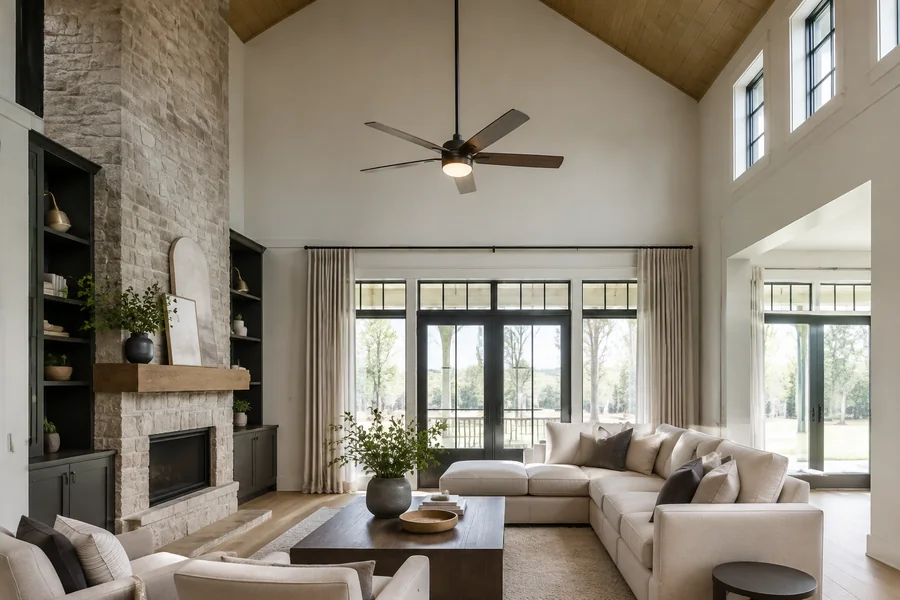
With a 20-foot ceiling, the fan starts to behave like a room system rather than a simple fixture. If the room is long or open, the way the air spreads across the whole plan is usually more important than the exact rod number, so you should think about coverage and maintenance at the same time.
If you want a safer early estimate, calculate two versions before buying: one with the shortest rod you are considering and one with the longest. Seeing both finished blade heights on paper helps you avoid a common mistake: choosing a rod that looks reasonable in isolation but leaves the finished fan either too close to the ceiling or too dominant in the room.
What Downrod Length Works for a 12-Foot Ceiling?
What should you measure in a 12-foot room?
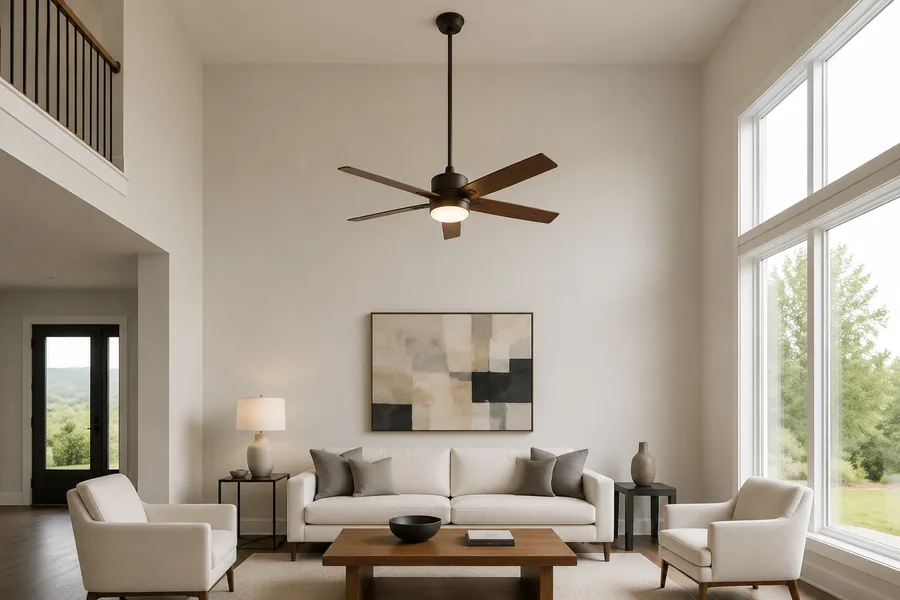
With a 12-foot ceiling, measure the fan body first and then work backward from your preferred blade height. A 24- to 36-inch downrod is often a sensible starting point, but a large light housing or a tall canopy can change the result. If you are comparing a medium fan, the 52-inch living room guide can help you separate fan size from ceiling height.
You should also check the furniture zone, not only the room centre. If the sofa sits away from the structural mounting point, position the fan around the area you use most. A comparison with an 8-foot ceiling installation shows why a 12-foot room normally needs more drop than a low room.
When should you choose 24, 36, or a longer rod?
Choose the shorter end when the fan body is tall or the ceiling has beams that limit the drop. Move toward 36 inches when the fan is compact and the blades would otherwise remain too high. You may need more length when a large room or a vaulted centre places the mounting point far above the seating area.
If you are deciding whether a medium or larger fan is more suitable, compare the 60-inch versus 72-inch guide after you calculate the height. A larger blade span cannot correct an incorrect total drop.
In a typical 12-foot living room, the fan does not need to hang halfway into the space to work well. You are normally trying to move it down from the hot air near the ceiling, while keeping the fixture visually connected to the room instead of making it look like a pendant dropped too far.
If you have a tall cabinet, a four-poster bed, or a statement light below the fan, measure their top heights as well. The downrod choice should work with the full room, not only the empty ceiling. This is especially important when you see the fixture from an entryway or stair landing.
A 12-foot room may still need a longer rod when the fan body is shallow and the seating group is large. Conversely, a bulky motor or deep light assembly can make a shorter rod the better choice. You should always compare the finished blade height, not the number printed on the rod.
For a 12-foot ceiling, the goal is usually to bring the fan down into a comfortable viewing and airflow zone without making the room feel crowded. If the room has a low cabinet, a hanging pendant, or a tall sofa back, let that object help you decide the final height rather than relying on a rod number alone.
You can also use a temporary marker to visualise the bottom of the fan before installation. A strip of painter’s tape on a wall at the proposed blade height can make the scale easier to judge than a number in inches. If the mark feels too low from the sofa or too high to create comfort, adjust before ordering.
What Downrod Length Works for a 15-Foot Ceiling?
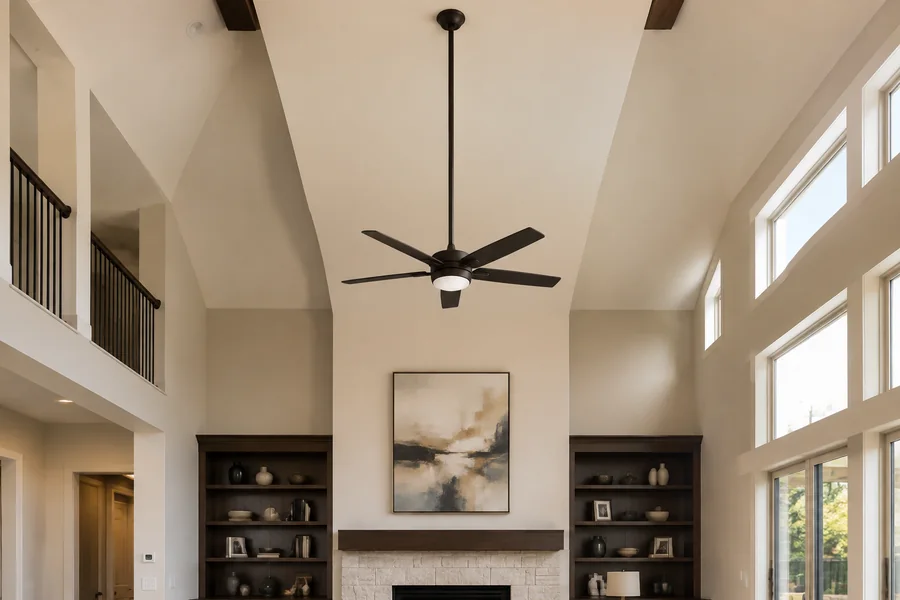
Why does a 15-foot ceiling usually need 48-72 inches?
At 15 feet, a short rod can leave the fan close to the peak, where the airflow feels distant from the sofa. A 48- to 72-inch starting range often brings the blades closer to the useful zone, but you should subtract the fan body height before choosing the final rod.
Your room width still matters. A large living room may need a larger fan or two coverage zones, so compare the high-ceiling fan guide with your actual seating layout instead of choosing a rod from height alone.
How do you prevent wobble on a longer rod?
Use a fan-rated support box, the correct mounting bracket, and any safety cable or stabilising hardware required by the manufacturer. Check that the rod, coupler, canopy, and wiring are designed to work together. A longer rod is not a simple decorative extension; it changes the load and movement of the assembly.
If the room is long, two fans may distribute air more evenly than one fan hanging from a very long rod. Read the one-large-versus-two-fan comparison before you commit to one central mounting point.
At 15 feet, the temptation is to choose a large fan and leave it high so it looks small against the ceiling. That often produces an attractive ceiling view but a weak experience at sofa level. A longer drop lets you use the fan for comfort rather than as a distant decorative object.
You should also consider the path people take below the fan. In a room with a central walkway, a table, or a raised platform, the safest useful blade height may differ from the height you would choose over a low seating area. The room is not always one flat zone.
Longer rods can make slight imbalances more visible, so the quality of the mounting and balancing work matters. After installation, you should hear a steady motor sound rather than a repeated click, and you should not see the canopy, rod, or blades moving in an irregular pattern.
A 15-foot ceiling often looks best when the fan is lowered enough to feel part of the room, not trapped near the top. That does not mean you should chase the longest possible rod. The better choice is the one that gives you useful breeze across the seating area while still looking visually calm from the doorway.
For a 15-foot ceiling, think carefully about whether the fan will be used mostly for summer cooling support, winter air mixing, or both. A rod length that improves summer comfort at sofa level may also help move warm air down in winter, but only if the fan has a reliable reverse function and a useful low-speed setting.
What Downrod Length Works for a 20-Foot Ceiling?
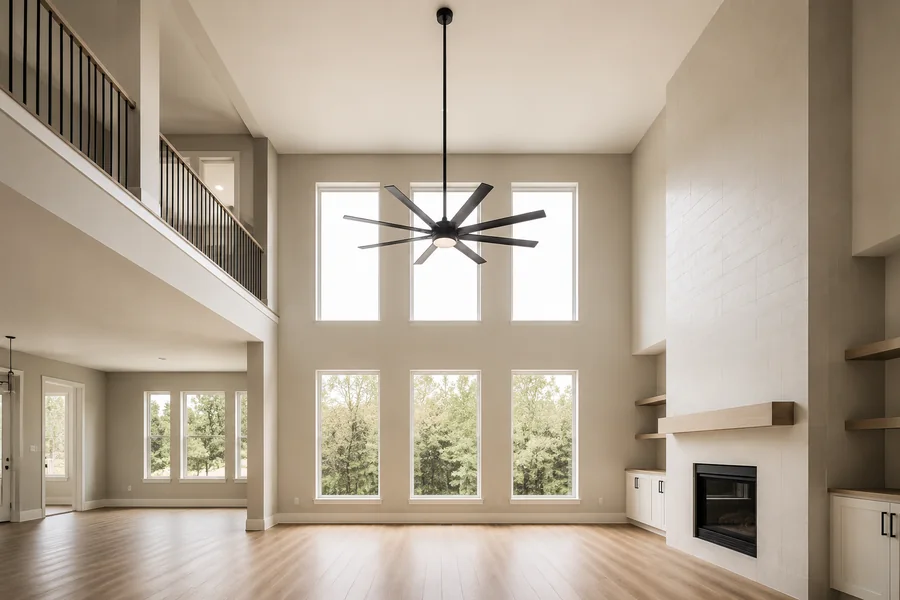
Why is 72-120 inches only a starting point?
A 20-foot ceiling can describe a compact tall room, a wide great room, or a long open-plan space. Those rooms do not need the same fan arrangement. A 72- to 120-inch rod may bring the blades into the right height range, but you must also check structural support, visual scale, and how the air will reach the occupied zones.
For a wide room, use the great room sizing guide to compare blade span and floor area. You should not use a long rod to compensate for a fan that is too small for the room.
When is one fan not enough?
One fan can work when your seating area is centred and compact. If the room is long or divided into living, dining, and kitchen zones, two fans may be more comfortable. The open-concept fan guide explains why fan centres should follow activity zones rather than the overall building footprint.
At this height, maintenance also becomes part of your decision. You need a realistic way to clean the blades, access the receiver, replace a light component, and inspect the support. A technically correct rod is not a good choice if the finished installation cannot be serviced safely.
At 20 feet, you are planning an airflow system rather than merely hanging a ceiling fixture. Warm air can collect high above the room, and the fan needs enough drop and output to influence the living zone below. A long rod is useful only when the blade span and motor are also matched to the floor plan.
If your room has two seating groups, think about whether each group needs its own fan. One central unit can leave the far end of a long room still, even when it has a high CFM number. Two smaller fans can be quieter in use because neither one has to run at maximum speed all day.
Service access becomes much more important at this height. Before you decide, consider how someone will clean the blades, inspect a remote receiver, replace an LED driver, or check a wobble. The most elegant high installation can become frustrating if every small repair needs specialist access equipment.
With a 20-foot ceiling, the fan starts to behave like a room system rather than a simple fixture. If the room is long or open, the way the air spreads across the whole plan is usually more important than the exact rod number, so you should think about coverage and maintenance at the same time.
In very tall spaces, the downrod may also affect how the fan looks in photographs, real-estate listings, and customer-facing project images. That may sound secondary, but for a living room, hospitality lounge, or display space, the finished visual proportion often matters almost as much as the airflow calculation.
How Does the Fan Body Change Your Downrod Calculation?
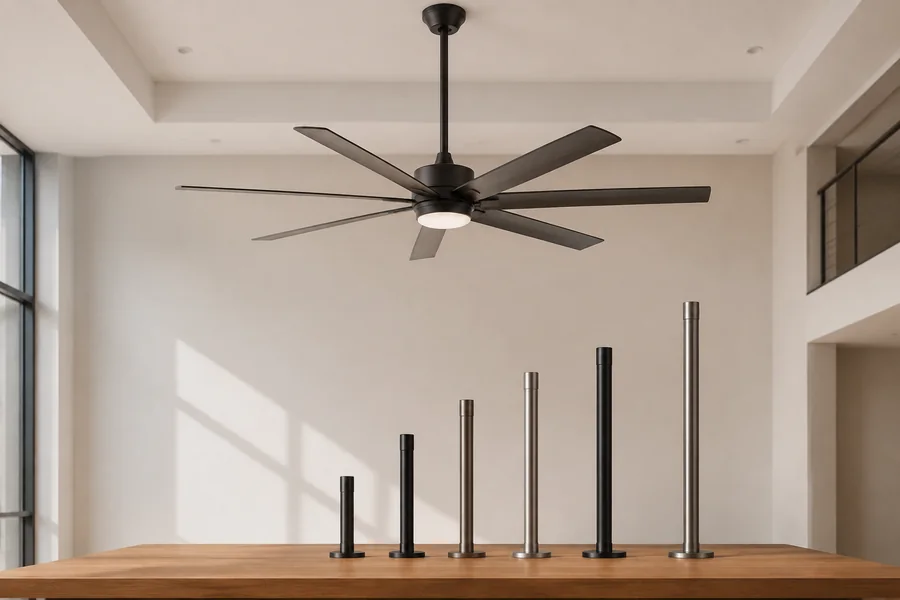
Why can the same downrod create different finished heights?
Two fans with the same downrod may finish at different blade heights because their canopies, motor housings, adapters, and light assemblies have different dimensions. Measure from the ceiling mounting surface to the lowest blade position on the actual model.
This is especially important when you compare a low-profile model with a large decorative fan. A large living room fan guide can help you think about room coverage, but the product drawing is still needed for the final drop calculation.
How do integrated lights change the total drop?
An integrated light can add height below the motor and change the visual centre of the room. It may also affect the distance to a dining table or a chandelier below. Measure the blades and the lowest light point separately so you do not confuse blade clearance with fixture clearance.
You can compare a fan without a light when ceiling lighting is already complete, a 66-inch wood fan light when you need a larger decorative fixture, and a 70-inch large fan for a wider high-ceiling room. Check the supported downrod and total drop for the exact configuration before choosing.
The fan body drawing should show more than the downrod. Look for the measurement from the ceiling to the blades and, if fitted, the measurement to the bottom of the light. Those two dimensions help you judge both airflow height and the visual weight of the completed fixture.
A lighted fan can change your calculations in two ways: it adds depth below the motor and it changes where the eye sees the centre of the fixture. In a living room with a large pendant or chandelier, you should check that the fan light will not compete with the other focal point.
If you are comparing models with different blade spans, do not assume the larger one is automatically deeper. Some large no-light designs have a relatively compact vertical profile, while some decorative fan lights add substantial height below the blades. The specification drawing is the useful source for this comparison.
The body of the fan changes the finished height more than many people expect. A compact no-light model, a deep light kit, and a decorative housing can all finish at different blade heights even with the same rod, so the drawing for the exact model matters more than a generic size chart.
When you compare two models, ask for side-view dimensions rather than relying only on front-view product images. Front images often hide the real motor depth and light depth. A side drawing or installation diagram is much more useful when your decision depends on total drop.
What If the Ceiling Is Sloped or Vaulted?
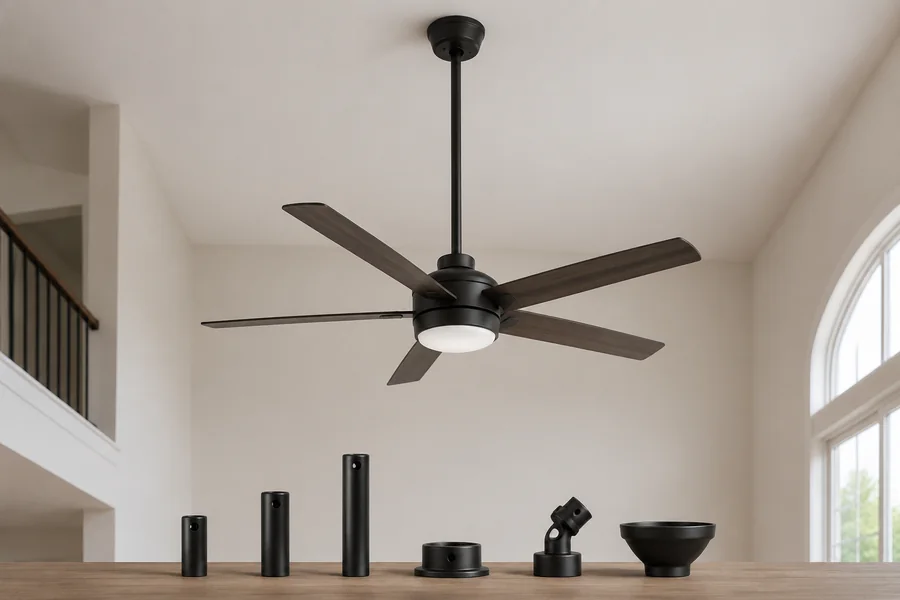
When do you need an angle adapter?
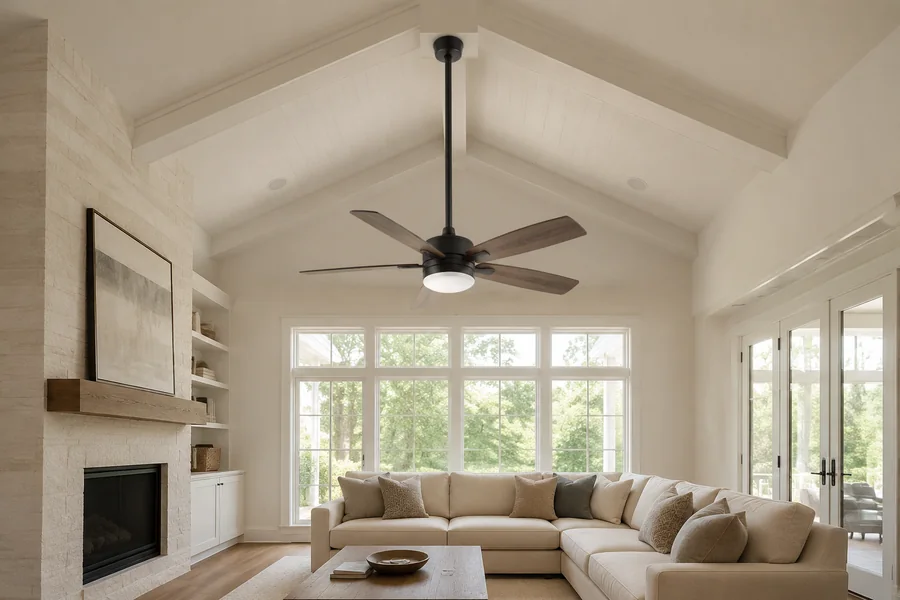
If your ceiling is angled, the canopy must either support that angle or connect to a compatible sloped-ceiling adapter. A longer rod alone does not make an incompatible canopy safe. Use the vaulted and sloped ceiling guide to check the mounting logic before you order.
The fan should hang vertically, and the blades should clear both the high and low sides of the ceiling plane. If the fan tilts with the ceiling, the blade path and balance can change.
How should you measure an angled ceiling?
Measure the ceiling angle, the peak height, the mounting point, and the distance from that point to the seating area. A cathedral ceiling setup guide can help you compare the downrod, fan size, and mounting height as one setup.
Do not use a flush-mount solution on a slope just because it keeps the fan close to the ceiling. In many cases, the short installation leaves no room for the fan to hang level or for the blades to clear the angled surface.
On a vaulted ceiling, the low side and high side of the blade circle can have very different clearances. You should measure the blade path, not only the distance from the motor to the ceiling. The fan needs room to rotate freely even when the ceiling line rises sharply on one side.
A longer rod can improve clearance, but it cannot make an incompatible canopy safe. If the motor does not hang level, the installation can affect blade balance, appearance, and the way the fan behaves at speed. Confirm the adapter and angle limit before you decide on the length.
It also helps to look at the room from its main sightline. A rod that is technically correct may still place the fan too close to a beam or make it appear off-centre above the sofa. You can often solve that by moving the mounting point rather than continuing to add downrod length.
If the ceiling is sloped or vaulted, think in terms of level hanging, not just length. The rod has to work with the adapter and the angle together, otherwise the fan may sit technically attached but still feel wrong in the room.
If your sloped ceiling has exposed beams, the beam depth may reduce the practical clearance even when the roof angle itself looks manageable. Measure from the lowest nearby obstruction, not only from the finished ceiling plane, because the blade path must stay clear of every fixed object.
What Should You Check Before Installing a Long Downrod?
How do you check the support and wiring?
Confirm that the electrical box or structural support is fan-rated, the bracket matches the fan, and the wiring is long enough for the selected rod and receiver. Follow the model-specific installation manual rather than assuming every long rod uses the same hardware.
You should also check the blade path against beams, walls, lights, and tall furniture. A fan can be centred in the room and still be too close to a beam on one side.
How do you plan controls and future maintenance?
A remote control is useful when the fan is several metres above the floor. Check where the receiver sits, how the reverse function works, and whether you can replace a light or receiver without dismantling the whole ceiling assembly.
Before you choose a large model, compare the fan size range guide with your room dimensions. Your final choice should make sense for height, coverage, control, and maintenance at the same time.
Before installation day, place the complete parts list together: fan, chosen downrod, canopy, coupler, remote receiver, adapter if needed, and mounting hardware. That makes it easier to spot a mismatch before the fan is partly assembled in the air.
When the fan is running, you should test more than the highest speed. Low and medium speeds reveal whether the motor is smooth, whether the airflow is comfortable, and whether any clicking or vibration develops. A tall room often needs the fan for long periods, so daily comfort matters more than a brief high-speed test.
Keep the installation manual and control information accessible after the fan is fitted. With a long downrod, knowing the receiver location, reverse procedure, and replacement parts can save time when you need service months or years later.
The final check is whether the completed fan still feels easy to live with after installation. If the control is awkward, the blades are hard to clean, or the fixture sits too far from the living zone, the rod length may be technically possible but still not the best choice.
A long downrod installation should feel steady at the speed you will use most often. If the fan only looks stable when it is off, the setup has not been fully proven. Ask the installer to test the fan after balancing and before the access equipment is removed.
If you are looking for a better ceiling fan light solution for your project, NEBOLA can provide one-stop support from product selection to customization. We focus on ceiling fan light R&D and manufacturing, helping brands, importers, and distributors find products that better match real space needs.
NEBOLA Ceiling Fan Light Support
Need help choosing a downrod length?
Share your ceiling height, fan model, and room layout, and NEBOLA can help you check the total drop and mounting direction.
FAQ
Is a 24- to 36-inch downrod usually enough for a 12-foot ceiling?
Yes, it is a useful starting range, but you still need to include the canopy, motor housing, light assembly, and your target blade height.
Does a 15-foot ceiling usually need a longer downrod than a 12-foot ceiling?
Yes, a 15-foot ceiling usually needs a longer downrod because the fan must be brought closer to the occupied zone.
Can one fan cover a 20-foot ceiling?
Yes, one fan can work in a suitable room, but the room length, seating zones, fan size, and maintenance access may make two fans more practical.
Does a sloped ceiling change the downrod calculation?
Yes, a sloped ceiling changes the clearance and mounting angle, so you may need an adapter and a different total drop.