

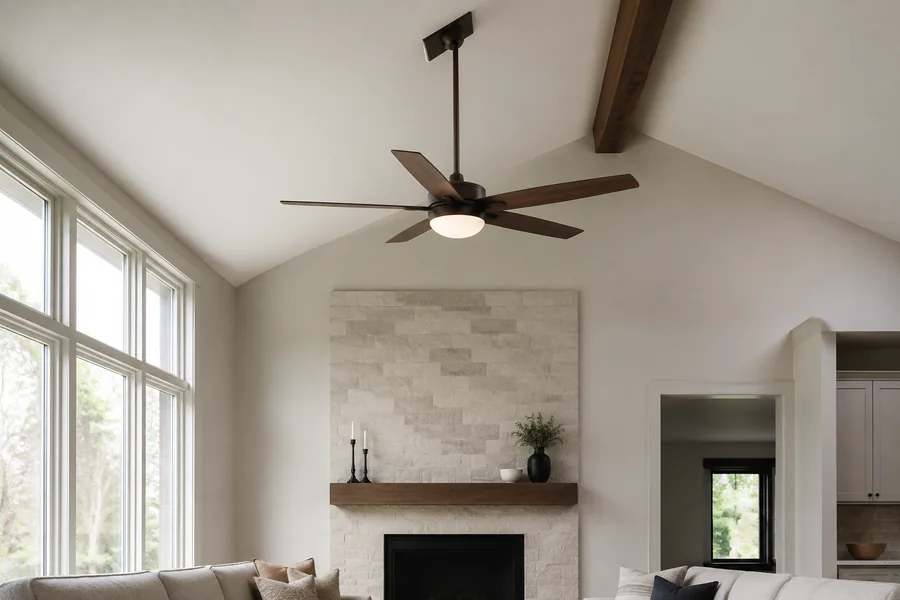
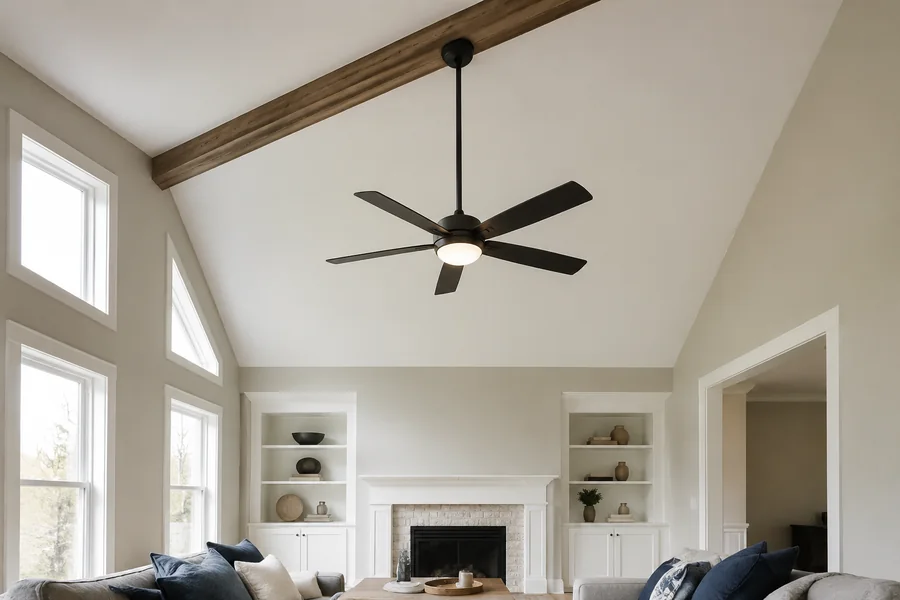
Yes, you can install a ceiling fan on many vaulted or sloped ceilings, but the fan must hang level and the mounting system must support the angle. You may need a sloped-ceiling adapter, a downrod, or a different fan type. Start with our living room fan collection only after you know the ceiling angle and the room’s main seating zone.
Can You Install a Ceiling Fan on a Vaulted or Sloped Ceiling?
When Is a Ceiling Fan Safe for a Vaulted or Sloped Ceiling?
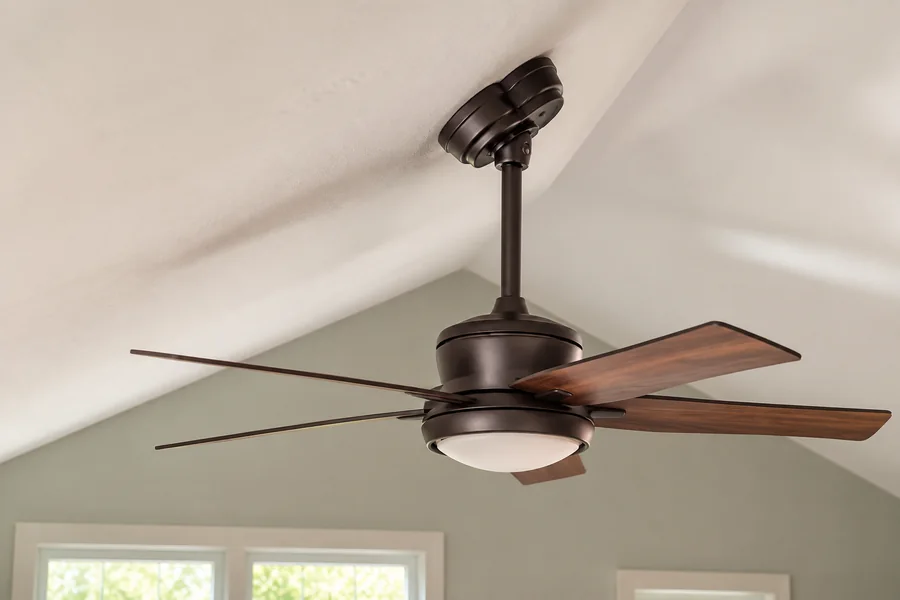
Yes, you can install a ceiling fan on many vaulted or sloped ceilings, but the fan must hang level and the mounting system must support the ceiling angle. You cannot judge suitability from the fan body alone. Research on airflow in occupied spaces also supports planning around the zone where you actually sit, not simply the highest point of the ceiling.
Your first check is the angle between the ceiling plane and the horizontal line. Your second check is the complete fan assembly: canopy, adapter, downrod, motor housing, and blade path. If any one of those parts is incompatible, the installation needs a different model or mounting method.
What Should You Measure Before Choosing the Fan?
| Ceiling condition | Typical mounting direction | Main question |
|---|---|---|
| Flat ceiling | Standard or flush mount | Does the fan suit the room height? |
| Mild slope | Angle-compatible canopy | What slope can the canopy support? |
| Steeper slope | Sloped-ceiling adapter plus downrod | Will the fan hang level? |
| Vaulted or cathedral ceiling | Longer downrod and adapter | Do the blades clear both sides? |
This table is a starting guide, not a replacement for the installation manual. You should confirm the maximum supported angle and the required adapter for the exact model.
The key question is not whether a fan can be attached to the ceiling surface. The key question is whether the motor can hang vertically below that surface while the blades keep clear of the ceiling. If the motor is tilted with the roof line, the fan may look wrong and may not have the clearance it needs.
You should treat a vaulted ceiling as a three-dimensional space. The mounting point, ceiling angle, blade radius, downrod, light kit, beams, and furniture all affect the final result. A simple picture of a fan on a slope cannot answer those measurements for your room.
The first inspection is easiest before you select a style. Once you know the angle and the available clearance, you can choose a compatible fan. Choosing a flush or decorative model first and trying to force it into the roof geometry usually creates the wrong order of decisions.
The easiest way to think about a sloped ceiling is to ask whether the fan can hang level while the ceiling does not. If the answer is no, you need a different mounting method or a different fan, because the angle itself is part of the installation.
If you are unsure whether your ceiling counts as vaulted, sloped, or angled, do not worry about the label first. What matters is the actual mounting plane. Any ceiling surface that is not flat and horizontal needs angle, clearance, and level-hanging checks before the fan is selected.
Which Ceiling Angles Can Use a Standard Fan Mount?
When can the canopy handle the slope?
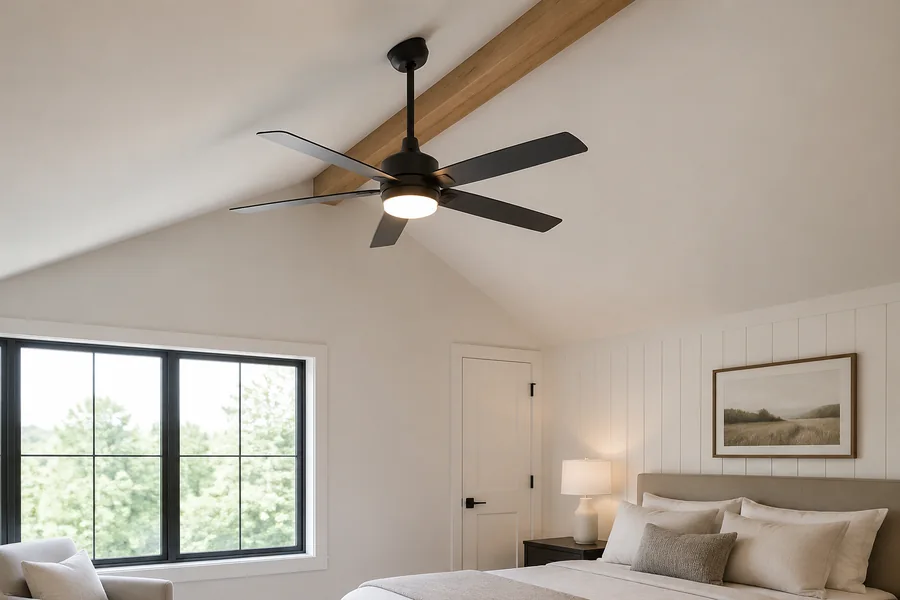
Some canopies are designed to follow a mild angle while keeping the motor hanging vertically. If your slope is modest, the standard canopy may be enough, but you still need to verify the manufacturer’s angle limit.
Do not copy the solution from an 8-foot or flat-ceiling room. A 9-foot ceiling comparison can help you understand the difference between a low, nearly flat installation and a tall or angled one.
When do you need a sloped-ceiling adapter?
You normally need an adapter when the ceiling angle is too steep for the canopy or when the fan does not hang vertically after the canopy is installed. The adapter creates a level connection between the angled ceiling and the downrod.
If your ceiling is tall as well as sloped, you may need both an adapter and a longer rod. The downrod length guide explains why the rod must be calculated from total fan drop, not from ceiling height alone.
You can measure the ceiling angle with an inclinometer, a digital level, or a phone tool used carefully as a rough check. Then compare the result with the exact maximum angle in the fan manual. Do not rely on the wording “sloped ceiling compatible” without finding the supported angle.
A mild slope may allow the canopy to move enough for the downrod to hang straight. A steeper roof typically needs an adapter that creates a level pivot. The adapter is not an optional accessory when the canopy cannot safely accommodate the angle.
If the ceiling is finished with heavy beams, wood cladding, or a deep ridge detail, include those elements in the measurement. The visible roof angle and the actual point where the canopy attaches are not always the same, especially in renovated rooms.
A standard canopy only works when the slope is mild enough to keep the motor level and the blades clear. Once the angle becomes more dramatic, the ceiling starts dictating the hardware, and the product has to follow the roof instead of the other way around.
A useful rule is to separate appearance from compatibility. A canopy may appear to sit neatly against a sloped ceiling, but the motor below it still needs to hang vertically. If the downrod leans, the fan is telling you the mount is not solving the angle correctly.
How Do You Choose Downrod Length for a Sloped Ceiling?
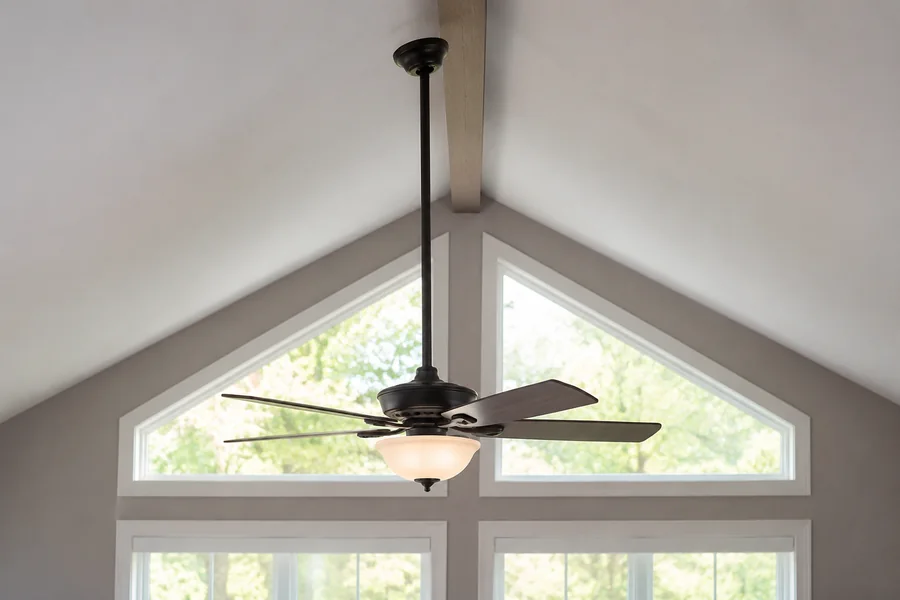
How does the slope affect the rod length?
A sloped ceiling changes the distance from the mounting point to the high and low sides of the blade path. You may need a longer rod to create enough clearance, especially when the fan is mounted near the peak of a vaulted room.
Measure the ceiling angle and the desired blade height together. The high-ceiling fan guide can help you keep the fan close enough to the occupied zone without lowering it into an unsafe position.
What should you measure from both sides?
Measure the clearance from the blade tips to the high side and low side of the ceiling. Then measure the distance from the blade tips to walls, beams, skylights, and light fixtures. The smaller clearance usually controls your final mounting height.
You should also measure the total drop to the lowest part of the fixture, especially if the fan includes a light. A safe blade height does not automatically mean the light housing has a comfortable relationship with the furniture below.
The right downrod creates two kinds of clearance: enough vertical distance below the slope for the blades to rotate, and enough distance below the ceiling for the air to reach the people in the room. You need both. A rod chosen only for blade clearance can still leave the fan too high to feel useful.
Start by marking the intended blade height above the floor. Then check the high side of the vaulted ceiling, where the blade tips are most likely to approach the roof. This approach is more accurate than guessing a rod from the overall peak height.
If your fan includes a light, measure the bottom of the light housing separately. The lower part of the fixture may be visually prominent in a sloped room and can affect the balance between the fan, pendant lights, and furniture below.
The best downrod for a sloped ceiling is the one that gives you a clear blade path and still lets the airflow reach the place where you actually sit. If you choose the rod only to clear the roof, you may end up with a fan that is safe but still too distant to be useful.
You should also check the rod from the room’s main sightline. In vaulted rooms, a rod that works mathematically can look unexpectedly long or short because the roof line draws the eye upward. The finished fan should feel intentionally placed within the slope rather than hanging as an afterthought.
How Much Blade Clearance Does a Sloped Ceiling Fan Need?
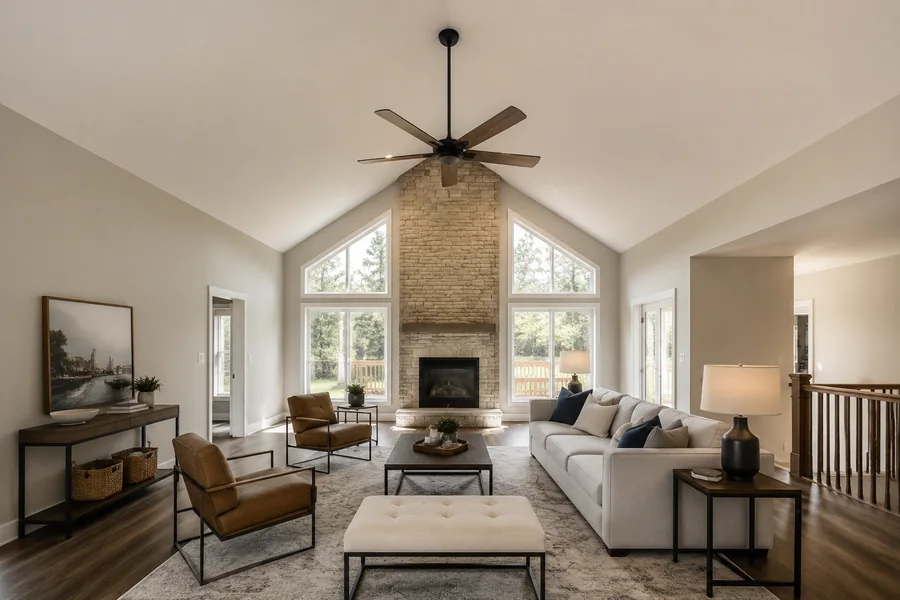
How do you check high-side and low-side clearance?
Imagine a circle around the motor that represents the blade path. The circle must stay clear of the ceiling on both sides of the slope. A fan that looks clear on the low side can still touch the high side when the blades rotate.
If you are unsure whether the blade span is too large, compare the fan size range guide with your room width. A smaller fan with the correct drop can be safer and more comfortable than a larger fan forced into a tight angled space.
How far should the blades stay from walls and beams?
Leave the clearance required by the model manual from walls, beams, and other fixtures. Do not measure only from the motor centre; the blade tips define the real moving boundary.
For a defined seating area, a 52-inch fan guide can help you decide whether a medium span is enough. You should choose the largest practical span that fits the room and the angle, not the largest span available.
Blade clearance should be checked as a full circle. The closest point may be at the high side of the ceiling, near a beam, or next to a skylight rather than directly above the motor. Use the fan’s blade span to draw that circle on a plan before the mounting point is fixed.
You should not assume a smaller fan solves every clearance issue. A small fan mounted too close to the ceiling can still be unsafe or ineffective. In many vaulted rooms, the better answer is a compatible downrod mount that gives a medium or large fan enough room to operate properly.
Keep the light layout in the same drawing. Recessed lights, pendants, and ceiling beams can create a crowded ceiling even when the blades technically clear. A good installation gives the fan its own clean space rather than squeezing it between unrelated fixtures.
Clearance should be read as moving space, not just static space. The blades need room on the high side and low side of the angle, and the fan also needs enough visual breathing room so the ceiling does not feel crowded once the fixture starts spinning.
If the ceiling has a steep angle, the blade nearest the high side becomes your risk point. Give that side extra attention in measurement. A drawing that only shows the low side can make the installation seem safer than it really is.
Which Ceiling Fan Mounts Work Best on Vaulted Ceilings?
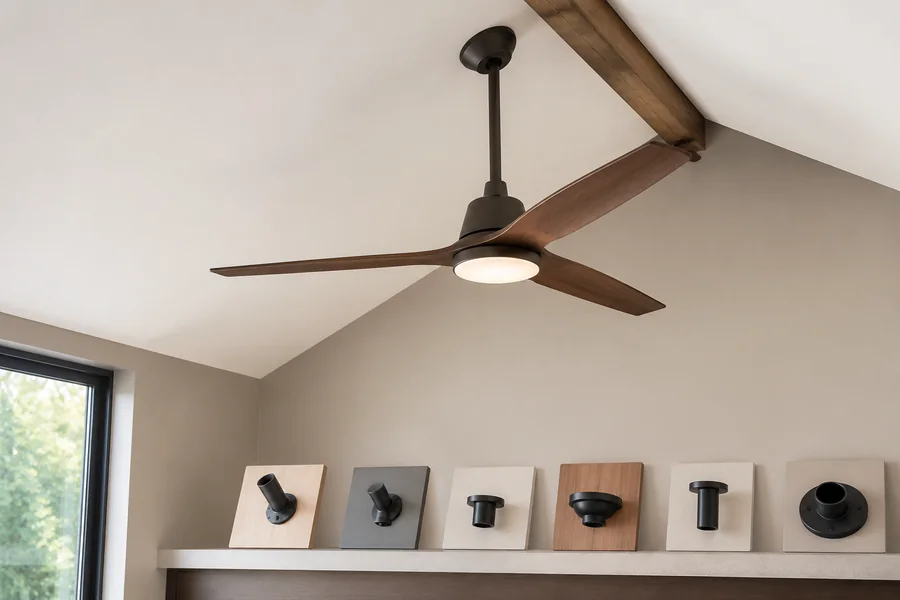
Why are downrod-compatible fans usually easier?
A downrod-compatible fan gives you room to use an adapter, create blade clearance, and bring the fan closer to the people below. It is usually easier to level than a compact fan designed only for a flat ceiling.
You should still confirm the angle limit, downrod range, and support requirements for the exact model. A standard downrod fan is not automatically compatible with every vaulted ceiling.
When is a flush-mount fan the wrong choice?
Most flush-mount fans are designed to sit close to a flat ceiling. On a slope, the canopy may not hold the motor level, and the blade path may sit too close to the high side. Do not force a flush-mount fan onto an angled surface.
For a vaulted room, you can compare the oak white fan for a natural room direction, the 52-inch DC fan for a medium seating zone, and the flush-mount fan light only when the specific model and canopy are confirmed for a flat ceiling or compatible angle. Do not assume a flush-mount product is suitable for a slope.
A downrod mount gives you flexibility because the fan can hang below the angled plane. It also lets you choose a practical blade height for the room. That is why it is usually the first mounting style to consider for a vaulted living room.
A flush-mount fan should be treated as a flat-ceiling choice unless the exact model documents a compatible angled installation. Its compact body may look appealing in a low room, but on a slope it often cannot level the motor or create a safe blade path.
You should choose product style after the mounting method is confirmed. A white fan can reduce visual weight, a wooden finish can complement a vaulted interior, and an integrated light can replace another fixture, but none of those style decisions can compensate for an incompatible mount.
A downrod-compatible model usually gives you the most freedom because you can adjust height, angle, and visual scale together. That flexibility matters in vaulted rooms, where the ceiling shape often matters as much as the fan itself.
When you compare fan types, keep installation service in mind. A beautiful fixture mounted on a difficult slope can become a maintenance problem if the receiver, light driver, or canopy hardware cannot be reached without special access.
How Do You Size a Fan for a Vaulted Living Room?
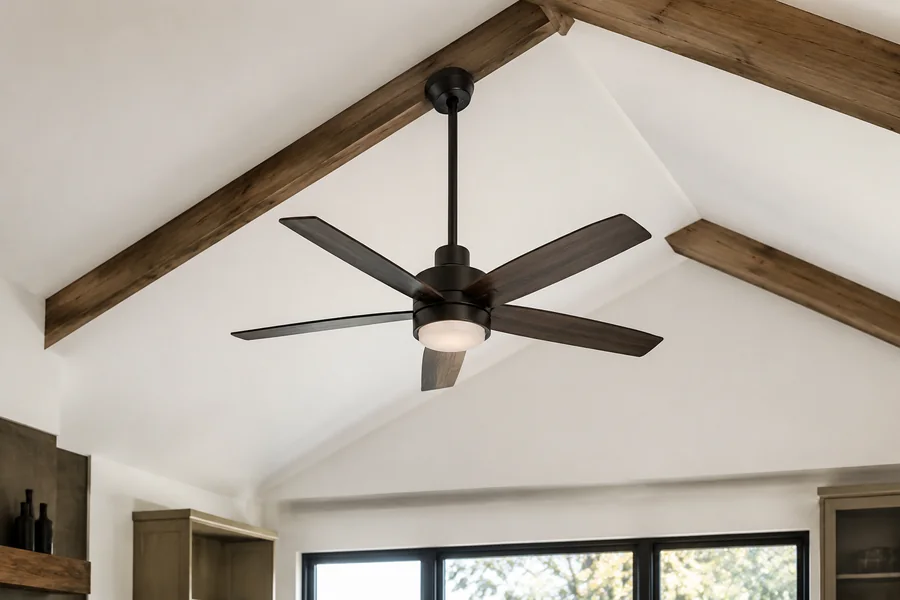
Should you size the fan by floor area or ceiling volume?
Start with floor area and the furniture zones, then adjust for the extra height. Ceiling volume explains why you may need a stronger motor or better placement, but it should not replace room-width and seating-zone measurements.
For a large room, use the large living room coverage guide to compare blade span and occupied area. If the room is unusually wide, you may need more than one fan rather than one oversized fixture.
When should you use one fan or two?
One fan can work when your seating is centred below one structural point. Two fans are more useful when the room is long or divided into separate zones. Compare the one-versus-two fan guide and the open-concept layout guide before choosing the mounting points.
The fans should follow the room’s actual activities. Place them over the living and dining zones rather than spacing them evenly across an empty ceiling.
A vaulted ceiling makes the room feel larger, but the size decision still starts with the floor area and the occupied zones. A tall ceiling does not automatically mean you need the biggest fan. You need enough coverage for the sofa, dining table, or kitchen edge where people actually spend time.
In an open-plan room, look for natural visual centres such as a lounge grouping and a dining table. One fan may be enough for one strong centre. Two fans are often more comfortable when the room has two separate activity zones and neither should be treated as an afterthought.
You should consider how the fans look together from the main entrance. A pair should read as a deliberate layout, with aligned finishes and controls, rather than two fixtures added later because one central fan did not reach the far side of the room.
Sizing a vaulted room is easier when you start from the furniture zone and move outward. The ceiling may be dramatic, but the comfort question stays simple: can the fan cool the places where people sit without overpowering the room when it is switched off?
The best fan size is usually the one that lets you run the fan at a comfortable middle speed. If the fan is too small, you may keep it on high and hear more noise. If it is too large for the zone, the breeze can feel too direct even at lower speed.
What Should You Check Before Installing a Sloped-Ceiling Fan?
How do you check structural support and wiring?
Use a fan-rated box or structural support, confirm the adapter and bracket are compatible, and make sure the wiring can reach the receiver through the selected downrod. Have a qualified installer verify the support before the fan is hung.
If the room is especially tall, the great room sizing guide can help you check whether the proposed fan is large enough for the space. Height and angle do not remove the need for proper structural support.
How do you test the finished installation?
After installation, run the fan at low and medium speed first. Check for wobble, unusual noise, blade-to-ceiling clearance, and any movement in the canopy or downrod. Stop and correct the problem before using the highest speed.
You should also test the remote, light, reverse function, and wall switch from the places where you will actually use them. A fan is not fully successful if it hangs safely but is awkward to control every day.
Check the support before you unpack the fan. The electrical box or structural support must be rated for a moving fan, not only a light. You also need enough room for the adapter, receiver, wiring, canopy, and downrod to assemble without crushing or pinching parts.
After the fan is installed, stand at the high side and low side of the room while it runs. Listen for changes in sound, watch the blade path, and check that the canopy remains still. A fan can appear fine from the floor centre while a clearance issue is visible from another angle.
Use the room at the speeds you expect to use every day. If the airflow is only noticeable at a noisy high setting, revisit the height, placement, or fan size. A vaulted-ceiling fan should provide a comfortable breeze without demanding maximum speed all the time.
After the fan is up, the real test is whether the room still feels natural when the fan is off. If the canopy, rod, and light make the ceiling look cluttered, or if the fan dominates the room more than the furniture, the layout may need a second look.
Before you sign off on the installation, check the fan from multiple room positions. Stand at the entry, sit on the sofa, and look from the low side of the ceiling. A vaulted installation can look right from one angle and awkward from another.
If you are looking for a better ceiling fan light solution for your project, NEBOLA can provide one-stop support from product selection to customization. We focus on ceiling fan light R&D and manufacturing, helping brands, importers, and distributors find products that better match real space needs.
NEBOLA Ceiling Fan Light Support
Planning a fan for a sloped ceiling?
Share the ceiling angle, room size, and fan model, and NEBOLA can help you review the adapter, downrod, and clearance requirements.
FAQ
Can you install a ceiling fan on a vaulted ceiling?
Yes, you can install one when the mounting system supports the ceiling angle, the motor hangs level, and the blades have safe clearance.
Does a sloped ceiling always need an adapter?
No, a mild slope may be supported by the canopy, but a steeper angle usually needs a compatible sloped-ceiling adapter.
Can a flush-mount fan be installed on any angled ceiling?
No, most flush-mount fans are designed for flat ceilings and should not be forced onto a sloped surface.
Does a vaulted ceiling usually need a downrod?
Yes, a downrod is usually needed to bring the fan away from the angled ceiling and keep the blades clear.