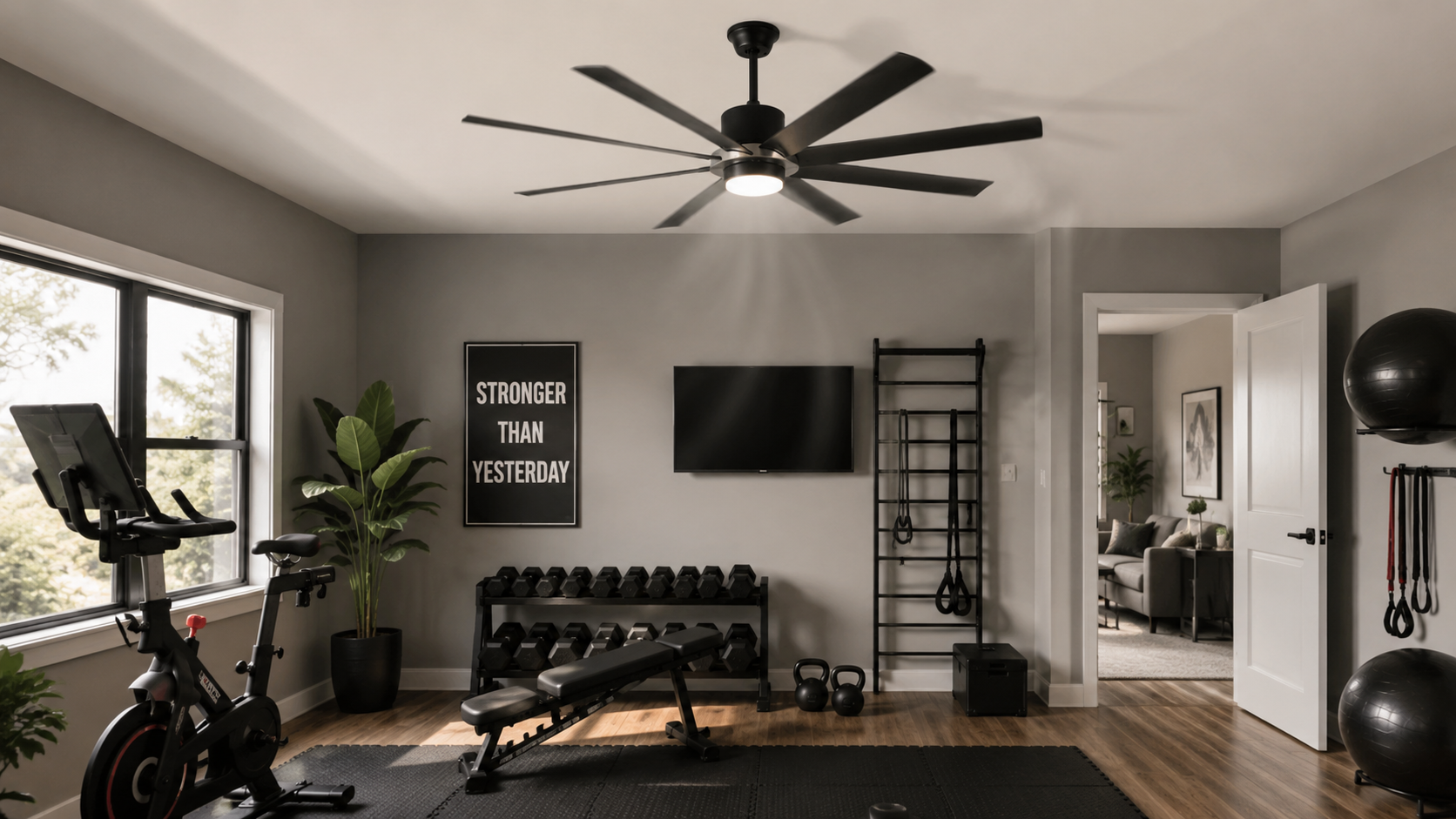


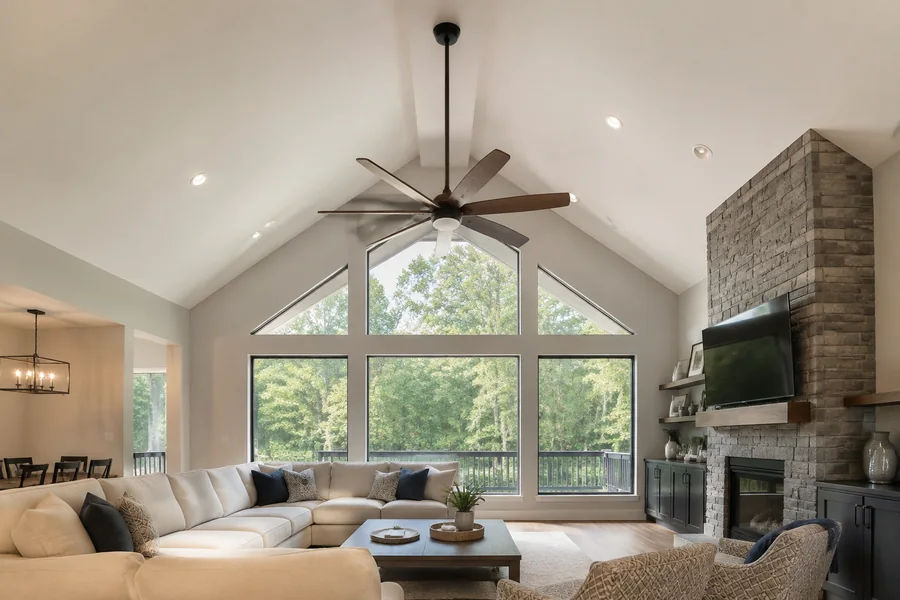
The best cathedral ceiling fan setup combines the right blade span, downrod length, and mounting height. You should bring the blades into the occupied zone, keep them clear of the angled ceiling, and choose one or two fans according to the furniture layout. Start with our living room fan collection after measuring the peak height, room width, and seating zones.
What Ceiling Fan Setup Works Best for a Cathedral Ceiling?
Why is a cathedral ceiling different?
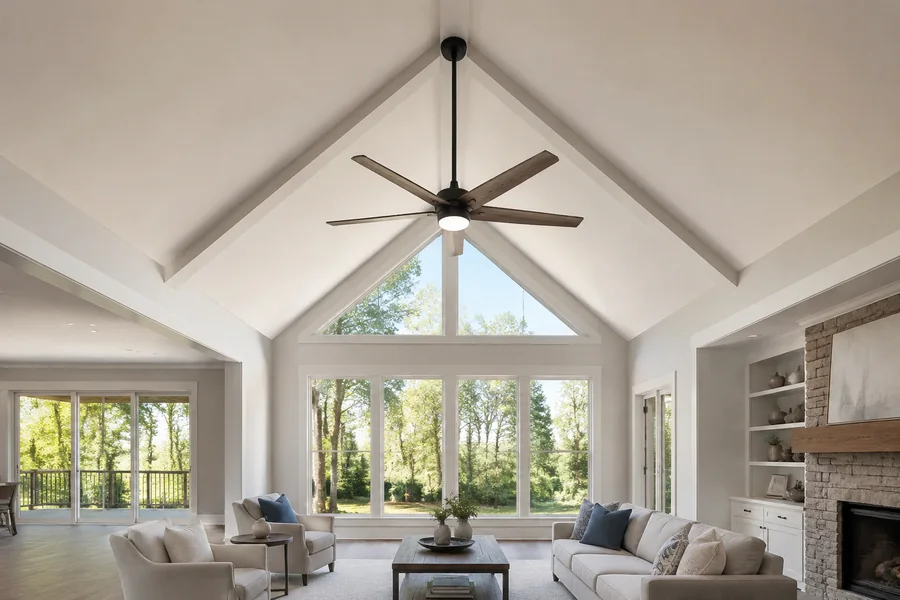
A cathedral ceiling is tall and angled, so your fan must solve three problems at once: it must hang level, sit at a useful height, and clear both sides of the ceiling. A fan placed at the peak can look balanced while moving too little air where you sit. Research on personal airflow and comfort supports planning around the occupied zone.
Your setup should begin with the room shape, not the fan style. Measure the peak height, the mounting point, the room width, the seating zone, the angle, and the location of beams or other ceiling fixtures.
What measurements should you take first?
Write down the finished floor-to-peak height, the floor-to-low-side height, the ceiling angle, the distance from the proposed mounting point to the main sofa, and the clearance to walls or beams. These measurements tell you whether you need one central fan, two fans, or a different mounting point.
You should also record the total height of the fan with its light installed. The lowest point of the fixture may hang much farther down than the blades, which affects the visual balance above a coffee table or dining area.
A cathedral ceiling is not simply a high flat ceiling. The angled planes change the available blade clearance, the visual centre of the room, and the position where the fan will actually look balanced. You should plan the fan from the living zone upward, rather than starting at the roof peak.
If the ceiling has a ridge directly above the room, the best location may be slightly below the peak or closer to the main seating group. That can improve both the airflow and the view from the sofa. The central point of the architecture is not always the central point of daily comfort.
You should decide early whether the fan is meant to be a quiet background fixture or a visible decorative feature. The answer affects blade finish, light kit, diameter, and how much visual space you leave around the downrod.
A cathedral ceiling usually needs the fan to act as both a visual anchor and an airflow tool. The best setup is the one that makes the room feel calm when you walk in and still gives you a usable breeze when you sit down.
The setup also has to respect the architecture. Cathedral ceilings often have strong lines, beams, ridges, or windows that guide the eye. A fan should support that structure, not interrupt it. That is why the mounting point deserves as much attention as the fan model. If the fan blocks the best view of the ceiling or hangs across a window line, the room can feel less open even when the airflow is correct.
What Fan Size Fits Your Cathedral Living Room?
How should you match blade span to floor area?
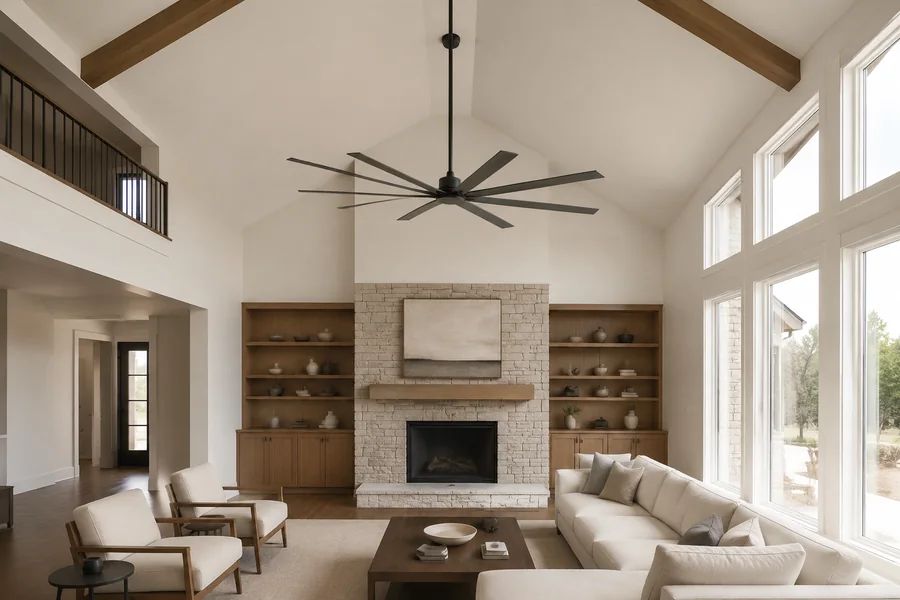
Choose blade span from the floor area and the seating zone, then use the cathedral height to refine the motor and mounting plan. A 56- or 60-inch fan may suit a defined seating group, while a broad great room may need 66 or 70 inches.
If you are comparing several sizes, use the 42- to 72-inch size guide and the 60-inch versus 72-inch comparison together. A larger fan is useful only when its blade path fits the walls, beams, lights, and visual scale of the room.
How should furniture affect your choice?
Project the centre of your sofa, lounge chairs, or dining table up to the ceiling. That point may be more useful than the geometric centre of the cathedral ceiling. You want the air to reach the people using the room, not an empty corner or the highest peak.
For a wide living room, the large-room fan guide can help you compare coverage. If the furniture is split into two zones, two medium fans may feel more even than one very large fan.
| Cathedral room type | Good starting span | Main reason |
|---|---|---|
| Defined seating group | 56-60 in | Balanced size over one zone |
| Wide living room | 60-66 in | Broader coverage and visual scale |
| Great room | 66-70 in | Stronger reach across a larger footprint |
| Two activity zones | Two medium fans | More even comfort across the room |
For a larger cathedral room, the 70-inch large fan can provide stronger visual and coverage scale. The 66-inch wood fan light offers a warmer decorative direction, while the 60-inch decorative fandelier may suit a room where the fan also needs to act as a ceiling feature. Check downrod and angle compatibility for each model.
A fan size chart gives you a starting point, but furniture is the final check. A 60-inch fan centred over a compact seating group may feel oversized, while the same fan can look proportionate in a broad living room with a long sofa, two chairs, and a large rug.
Use the blade tips as the real footprint, not the motor housing. Measure to beams, walls, pendants, and upper cabinets. A larger fan can be more efficient at a lower speed, but only when the blade circle has enough clear space to work properly.
If your room extends into a kitchen or dining zone, think about whether one fan should serve both spaces. You may get a better result with two medium fans, each placed where people gather, instead of one very large model trying to reach every corner.
Blade span should follow the floor plan, not the drama of the ceiling. A room with one seating cluster needs different coverage from a wide great room, even if both have the same cathedral height.
If you are between two fan sizes, choose based on the area you actually want to feel, not the maximum ceiling volume. A slightly smaller fan placed correctly can feel more refined than a larger fan that visually crowds beams, windows, or a central light.
How High Should a Cathedral Ceiling Fan Hang?
Where should the blades sit above the floor?
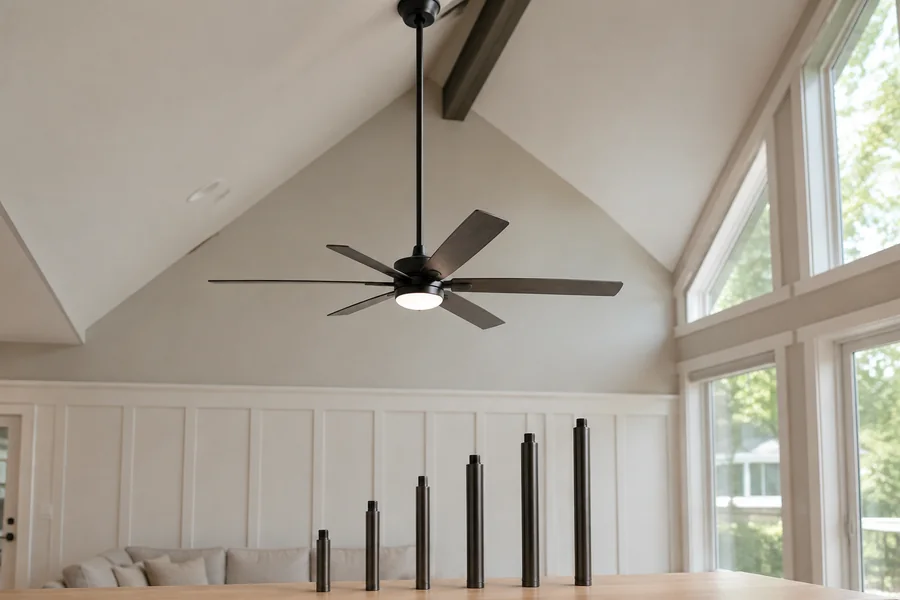
Aim for a blade height that brings the airflow into the occupied zone while keeping the required safety clearance. In many residential rooms, a blade height around 8 to 10 feet is a useful planning reference, but you must follow the exact fan manual and local requirements.
A high-ceiling fan guide can help you compare blade height with room scale. You should not leave the fan at the cathedral peak simply because that is the easiest point to wire.
How do you avoid placing the fan too low?
Include the canopy, downrod, motor housing, and light assembly in the total drop. Check the lowest fixture point against furniture, walking paths, and other lights. A fan can have safe blade clearance but still hang too low as a complete light fixture.
If you use a long downrod, inspect the finished view from the sofa and the room entrance. The fan should look connected to the room rather than suspended awkwardly below the ceiling.
The right hanging height helps the fan feel connected to the furniture below. If it stays near the ridge, you may notice the fan visually but not the airflow. If it hangs too low, it can interrupt the tall, open feeling that makes a cathedral ceiling attractive.
Look at the room from more than one position. From the sofa, you want the fixture to feel proportionate and the breeze to reach you. From the entrance, you want the fan and downrod to sit comfortably within the roof shape instead of appearing randomly suspended.
You should also account for ceiling heating and cooling patterns. Warm air can gather near the upper ceiling in winter, while a summer breeze is most useful around the seating area. The correct blade height helps the fan contribute in both situations.
The most comfortable height is usually the one that keeps the fan connected to the room while leaving enough air for the blades to do real work. If the fan disappears too close to the peak, it becomes a ceiling object first and a comfort tool second.
The finished height should also allow the fan to feel intentional when viewed from the side. In a cathedral room, people often see the fan from stairs, balconies, or adjacent spaces. The downrod and fan body need to make sense from those side views too.
How Do You Choose the Right Downrod Length?
How do you calculate total drop?
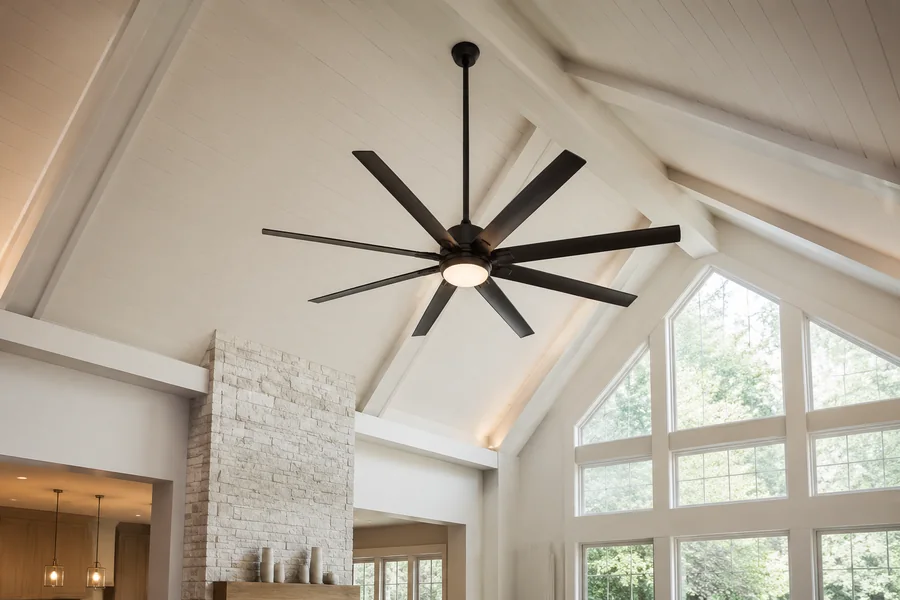
Subtract the desired blade height from the ceiling height, then account for the fan body and canopy. The remaining distance gives you a starting downrod direction. The 12-, 15-, and 20-foot downrod guide explains why the same rod length cannot be used for every tall room.
You should measure from the actual mounting surface, not from the finished ceiling peak shown in an architectural drawing. Beams, trim, and angled surfaces can change the point where the canopy sits.
What makes a long downrod stable?
A long downrod needs suitable structural support, a compatible coupler, correct wiring, and any safety cable or stabilising hardware specified by the manufacturer. Balance matters more as the rod becomes longer because small movement is easier to notice.
If your ceiling is sharply angled, review the vaulted and sloped ceiling guide before choosing the rod. You may need an angle adapter as well as extra length.
A downrod is part of the airflow design, not just a suspension part. Its length determines where the fan sits between the ridge and the room. Measure the total drop using the actual fan body and, where relevant, its light kit, not a generic diagram.
Long rods make small alignment errors easier to see. If the mounting point is slightly off-centre or the ceiling angle is not properly accounted for, the fan can appear crooked from the entrance even when the electrical connection is secure. Careful layout prevents that awkward result.
You should confirm the available rod lengths before selecting the fan finish or light style. A beautiful fixture that cannot accept the required rod or adapter is not a suitable cathedral-ceiling choice.
A long downrod only helps when the support is stable and the visual result still feels balanced. Cathedral rooms make even small errors easy to see, so the finished height should be chosen as much for appearance as for airflow.
If you need a very long rod, ask whether the model has recommended maximum rod lengths or balancing instructions. Not every decorative fan is equally comfortable on a long suspension, and the installation should not rely on guesswork.
Should You Use One Large Fan or Two Fans?
When does one central fan work well?
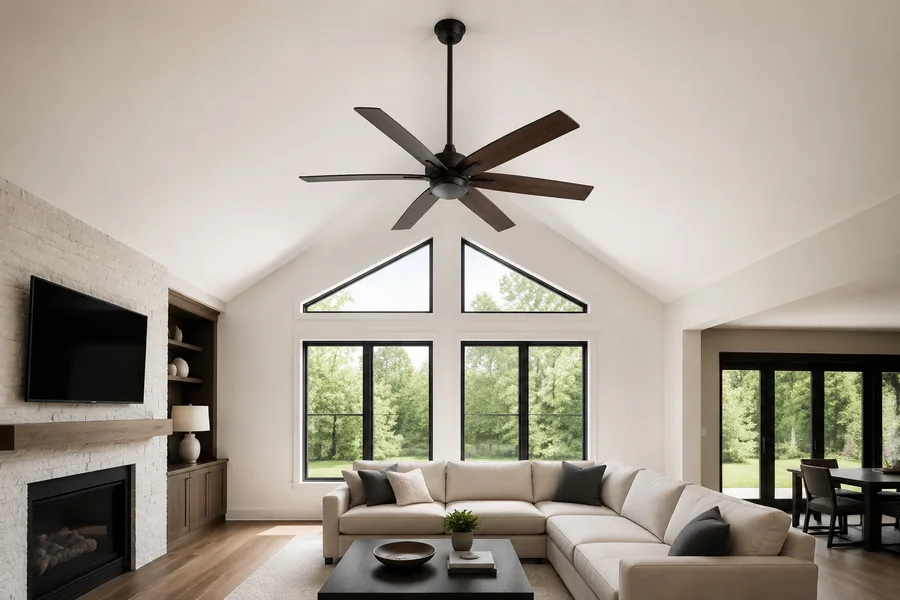
One fan works well when your main seating zone is centred under one strong mounting point. You get a cleaner ceiling, one set of controls, and a clear visual centre. The one-versus-two fan comparison can help you weigh that simpler layout against wider coverage.
A single large fan is also easier to coordinate with a chandelier or pendant. You can keep the light fixture and fan from competing for two different centres in the same room.
When are two fans more practical?
Two fans are more practical when your cathedral room is long, open to a kitchen, or divided into separate activity zones. The open-concept fan guide shows why each fan should sit over a useful zone instead of being spaced only by the ceiling length.
Two fans require two suitable support points, coordinated controls, and enough distance between the blade paths. You should decide their positions together with the furniture and lighting plan.
One large fan offers a clean focal point when the room has one main seating group. It can simplify the ceiling visually and make daily controls easy. This layout works best when the blade span reaches the lounge zone without getting too close to beams or side walls.
Two fans are usually better when the room is long, shaped like an L, or clearly divided into lounge and dining areas. Each fan can run at a quieter speed because it serves a smaller occupied zone. That can feel calmer than one oversized fan running hard in the centre.
If you choose two fans, coordinate their heights, finishes, and control method. The pair should look like one planned system. Even a slight difference in drop length becomes noticeable against a tall cathedral ceiling.
One fan is simpler, but two fans can be calmer in a long room because each one can run at a more relaxed speed. The right answer is the one that serves the room’s furniture zones without making the ceiling look overworked.
Two fans also change how you arrange lighting. Recessed lights may need to be spaced around both blade paths, and pendants may need to move away from the fan centres. Plan these fixtures together so the ceiling does not become visually busy.
Should a Cathedral Ceiling Fan Have a Light?
When is an integrated light useful?
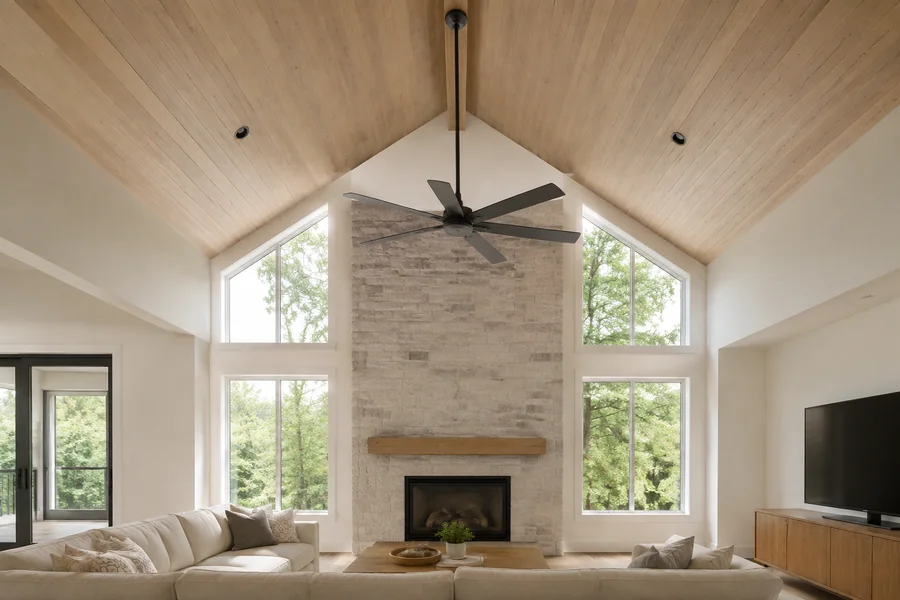
An integrated light is useful when the fan is the main overhead fixture and you need both circulation and illumination from one point. Check the beam angle, dimming range, colour temperature, and whether the light reaches the seating area.
If the room already has recessed lights, wall lights, or a pendant, a fan without an integrated light may keep the cathedral ceiling calmer. You can compare that approach with the living room lighting guide, which explains how ceiling fixtures interact with room layout.
How do you keep a decorative fan from looking too heavy?
Use the room’s finishes, furniture scale, and sightlines to judge the fan. A decorative model can become a strong focal point, but it should not block a chandelier, overwhelm the roof shape, or hang so low that the room feels crowded.
You should compare the fan when it is switched off as well as when it is moving. Blade colour, light housing, and downrod finish all affect how the fixture sits against the cathedral ceiling.
An integrated light is useful when you need a central source of illumination and do not already have a chandelier, pendant, or sufficient recessed lighting. You should check the light distribution from the sofa and dining table, because a high-mounted light can feel dim even when its rated output looks adequate.
A no-light fan can be the better choice when the ceiling already has several lighting layers. It leaves the fan to do one job well: move air. This can make a busy cathedral ceiling feel calmer, especially in rooms with exposed beams or a statement pendant.
Decorative fan lights work best when their scale supports the room rather than competing with the ceiling shape. Consider the fan’s off-state appearance, the downrod finish, and how the light housing looks from the room entrance as well as from directly below.
A fan light is useful only when it adds to the room’s lighting layers instead of fighting them. In a cathedral room, the wrong light can make the fan feel heavier than it needs to be, so the lighting plan and the fan plan should be read together.
If the fan light is high above the room, brightness alone is not enough. The light needs a useful spread and a comfortable colour temperature. Otherwise, you may still need lamps or wall lighting even though the fan technically includes an LED.
What Installation Details Matter Most?
How do you check angle compatibility and support?
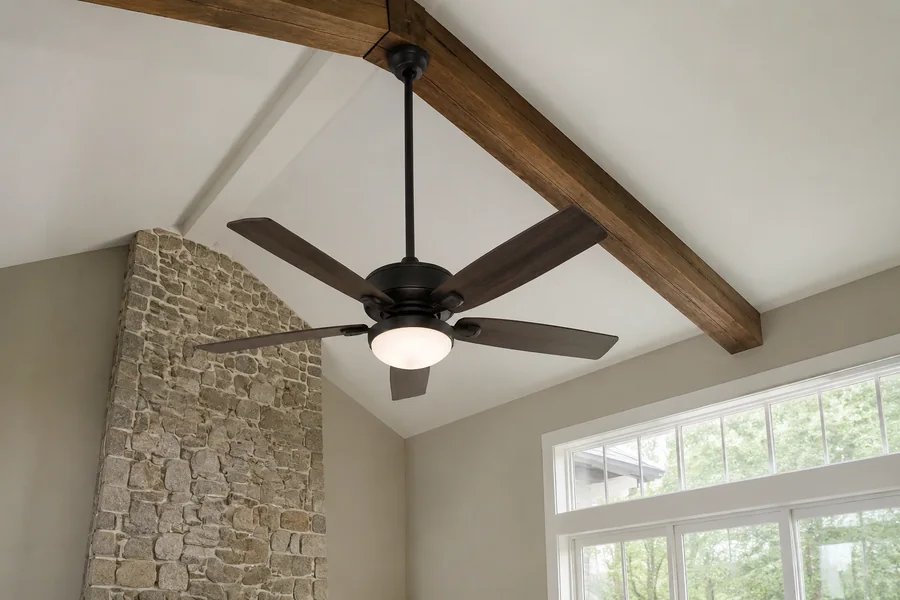
Confirm the ceiling angle, fan-rated support, adapter, bracket, downrod, and wiring before installation. A lighting box alone is not enough for a moving fan, and a canopy that fits the ceiling visually may still fail to hold the motor level.
If the room is low at the edges or has a complicated roof shape, compare the 9-foot ceiling guide with your actual mounting point. You may need to move the fan away from the peak or select a different downrod.
How do you plan maintenance and control?
At cathedral height, remote control, reverse mode, receiver access, blade cleaning, and light replacement matter from the start. You should know how the fan will be serviced before the ladder or lift leaves the room.
After installation, run the fan at low and medium speed first. Check wobble, noise, blade-to-ceiling clearance, and the relationship between the airflow and the seating area before using the highest speed.
The ceiling box, bracket, adapter, downrod, and wiring all need to work as one assembly. You should never assume that a light-rated box can carry the dynamic load of a ceiling fan. Confirm the fan-rated support before the installation begins.
Make a plan for service before the room is finished. At cathedral height, changing a receiver, cleaning blades, or replacing a light component can require special access. A remote with reverse control and dependable dimming is especially useful when the fan will be difficult to reach.
After installation, test the fan from the sofa, not only from the ladder. Check whether the airflow reaches the seating area, whether the fan looks centred from the entrance, and whether any wobble or noise appears at the medium speeds you will use most often.
At cathedral height, the most practical question is often serviceability. If you cannot imagine how the fan will be cleaned, balanced, or repaired later, the installation is not fully solved yet.
The last practical check is how the fan behaves at the speeds you will use every week. A cathedral ceiling can amplify small noises and make wobble more visible, so low- and medium-speed testing is more useful than a quick full-speed demonstration.
If you are looking for a better ceiling fan light solution for your project, NEBOLA can provide one-stop support from product selection to customization. We focus on ceiling fan light R&D and manufacturing, helping brands, importers, and distributors find products that better match real space needs.
NEBOLA Ceiling Fan Light Support
Need a cathedral ceiling fan setup?
Share the ceiling height, room dimensions, and seating zones, and NEBOLA can help you compare size, downrod, and mounting height.
FAQ
Does a cathedral ceiling usually need a downrod?
Yes, most cathedral ceilings need a downrod because the fan must hang below the peak and remain level.
Is a 60-inch fan large enough for every cathedral living room?
No, a 60-inch fan can suit some rooms, but a wider room or multiple seating zones may need a larger fan or two fans.
Can one fan cover a cathedral ceiling living room?
Yes, one fan can work when the seating area is centred and the blade span provides enough coverage.
Should a cathedral ceiling fan always include a light?
No, choose an integrated light only when the room needs overhead illumination and the light will not compete with other fixtures.