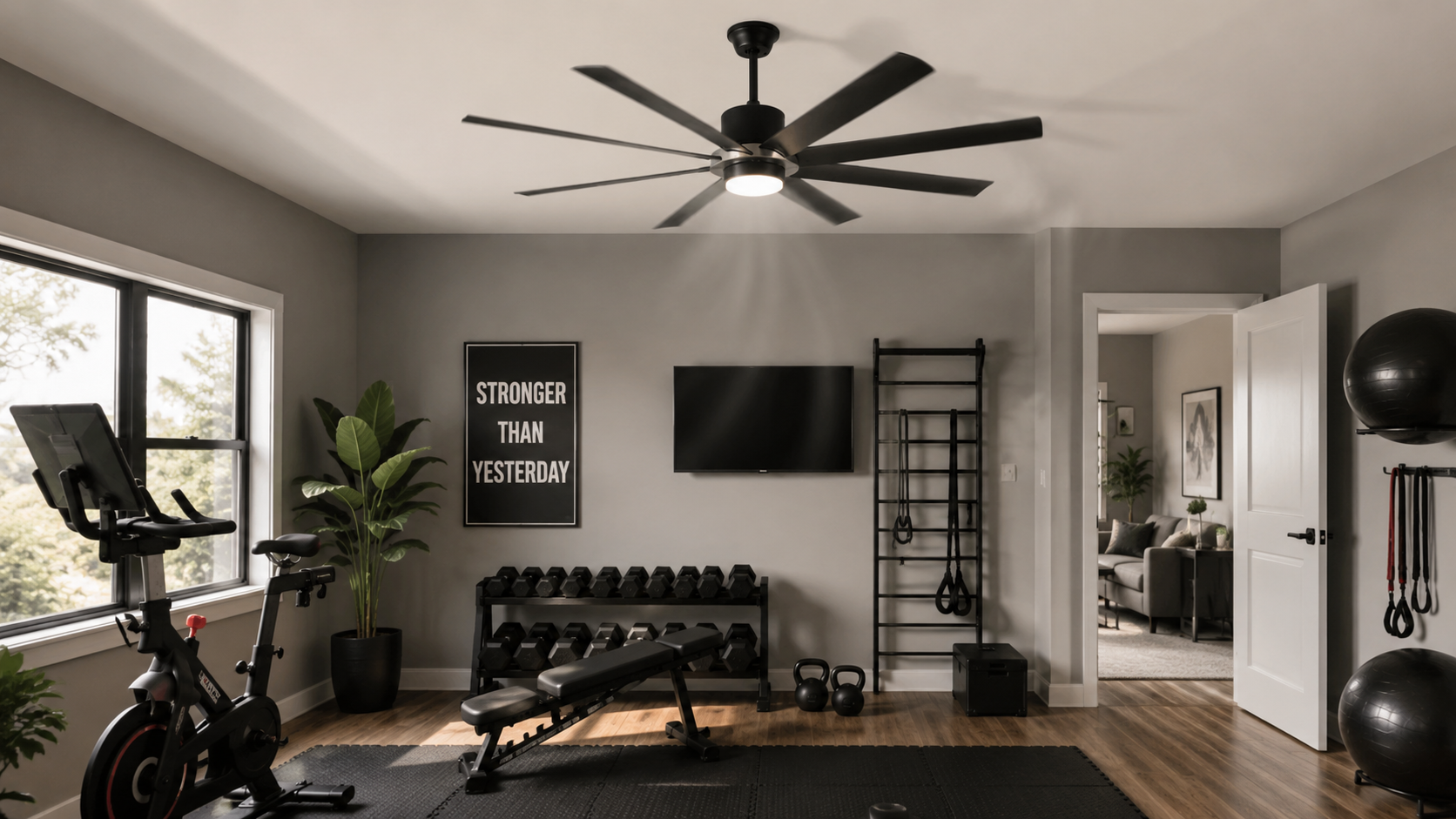


A ceiling fan looks good in a modern living room when it feels planned, not added at the last minute. You want the fan to match the room’s scale, ceiling height, finish palette, lighting mood, and daily comfort. If any one of those pieces feels wrong, the whole ceiling can look less refined even when the fan is technically attractive.
Before you choose a modern living room ceiling fan by photo alone, start with the room itself. If you still need a broader product direction, the living room fan collection gives you a clean starting point before you narrow the style.
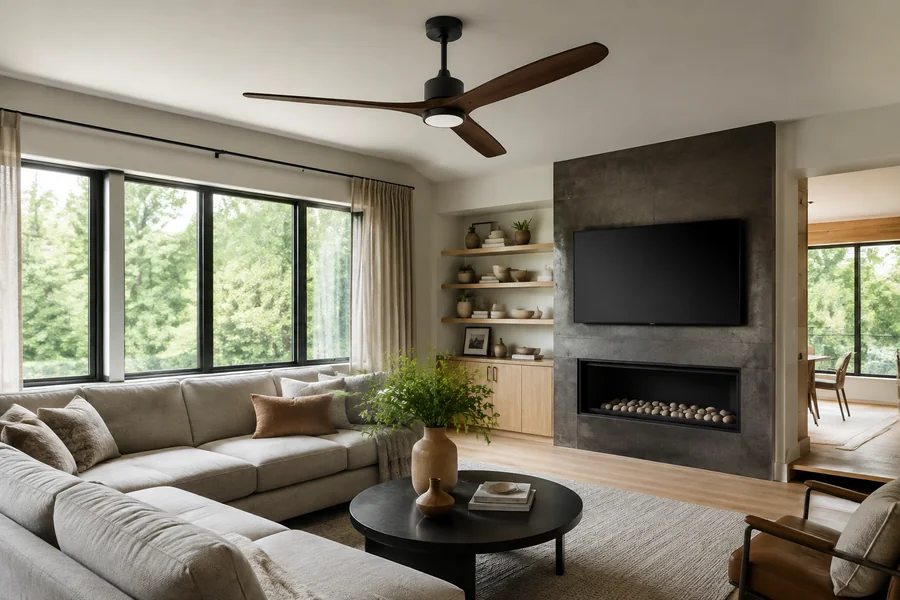
What Makes a Ceiling Fan Look Right in a Modern Living Room?
A fan looks right when it supports the room’s architecture. We should be able to look up and feel that the fixture belongs with the sofa scale, ceiling plane, wall color, and lighting layers. The fan does not need to disappear, but it should not interrupt the room every time you walk in.
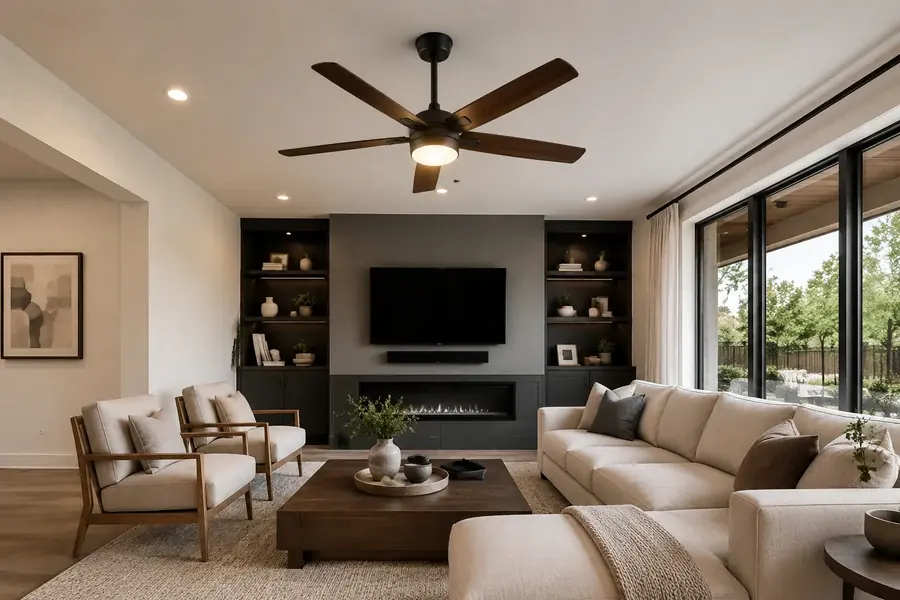
In a modern interior, the ceiling usually benefits from fewer distractions. That is why proportion, line quality, and finish discipline matter more than extra decoration. A fan that looks simple in a catalogue may look refined in your living room if the scale and placement are correct.
How should you judge the fan from inside the room?
Stand near the main entry and imagine the fan from below, not from a product photo. If the body feels too thick, the blade span feels nervous, or the finish fights with nearby hardware, you will notice it every day. The best modern fan should make the ceiling feel calmer and more intentional.
Why does visual comfort matter as much as airflow?
Aesthetic comfort changes how usable a product feels. Nielsen Norman Group’s research on the aesthetic effect is a useful reminder that visual quality can shape how we experience function. In a living room, that means a good-looking fan should also feel easy, quiet, and natural to live with.
We should also think about how the fan looks when the room is not staged. At night, with the TV on and lamps dimmed, a fan with too much glare or too much contrast can feel far more noticeable than it did in daylight. A good modern choice keeps its composure in those normal living moments.
This is why we cannot separate appearance from use. If the fan looks refined but the air feels too direct, or if the control feels clumsy, the design stops feeling modern. The best result is usually a fan that quietly supports the room for hours without asking for attention.
A modern room also rewards restraint in the ceiling zone. If your ceiling already has recessed lights, beams, speakers, or a central fixture point, the fan should simplify the composition rather than add another loud shape.
We should also check how the fan relates to the ceiling fixture point. If the electrical box is not aligned with the seating zone, the fan may be technically centered but visually wrong for the room.
How Should You Match Fan Size to the Room Instead of the Product Photo?
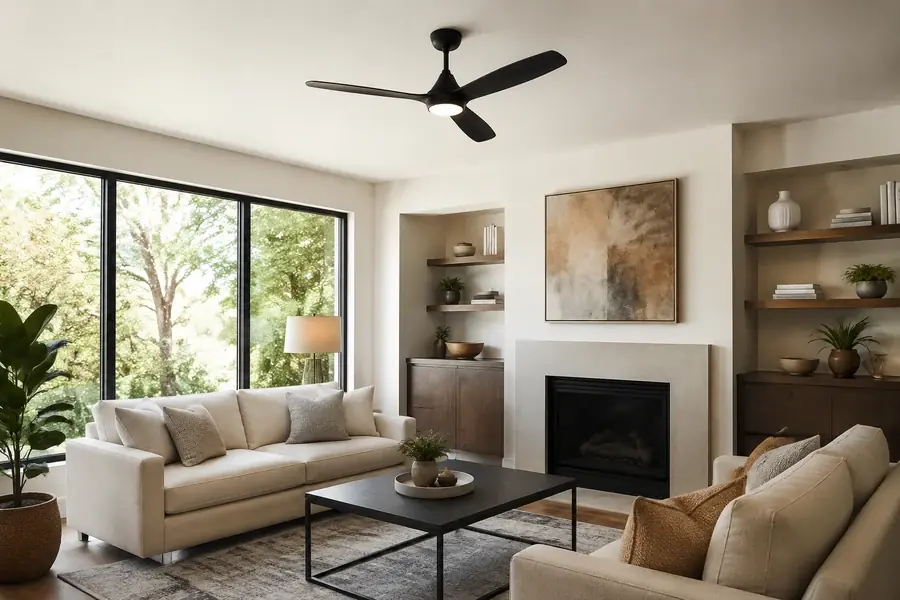
Product photos often make every fan look balanced because the room is staged around the fixture. Your room is different. We need to compare blade span, furniture spacing, ceiling height, and the main seating zone before the style choice can feel reliable.
| Room condition | What we should check | Style direction |
|---|---|---|
| Compact modern room | Low visual drop and clean blade line | White, slim, or low-profile body |
| Medium living room | Balanced 48-54 inch coverage | Simple LED fan or quiet wood finish |
| Large open room | Wider span and stronger scale | Larger modern body with calmer details |
| Tall or sloped ceiling | Downrod length and visual centering | Simple body with enough presence |
When is a 52-inch fan visually enough?
A 52-inch fan can look right in many medium living rooms when the seating area is not too wide. If you are unsure, the 52-inch room guide helps you check whether the span fits the real zone instead of the total square footage.
When does a modern room need more span?
A larger room can make a small fan look timid and misplaced. If your room is wide, open, or connected to a dining area, compare the 60 vs 72-inch guide and the blade span guide before you settle on the final look.
Measure the main living zone, not only the full room outline. If your sofa area is 12 feet wide inside a larger open plan, the fan should serve that zone first. This keeps the fan visually centered on the way you actually use the room.
We should also leave room around the blade circle. A fan that nearly reaches beams, tall cabinets, or a sloped ceiling edge can look squeezed even when the size chart says it is acceptable. Visual clearance matters because modern interiors depend on breathing space.
We should also compare size with furniture rhythm. A long sectional, wide rug, or broad coffee table can visually support a larger fan, while small seating pieces may need something quieter even in the same square footage.
For open rooms, we should separate total area from comfort area. A fan can look right over the sofa zone even when it does not cover the full open plan, as long as we do not expect it to solve every connected space.
Which Fan Shape Works Best With Modern Interior Lines?
Modern rooms usually favor shapes that look controlled from below. A wide flat blade, a tight motor housing, and a clean canopy can make the fan feel like part of the ceiling plane. A bulky body, heavy ornament, or awkward bracket can make the same room feel older and less deliberate.
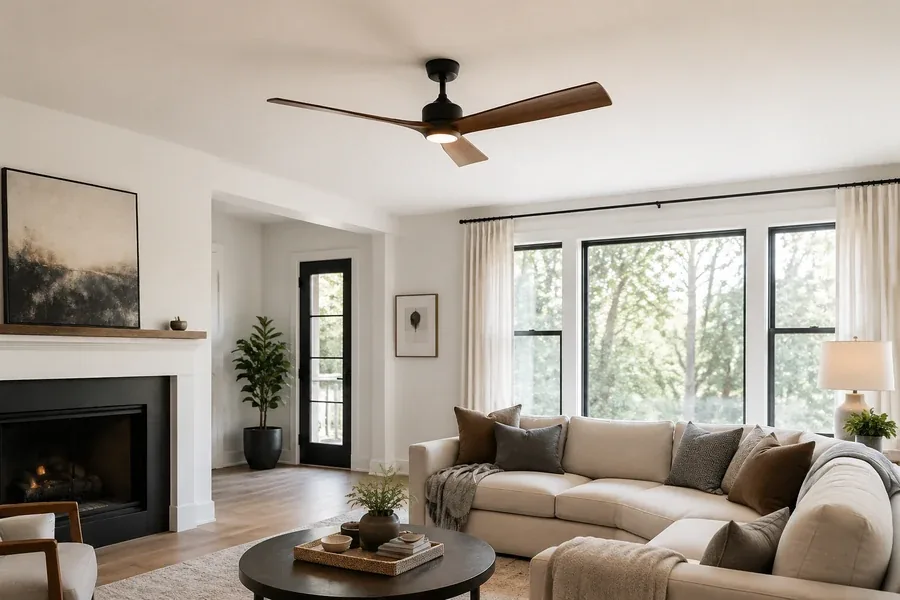
That does not mean every modern fan must be plain. It means the form should have one clear idea. If the fan has a sculptural body, the blades should stay quiet. If the blades have strong character, the motor housing should stay cleaner.
When does a low-profile fan look better?
A low-profile shape works best when your ceiling is lower, your room is compact, or your eye line already has a lot going on. A thin fan helps keep the ceiling from feeling crowded. A slim white ceiling fan is a good example of using profile control to protect the room’s modern feeling.
When can a stronger shape still look modern?
A stronger shape can work when the room is open enough to carry it. If your sofa, rug, and ceiling height all have enough scale, a more expressive body can feel intentional. We just need to keep the finish simple so the fan does not compete with every other detail.
Look at the fan body as a silhouette. From the sofa, you usually see the underside, the blade roots, and the light diffuser more than the dramatic side angle shown in product photos. If that underside looks neat, the whole fan tends to feel more expensive.
We should avoid shapes that mix too many design languages. A modern living room can handle a curved blade or a stronger center body, but it usually cannot handle a bulky motor, decorative trim, exposed screws, and a loud light lens all at once.
A good rule is to match the fan’s softness to the furniture. Straight furniture can handle a sharper fan, while rounded sofas and soft neutral rooms may look better with a gentler blade line.
Which Finish Makes the Ceiling Fan Feel Built Into the Room?
Finish is where many modern fan choices succeed or fail. A fan can have the right size and still look wrong if the color has nothing to do with the rest of the room. We usually want the fan to either blend into the ceiling or repeat a finish already visible in the space.

| Finish | Best room match | What to avoid |
|---|---|---|
| Matte white | White ceilings, quiet modern apartments | Too much flat white with no texture |
| Matte black | High contrast rooms, black window frames | Heavy look on a low ceiling |
| Light wood | Warm modern rooms with natural furniture | Rustic drift if the grain is too busy |
| Champagne or soft gold | Polished rooms with warm metal accents | Shiny yellow-gold that feels cheap |
When does white look more premium than black?
White can look more premium when your ceiling is low, your walls are light, or your room is already rich in texture. A modern white fan light can keep the upper part of the room calm while still giving you useful lighting and airflow.
When should you use black or wood?
Black works when the room needs a deliberate outline. Wood works when the room needs warmth. In both cases, the fan should connect to something else in the room, such as legs, frames, shelves, flooring, or hardware. Random contrast rarely looks high-end.
A finish should repeat a decision you already made in the room. If you have pale walls, light flooring, and soft fabric, a white or light wood fan often feels natural. If you have black window frames or dark metal table legs, a black fan can feel intentional instead of random.
Finish quality also changes under LED light. A cheap glossy finish can look acceptable in daylight and harsh at night. When possible, compare the finish against the room’s evening lighting because that is when the fan will often be most visible.
If you are choosing between two finishes, ask which one would still make sense if the fan light were turned off. A finish that only works because the product photo is dramatic may feel less natural in your own room.
If your room has mixed finishes already, choose the fan finish that calms the ceiling instead of adding another accent. The ceiling is usually not the best place to introduce a completely new material story.
How Should the Fan Light Support a Modern Living Room?
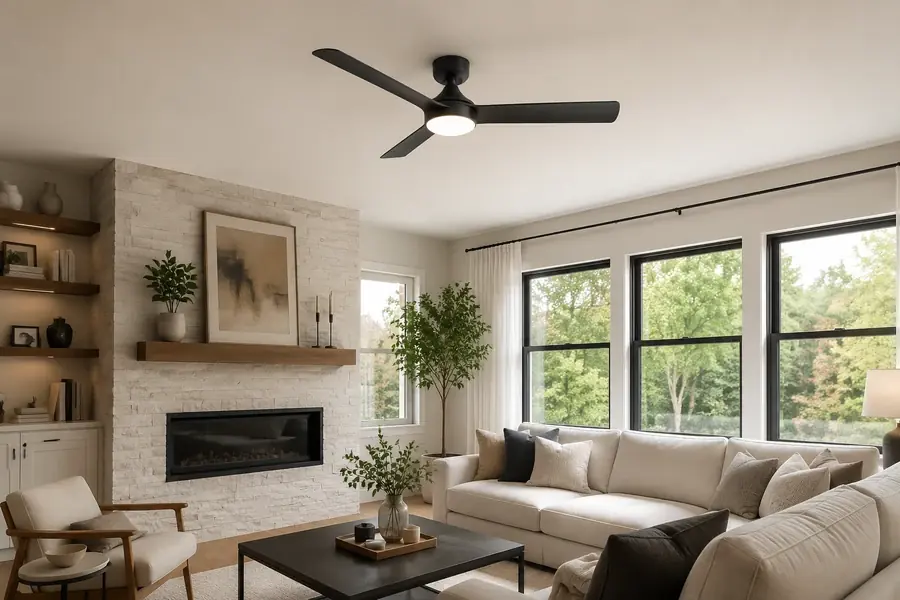
A modern ceiling fan with light should not behave like a bare overhead bulb. The light should be diffused, useful, and calm enough for evening use. If the LED module creates glare on the TV wall or washes the sofa in harsh light, the fan will feel less sophisticated no matter how clean the body looks.
When does integrated LED look cleaner?
Integrated LED usually looks cleaner when the diffuser is smooth and the bottom profile stays simple. A retractable fan light can also work when you want the fixture to feel more like a ceiling light at rest while still giving airflow when needed.
When should the fan light stay secondary?
If your room already has lamps, wall lights, or recessed lighting, the fan light can stay softer. That often looks better in a modern living room because the ceiling fixture does not have to carry every lighting task. For deeper planning, the living room lighting guide helps you think beyond one fixture.
We should decide whether the fan light is the main light or a supporting layer. If it is the main light, the diffuser, lumen range, and dimming curve need more attention. If it is only supporting other lamps, a softer integrated light can look more elegant.
The color temperature should also fit the room mood. A very cool light can make a warm modern room feel flat, while a very warm light can make a crisp room feel dull. The fan light should support the surfaces you already chose.
When the fan light has dimming, we should test the low setting as carefully as the high setting. Living rooms often spend more time in relaxed low light than in full brightness.
How Do Ceiling Height and Mounting Style Affect the Look?
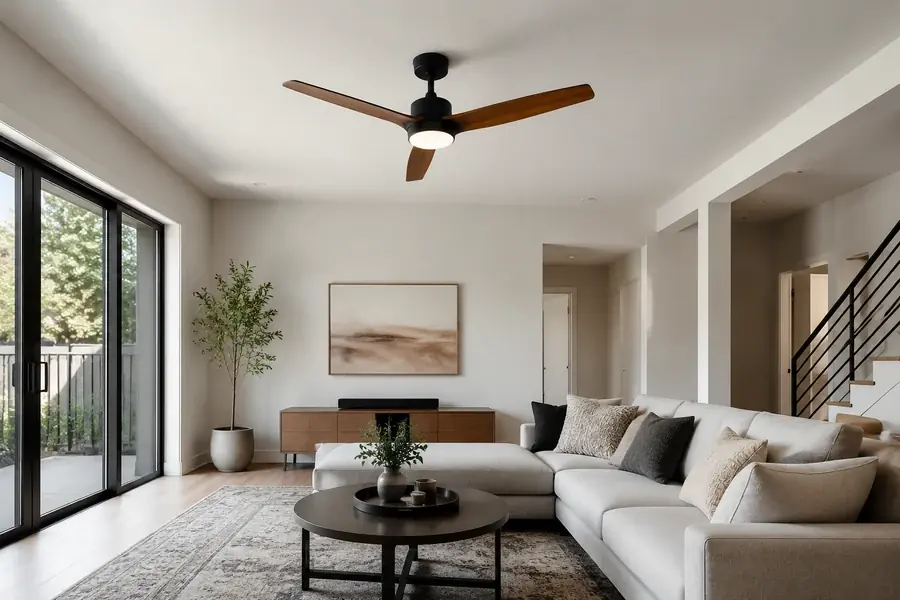
Ceiling height changes both comfort and appearance. A fan that hangs too low can make a modern living room feel cramped. A fan that sits too high can look disconnected and move air above the zone where you actually sit.
When should you choose flush mount or low profile?
Flush mount or low profile makes sense when the ceiling is low and the visual drop needs to stay small. If your room is around 8 feet high, the 8-foot ceiling guide can help you avoid a fan that looks too heavy overhead.
When does a downrod look more balanced?
A downrod can look better when the ceiling is 9 feet or higher, vaulted, or visually tall. The 9-foot mount guide, high ceiling guide, and downrod length guide can help you place the fan where it feels balanced.
Mounting style changes the visual weight of the fan. A flush mount can make a low ceiling feel cleaner, but on a taller ceiling it may look stuck too high and lose presence. A short downrod can sometimes make the fan look more balanced and also help airflow reach the seating area.
If the ceiling is sloped, we should think about alignment before style. A beautiful fan can look wrong if it hangs at an awkward angle or sits too close to the high side of the ceiling. Mounting hardware is part of the visual design, not only installation.
The downrod color also matters. A mismatched rod can make the fan look less integrated, especially on tall ceilings where the rod becomes a visible vertical line.
What Details Make a Modern Ceiling Fan Look Expensive?
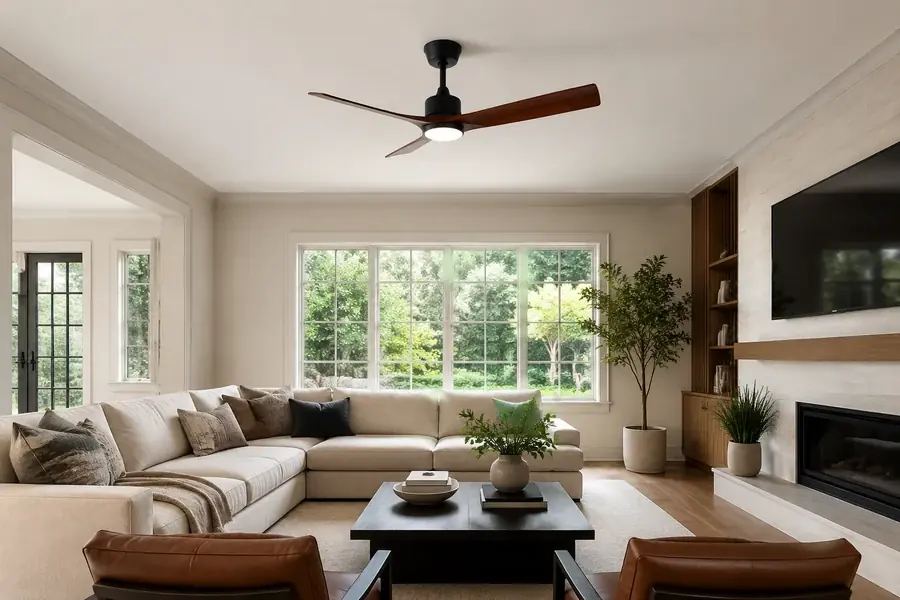
Expensive-looking fans usually have quieter details. The blades line up cleanly, the canopy sits tight to the ceiling, the motor housing does not look swollen, and the light diffuser does not look like a plastic afterthought. These details are small, but they shape the whole impression.
Why does build quality show up visually?
If the fan wobbles, hums, or has uneven blade gaps, the room immediately feels less polished. Style is not only surface. It is also how smoothly the fixture runs once installed. If quiet comfort matters, the quiet fan guide is worth checking before you choose only by appearance.
Which product direction fits a smaller polished room?
For a compact modern space, a small modern fan light can feel more refined than a large fan forced into the room. The goal is not to make the ceiling busier. The goal is to make the room feel complete.
Small details decide whether the fan keeps looking good after installation. A clean canopy, even blade gaps, a smooth diffuser edge, and a stable low-speed setting all communicate quality. You may not name these details immediately, but you will feel them in the room.
We should also judge the remote or wall control as part of the experience. If the fan looks sleek but the control feels cheap or confusing, the room loses some of that polished feeling. Modern design should feel simple in your hand as well as on the ceiling.
Packaging and installation hardware are not visible later, but they influence the finished result. Better hardware helps the canopy sit cleaner and reduces the small alignment problems that make a ceiling fixture look cheap.
What Style Mistakes Make a Modern Fan Look Awkward?
The biggest mistake is choosing a fan as a separate object. If the finish, drop height, light color, blade span, and room mood are decided separately, the final result can feel patched together. Modern style needs fewer decisions that contradict each other.
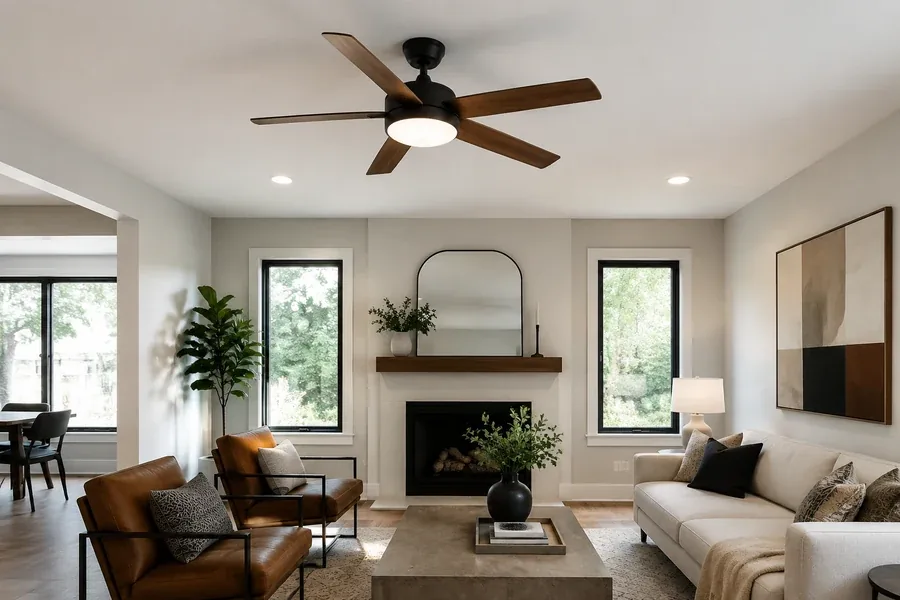
Can a fan be too decorative for a modern room?
Yes, it can. Decorative detail works when the room has enough space and the rest of the ceiling stays calm. If the fan adds crystals, exposed bulbs, heavy trim, and strong contrast all at once, it may pull the room away from the modern feeling you wanted.
Can a fan be too plain?
Yes, it can. A very plain fan can look cheap if the proportions are weak or the finish feels thin. Minimal does not mean unfinished. We still need good scale, clean edges, and a finish that works with your room.
Another common mistake is matching only one detail. For example, choosing a black fan because the coffee table has black legs may still fail if the ceiling is low and the fan body is thick. We need the whole object to fit, not only the color.
We should also avoid chasing a trend that does not match the room. A sculptural fan can look stunning in the right interior, but in a quiet apartment it may feel like the loudest object in the room. A calmer product often looks better for longer.
We should be especially careful with fans that try to be both ultra-modern and very decorative. Unless the room already combines those ideas, the fan can feel like two products forced into one body.
How Should You Choose the Right Fan for a Modern Living Room?
Start with the room, not the fan. If your living room already feels calm and finished, choose the fan that blends into the ceiling line. If the room is tall, open, or visually sparse, let the fan carry a little more presence so the ceiling feels intentional instead of empty.
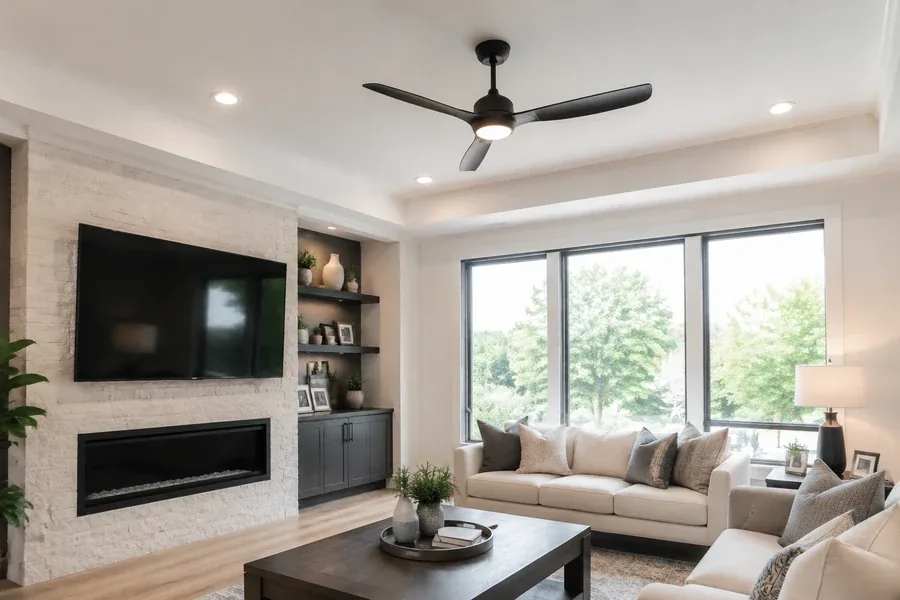
What should you check first?
Check ceiling height, room size, seating zone, and how much light the room already has. Once those basics are clear, finish, blade shape, and light style become much easier to judge. That order keeps you from choosing a pretty fan that works against the room.
When should you choose the quieter visual option?
Pick the quieter visual option when the room already has enough texture, when the ceiling is low, or when you do not want the fan to compete with the sofa, wall art, or lighting. A calmer fan often looks better for longer because it leaves the room space to change around it.
When should you choose the more visible option?
Choose a more visible fan when the room needs proportion rather than decoration. In a larger or taller living room, a slightly stronger shape can make the ceiling feel balanced without making the room feel busy. The key is presence, not excess.
How do you compare your final two choices?
| What you notice in the room | The safer direction | Why it usually works better |
|---|---|---|
| Low ceiling or compact room | Low-profile modern fan | Keeps the ceiling line light and avoids visual clutter |
| Tall, open, or sparse room | Fan with a little more presence | Helps the ceiling feel intentional and balanced |
| Warm finishes already in the room | Contemporary fan with a warmer finish | Repeats the room’s existing visual language |
| You want the room to stay flexible over time | Clean fan in a neutral finish | Easier to live with when furniture or wall colors change |
If two options still feel close, imagine each one at night with the light dimmed and the room in normal use. The better choice is usually the one that feels calmer from the sofa and still looks clear when you stand under it. That is the kind of decision that keeps working after the novelty fades.
If you want help turning those room notes into a real product shortlist, NEBOLA can map size, finish, light, and mounting into options that fit the space.
For a clearer product shortlist, you can also review the living room fan collection and compare the available size, finish, lighting, and mounting directions.
NEBOLA Ceiling Fan Light Support
Need a ceiling fan that fits the room, not just the catalog?
Share your room size, ceiling height, finish direction, and lighting goal. We can help you choose a modern ceiling fan light that feels balanced in the real space.
FAQ
Is a minimalist ceiling fan always the best choice for a modern living room?
No, a minimalist ceiling fan is not always the best choice. It works well when the room already has texture and warmth, but a larger or more defined modern fan can look better when the space needs stronger visual balance.
Can a white ceiling fan look premium in a modern room?
Yes, a white ceiling fan can look premium when the body is slim, the finish is clean, and the ceiling needs a quieter fixture. It often works especially well in apartments and light modern rooms.
Should a modern living room fan have a light?
Yes, it can have a light when the diffuser is soft and the lighting supports the room. If you already have enough lamps or recessed lighting, a fan without light may look cleaner.
Can a black ceiling fan make a room feel smaller?
Yes, a black ceiling fan can make a room feel smaller if the ceiling is low or the room already has heavy contrast. It works better when black repeats another finish in the room.
Should you choose fan size before finish?
Yes, you should usually choose the right size and mounting type before the finish. A beautiful finish cannot fix a fan that is too small, too low, or poorly placed.