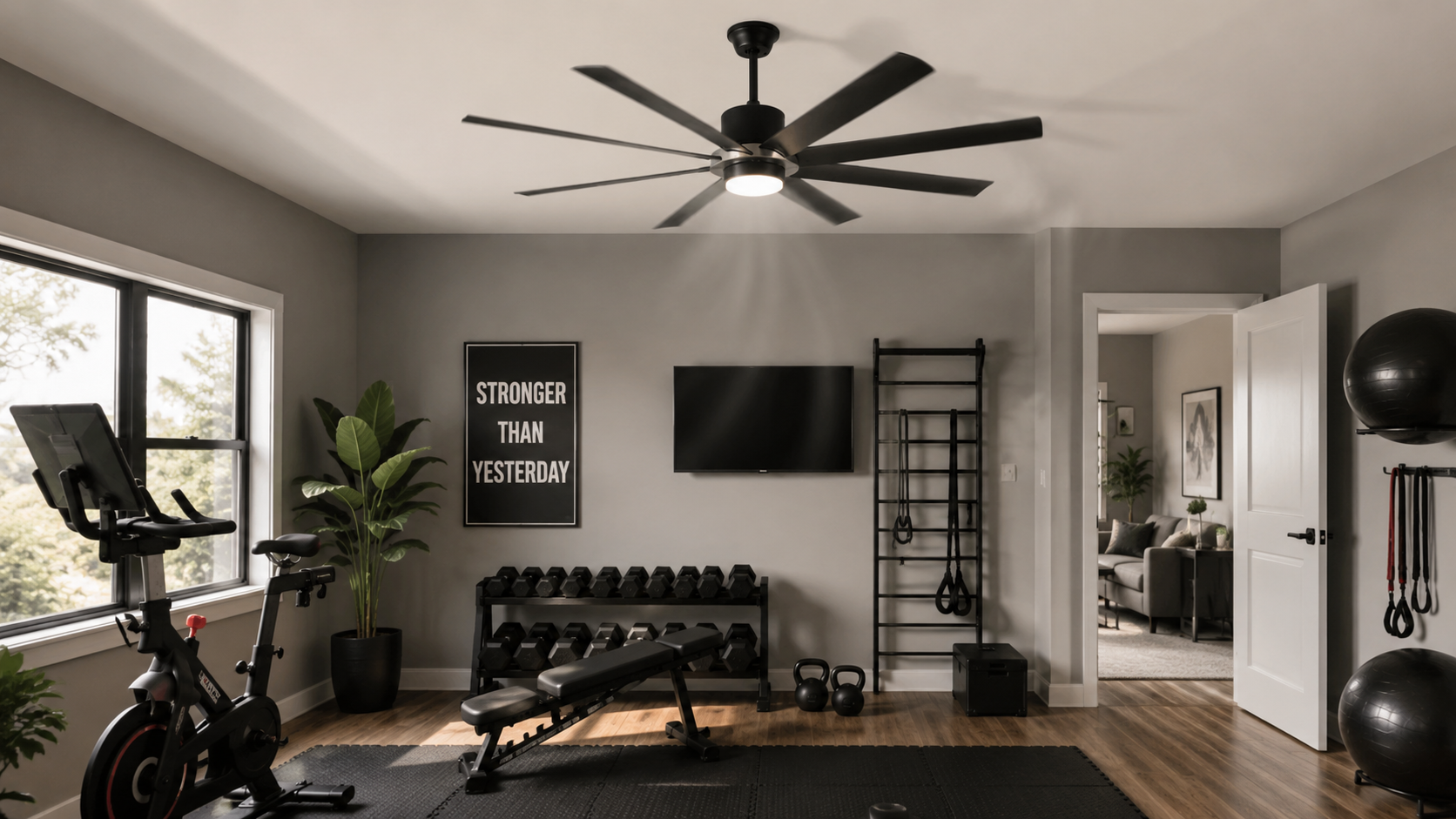


Choosing a lounge ceiling fan is easier when you start with the room rather than the product photo. Measure your lounge, note where you sit, check the ceiling height, and decide whether you need airflow only or both airflow and everyday lighting. That first pass keeps the choice grounded in how the room is used, not just how the fan looks in a catalogue.
For most rooms, the right decision comes down to four things: blade span, useful airflow, comfortable light, and safe mounting height. We will work through each point so you can choose a ceiling fan for your lounge that feels proportionate, quiet, and practical after installation.
What Room Conditions Should You Check Before Choosing a Lounge Ceiling Fan?
How should you measure the lounge before you choose a fan?
Measure the usable floor area, not just the outside walls. Record the room length and width, then mark the sofa, television, dining edge, reading chair, and main walking routes; this tells you where airflow will actually help and whether a centred ceiling point will serve the room.
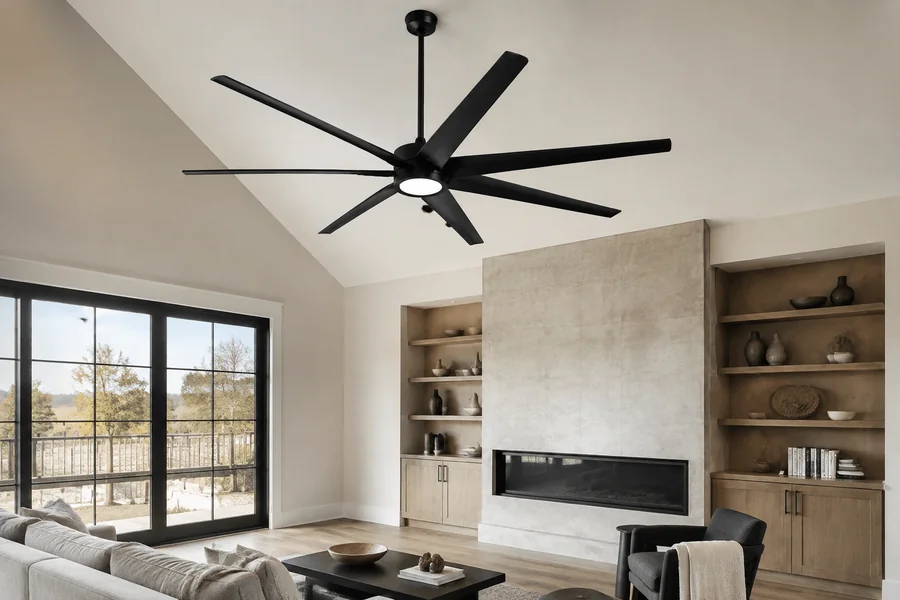
You should also note whether the lounge is square, long, L-shaped, or connected to a dining or kitchen zone. If the space is open or unusually wide, compare the open-plan fan layout guide before you assume one fan will cover every area.
A lounge also changes throughout the day. In the afternoon, you may want gentle airflow while the room warms up from sunlight; at night, you may care more about low noise, soft light, and whether the fan distracts from conversation. Thinking through those daily moments helps you avoid choosing a fan that works on paper but feels wrong in use.
We usually find that the best lounge fan is the one that solves a specific discomfort. Maybe the room feels stuffy after dinner, maybe the sofa area needs a quiet breeze, or maybe the old ceiling light leaves the middle of the room dim. When you name that problem first, every later choice becomes easier: size answers coverage, airflow answers comfort, lighting answers daily use, and mounting answers safety.
Why do ceiling height and furniture position matter?
Ceiling height changes both comfort and installation choice. With an 8-foot ceiling, you usually need a compact or flush-mount design; with a 9-foot ceiling, you have more flexibility; with a much higher or vaulted ceiling, you need to plan the downrod and airflow zone instead of choosing by blade span alone.
Your seating position matters just as much. Place the fan over the zone where you spend time, while keeping clear of tall cabinets, pendant lights, beams, and door swings; the 8-foot ceiling guide and 9-foot mounting guide explain why a few inches can change the result.
What Ceiling Fan Size Fits Your Lounge?
Which blade span works for a small or medium lounge?
A small lounge often needs a compact fan that does not crowd the ceiling or overpower the seating area. A 42-inch to 48-inch fan can work when the room is modest, while a 52-inch fan is often a better starting point when you have a medium lounge and want more even air movement.
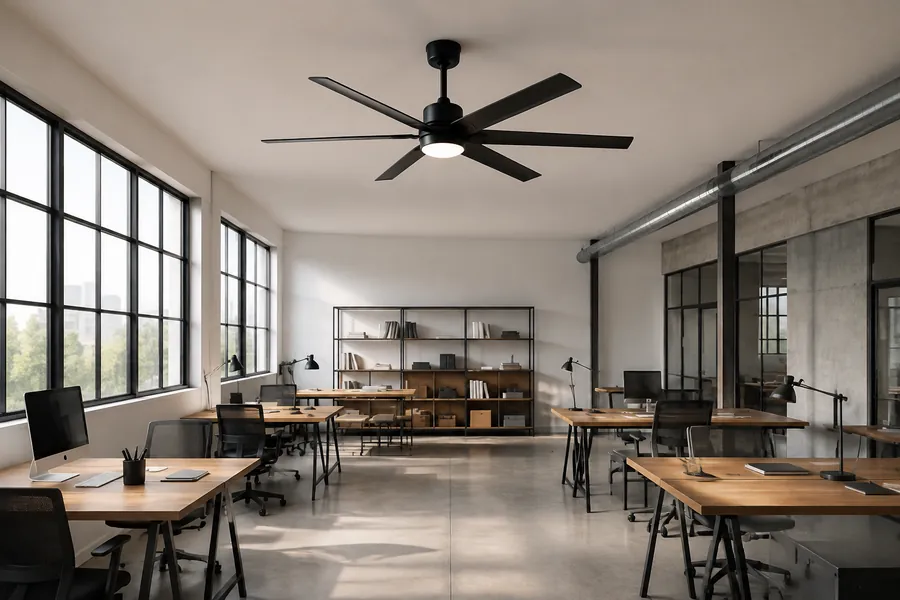
If you are comparing a 52-inch model, use this 52-inch lounge sizing guide to check the room area, blade clearance, and ceiling height together. The fan size comparison is useful when your lounge sits between two common sizes.
When should you move up to a 56-inch or larger fan?
Move up when your lounge is wide, the seating zone is spread out, or the ceiling fan needs to cover a generous central area. A 56-inch fan can give you broader coverage without the visual weight of a very large fixture, while a 60-inch or 72-inch model makes more sense when the room is genuinely large and the ceiling leaves enough visual space.
Do not choose a large fan simply because the lounge looks impressive in a photograph. Compare the 60-inch versus 72-inch guide and the great-room sizing guide so you can match coverage with the room rather than create a fixture that feels oversized.
When you are uncertain, stand in the room and imagine the blade tips. The fan should feel connected to the seating zone without visually pressing down on the room. If the ceiling is low, a slightly smaller fan can feel calmer; if the ceiling is high, a larger span may look more balanced because the fixture sits farther from your eyes.
| Lounge condition | Useful starting direction | What you should confirm |
|---|---|---|
| Small lounge | 42-48 inch indoor fan | Clearance, gentle speed, compact body |
| Medium lounge | 52-56 inch fan | Seating-zone coverage and light output |
| Large lounge | 60-72 inch fan or a multi-fan plan | Room shape, airflow distribution, ceiling scale |
| Long or open-plan lounge | One large fan or two smaller fans | Whether one airflow zone can reach the full layout |
How Much Airflow Should Your Lounge Ceiling Fan Deliver?
How should you think about airflow instead of chasing a large number?
Airflow should match the comfort zone you want to create, not just the maximum figure printed on a product page. In a lounge, you usually want a steady downward or circulating breeze over the seating area, with enough low-speed control that you can stay comfortable while watching television, reading, or talking.
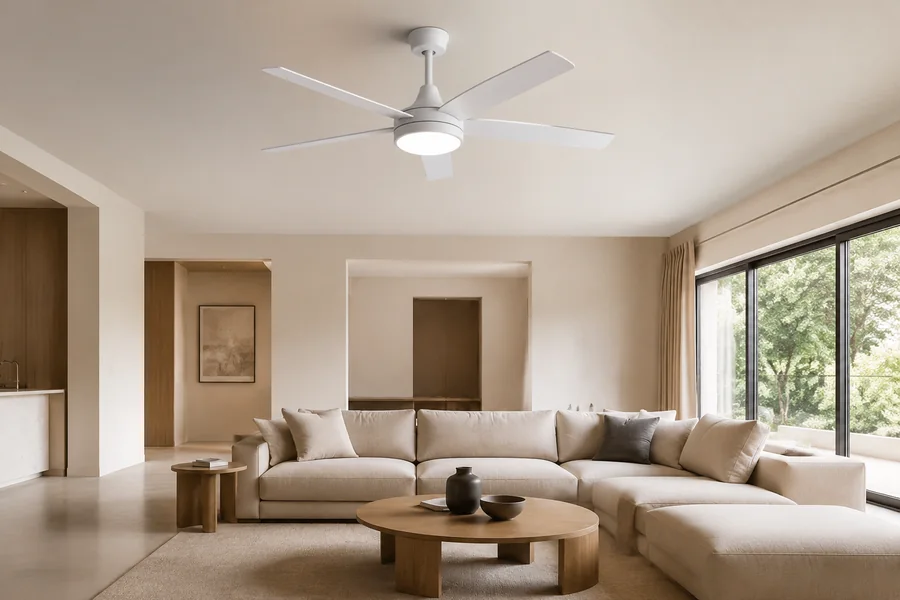
Blade span, blade pitch, motor torque, and mounting height work together. The blade pitch guide explains why two fans with similar diameters can feel very different, while the large-room airflow guide helps you connect airflow with coverage.
When does one fan stop being enough?
One fan may stop being enough when your lounge is long, divided by furniture, connected to another room, or used in several separate seating zones. You can compare one large fan with two smaller fans in this one-fan or two-fan comparison before deciding whether a single centre point will leave the edges still.
If your room has one main sofa group and one clear ceiling box, one fan is usually easier to plan. If your room has a lounge zone and a dining zone, two smaller fans may feel more natural because each area gets its own comfort zone. The better choice is the one that follows how you actually use the space.
For a very large room, a wider fan can be sensible, but it still needs the right installation height and clear blade path. If your lounge has a double-height volume, read the double-height room guide and the high-ceiling fan guide before you select the motor or downrod.
Should Your Lounge Ceiling Fan Include a Light?
When does a lounge ceiling fan with light make sense?
A fan with light makes sense when one ceiling point needs to provide both air movement and general illumination. This is especially practical when your lounge has limited wiring, when you are replacing one central fixture, or when you want the ceiling plan to stay simple.
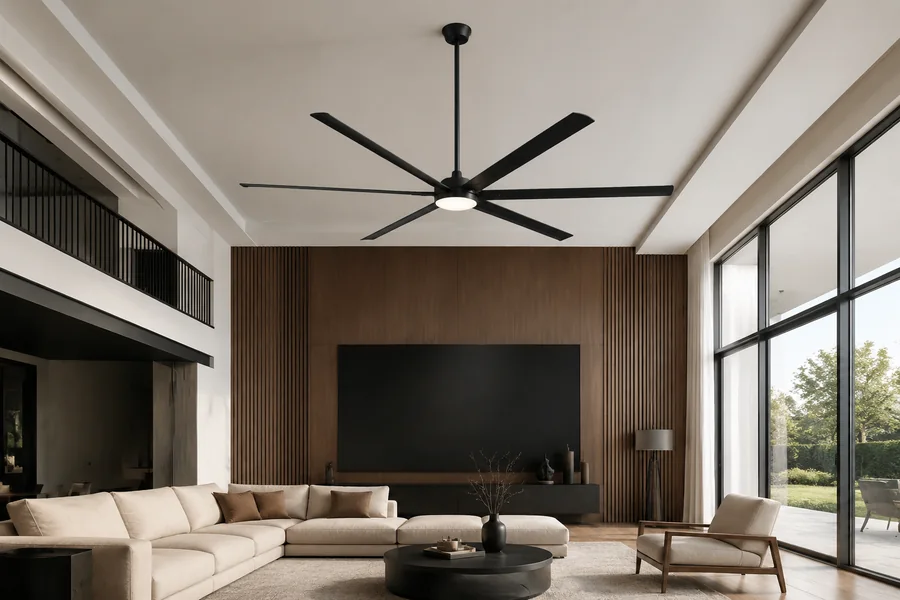
You should still treat the light as one layer rather than the entire lighting plan. The fan with or without light guide explains the trade-off, while the lumen guide helps you judge whether the light can support your room size.
Which lighting details should you compare?
Compare lumens, colour temperature, CRI, dimming, diffuser quality, and whether the light output reaches the seating area without glare. Wattage alone will not tell you whether your lounge will feel warm, bright enough, or uncomfortable after sunset. If you use the lounge for television, avoid harsh downward glare; if you use it for reading or family activity, make sure the central light can support the task without making the room feel clinical.
For a more technical check, use the LED lighting specs guide and the colour temperature guide. If you want warmer evening light, a 2700K to 3000K direction can feel softer; if you need a cleaner daytime look, a higher colour temperature may suit your room better.
Also check how the light is diffused. A shallow clear lens can feel sharp when you recline on a sofa, while a softer diffuser can make the same lumen output feel more comfortable. If your lounge already has floor lamps, wall lights, or cabinet lighting, the fan light can work as a practical center layer rather than the only source.
| Lighting check | What it tells you | What to look for in a lounge |
|---|---|---|
| Lumens | Visible light output | Enough general brightness for the room size |
| Colour temperature | Warm or cool appearance | A tone that works with your walls and furniture |
| CRI | How accurately colours appear | Natural-looking fabrics, wood, and artwork |
| Dimming | Whether brightness can change | Low enough for evening comfort without flicker |
| Diffuser | How softly light spreads | Less glare over the sofa and television |
Which Mounting Type Fits Your Lounge Ceiling?
When is a flush-mount or low-profile fan the right choice?
Choose flush-mount or low-profile when your lounge ceiling is low and you need to protect head clearance. The body stays close to the ceiling, which can make the room feel less crowded, but you should check the complete drop height including the light kit, canopy, and motor housing.
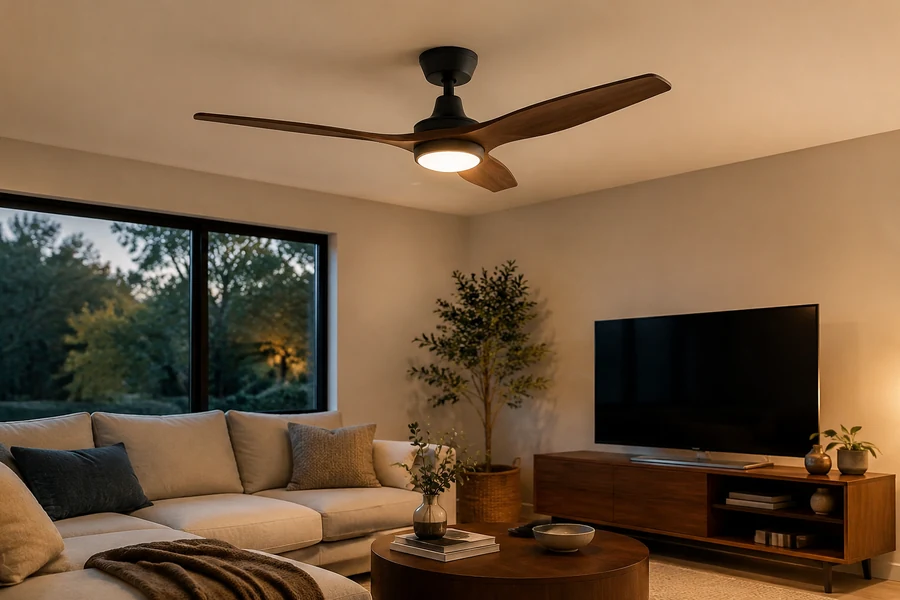
A low profile design is not automatically the best airflow choice. It protects clearance, but the blades sit close to the ceiling, so you should compare comfort at low and medium speeds instead of judging by fixture depth alone. You can compare short-downrod mounting notes to see when a short downrod may position the blades more effectively, and the mounting-height guide when your ceiling rises above the usual lounge height.
If your lounge ceiling has beams, coffers, recessed lighting, or an off-center junction box, mounting becomes a design issue as well as a technical issue. You need enough space around the blades, a canopy that sits cleanly against the ceiling, and a fixture position that does not fight with the room’s lighting plan.
When should you use a downrod or angled-ceiling mount?
Use a downrod when the ceiling is high enough for the blades to sit in a useful airflow zone without reducing safety clearance. The aim is not to make the fan hang low; the aim is to keep the airflow close enough to the occupied area that you can feel it at comfortable speeds. If the ceiling slopes, you also need a compatible angled adapter or mounting system so the fan hangs level instead of following the roof line.
Before you order, compare the sloped-ceiling guide and the cathedral-ceiling setup. These details matter because a fan can have the right diameter and still perform poorly if the mounting position leaves the blades too high, too low, or out of level.
How Do Noise, Controls, and Indoor Safety Affect Daily Comfort?
How much noise should you expect from an indoor lounge fan?
You should expect a well-installed indoor fan to sound calm at low speed, with most of the perceived noise coming from air movement rather than rattling, clicking, or motor vibration. If you sit close to the fan, watch television beneath it, or use the lounge for conversation, low-speed noise matters more than a maximum-speed claim. A lounge fan should be quiet enough that you forget it is working until you turn it off and notice the air becoming still.
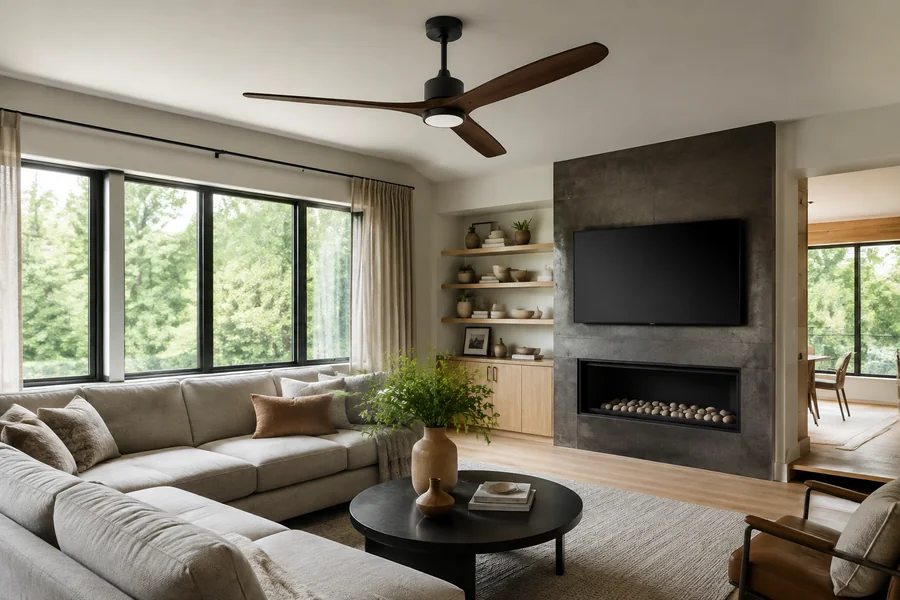
Use the ceiling fan noise guide to compare motor sound, blade balance, speed settings, and installation quality. A DC motor can help with smooth low-speed control, but a loose bracket or unbalanced blade can still make a quiet motor feel noisy.
Which controls and safety checks should you complete?
A remote control is useful when the fan is over a sofa or in the centre of a large lounge, while wall control can be better when several people need predictable access. You should confirm speed steps, light control, dimming behaviour, timer settings, reverse function, and whether replacement controls are available for the product line. For family lounges, simple controls are often better than clever controls that guests cannot understand.
Before installation, confirm the ceiling support, electrical connection, blade clearance, and mounting hardware. This ceiling fan safety guide is a useful independent reference for the electrical and installation checks you should not skip, especially when you are replacing an existing light fitting.
Which Ceiling Fan Styles and Product Directions Suit a Lounge?
Which visual direction works with a relaxed lounge?
Start with the room you already have. A white fan can visually recede into a light ceiling, a wood-blade fan can warm a neutral lounge, and a black fan can give stronger definition when your room already includes dark metal or dark furniture. Try to match one existing material instead of introducing a completely new finish; that is usually what makes a fan feel intentional rather than added at the end.
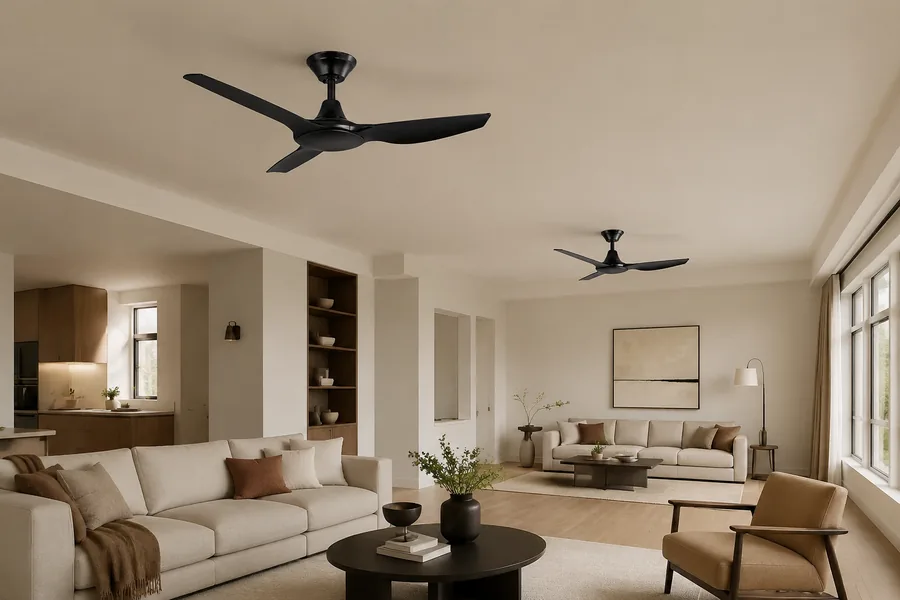
If your lounge is modern, compare the modern lounge style guide with the modern and minimalist comparison. If you want a softer decorative direction, the farmhouse and rustic comparison and Scandinavian and coastal comparison can help you avoid a fan that looks disconnected from the room.
Which product directions should you compare for a lounge project?
If you want a broad indoor range, start with this white ceiling fan range and compare how a light finish sits against your ceiling and furniture. A white body is useful when your lounge already has pale walls, pale cabinetry, or a clean contemporary ceiling. If you need a general residential direction with DC motor options, review the indoor DC fan range before narrowing the blade span and control set.
For a more decorative lounge, a 52-inch vintage fan with dimmable LED can combine a stronger visual identity with everyday lighting. This kind of direction works best when the fan should be noticed but not dominate the ceiling. If you are considering a fandelier, read the fandelier comparison and the high-end fan design guide before you trade airflow for decoration.
How Can You Compare a Lounge Ceiling Fan Before You Buy?
What should you compare on the product specification sheet?
Before you choose, write down the room size, ceiling height, preferred blade span, total drop, motor type, speed range, light output, colour temperature, control method, and installation requirements. This simple list keeps you from comparing one model by price, another by appearance, and a third by airflow without a common basis. If two fans look similar, this checklist usually reveals the real difference: one may have better lighting, another may have better low-speed comfort, and another may simply be easier to install.
You should also check the product’s actual application. An indoor lounge fan is not automatically suitable for a vaulted room, an open-plan layout, or a ceiling with an unusual junction box; your room layout notes, airflow requirements, and double-height room notes show where a standard choice can fall short.
If you are comparing several models, do not rank them by a single feature. Give each model a simple score for size fit, airflow control, lighting comfort, mounting suitability, noise, visual style, and service support. The fan with the best total fit is often more useful than the fan with the biggest size or the strongest marketing claim.
This is also where sample testing helps. If you can test a fan before a larger project order, run it at low and medium speeds, check the light after sunset, listen for motor or blade noise, and confirm the remote logic. A lounge is a comfort space, so a fan that feels calm in real use will usually serve you better than a model that only looks impressive in the specification sheet.
How can you choose the right lounge fan with confidence?
Choose the smallest fan that gives you the coverage you need without forcing the room to carry unnecessary visual weight. Then check whether the light supports your evening routine, whether the mount keeps the blades at a useful height, and whether low-speed control feels comfortable from your main seat. If one point feels uncertain, solve that point before ordering; a lounge fan is difficult to judge fairly after installation if the size, light, or mounting choice was wrong from the beginning.
If you are looking for a better ceiling fan light solution for your project, NEBOLA can provide one-stop support from product selection to customization. We focus on ceiling fan light R&D and manufacturing, helping brands, importers, and distributors find products that better match real space needs. You can return to the living room ceiling fan range after you have narrowed your size, airflow, lighting, and mounting requirements.
NEBOLA Ceiling Fan Light Support
Share your lounge dimensions and ceiling details, and we can help you compare a practical fan light direction.
FAQ
Is a 52-inch ceiling fan suitable for a lounge?
Yes, a 52-inch ceiling fan can suit many medium and larger lounges, but you should still check the room shape, furniture layout, blade clearance, and ceiling height before choosing it. If the lounge is long or open-plan, you may need broader coverage or a second fan instead of relying on one 52-inch model.
Should a lounge ceiling fan have a light?
Yes, a lounge ceiling fan can include a light when you need one ceiling point to provide both airflow and general illumination, although a no-light fan may be cleaner when your room already has layered lighting. Compare lumens, colour temperature, dimming, and glare before you choose.
Can you use a flush-mount fan in a lounge?
Yes, you can use a flush-mount fan in a lounge with a low ceiling, but you should confirm the total fixture height and accept that a downrod model may deliver better blade position when the ceiling allows it. The safest choice is the one that protects clearance while still moving air through the seating zone.
Is a DC motor useful for an indoor lounge fan?
Yes, a DC motor is useful when you want smoother speed changes, quieter low-speed operation, and lower running power, but the complete fan design and installation quality still affect what you feel in the room. Blade balance, mounting strength, and control quality still matter.
Can one ceiling fan cool an open-plan lounge?
Yes, one ceiling fan can work when the lounge is compact and the airflow zone matches the seating area, but a long or open-plan layout may need two fans or a larger coverage plan. Think about where you sit, not only where the ceiling box is located.
Do you need a longer downrod for a high lounge ceiling?
Yes, you may need a longer downrod when the ceiling is high or vaulted because the blades should sit in a useful airflow zone, but the exact length depends on the ceiling height, fan design, and mounting angle. You should also confirm support, slope compatibility, and safe clearance before installation.