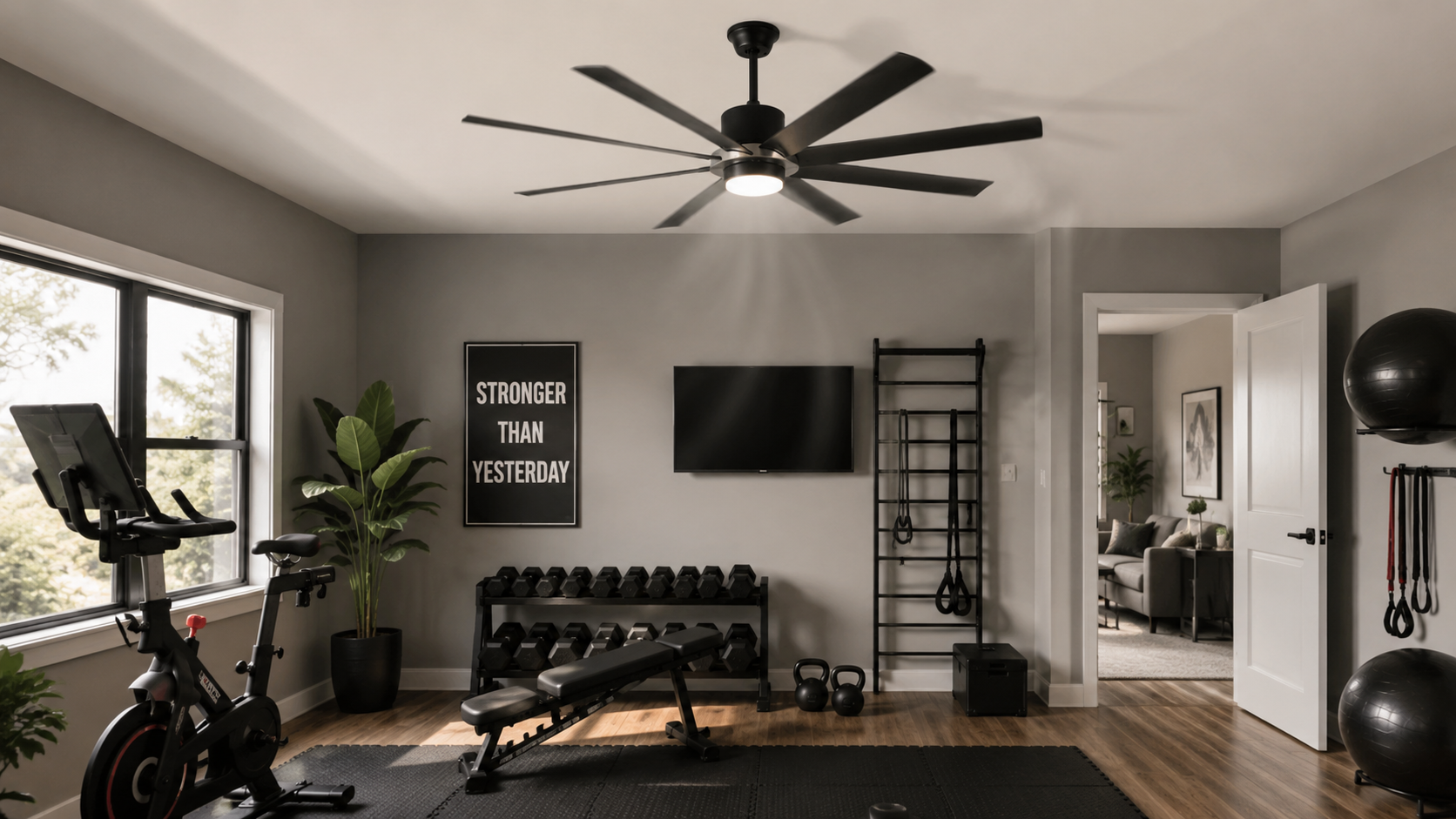


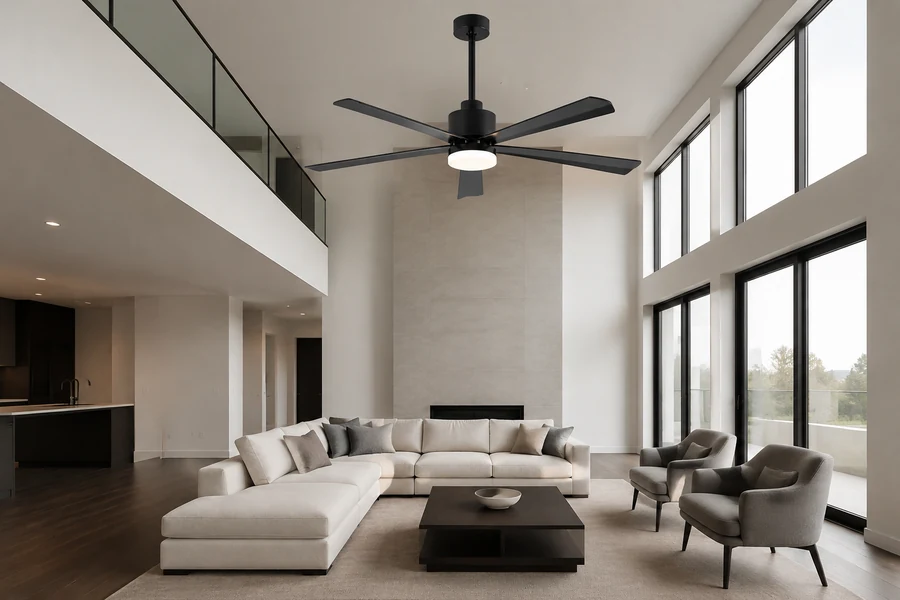
A standard ceiling fan often struggles in a double-height living room because it hangs too high, covers too little floor area, or moves air in the wrong part of the room. If you need a large ceiling fan for a high-ceiling living room, start with the occupied zone, then choose the blade span, downrod, motor, airflow, and mounting hardware that bring comfort down to where you sit.
A tall room is not solved by diameter alone. We need to look at ceiling height, room footprint, ceiling angle, furniture layout, support structure, and lighting. This guide explains why standard fans fall short and how you can build a more reliable high-ceiling ceiling fan setup.
| Room condition | Typical direction | What to verify |
|---|---|---|
| 12-foot ceiling, one seating zone | Medium or large downrod fan | Blade height, CFM, support |
| 15-foot ceiling, wide room | Large high-airflow fan | Downrod length, pitch, motor |
| 20-foot ceiling | Large fan or multiple zones | Coverage, service access, controls |
| Vaulted or sloped ceiling | Downrod with angled adapter | Slope rating, blade clearance |
Why Does a Double-Height Living Room Expose the Limits of a Standard Fan?
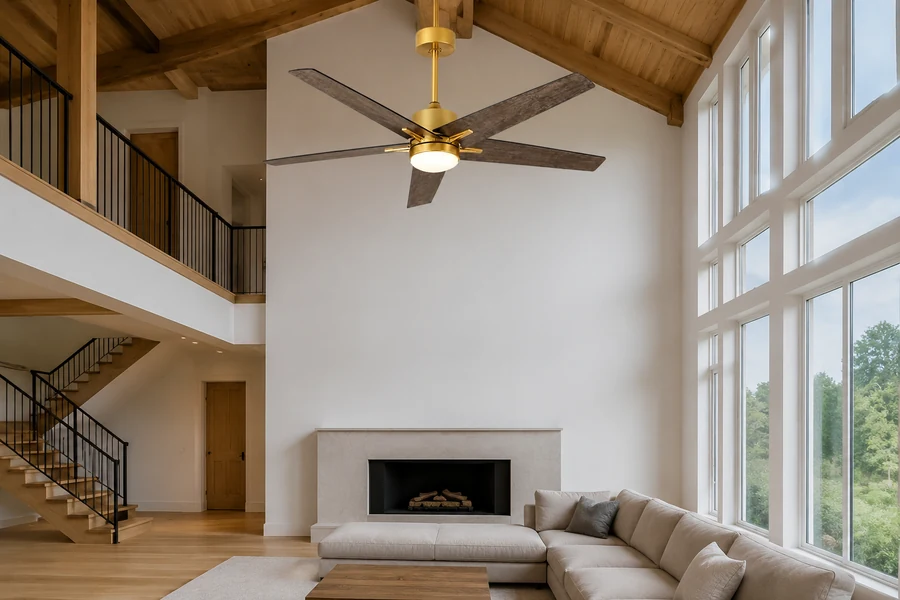
A double-height room also needs a comfort plan, not just a larger product. This WBDG thermal comfort guidance provides useful background for thinking about thermal comfort in larger interior volumes; we should then translate that principle into your fan height, airflow zone, and control plan.
Why does a standard fan often sit too high?
In a double-height living room, the ceiling may be far above the zone where you sit and relax. If you use the short downrod supplied for a normal room, the fan can remain near the upper part of the volume, where the airflow does not feel strong at sofa height.
The fan may still be spinning and moving air, but the comfort result can feel weak. We should judge the installation by the occupied zone, not by whether the fan looks centered on the ceiling peak. If you are also comparing material-led rooms, our farmhouse and rustic comparison can help you judge visual weight. If you are also comparing material-led rooms, our farmhouse and rustic comparison can help you judge visual weight.
In your double-height room, this detail should be checked against the real occupied zone rather than the ceiling peak. Use the position of your sofa, chairs, walkways, and lighting to judge whether the fan creates useful comfort below. We should also leave enough service and safety margin around the fan, because a tall installation is harder to adjust after the ceiling is closed and the furniture is in place.
Why does a standard blade span struggle with room volume?
A standard fan may cover a normal living room well but feel undersized in a double-height space with a wide footprint. The larger volume and longer air path can make the same fan feel less effective, especially when the room has separate seating or dining zones.
This does not mean you should always choose the largest fan available. We need to compare blade span, CFM, motor performance, and layout so the fan delivers useful movement without becoming visually oversized or difficult to install. For a lighter style comparison, see our Scandinavian, mid-century, and coastal guide as well. For a lighter style comparison, see our Scandinavian, mid-century, and coastal guide as well.
In your double-height room, this detail should be checked against the real occupied zone rather than the ceiling peak. Use the position of your sofa, chairs, walkways, and lighting to judge whether the fan creates useful comfort below. We should also leave enough service and safety margin around the fan, because a tall installation is harder to adjust after the ceiling is closed and the furniture is in place.
How Does Ceiling Height Change Fan Mounting and Airflow?
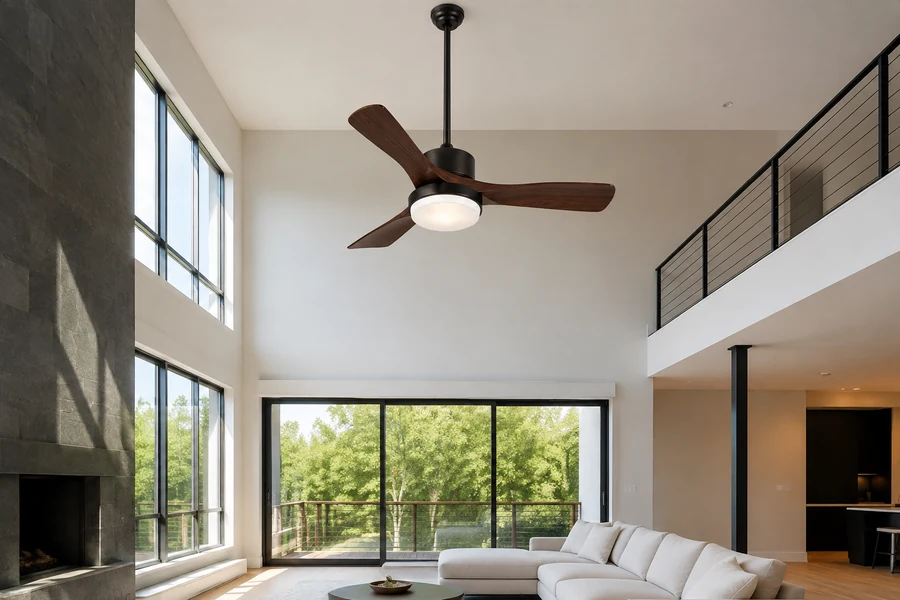
What happens when the fan hangs near the ceiling peak?
When the fan stays near the peak, it may circulate air in the upper volume while the lower seating area still feels stagnant. Use the high-ceiling sizing guide to think through blade height, room scale, and the distance between the fan and the people below.
We should also consider the ceiling shape. A flat double-height ceiling is easier to plan than a vaulted or cathedral ceiling, where the fan may need an angled adapter and more careful clearance from the slope.
In your double-height room, this detail should be checked against the real occupied zone rather than the ceiling peak. Use the position of your sofa, chairs, walkways, and lighting to judge whether the fan creates useful comfort below. We should also leave enough service and safety margin around the fan, because a tall installation is harder to adjust after the ceiling is closed and the furniture is in place.
How does a downrod bring airflow into the occupied zone?
A downrod lowers the fan so the blades can work closer to the area you actually use. The downrod guide helps you compare 12-, 15-, and 20-foot ceiling conditions, but the final length still depends on the fan’s total body height and room layout.
You should not choose the longest rod simply because the room is tall. The fan needs to remain stable, clear of people and furniture, and visually connected to the room. A good height is a balance between airflow and safe proportion.
In your double-height room, this detail should be checked against the real occupied zone rather than the ceiling peak. Use the position of your sofa, chairs, walkways, and lighting to judge whether the fan creates useful comfort below. We should also leave enough service and safety margin around the fan, because a tall installation is harder to adjust after the ceiling is closed and the furniture is in place.
What Fan Size Works Best for a Large Ceiling and Wide Living Room?
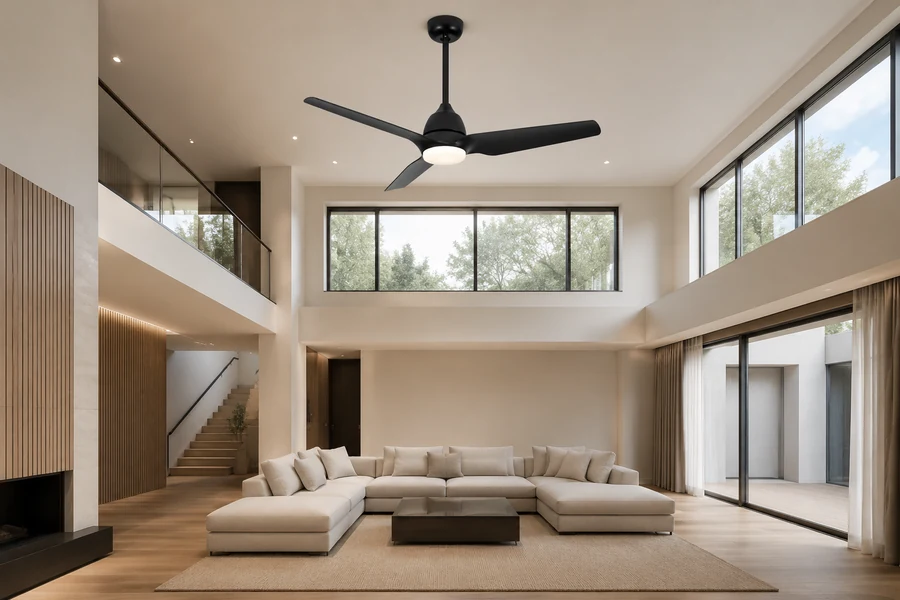
When can a 52-inch fan still work?
A 52-inch fan can still work when your main seating zone is moderate and the double-height volume is concentrated above a smaller area. Compare the real layout with this 52-inch living-room guide before assuming you need a much larger fan.
If the sofa, chairs, and coffee table occupy a compact zone, a well-positioned 52-inch fan may feel more comfortable than a huge fan placed too high. We should solve the occupied zone first, then the full architectural volume.
In your double-height room, this detail should be checked against the real occupied zone rather than the ceiling peak. Use the position of your sofa, chairs, walkways, and lighting to judge whether the fan creates useful comfort below. We should also leave enough service and safety margin around the fan, because a tall installation is harder to adjust after the ceiling is closed and the furniture is in place.
When should you move toward 60, 66, or 70 inches?
When the living room is wide, the seating zones are open, and the ceiling is tall, a larger fan can distribute air across more floor area. You can compare size ranges in the large-room size guide and the full size comparison before choosing.
A large fan still needs a stable motor, balanced blades, enough ceiling clearance, and the correct downrod. Bigger can improve coverage, but bigger without engineering or mounting discipline can increase wobble, noise, and visual pressure.
In your double-height room, this detail should be checked against the real occupied zone rather than the ceiling peak. Use the position of your sofa, chairs, walkways, and lighting to judge whether the fan creates useful comfort below. We should also leave enough service and safety margin around the fan, because a tall installation is harder to adjust after the ceiling is closed and the furniture is in place.
How Should You Match CFM, Blade Pitch, and Airflow to the Room?
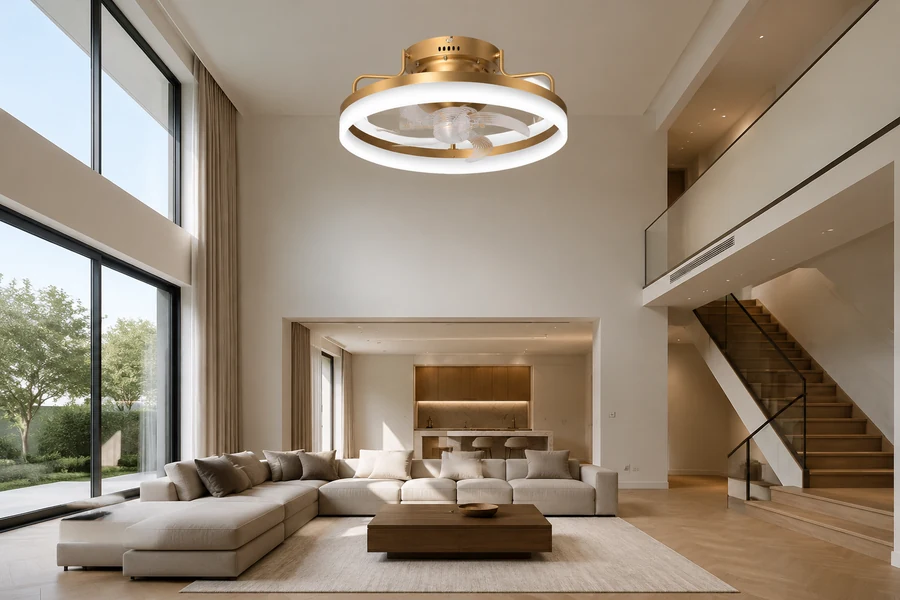
Why does CFM matter in a double-height space?
CFM tells you how much air the fan moves per minute, but the number should not be read alone. In a double-height living room, you also need to know where the air reaches, how the fan performs at low speed, and whether the room layout allows the movement to spread.
This large-room airflow guide helps connect airflow to size and coverage. We should think about comfort at the sofa, not just the maximum number printed on a specification sheet.
In your double-height room, this detail should be checked against the real occupied zone rather than the ceiling peak. Use the position of your sofa, chairs, walkways, and lighting to judge whether the fan creates useful comfort below. We should also leave enough service and safety margin around the fan, because a tall installation is harder to adjust after the ceiling is closed and the furniture is in place.
How does blade pitch change high-ceiling performance?
Blade pitch changes how aggressively the blades push air, which is why this blade-pitch guide matters when you compare large fans. A larger fan with a shallow pitch may not feel as effective as a slightly smaller fan with a better motor and more suitable pitch.
You should balance pitch with motor torque and noise. A strong pitch can create useful airflow, but if the motor struggles or the fan becomes loud at normal speed, the room will not feel comfortable for long periods.
In your double-height room, this detail should be checked against the real occupied zone rather than the ceiling peak. Use the position of your sofa, chairs, walkways, and lighting to judge whether the fan creates useful comfort below. We should also leave enough service and safety margin around the fan, because a tall installation is harder to adjust after the ceiling is closed and the furniture is in place.
Should You Use One Large Fan or Multiple Fans?
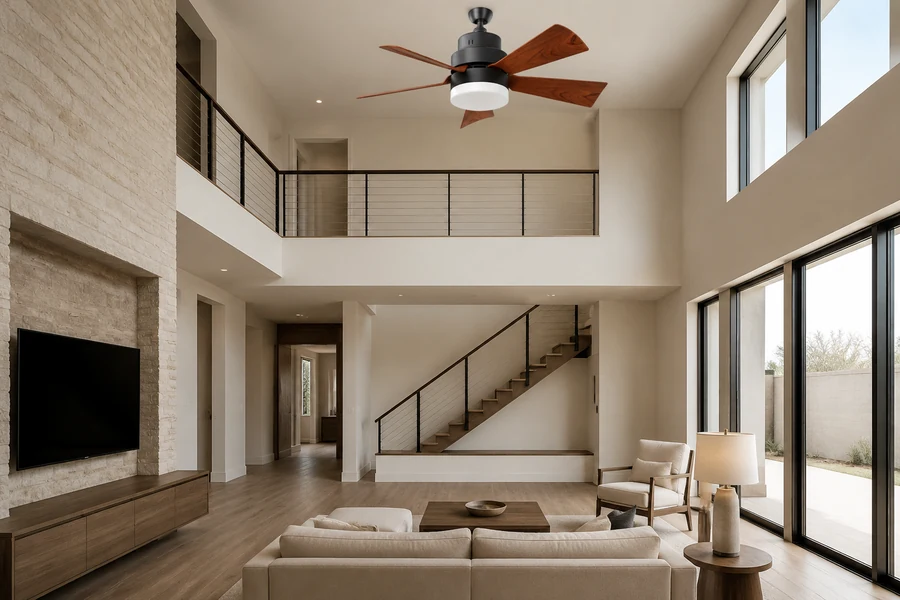
When does one large fan make sense?
One large fan usually makes sense when your room has one dominant seating zone and enough open area around the blade circle. The one-versus-two fan comparison gives you a useful way to compare coverage, installation, and visual balance.
A single fan can keep the ceiling cleaner and simplify control. We should still verify that the fan can reach the whole occupied area; a large diameter does not automatically solve a long, narrow, or divided room.
In your double-height room, this detail should be checked against the real occupied zone rather than the ceiling peak. Use the position of your sofa, chairs, walkways, and lighting to judge whether the fan creates useful comfort below. We should also leave enough service and safety margin around the fan, because a tall installation is harder to adjust after the ceiling is closed and the furniture is in place.
When do two smaller fans work better?
Two fans can work better when the room has two clear zones, a long footprint, or furniture that blocks one central airflow path. This open-plan fan guide can help you think about spacing and control.
The trade-off is more visual and electrical complexity. You need enough ceiling support, consistent product height, and a control plan that lets you run one or both fans without creating an awkward ceiling pattern.
In your double-height room, this detail should be checked against the real occupied zone rather than the ceiling peak. Use the position of your sofa, chairs, walkways, and lighting to judge whether the fan creates useful comfort below. We should also leave enough service and safety margin around the fan, because a tall installation is harder to adjust after the ceiling is closed and the furniture is in place.
How Do Vaulted, Cathedral, and Sloped Ceilings Add More Problems?
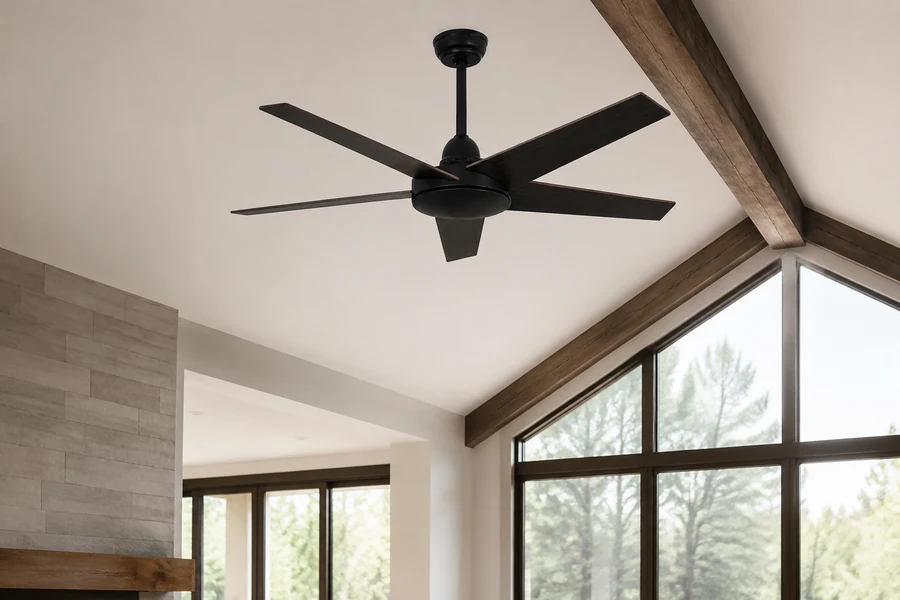
What changes on a vaulted or sloped ceiling?
On a sloped ceiling, the fan must hang level and clear the highest side of the blade path. Review the sloped-ceiling guide before you choose a large fan, because the angle can change both the mount and the required downrod.
You should also check beams, rafters, skylights, and upper windows. A fan can fit the room’s width and still fail because one blade edge passes too close to a structural feature.
In your double-height room, this detail should be checked against the real occupied zone rather than the ceiling peak. Use the position of your sofa, chairs, walkways, and lighting to judge whether the fan creates useful comfort below. We should also leave enough service and safety margin around the fan, because a tall installation is harder to adjust after the ceiling is closed and the furniture is in place.
Why does cathedral-ceiling planning need more than a long rod?
A cathedral ceiling needs a complete setup: fan size, downrod, angled adapter, support box, wiring, and final hanging height. The cathedral-ceiling setup explains why a long rod alone does not guarantee a safe or comfortable installation.
We should treat the mounting hardware as part of the room design. A clean canopy and straight downrod can make a tall room feel intentional, while a mismatched adapter or exposed connection can make the ceiling look unfinished.
In your double-height room, this detail should be checked against the real occupied zone rather than the ceiling peak. Use the position of your sofa, chairs, walkways, and lighting to judge whether the fan creates useful comfort below. We should also leave enough service and safety margin around the fan, because a tall installation is harder to adjust after the ceiling is closed and the furniture is in place.
How Should You Choose a High-Ceiling Fan Light?
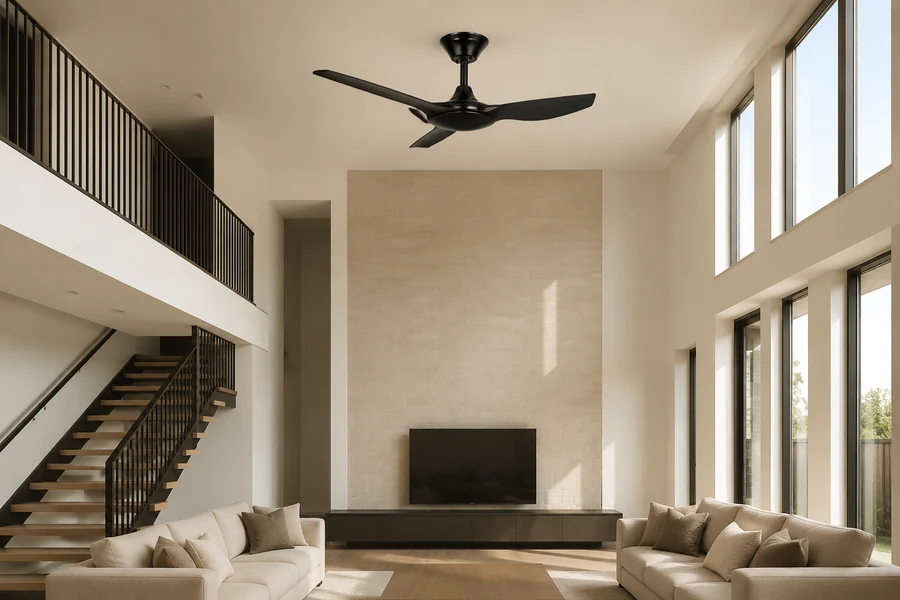
When does a fan light help a double-height room?
A fan light can help when the double-height ceiling needs both air movement and a central lighting layer. Use this fan-light comparison to decide whether the integrated light should be the main source or simply support floor lamps and wall lighting.
A light at the end of a long downrod needs enough output and comfortable diffusion. We should check lumen range, dimming, color temperature, and glare because a weak or harsh light can make the room feel less balanced.
In your double-height room, this detail should be checked against the real occupied zone rather than the ceiling peak. Use the position of your sofa, chairs, walkways, and lighting to judge whether the fan creates useful comfort below. We should also leave enough service and safety margin around the fan, because a tall installation is harder to adjust after the ceiling is closed and the furniture is in place.
When is a fan without light the better choice?
A fan without light can be better when the room already has a chandelier, pendant, track lights, or a layered lighting plan. This gives you more freedom to choose a high-airflow fan without making the central fixture too visually complex.
If you keep the light, compare the LED lighting guide and lumen guide. If you remove the light, make sure the existing fixtures still reach the seating area below the tall ceiling.
In your double-height room, this detail should be checked against the real occupied zone rather than the ceiling peak. Use the position of your sofa, chairs, walkways, and lighting to judge whether the fan creates useful comfort below. We should also leave enough service and safety margin around the fan, because a tall installation is harder to adjust after the ceiling is closed and the furniture is in place.
What Installation Details Decide Whether the Setup Works?
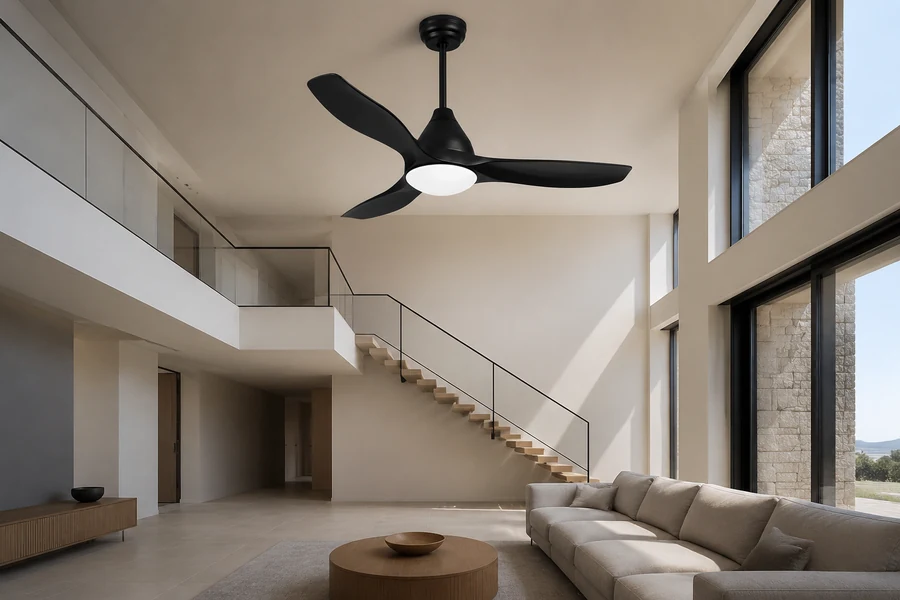
Why does the support box matter?
A large fan is a moving electrical fixture, so the support point must be rated for the fan’s weight and movement. A light-only box or weak attachment can create vibration, noise, and long-term safety problems.
We should confirm the fan-rated box, structural attachment, downrod connection, and canopy before the installation begins. If you are unsure about the ceiling structure, a qualified installer can verify the support rather than leaving the decision to guesswork.
In your double-height room, this detail should be checked against the real occupied zone rather than the ceiling peak. Use the position of your sofa, chairs, walkways, and lighting to judge whether the fan creates useful comfort below. We should also leave enough service and safety margin around the fan, because a tall installation is harder to adjust after the ceiling is closed and the furniture is in place.
How do controls and wiring affect a tall room?
A tall room can make remote control especially useful because a wall switch may not provide all the speed and light adjustments you need. Compare the LED lighting guide and control details before ordering, especially when the receiver must fit inside a canopy.
You should also decide whether you want separate fan and light control, wall control, remote control, or smart integration. The right system makes the fan easier to use after installation, which matters even more when the fixture is difficult to reach.
In your double-height room, this detail should be checked against the real occupied zone rather than the ceiling peak. Use the position of your sofa, chairs, walkways, and lighting to judge whether the fan creates useful comfort below. We should also leave enough service and safety margin around the fan, because a tall installation is harder to adjust after the ceiling is closed and the furniture is in place.
Which NEBOLA Product Directions Suit Double-Height Living Rooms?
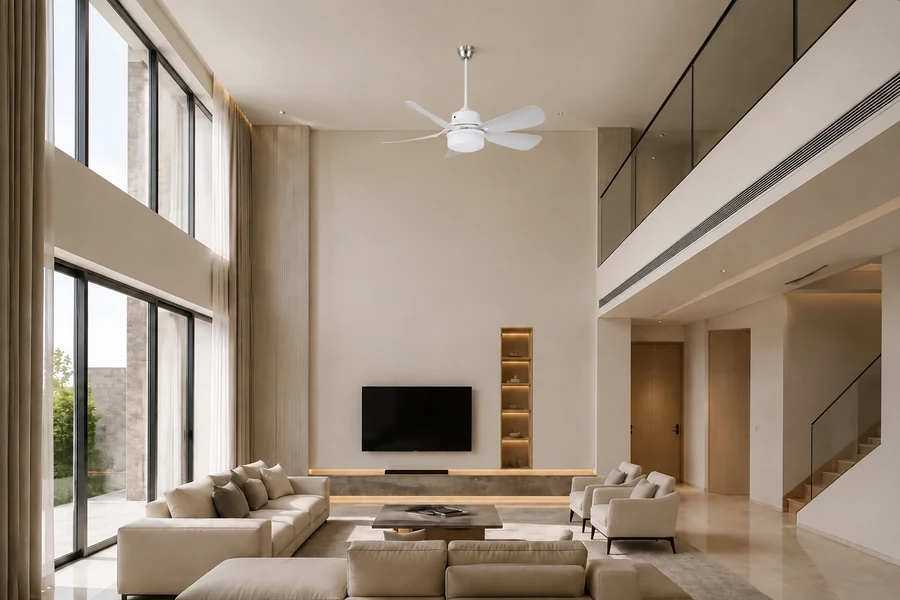
When does a 70-inch direction make sense?
For a broad, tall space, you can review the 70-inch high-ceiling fan. A larger blade span can make sense when the seating zone is wide and the mounting structure, motor, and ceiling clearance support it.
We should confirm whether the industrial direction fits your residential room visually. The point is not to choose the biggest product automatically, but to use the size and airflow direction when the room genuinely needs more coverage.
In your double-height room, this detail should be checked against the real occupied zone rather than the ceiling peak. Use the position of your sofa, chairs, walkways, and lighting to judge whether the fan creates useful comfort below. We should also leave enough service and safety margin around the fan, because a tall installation is harder to adjust after the ceiling is closed and the furniture is in place.
When does a wood or oak direction fit better?
If you need more natural warmth, you can compare the 66-inch wood fan. For a covered or moisture-aware setting, the oak outdoor fan can be a useful direction when the location and rating are suitable.
You should compare the actual ceiling height, room style, blade span, lighting needs, and motor specification before choosing by finish. A wood fan can soften a tall room, while a larger industrial direction can emphasize scale and coverage.
In your double-height room, this detail should be checked against the real occupied zone rather than the ceiling peak. Use the position of your sofa, chairs, walkways, and lighting to judge whether the fan creates useful comfort below. We should also leave enough service and safety margin around the fan, because a tall installation is harder to adjust after the ceiling is closed and the furniture is in place.
How Can You Build a Reliable Double-Height Fan Plan?
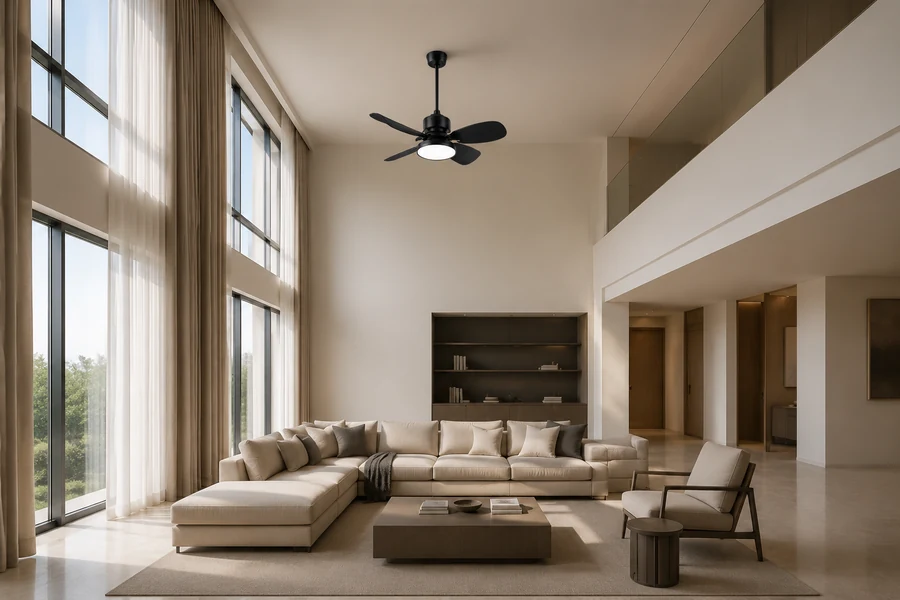
What should you calculate first?
Start with the room footprint, the main occupied zone, ceiling height, ceiling angle, obstructions, and the distance from the ceiling to the blades. Then compare blade span, CFM, pitch, motor, downrod, support, and controls.
You can use the large-room fan guide and the great-room guide to organize those measurements. We should make the room plan clear before we choose a product style.
In your double-height room, this detail should be checked against the real occupied zone rather than the ceiling peak. Use the position of your sofa, chairs, walkways, and lighting to judge whether the fan creates useful comfort below. We should also leave enough service and safety margin around the fan, because a tall installation is harder to adjust after the ceiling is closed and the furniture is in place.
What should you confirm before installation?
Before installation, confirm the mounting height, downrod, angled adapter if needed, fan-rated support, blade clearance, control wiring, light output, and service access. If the room has a sloped surface, use the sloped-ceiling guide again as a final reference.
For a wider product starting point, return to the living-room ceiling fan collection after your measurements are complete. The right double-height setup is the one that reaches your occupied zone, stays stable, and looks proportionate without forcing a standard fan to do a job it was never designed to do.
For related planning, you can also review 8-foot ceiling guide, 9-foot ceiling guide, noise guide, color-temperature guide, fandelier comparison, modern style guide, style difference guide, premium-fan guide before you finalize the room plan.
In your double-height room, this detail should be checked against the real occupied zone rather than the ceiling peak. Use the position of your sofa, chairs, walkways, and lighting to judge whether the fan creates useful comfort below. We should also leave enough service and safety margin around the fan, because a tall installation is harder to adjust after the ceiling is closed and the furniture is in place.
If you are looking for a better ceiling fan light solution for your project, NEBOLA can provide one-stop support from product selection to customization. We focus on ceiling fan light R&D and manufacturing, helping brands, importers, and distributors find products that better match real space needs.
NEBOLA Ceiling Fan Light Support
Ready to Plan the Right Fan for a Double-Height Room?
Share your room size, ceiling height, style direction, and lighting needs with us. We can help you compare practical fan light configurations.
FAQ
Can a standard 52-inch ceiling fan work in a double-height living room?
Yes, a standard 52-inch fan can work in a double-height living room when the occupied zone is compact and the fan is mounted at a useful height. In a large open volume, you may need a wider span, stronger airflow, or more than one fan zone.
Does a longer downrod always solve a double-height room?
No, a longer downrod does not solve every double-height room. You still need the right blade span, motor output, support structure, clearance, and final hanging height. Too much drop can create safety and visual problems.
Is a large ceiling fan better for a high ceiling living room?
Yes, a large ceiling fan can be better for a high ceiling living room when the room has enough open floor area and the fan is engineered for the span. You should compare airflow, mounting height, noise, and blade clearance rather than choosing a large diameter alone.
Can one fan cool an entire double-height living room?
No, one fan cannot always serve an entire double-height living room. The answer depends on the room footprint, seating zones, ceiling height, obstructions, and whether you need comfort throughout the space or only above the main seating area.
Should I use a flush mount fan on a double-height ceiling?
No, a flush mount fan is usually not the best choice for a double-height ceiling because it keeps the fan too close to the ceiling peak. A suitable downrod usually places the blades in a more useful airflow zone.
Do high ceilings make fan noise worse?
Yes, high ceilings can make fan noise feel more noticeable because sound can travel through a large open volume and reflect from hard surfaces. You should check motor quality, blade balance, speed settings, and installation stability.